February 8th, 2010 by Elizabeth Kissling
If I correctly understand the terms of SHM’s copyright agreement with Oxford University Press, I am permitted to publish this unedited version of my review as a “pre-print” article. The final version will be available only from Social History of Medicine.
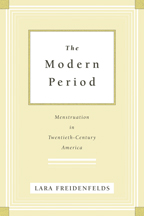
Lara Freidenfelds, The Modern Period: Menstruation in Twentieth Century America, Baltimore: Johns Hopkins University Press, 2008. Pp. 242. £31/$60. ISBN 978 0-8018 9245 5.
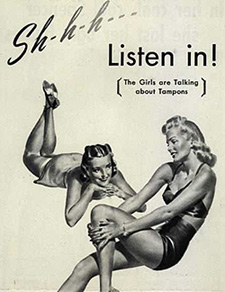
Lara Freidenfelds, an historian currently teaching in Women’s Studies at Wellesley College, has written a thorough and engaging history of menstruation in twentieth century USA. Her title, The Modern Period, is more than a succinct description; it cleverly references her discussion throughout of how advancing Progressive values shaped beliefs and practices surrounding menstruation. These Progressive values included faith in scientific rationality, belief in the value of education, and unqualified endorsement of technological progress. The ‘modern period’ also references the evolution of menstrual management practices into a coherent whole and the movement away from practices and beliefs considered old-fashioned, such as worries about catching a chill or the use of cloth pads. Her analysis throughout addresses the class implications of modernization; that is, the perceived need to adopt modern practices of bodily presentation and self-control for class mobility. Such modernization, asserts Friedenfelds, is a key component of Americans’ ability to see themselves as middle-class across great gaps in education and income. Continue reading...
Tags: beliefs, books, history, manners, menstrual etiquette, Menstrual Taboo, oral history, tampons, tradition
Posted in Communication, Girls, Menstruation, New Research, books | 1 Comment »
September 20th, 2009 by Elizabeth Kissling
That’s how Varda Polak-Sahm, writing in today’s Washington Post, describes her visit to the Mikveh in preparation for her second wedding. The Mikveh is the ritual purification bath Halakha, the Jewish law, requires of women after each menstrual cycle and prior to an Orthodox wedding ceremony.
According to Orthodox rabbinic law, immersion in the mayyim hayyim, or living waters, removes the impurity left by menstruation and transforms the woman’s status from contaminated to pure. This is an essential element of Jewish existence. Before a synagogue is built, Jewish communities install a Mikveh. Without purification, Orthodox men cannot even touch their wives. Thus, without purification in the Mikveh, there is no future for the Jewish people.
Polak-Sahm writes about her own changing understanding of the Mikveh in this brief essay, making her new book, The House of Secrets: The Hidden World of the Mikveh, sound like a worthwhile read for those of us interested in traditions and beliefs surrounding menstruation.

Tags: books, Menstruation, mikveh, ritual, tradition
Posted in Religion/Spirituality | Comments Off
July 15th, 2009 by Elizabeth Kissling
The Hasidic movement Chabad Lubavitch has opened the first mikvah, a ritual bath for spiritual purification, in Montana. Estimates are that there are fewer than 1000 Jews residing in Montana, but Chabad says this is the only contemporary mikvah in a vast area that includes Idaho, North Dakota and South Dakota.
From the Associated Press article:
Jewish law requires married women to immerse in the mikvah for ritual purity after menstruation and a period of abstaining from sex. Brides are expected to immerse before their weddings. The bath can also be used as purification as part of converting to Judaism.
Outside of the small Orthodox Jewish community, many American Jews had stopped using the mikvah, partly out of objections to its perspective on women. However, in recent years, more Jews have been rediscovering traditional practices, and the ritual bath has had a renaissance.
As a shiksa, I don’t care to open the debate about the mikvah’s perspectives on women, but simply to note the significance of this increased availability of means for women to practice menstrual ritual of their faith. (Those who are interested in the question of whether the mikvah is sexist may wish to read this article by Jancie Lochansky, which puts that question to Rivkah Slonim, author of Total Immersion: A Mikvah Anthology.) Continue reading...
Tags: mikveh, ritual, tradition
Posted in Religion/Spirituality | Comments Off
Readers should note that statements published in re: Cycling are those of individual authors and do not necessarily reflect the positions of the Society as a whole.