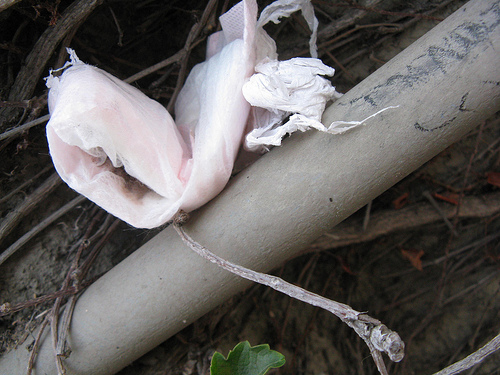
I always felt that airline travel involves building many short-lasting friendships where people bond over delayed flights, weather problems and luggage issues. Recently I was traveling and had to make a connection in the Dallas/Ft. Worth airport. I was using the restroom and I could hear the lady in the stall next to me change her sanitary napkin. She dropped the plastic wrapping from the new pad and it floated into my stall. Without hesitation, I picked up the wrapper and disposed of it. We both exited our stalls around the same time and as we approached the sinks she turned to me and said quickly but firmly, “Thank you so much for doing that.” I was a bit taken aback but responded “Oh, no problem,” we washed our hands and we bid each other farewell as we left the restroom.
The reason I was taken aback was because I felt she had nothing to thank me for. I simply picked up a piece of wrapping and threw it away. However, the serious tone of her voice told me that she was grateful for what I did. Perhaps it saved her what she deemed the embarrassment of picking it up herself? Or maybe she was just thanking me for a kind gesture. It wasn’t as if I gave her something (like a pad or tampon) that she could thank me for and the act in no way inconvenienced me. I wonder if she would have felt inclined to thank me if she had dropped a candy wrapper or tissue instead.
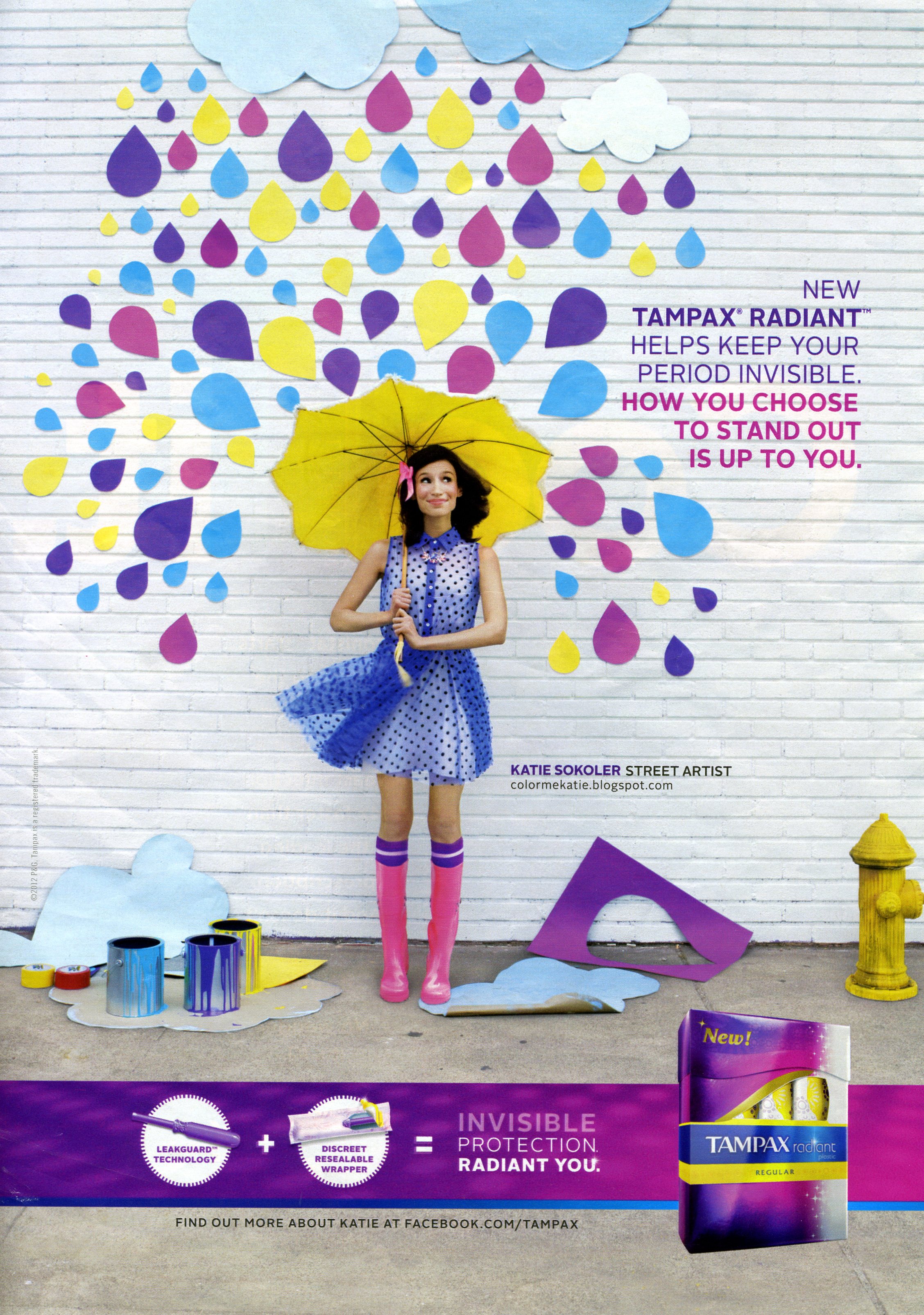
While there has always been this overall social need to conceal the period, it seems lately that there has been a surge in the desire to conceal menstrual products. Procter and Gamble has a site, Being Girl, that gives the Dos and Don’ts of tampon usage, including practicing at home to “see how quiet you can be when making a quick change.” And silence is one aspect that P&G tends to advertise, especially with its Tampax Pearl product. The wrapper becomes a selling point for Tampax Pearl because of its quiet and easy-to-open tabs that allow for utmost discretion.
I’m sure most re:Cycling readers have seen the U by Kotex line of menstrual products. This line is aimed at a younger crowd, the website has a section for tweens, and takes the idea of concealing in a different direction. Instead of making the products discreet and quiet the company advertises “hot new colors and wrappers.” However, changing the color or design of a tampon wrapper is still missing the point and is just as damaging as advertising products with quiet wrappers. The period is still being hidden. If a woman drops a bright green tampon wrapper on the floor is she now going to be less embarrassed because of the color? It doesn’t matter if the wrapper is white, pastel or a bright color, she shouldn’t be embarrassed at all. That is what needs to change — the embarrassment factor women have about their periods, not the colors of the products used.
Today, in vintage femcare advertising, we bring you Tampax’s idea of menstrual shaming, 1990s style:
But Tampax doesn’t understand menstruation as well as they think they do. Sure, it might be a little tiresome to have a Mariachi band follow you around everywhere for most of a week, but as I’ve indicated before, I love the idea of a musical celebration of my monthly miracle.
I wasn’t the only one who noticed: a recent article in Ad Age says the “30% better protection” strategy has not been used in femcare marketing since Rely tampons were withdrawn from the market in 1980. Not coincidentally, that was the last time Tampax picked up significant market share — a lot of those former Rely users switched to Tampax (Tampax was not owned by P&G at the time, but Rely was).
With the U by Kotex brand apparently winning new customers as well as winning others away from Tampax, how successful will “30% better protection” be as a persuasive strategy? Jack Neff (author of the Ad Age piece) points out that it’s pretty challenging “in a category where absorbency has been tightly regulated by the Food and Drug Administration in the wake of the Rely withdrawal.”
It looks like Kotex is winning. Explicit comparison to the competitor’s product is an advertising strategy of 30-40 years ago. Under the new rules, the competitor’s product doesn’t even exist, and certainly isn’t deserving of mention in a promotion for your own.
This ad for Tampax appeared in the March, 2011, issue of Marie Claire
In my visual communication class this week, I used several femcare ads (along with a couple of cell phone commercials and other images) to illustrate Althusser’s concept of interpellation. My students got more of a lesson than they bargained for, as I ended up also talking a little about the history of advertising for femcare products. I mentioned but did not show this historically significant ad, notable to my students for the appearance of pre-Friends Courtney Cox, but more important because it was the first time the word “period” was uttered on television in a menstrual product ad.
Apparently Max le Tampax is all stressed out about heading off to the Tampon Academy, where he’ll learn all about freshness and vaginal awareness and how to be empowerful to women.
The latest magazine ads for Always “Infinity” maxi pads remind me of this old joke:
Two young boys walk into a pharmacy one day, pick out a box of Tampax and proceed to the checkout counter.
The man at the counter asks the older boy, “Son, how old are you?”
“Eight,” the boy replies.
The man continues, “Do you know what these are used for?”
“Not exactly,” the boy says. “But they aren’t for me. They’re for him. He’s my brother. He’s four. We saw on TV that if you use these you would be able to swim and ride a bike. Right now he can’t do either one.”
So if I use Always, will I be able to be a contortionist like the acrobat in the picture? Because right now, I’m pretty sure I can’t do that.
This advert for Tampax appears in the February 2010 issue of Marie Claire, and probably other ladymags as well. It shows tennis star Serena Williams posing in a victory stance with clenched fist in the foreground, while security guards cart off Mother Nature, who is bearing a red-wrapped gift for Serena. The legend printed across the picture reads, “Serena shuts out Mother Nature’s monthly gift”.
As I said previously, I have some ambivalence about these ads. In today’s period-hating cultural climate, it takes some courage for a celebrity to appear in advertisement for a menstrual product. And it’s great to see acknowledgement that an athlete can win contests at any phase of her menstrual cycle (even the Boston Marathon).
But look closely at this ad, and read the copy. What’s missing?
That’s right – there’s no mention of blood or menstruation. The word period, itself a euphemism, isn’t even used. Only the flowery, secretive euphemism “Mother Nature’s monthly gift” represents menses.
And Mother Nature is reduced from the clever, wise-cracking Aunt Flo portrayed here to a kooky sitcom aunt reminiscent of Gladys Kravitz. Who wants to receive her gift?
Guest Post by Heather Dillaway, Wayne State University
Screenshot
Trying to find a reason to stay up late this past Saturday night, I found myself watching Saturday Night Live for a few minutes. Unfortunately I tuned in right before a skit called “Tampax to the Max,” a skit within which two male SNL actors played sports announcers for a “Ladies’ Billiards” competition. Drew Barrymore and SNL’s Kristen Wiig played the two billiards players, but the skit wasn’t really about the billiards tournament at all. The skit was written specifically to highlight Tampax as a sponsor of the billiards event and, therefore, the skit was filled with superfluous tampon jokes and random interjections of the word “Tampax” (which, of course, brought the most laughs for the skit). Putting all other comments aside about the perpetuation of gender inequality in sports as well as all of my feelings about how ridiculous Drew Barrymore and her SNL counterpart (Kristen Wiig) were made to look in this skit, I think that we cannot just sit by and let this skit air without commenting about the place of menstrual products (and, by default, menstruation itself) within it. On one hand, this skit was simply a way for some SNL writer to air some really bad Tampax jokes and allow male actors on SNL to get a chance to say “Tampax” as many times as they could within one skit. In this context, perhaps some could characterize this skit as harmless. Yet, on the other hand, menstruation and women’s activities surrounding menstruation become a complete joke in this skit as a result. The inferences made about the connections between menstrual products and women’s sports are strange (Is Tampax what everyone thinks about when they watch women’s sports events? And are the sponsors more important than the actual sports event, if it is a female sports event? And is it more fun to think about women’s menstruation than to watch women compete?). The fact that the billiard players’ place within the skit becomes shadowed by their menstrual products is maddening, however. The skit makes clear that women’s involvement in billiards (perhaps sports in general?) is unimportant but their use of menstrual products is much more interesting to men…
While I understand that SNL makes light of all different kinds of bodily processes (and that IS funny at times), the underlying equations of women with their reproductive processes and the laughs gotten from the pure mention of Tampax in this skit are disturbing. As I watched this skit, I couldn’t help thinking about why we haven’t moved on from laughing about menstruation and menstrual products. As we all know, jokes often let us know exactly how unequal the world is and, in my opinion, letting male SNL actors just get a chance to make some random Tampax jokes in a skit is not doing women or reproduction or menstruation any good at all. Does menstruation become any more positive or any more well understood because of this skit? I don’t think so. I was offended by this skit, and would be interested to hear if I was the only one who was….
Apropos of Chris’ most recent post, the video of Serena Williams’ new ad for Tampax just popped up in my RSS feed. You can check it out at right.
I’m so torn on this. I’m pretty certain that this is the First. Time. Ever. that the word “blood” has been used in an ad for menstrual products. Do you know what a huge step forward for body acceptance and menstrual literacy that is? When I was growing up in the 1970s, pads were advertised by showing how well they absorbed BLUE fluid. (So were diapers, by the way.) Kotex was the first company to use the color red and the word “period” in ad campaign less than ten years ago. So there is a part of me that is delighted when Catherine Lloyd Burns, playing Mother Nature, smiles slyly and says, “Well, there is plenty of blood, but none of it’s bad”.
I also enjoy seeing a powerful woman say that she isn’t afraid of menstruation, and shown succeeding athletically while menstruating. Kinda reminds me of when Uta Pippig won the Boston Marathon while menstruating.
But the core message and most troubling element of this entire “Mother Nature” campaign is the idea that menstruation is the gift nobody wants. Can’t P&G (and Kotex, and every other femcare advertiser) just promote the damn products without promoting shame and body hatred? Women will buy menstrual products without being told that periods should make them feel “not so fresh”. In fact, the ads might be more compelling if they emphasized the absorbency of the product and treated menstruation as a fact of life, rather than a secret disaster. Just spare us the blue fluid, please.
Readers should note that statements published in re: Cycling are those of individual authors and do not necessarily reflect the positions of the Society as a whole.