Blog of the Society for Menstrual Cycle Research

The Menstrual Cycle and the Sleep Cycle

November 18th, 2010 by Elizabeth Kissling

New research confirms what many of our readers already suspected: the menstrual cycle affects one’s quality of sleep. A study of 931 women with sleep complaints, published in the December 2010 issue of Climacteric, found that it’s not just hot flashes that interrupt sleep: women with irregular cycles were more likely to report difficulties falling asleep and insomnia symptoms.


Post to Twitter Post to Plurk Post to Yahoo Buzz Post to Delicious Post to Digg Post to Facebook Post to MySpace Post to Reddit Post to StumbleUpon

“A Non-Hormonal ‘Fix-It’ for Women Suffering From a ‘Broken Internal Thermostat’”: Just Wear Athletic Clothing to Bed!

November 15th, 2010 by Heather Dillaway

sleepless.jpgThe title of this blog entry comes straight from a media release about Goodnighties® Recovery Sleepwear. That’s right, now there is finally sleepwear made out of a fabric similar to the fabric worn by “Olympians, Astronauts and Even Racehorses” to wick away the moisture of hot flashes, night sweats, and chills accompanying some women’s perimenopause, menopause, and postmenopause. Using the “power of negative ions,” Goodnighties® sleepwear purportedly offers that rest, relaxation, recovery (and, ultimately, sleep!) that most midlife women are lacking! Some users are quoted on the website as saying that Goodnighties® sleepwear “changed their lives.”

One one hand, this makes complete sense — why didn’t people think of this before? Athletic clothing would help someone deal with hot flashes and night sweats in the middle of the night, if only making it so that one doesn’t have to get up and change their clothes or sheets. And considering we’re currently in a “menoboom” (Barbre, 1998), with the aging and menopause of the Baby Boomers, what a great idea to market moisture-wicking clothing to menopausal women! Talk about a money-maker.

On the other hand, while I think on the whole this is probably a good product for many, I do take issue with some of the language on the site, because of the negative connotations about menopause in particular (e.g., the emphasis on “fixing” “broken thermostats,” “suffering,” and quotes about how 85 percent of women are “known to suffer”). But, this line of clothing is also marketed towards others — those undergoing infertility treatments, “athletes, regular exercisers and weekend warriors with sore muscles,” “people with aches and pains due to injury, surgery, chemotherapy, etc.,” and “[t]hose suffering from painful health issues like fibromyalgia, arthritis and diabetes” — so, it’s not exclusively marketed to menopausal women and not exclusively designed to define menopause as a bad thing.

On another issue, though, the emphasis on relief, recovery, and fixing does make me think that this product is being marketed as something that resolves (negative) symptoms, but I’m not sure how that could be the case? Does anyone have any experience with Goodnighties® sleepwear? Is it actually capable of alleviating the symptoms, or is it just making the public manifestation of the symptom disappear?

Post to Twitter Post to Plurk Post to Yahoo Buzz Post to Delicious Post to Digg Post to Facebook Post to MySpace Post to Reddit Post to StumbleUpon

Napping is Good for You!

April 28th, 2010 by Elizabeth Kissling
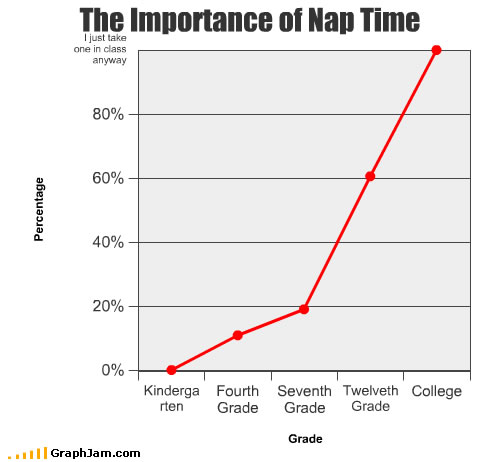
The Importance of Nap Time by Age, graph by cmoney345

The Importance of Nap Time by Age, graph by cmoney345

This is a very small study, but I don’t need much encouragement for an afternoon nap. Researchers wanted to test whether a mid-afternoon nap during the late-luteal phase of the menstrual cycle (commonly known as the premenstrual period) would improve symptoms of sleepiness, mood, and cognitive performance without negatively impacting subsequent nocturnal sleep. They tested this hypothesis on ten women with significant premenstrual symptoms and a control group of nine women with minimal or no symptoms, and found that napping made both groups feel better. More precisely,

Napping improved sleepiness, alertness, mood, and some aspects of cognitive performance. Improvements were maintained for at least 30 minutes and up to 6 hours after napping. An afternoon nap benefited both groups of women, but those with significant symptoms had a slightly greater improvement in intensity of mood 30 minutes after the nap.

Napping – it’s not just for kindergarteners. Wouldn’t the world be a better place if everyone could have a Fig Newton and a blankie at about 2:30 pm?

Post to Twitter Post to Plurk Post to Yahoo Buzz Post to Delicious Post to Digg Post to Facebook Post to MySpace Post to Reddit Post to StumbleUpon

Readers should note that statements published in re: Cycling are those of individual authors and do not necessarily reflect the positions of the Society as a whole.