Blog of the Society for Menstrual Cycle Research

“It means there’s blood flowing out of my uterus!”

November 4th, 2011 by Elizabeth Kissling

So says 15-year-old Judy to her boyfriend Johnny on the occasion of her first period, in this vintage film about menstruation, Linda’s Film About Menstruation. This 18-minute treasure was produced in 1974 by the Creative Artists Public Service Program of the New York State Council of the Arts (CAPS), a program that ran from 1970 to 1981.

Would that cities and states still had arts budgets for these kinds of projects!

Post to Twitter Post to Plurk Post to Yahoo Buzz Post to Delicious Post to Digg Post to Facebook Post to MySpace Post to Reddit Post to StumbleUpon

Golly! Molly is growing up.

February 14th, 2011 by Elizabeth Kissling

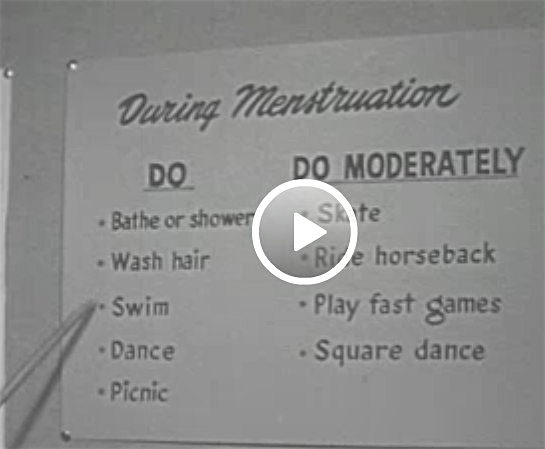
Molly Grows Up _ screenshotPreparing for class discussions this week about sex education policy in the U.S. found me flipping through the Prelinger Archives, where I found this gem: Molly Grows Up. It’s a menstrual education film apparently intended for girls in about the sixth grade, made in 1953. Along with a basic explanation of the physiology of menstruation and puberty, the school nurse assures the girls that no one can tell when they are menstruating. But then she offers them this advice visible in this screen shot — and recommends the girls wear their best dresses and take extra care with “hygiene”.

You can view the film here.

Post to Twitter Post to Plurk Post to Yahoo Buzz Post to Delicious Post to Digg Post to Facebook Post to MySpace Post to Reddit Post to StumbleUpon

It’s OK to Talk to My Daughter about Sex, but Don’t Tell Her about her Vulva!

June 15th, 2010 by Elizabeth Kissling

In Therese Shechter’s guest-post about the German teen magazine feature article, “Every Vulva Is Different”, she noted that we’re unlikely to see such an explicit, body-positive article in a U.S. teen magazine. Therese, as usual, knows what she’s talking about. In this just-released video clip from her forthcoming documentary How to Lose Your Virginity, Susan Schulz, the Editor-in-Chief of CosmoGirl! magazine, tells viewers about the time CosmoGirl! ran an article titled “Vulva Love”, which included a cartoon drawing of vulvar anatomy and some basic, age-appropriate physiological and health information about vulvas. It was the most complained about article ever published by the magazine. The complaints were not from the magazine readers, however: the grievances were filed by the mothers of subscribers. Parents thought it was inappropriate material for their teen daughters.

After you watch the clip, consider throwing a few bucks Trixie’s way so she can complete the film – the project needs another $3585 pledged by July 1 to receive the $10,000 they’re trying to raise.

Post to Twitter Post to Plurk Post to Yahoo Buzz Post to Delicious Post to Digg Post to Facebook Post to MySpace Post to Reddit Post to StumbleUpon

The Eco-Vag: Natural Lubricant with Umbra

February 12th, 2010 by Giovanna Chesler

Umbra Fisk is a character developed at Grist TV (and performed by Jennifer Prediger) who brings a surprising smile to a movement more familiar with a Green grimace. Her Ask Umbra videos appear often enough to remind us how to bike to work safely or enlighten us on growing food in your apartment.  In her latest video, she describes how to make lube from flax seed. As she explains, personal lubricants are loaded with petrochemicals that one might otherwise find in brake fluid and antifreeze. The recipe is as quick and easy as her messages and welcome humor. Thanks Umbra for bringing on the Omega 3′s and helping us all avoid “Toxic Hoo-Ha Syndrome.”

Post to Twitter Post to Plurk Post to Yahoo Buzz Post to Delicious Post to Digg Post to Facebook Post to MySpace Post to Reddit Post to StumbleUpon

Every Vulva Is Different

December 19th, 2009 by Elizabeth Kissling

Guest Post by Therese Shechter, filmmaker (Trixie Films)

Alert: Links are Not Safe for Work
Photo of woman wearing only underpants, superimposed with words, "Jede Vulva ist Anders" (Deutsch for "every vulva is different")German teen magazine Bravo, known for it’s explicit information on sexuality and sexual health has done it again with their feature: Vulva-Galerie: Schau, welche Unterschiede es gibt! which according to my Google translator means”Vulva Gallery: Look, what are the differences?”

The text says: The vulva is the externally visible part of the vagina. Do you want to finally know what it looks like on other girls? We show you the variations! If you click on Hier siehst du, welche Vulva-Variationen es gibt! (Here are the vulva variations!), you get a gallery of photographs of female genitals, photographed from the front. Some are pierced, some are hairy, some are shaved, some have larger labia…but unfortunately, they’re all white and none of the women seem to be on the larger side.

That’s too bad, because the underlying message is a good one: Stop comparing your ladyparts to women in mainstream porn. This is what we look like when we’re not being seen through the male gaze. Every vulva is different and special in its own way. Again, I wish there had been some diversity in race and size. Is Germany really such a homogeneous society? I don’t think so. The photo series ends with a more explicit photo of the inner vulva, complete with labels.

Not only would this never fly in the US, it reminds me of an interview we did with CosmoGirl! editor Susan Schulz who told us about an illustration of a vulva they commissioned in order to acquaint their readers with their own ladyparts. The title was ‘Vulva Love’ and it was done in a fun folksy way and totally non-pervy. Susan told us they got more hate mail from parents about that item than anything else they ever ran. The illustrator didn’t even want their name on the piece. I’ve searched online for the image but can’t find it, so I’ll post it and our interview with Susan in when I’m back in the USA.

By the way, the Bravo vulva item is part of a regular feature called Dr. Sommer which includes topics for teen boys and girls like vaginal health, penile pain, “Are You Really Ready for Sex?” and “Love School”(if you are ready, I guess). My knowledge of the German language is now exhausted, but if anyone wants to translate other items, please leave it in the comments!

Cross-posted at The American Virgin.

Post to Twitter Post to Plurk Post to Yahoo Buzz Post to Delicious Post to Digg Post to Facebook Post to MySpace Post to Reddit Post to StumbleUpon

Recognizing the Vaginal Corona

December 8th, 2009 by Elizabeth Kissling

Vaginal_coronaVia the fabulous Scarleteen (best sex education resource on the web), I’ve just learned of the English translation of a remarkable booklet from Swedish Association for Sexuality Education: Vaginal corona: Myths surrounding virginity – your questions answered.

The mythical status of the hymen has caused far too much harm for far too long. Last spring, RFSU published an information booklet in Swedish intended to dispel some of the myths surrounding the hymen and virginity.

The booklet describes what the female genitals look like and what the vaginal corona actually is. It also dispels many of the myths surrounding female sexuality and the misconceptions concerning the hymen and virginity. Etymologically, the term hymen comes from the Greek word for membrane. In Swedish, the hymen used to be called mödomshinna, which translates literally as “virginity membrane.” In fact, there is no brittle membrane, but rather multiple folds of mucous membrane. A vaginal corona, in other words.

“The vaginal corona is a permanent part of a woman’s body throughout her life. It doesn’t disappear after she first has sexual intercourse, and most women don’t bleed the first time,” said Ms Regnér.

This is important work, and should be widely disseminated. At the link above, you can download the booklet in PDF form in Arabic, English, and Sorani, or order a print copy via email.

Post to Twitter Post to Plurk Post to Yahoo Buzz Post to Delicious Post to Digg Post to Facebook Post to MySpace Post to Reddit Post to StumbleUpon

Readers should note that statements published in re: Cycling are those of individual authors and do not necessarily reflect the positions of the Society as a whole.