Blog of the Society for Menstrual Cycle Research

Respecting the Maori Menstrual Taboo

October 14th, 2010 by Elizabeth Kissling

Female visitors to Te Papa (Museum of New Zealand) are faced with a difficult moral dilemma regarding the taonga Maori collection included in an upcoming tour.

An invitation for regional museum staff to go on a behind-the-scenes tour of some of Te Papa’s collections included the condition that “wahine who are either hapu [pregnant] or mate wahine [menstruating]” were unable to attend.

Te Papa spokeswoman Jane Keig said the policy was in place because of Maori beliefs surrounding the taonga Maori collection included in the tour.

“There are items within that collection that have been used in sacred rituals. That rule is in place with consideration for both the safety of the taonga and the women,” Keig said.

She said there was a belief that each taonga had its own wairua, or spirit, inside it.

“Pregnant women are sacred and the policy is in place to protect women from these objects.”

The policy does not apply to the entire exhibit, but to a “behind-the-scenes” tour offered November 5. Visitors’ reproductive status will not be verified in any way, but women are expected to be honest about it and obey the request.


Post to Twitter Post to Plurk Post to Yahoo Buzz Post to Delicious Post to Digg Post to Facebook Post to MySpace Post to Reddit Post to StumbleUpon

The Red Scare: Blood Rituals

July 16th, 2010 by Elizabeth Kissling

Red Scare illustration from Whore! MagazineAnyone else seen the premier issue of Whore! Magazine (Fast, Feminist, and Feminine) yet? My copy arrived yesterday and while I haven’t read the whole thing yet, I’m enjoying the quality of the writing and the production values.

I’m also pleased to see a positive story about menstruation in a magazine, in Tracy Merlau’s essay, “The Red Scare”. It’s short, sentimental essay about adolescence and menarche, and the sadness of the nearly complete absence of any public recognition, let alone celebration, of menarche for girls in the U.S.

Recommended.

Post to Twitter Post to Plurk Post to Yahoo Buzz Post to Delicious Post to Digg Post to Facebook Post to MySpace Post to Reddit Post to StumbleUpon

Tonight’s the Night: Listen to Seeing RED

June 14th, 2010 by Laura Wershler

Tonight’s the night, Monday, June 14th, to tune in as CBC Radio airs Part One of: Seeing RED: A Cultural History of Menstruation This two part documentary concludes next Monday, June 21st. If you miss the original broadcast, which you can listen to online at 9:00 PM in all time zones (choose the program IDEAS) you will be able to link to the podcast at any time convenient to you as of Tuesday, June 15th.  SHAA SEP 07 029

Introduction to the documentary:

They are misfits. Witches. Children. Just a few of the labels used to portray menstruating women over time. The Bible has described the bleeding woman as undergoing “customary impurity”. In the Middle Ages, it was thought that women menstruated to release “sexual overflow”. Their counterparts in the Victorian era were told that a period would deplete their body’s precious resources. Twentieth century feminists worked hard to reclaim menstruation as a vital and positive part of womanhood. IDEAS producer Mary O’Connell explores menstruation from a cultural and historical perspective.

Several members of the Society for Menstrual Cycle Research were interviewed for this documentary. We invite our readers to listen to the program and share their thoughts and comments.    (Photo by Laura Wershler of Bleedy, the Period Puppet, created by Bree Horel at a Menstrual Arts and Crafts event held by Sexual Health Access Alberta.)

Post to Twitter Post to Plurk Post to Yahoo Buzz Post to Delicious Post to Digg Post to Facebook Post to MySpace Post to Reddit Post to StumbleUpon

Menstrual Tracking 2.0

March 22nd, 2010 by Elizabeth Kissling

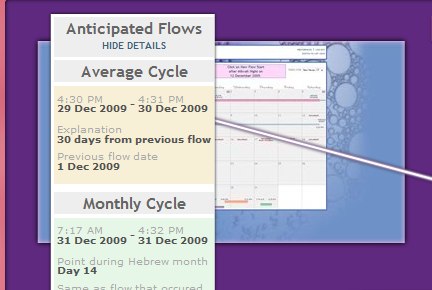
Mikvah CalendarI haven’t studied every online tool for period tracking but this one appears to be the most sophisticated yet: MikvahCalendar.com helps observant Jewish women track their cycles, including her niddah (ritually impure) time. It automatically calculates sunrise and sunset, sends email or text reminders, and can be customized for Chabad, Ashkenazic, and Sephardic traditions. And it’s Rabbincally Approved.

Post to Twitter Post to Plurk Post to Yahoo Buzz Post to Delicious Post to Digg Post to Facebook Post to MySpace Post to Reddit Post to StumbleUpon

An Autonomous Kingdom of Women

September 20th, 2009 by Elizabeth Kissling

That’s how Varda Polak-Sahm, writing in today’s Washington Post, describes her visit to the Mikveh in preparation for her second wedding. The Mikveh is the ritual purification bath Halakha, the Jewish law, requires of women after each menstrual cycle and prior to an Orthodox wedding ceremony.

According to Orthodox rabbinic law, immersion in the mayyim hayyim, or living waters, removes the impurity left by menstruation and transforms the woman’s status from contaminated to pure. This is an essential element of Jewish existence. Before a synagogue is built, Jewish communities install a Mikveh. Without purification, Orthodox men cannot even touch their wives. Thus, without purification in the Mikveh, there is no future for the Jewish people.

Polak-Sahm writes about her own changing understanding of the Mikveh in this brief essay, making her new book, The House of Secrets: The Hidden World of the Mikveh, sound like a worthwhile read for those of us interested in traditions and beliefs surrounding menstruation.

Post to Twitter Post to Plurk Post to Yahoo Buzz Post to Delicious Post to Digg Post to Facebook Post to MySpace Post to Reddit Post to StumbleUpon

Mikvah in Montana

July 15th, 2009 by Elizabeth Kissling

The Hasidic movement Chabad Lubavitch has opened the first mikvah, a ritual bath for spiritual purification, in Montana. Estimates are that there are fewer than 1000 Jews residing in Montana, but Chabad says this is the only contemporary mikvah in a vast area that includes Idaho, North Dakota and South Dakota.

From the Associated Press article:

Jewish law requires married women to immerse in the mikvah for ritual purity after menstruation and a period of abstaining from sex. Brides are expected to immerse before their weddings. The bath can also be used as purification as part of converting to Judaism.

Outside of the small Orthodox Jewish community, many American Jews had stopped using the mikvah, partly out of objections to its perspective on women. However, in recent years, more Jews have been rediscovering traditional practices, and the ritual bath has had a renaissance.

As a shiksa, I don’t care to open the debate about the mikvah’s perspectives on women, but simply to note the significance of this increased availability of means for women to practice menstrual ritual of their faith. (Those who are interested in the question of whether the mikvah is sexist may wish to read this article by Jancie Lochansky, which puts that question to Rivkah Slonim, author of Total Immersion: A Mikvah Anthology.)

Post to Twitter Post to Plurk Post to Yahoo Buzz Post to Delicious Post to Digg Post to Facebook Post to MySpace Post to Reddit Post to StumbleUpon

Readers should note that statements published in re: Cycling are those of individual authors and do not necessarily reflect the positions of the Society as a whole.