Blog of the Society for Menstrual Cycle Research

Things We Don’t Talk About: Healing Narratives from the Red Tent

March 19th, 2012 by Chris Bobel

What would the world be like if young women were mentored by older women?

What would the world be like if we knew we had a place for our stories to be told?

So intones the voiceover at the start of the trailer of a forthcoming film.

And it is right on time.

The recent media attention paid to Tomi- Ann Roberts and Nikki Dunnavant’s research recent re: religious identification and menstrual traditions has got me thinking (more than usual) about women, bonding and menses. Roberts and Dunnavant’s religious women harbored more negative attitudes toward their periods than their secular counterparts, but they reported a sense of woman-to-woman connection during their menstruation that non-religious women did not.

So how do we create community and lose the shame?

Red tents anyone?

“Things We Don’t Talk About: Healing Narratives from the Red Tent” explores the increasing reach of the “Red Tent Temple Movement” seeded by women’s empowerment facilitator Alisa Starkweather and inspired by Anita Diamant’s 1997 bestselling novel The Red Tent – a rich fictionalized treatment of biblical character Dinah. In the novel, Dinah and her tribeswomen gather during their menses in a sacred women-only space.

The practice in a book became a movement.

Starkweather and others in more than 50 red tents across the nation and beyond (in 30 states and 6 countries) believe that the simple practice of gathering women and girls in a space dedicated ONLY to them (whatever their date on the menstrual calendar) is precisely what women and girls need to feel supported and nurtured. This is the stuff of healing, they say.

Red tents are an initiative within what I call the ‘feminist spiritualist’ wing of the menstrual activist movement — a loose collection of activists who emerged in the 1970s and share an earnest celebration of embodied womanhood. This style of activism, I’ve argued, has endured and innovated for more than 4 decades, but remains on the fringe of feminist movements as a mostly white middle class concern.  Liedenfrost’s film, however, may nudge an expansion of the movement (or perhaps, show that it is already slowly capturing a diverse following?). A commitment to inclusion rings through the voices of the women captured in “Things We Don’t Talk About….” Red tents, as one woman explains during the trailer, are safe, welcoming and invite each woman to “come as you are and who you are is enough.”

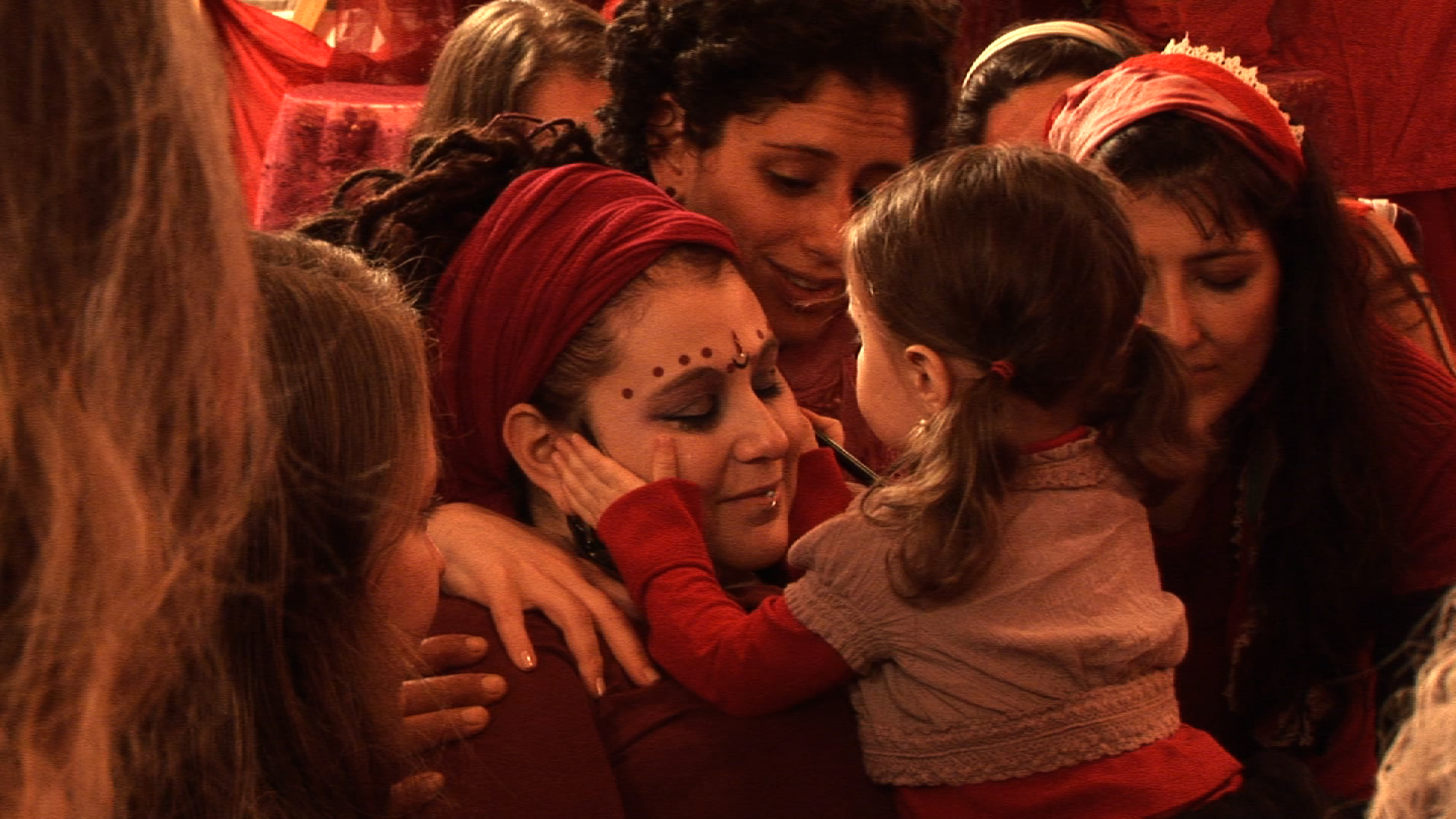
Filmmaker Isadora Gabrielle Liedenfrost, a seasoned filmmaker specializing in “multicultural motifs and embedded cultures and spiritual traditions” presents a rich palette of reds, auburns, and fuchsias and a haunting soundtrack in this piece. Her camera brings us images of small and large groups of women crying, laughing, dancing and hugging together woven with the heartfelt stories of the empowering benefits of women-in-community.

Photo credit: Isadora Gabrielle Liedenfrost (used with permission)


I am left asking: could red tents offer women—whatever their spiritual inclination—a shame-free community? Could they restore a lost tradition now updated in a contemporary body-positive context? Surely, the feminine intimacy offered here is not for every woman, but for many, it might feel like home is a lovely little tent.

Post to Twitter Post to Plurk Post to Yahoo Buzz Post to Delicious Post to Digg Post to Facebook Post to MySpace Post to Reddit Post to StumbleUpon

Menstrual Tracking 2.0

March 22nd, 2010 by Elizabeth Kissling

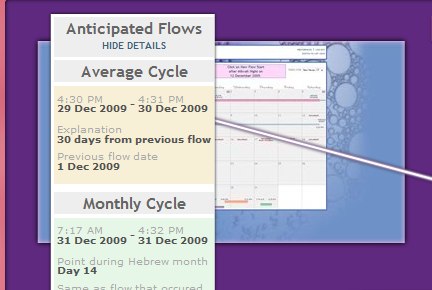
Mikvah CalendarI haven’t studied every online tool for period tracking but this one appears to be the most sophisticated yet: MikvahCalendar.com helps observant Jewish women track their cycles, including her niddah (ritually impure) time. It automatically calculates sunrise and sunset, sends email or text reminders, and can be customized for Chabad, Ashkenazic, and Sephardic traditions. And it’s Rabbincally Approved.

Post to Twitter Post to Plurk Post to Yahoo Buzz Post to Delicious Post to Digg Post to Facebook Post to MySpace Post to Reddit Post to StumbleUpon

Jesus: A Menstrual Hero?

March 10th, 2010 by Elizabeth Kissling

Guest Post by David Linton, Marymount Manhattan College

Debates about Christianity’s attitudes toward women sometimes focus on Jesus’ relationship with Mary Magdalene and isolated engagements with other unnamed women encountered during his travels.  Little is made of a healing scene in the book of Luke(8:43-48) where Jesus had momentary contact with a woman who, in all likelihood, had a severe case of menorrhagia.  Here’s how the translation is described in the Revised Standard Version”

“As he went, the people pressed round him.  And a woman who had a flow of blood for twelve years and could not be healed by any one came up behind him, and touched the fringe of his garment; and immediately her flow of blood ceased.  And Jesus said, “Who was it that touched me?”  When all denied it, Peter said, “Master, the multitudes surround you and press upon you!”  But Jesus said, “Some one touched me; for I perceive that power has gone forth from me.”  And when the woman saw that she was not hidden, she came trembling, and falling down before him declared in the presence of all the people why she had touched him and how she had been immediately healed.  And he said to her, “Daughter, your faith has made you well; go in peace.”

The story is rendered with remarkable efficiency.  The stealth of the woman was motivated by her clear understanding that she was a pariah in her community,that she was forbidden by the rigid rules of Leviticus from having contact with others lest she contaminate them.  Peter’s response is particularly interesting.  Rather than acknowledging the severe violation of the rules and dealing with its consequences (Jesus would have had to go away from everyone to be cleansed), Peter denied that any contact had even occurred. (Does this foreshadow his later denial of even knowing Jesus?)

But Jesus seems utterly indifferent to the rules as he places the well being of a suffering woman above the demands of his cultural prohibitions.

The fact that Jesus’ heroic menstrual encounter has been expunged from the narrative of his life reveals, yet again, just how pernicious the taboos and prejudices are. Wouldn’t it be wonderful if Sunday School classes set the menstrual record straight?

To make matters worse, the wonderful gospel song that extols the woman’s faith, first recorded by Sam Cooke and the Soul Stirrers, “The Hem of His Garment” has been similarly sanitized so that she is simply “sick.”  The  YouTube link that contains the song takes on extra layers of meaning when you listen to it with the thought in mind that it is an unacknowledged story of reactons to the menstrual taboo.  The YouTube link also contains an additional Soul Stirrers recording, “Jesus Wash Away My Troubles” – a bonus!

Post to Twitter Post to Plurk Post to Yahoo Buzz Post to Delicious Post to Digg Post to Facebook Post to MySpace Post to Reddit Post to StumbleUpon

Readers should note that statements published in re: Cycling are those of individual authors and do not necessarily reflect the positions of the Society as a whole.