Blog of the Society for Menstrual Cycle Research

Hot Flash—Progesterone is an Effective Alternative to Estrogen

July 19th, 2010 by Elizabeth Kissling

Guest post by Jerilynn Prior, Centre for Menstrual Cycle and Ovulation Research

hot flash hellIt’s been two weeks since Chris Hitchcock and I returned from San Diego’s recent Endocrine Society meetings. We are feeling incredibly happy with the success of our protracted, intense commitments to a controlled trial of oral micronized progesterone (marketed in the USA and Canada as Prometrium®) for night sweats and hot flushes/flashes. At the Endocrine Society we presented the first-ever trial showing that the molecularly identical progesterone by mouth is effective treatment for vasomotor symptoms (VMS = hot flushes/flashes and night sweats)(1). We were also invited to present our data at an Endocrine Society-sponsored press conference.

Why did a scientific study require so much from us? First, this trial started in 2003 as the initial scientific venture of the newly founded Centre for Menstrual Cycle and Ovulation Research–thus CeMCOR’s reputation became tied to this trial. Second, despite concerted efforts, we were never able to obtain peer reviewed funding for this study—we successfully supported it with individual private donations. Finally, because of the “estrogen myth” and its corollary negatives about progesterone, I wanted to gain additional accurate information about how Prometrium® works in women’s cardiovascular system from this same study. For that reason we decided to enroll only very healthy women who were within 1-10 years since their final flow—they had to be non-smokers, without obesity, diabetes, or high blood pressure, and further to have normal measured waist circumference, blood pressure, cholesterol, and fasting blood sugar levels. Therefore many women were interested but few were eligible.

Hooked on Estrogen

May 13th, 2010 by Elizabeth Kissling

Guest Post by Jerilynn Prior, M.D.,  Centre for Menstrual Cycle and Ovulation Research

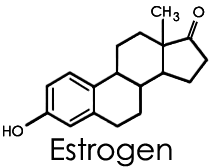
Estrogen moleculeYes! I’m sure you can hear my whoop of excitement and vindication. Finally, something negative about estrogen and positive about progesterone in the mainstream media. According to this article by Emily Anthes in the current issue of Scientific American: Mind,  women’s risk for addiction, and potential for successful withdrawal, are both linked to our menstrual cycle hormones. Estrogen increases women’s addictive behaviors while progesterone assists with successful addiction recovery.

Why am I feeling vindicated? Because I recently declared that hot flushes/flashes and night sweats are estrogen addiction (1). That wild but supportable hypothesis is based on the evidence that prolonged or high-dose estrogen exposure is required for hot flushes to occur. But, it is the subsequent abrupt decrease in estrogen levels that triggers vasomotor symptoms. Drug exposure—drug withdrawal symptoms. And do women feel high on estrogen? Perhaps. Clearly the withdrawal is miserable—as one woman said, “I continued to take it only because I couldn’t stand being off the hormone. I really couldn’t function.” (p. 2130 (2). Just ask any woman taking estrogen for hot flushes who has tried to stop it.

Neurology and steroid hormones – where is progesterone in this discussion?

April 23rd, 2010 by Chris Hitchcock

Recently the New York Times published a long article entitled the Estrogen Dilemma. It’s an article rich with many issues, and previous blogs have critiqued its uncritical acceptance of the timing hypothesis, and its failure to distinguish between the transient symptoms of perimenopause, early menopause, and the rest of your long, healthy, post-menopausal life.

But it is quite remarkable to me that, when speculating about potential hormonal treatment for poor memory and issues of staying on task, the only steroid hormone that seemed to be on anyone’s radar was estrogen. The writer had a lot of space (7600 words) and gave the scientist a lot of freedom to speculate, so I’m guessing that the absence of progesterone in the article is a true representation of her conceptual blind-spot. Progesterone was mentioned a few times, in the context of protection from uterine cancer, and in the context of using MPA (a synthetic relative) as a possible scapegoat in interpreting the WHI randomized hormone therapy trial data. But never did I see any suggestion that progesterone might be anything other than a necessary evil.

In fact, there are some intriguing new research areas that look at progesterone as therapy in neurological domains.

The Great Perimenopause Cover-Up

April 19th, 2010 by Elizabeth Kissling

Guest Post by Jerilynn C. Prior, Centre for Menstrual Cycle and Ovulation Research

I just read “The Estrogen Dilemma” in Sunday’s New York Times Magazine,  and I feel like weeping—in sorrow and deep sadness. This article by Cynthia Gorney is about energetic, intelligent women who feel they must take estrogen in order to survive perimenopause yet have deep worries about its risks. I know personally the anguishing changes that erupt during perimenopause. “The Estrogen Dilemma” also evoked my frustration and even rage. It is wrong that symptomatic women in the midst of the long and stormy midlife transition have to face a conundrum—to take estrogen or not. It arises from a Nixonian-style cover-up of three proven and important-for-women truths: 1)    Perimenopause causes higher and not lower estrogen levels. (By perimenopause I mean the transition from fertile menstrual cycles to menopause, or the life phase beginning one year beyond the final menstrual flow.) 2)    Progesterone, estrogen’s essential partner hormone, in contrast to estrogen, truly is lower in perimenopause. 3)    Women survive perimenopause and “graduate” into a less symptomatic menopause.

Bioidentical Balderdash

January 1st, 2010 by Chris Hitchcock

The bioidentical hormone therapy industry has been getting a bad rap lately in the US, and this press release is an example of why. Among other things, the writer confuses estrogen and progesterone, in one paragraph saying their product is a “safe and scientifically-proven, all-natural estrogen delivery cream[]“, and in the next describing it as a “natural progesterone cream” (emphasis is mine). Moreover, the press release springboards from another estrogen-positive press release that claims that estrogen may be the cure for female depression, citing an ob/gyn author of a book, and promoting a soon-to-be-launched web page.

So, in one breath the product is an estrogen delivery cream that will help with low estrogen, but in the next breath (on the linked product page) it is argued that it will help with estrogen that is too high (which is more accurate). The product website emphasizes that  it is “without dangerous pharmaceuticals”:

This remarkable product contains NO risky synthetic estrogens or progestins. [Product] Cream is similar to the progesterone your body naturally produces, so there are no worries about dangerous interactions or nasty side effects.

Taking Women’s Health Seriously

December 8th, 2009 by Elizabeth Kissling

Here’s one way that Canada shows some concern for risks to women’s health: the owner of a New Brunswick health food store was fined $7500 for smuggling a progesterone-laced cream from the U.S. The cream, called Aim Renewed Balance, is purported “to help restore balance between the hormones that cause premenstrual syndrome and menopause symptoms, such as hot flashes and mood swings.” It is not approved for use in Canada.

Post to Twitter Post to Plurk Post to Yahoo Buzz Post to Delicious Post to Digg Post to Facebook Post to MySpace Post to Reddit Post to StumbleUpon

Hot Flushes Relief Needn’t Enter the Bio-Identicals Fray

November 5th, 2009 by Elizabeth Kissling

Guest Post by Jerilynn Prior, Centre for Menstrual Cycle and Ovulation Research

pharmacy_clipAs a clinician scientist with expertise in hormones and women’s health, I sit in Canada and look at the hype and dis-sing going on about “bio-identicals” in the USA and shake my head. If we don’t want estrogen that is not FDA approved to be used to treat hot flushes, the simple answer is to regulate appropriately. The perpetual debate about bio-identical hormones has now hit USA Today with a headline: “Bioidenticals: Estrogen without FDA approval for menopause?

In Canada, all hormonal preparations require a prescription. Full stop.  And the pharmacists who compound estriol or progesterone do so with my prescription for a specific dose and clear purpose. Those compounding pharmacists are also regulated the same way as pharmacists who dispense FDA/Health Canada approved medications. End of story.

What bothers me is that I believe there is an intrinsic advantage to  hormones that are molecularly the same as our bodies produce. They are certainly better, a priori than those that are natural for horses or are “similar-but-different.” When oral micronized progesterone (molecularly identical, Prometrium®) is prescribed with estradiol (there are multiple FDA-approved brands of molecularly identical estrogen), there is no increased breast cancer risk.[1] On the other hand, medroxyprogesterone (a similar synthetic derivative of progesterone) with estradiol increases the risk for breast cancer by 79%.[1] That’s called a nasty surprise.

Readers should note that statements published in re: Cycling are those of individual authors and do not necessarily reflect the positions of the Society as a whole.