Blog of the Society for Menstrual Cycle Research

Pads STILL as big as your head!

November 24th, 2009 by Elizabeth Kissling
December 2009 advertisement for Always Infinity pads, which promises to "pull its own disappearing act" and "absorb four times more than you may need".

(Click to embiggen.)

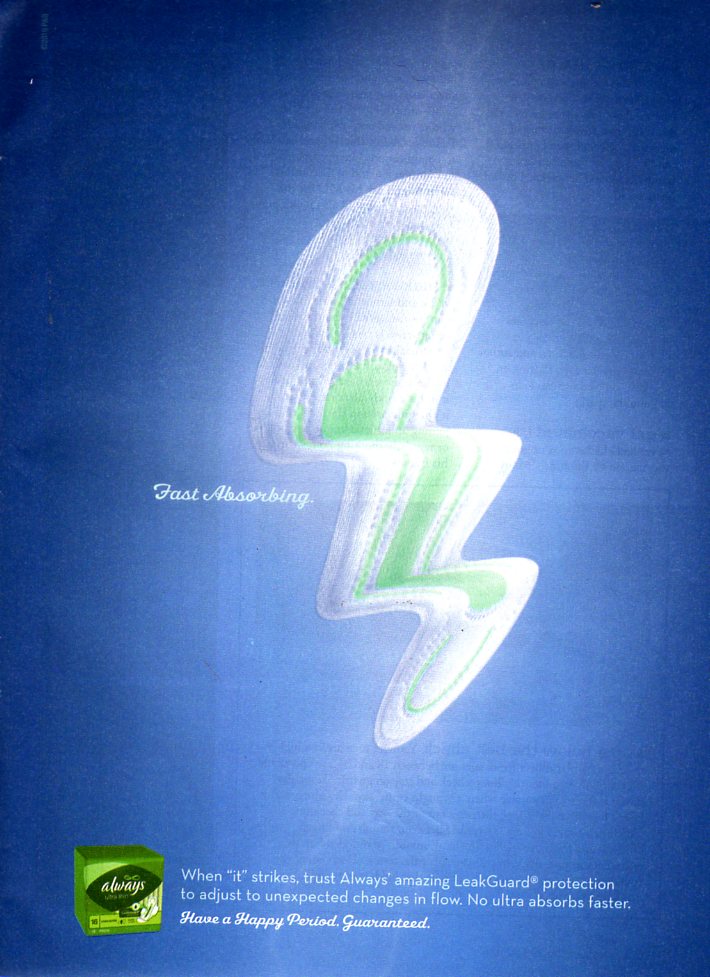
Looks like our friends at Always Infinity have ditched the skinny model,* but everything else in the ad is the same, right down to the copy about a disappearing act and the close-up shot of magic blue fluid.

ALWAYS_c_u

That pad still looks disproportionately large to me: its width measures less than 1/2 inch (1.2 cm) the inside circumference of the hat!

*Or is she missing because this version of the ad appeared in Ebony magazine, and P&G found it cheaper to use half the image than to create a new ad with an African-American model?

Post to Twitter Post to Plurk Post to Yahoo Buzz Post to Delicious Post to Digg Post to Facebook Post to MySpace Post to Reddit Post to StumbleUpon

Works Like Magic

November 2nd, 2009 by Elizabeth Kissling
magicALWAYS026

(Click to embiggen.)

Just when you think femcare ads can’t get any sillier . . . the new Always “Infinity” pad promises to “pull its own disappearing act”. Hmm . . . don’t we want pads to STAY where we PUT them?!

Oh, it’s the “fluid” that disappears. (That’s right, fluid. Not blood.) “It’s so amazing it makes fluid seem to POOF! disappear. Just like magic.”

That pad ought to be absorbent – it’s almost as large as an ironing board cover!

Seriously – something’s magic here. Maybe it’s PhotoShop, but that pad is almost as wide as her ribcage. It’s definitely bigger than her head. Do you suppose that P&G uses the same ad agency as Ralph Lauren?

Post to Twitter Post to Plurk Post to Yahoo Buzz Post to Delicious Post to Digg Post to Facebook Post to MySpace Post to Reddit Post to StumbleUpon

“Happy It’s Here”

October 16th, 2009 by Elizabeth Kissling

P&G_WhisperProctor and Gamble has just launched a new internet campaign in Singapore for their menstrual pads. The flash-heavy website tells why girls are Happy It’s Here :

Happy, confident, and loving life. You know what you want and where you want to go next. You feel wonderful about being a girl!

This is not a new product, but a new campaign for the pads known as “Always” in the U.S. Guess what they’re called in Asian markets.

Wait for it.

Whisper“.

That’s right. P&G’s ad promotion “to instill a positive attitude in young Singaporean women about their menstrual periods, seeking to dispel some of the squeamishness toward the subject that persists in much of Asia” is for a product called Whisper, with all the connotations of menstrual silence that carries.

In fairness to P&G, the name change from the U.S. product pre-dates the new internet campaign by ten years. And I wanted to give them a break after reading this quote in the Wall Street Journal article about the new campaign:

“We see our role as being over and beyond just selling the products,” says Sujay Wasan, associate marketing director for P&G’s feminine-care division in Asia. “Periods are not a necessary evil, or a curse, or a problem to be solved. It’s an absolutely natural part of being a woman, and it needs to be appreciated and celebrated,” he said.

But then I finally figured out how to turn off the site’s annoying music (yeah, I’m not really their target audience) and started poking around. I saw the links for “about your period” and “28-day cycle” and assumed P&G was serious about trying to do a little menstrual education here. So I clicked on the 28-day cycle link from the menu, and pretended today was the first day of my cycle so that I could check it out. I read, “Day 1: During your period you may feel thinner. That’s because your body may burn carbs better. Tip: Show off your figure at the gym, beach or by the pool!”

Now, on the one hand, I’m glad to see some recognition that bleeding isn’t the only thing happening during menstruation and acknowledgment that the menstrual cycle is not a bodily process isolated in the uterus and vagina. But advice to young women to practice being a sex object really grates my cheese. And it only continues: on Day 2, I’m told that since I’m burning up those carbs and feeling so thin, I should put on some hip-hugging jeans. Day 5, I’m told that I’m unlikely to feel jealous, so I should let my boyfriend have a guy’s night out. Heterosexist, much?

It goes on and on, with descriptions of the cycle in terms of emotional experience rather than physiological processes, and even though there’s a caveat at the beginning of the calendar that every girl is different, it offers mighty presumptive advice for dealing with these emotional changes. Happy It’s Here assumes that all girls are heterosexual and aspire to be paragons of femininity, as defined by the beauty product industry and other handmaidens of the patriarchy (yes, I’m using the p-word).

It also overemphasizes emotional element of the menstrual cycle, at the expense of knowledge about the physiology and anatomy of menstruation.The only mention of hormones comes on Day 15: “Estrogen is low and that nasty progesterone kicks in. Brace yourself for mood swings, irritability and bloating.” Oh, that nasty progesterone! If only it weren’t essential for fertility, a functional uterus, and bone health.

‘Well, there is plenty of blood, but none of it’s bad’

September 29th, 2009 by Elizabeth Kissling

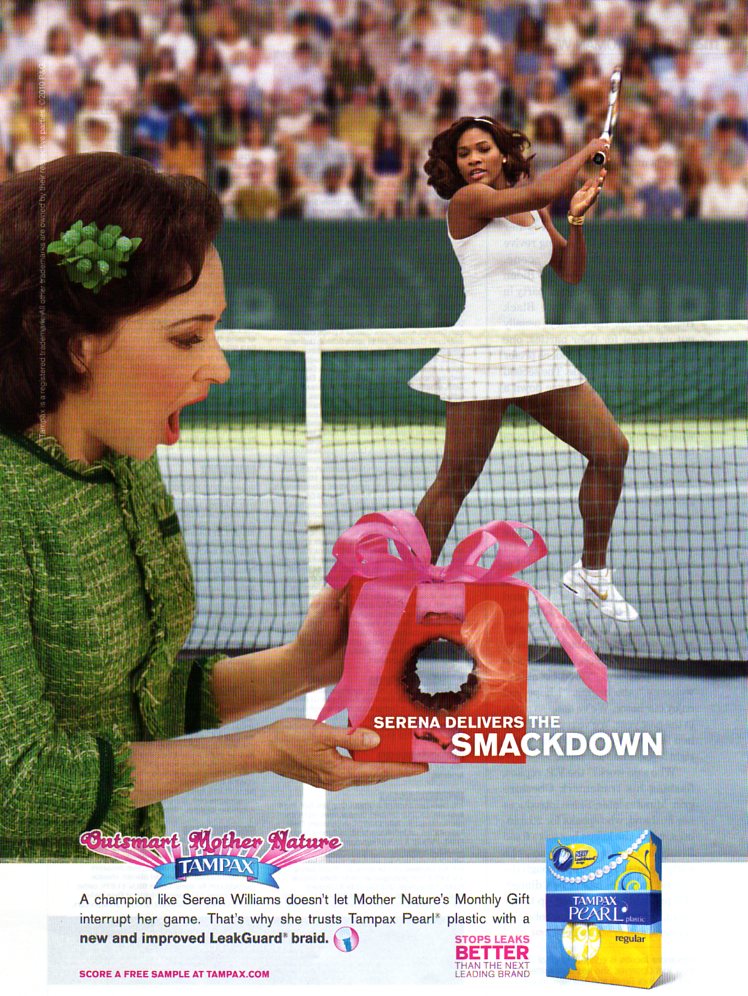
Apropos of Chris’ most recent post, the video of Serena Williams’ new ad for Tampax just popped up in my RSS feed. You can check it out at right.

I’m so torn on this. I’m pretty certain that this is the First. Time. Ever. that the word “blood” has been used in an ad for menstrual products. Do you know what a huge step forward for body acceptance and menstrual literacy that is? When I was growing up in the 1970s, pads were advertised by showing how well they absorbed BLUE fluid. (So were diapers, by the way.) Kotex was the first company to use the color red and the word “period” in ad campaign less than ten years ago. So there is a part of me that is delighted when Catherine Lloyd Burns, playing Mother Nature, smiles slyly and says, “Well, there is plenty of blood, but none of it’s bad”.

I also enjoy seeing a powerful woman say that she isn’t afraid of menstruation, and shown succeeding athletically while menstruating. Kinda reminds me of when Uta Pippig won the Boston Marathon while menstruating.

But the core message and most troubling element of this entire “Mother Nature” campaign is the idea that menstruation is the gift nobody wants. Can’t P&G (and Kotex, and every other femcare advertiser) just promote the damn products without promoting shame and body hatred? Women will buy menstrual products without being told that periods should make them feel “not so fresh”. In fact, the ads might be more compelling if they emphasized the absorbency of the product and treated menstruation as a fact of life, rather than a secret disaster. Just spare us the blue fluid, please.

Post to Twitter Post to Plurk Post to Yahoo Buzz Post to Delicious Post to Digg Post to Facebook Post to MySpace Post to Reddit Post to StumbleUpon

The Top Ten Explanations for an Angry Woman

September 29th, 2009 by Chris Bobel
USA Today reports Serena Williams deal with P&G

USA Today reports Serena Williams deal with P&G

10) She is upset and wants someone to know

9) Something about estrogen levels

8 ) She is about to start her period

7) Matter over mind…her body has taken over

6) I don’t know, but she will feel better in a week or less

5) Hormones

4) Women do that about every 28 days

3) Time for tampons

2)We gave up trying to figure that out a long time ago, but it will pass

1) PMS, of course.

I know I am not the only one exasperated with the easy dismissal of women’s anger as little more than PMS.

Sometimes (and I’d venture, MUCH of the time), an angry woman IS simply, well, an angry woman.

But WE (culturally-speaking), tend to immediately link women’s anger with PMS. This is lazy and effectively trivializes and silences women. While I don’t dispute that hormonal fluctuations can and often do explain the TIMING and/or SEVERITY of a woman’s emotional expression, I argue that is it important, no IMPERATIVE, that we resist the temptation to immediately attribute a woman’s rage to the biological.

On 12 September 2009, Serena Williams verbally abused a line judge during the US Open. In the following days, the blogosphere hosted a hungry feast on the event. Racists had their usual deplorable field day; biological determinists joined in for the fun. Bloggers (many of them devoted fans) breezily attributed Serena’s outburst (and sure, it WAS a doozy), to PMS. One blogger referred to the incident as “Serena’s PMS Moment.”

“It was a total PMS moment…. completely unexplainable…

Another blogger wrote,

“Serena has already told the world that she has very difficult periods, in particular, menstrual migraines. And where there are menstrual migraines, PMS poisoning can’t be too far away.”

One more sample:

“She had a bad day on court, but to me, it just sounds like classic PMS emotional roller-coastering.

Then on 21 September 2009, Procter & Gamble’s announced that Serena Williams will headline a series of their “Outsmart Mother Nature” ads (print and video). Williams, says, P&G, was chosen because she “represents the energy, independence and strength of women they want to celebrate.” (And P&G supports her apology for her outburst.)

See the ad here. (Great fodder for another post, another time.)

Even though this deal was in works months (longer?) before the US Open and thus, unrelated to Serena’s “PMS Moment,” the press, like USA Today, still implicitly makes the link.

Take a good look at this story.  Notice the juxtaposition of a very angry (and very powerful) Serena Williams underneath the brand name TAMPAX. No cognitive dissonance there, right? Even funny, as in, ‘that’s rich….now Ms PMS is the spokesperson for a MENSTRUAL product. Good one, Tampax!”

Yesterday, I entered PMS + Serena Williams + US Open into google and I got 45, 000 hits. The feast continues.

Maybe Serena was PMSing that fateful day. Maybe not. I am not in a position to evaluate what motivated her to come unhinged. But neither are the legions of others who think they’ve got it all figured out, or worse, code anger as PMS, reducing a woman’s emotional expression to a “PMS moment.”

I realize that often, people use PMS to (generously?) excuse a woman’s anger (as in ‘she didn’t mean it, she was just hormonal’). But that’s no better, really. Anger should be neither erased nor excused. Anger is powerful stuff. Anger is energy. Anger is information.

Girls, Periods, and Missing School, or More Hazards of Menstrual Silence

September 21st, 2009 by Chris Bobel

Moon CupEver-alert Liz Kissling drew my attention to this post on Nicholas Kristof’s blog (he’s the co-author of Half the Sky - check it out)

Kristof picked up on the does-menstruation-keep-girls-out-of-school buzz that researchers and on-the-ground development workers have been asking for some time. This is the same link that opportunistic P&G picked up in 2007 with the launch of their cause marketing campaign “Protecting Futures.” The campaign involved Always-brand pad distribution, school bathroom construction and health education, yet, as far I can tell, “Protecting Futures” has ended with a whimper…I can’t find a thing about it on the web, save dated references.

Maybe the campaign has slipped into obscurity because the girls lack commercial products–girls miss school causal connection is being weakened by research like the study cited by Kristof.

Researchers Emily Oster and Rebecca Thorton supplied girls with menstrual cups (note: not single use pads) and measured whether their use of cups had an effect on school attendance and grades. Nope, they found, makes no difference; the girls with and without cups missed about the same number of days and performed about the same in school.

In a way, their findings didn’t surprise me.

Girls have been managing their flow since, well, there were girls, and I bristle at the implication that their lack of access to single use commercial products was high on the global south wish list. It always seemed like a version of those ignorant primitives will never join the 21st century until they consume more stuff line of thinking that motivates (ethnocentric) global north “do-gooders” (and multinational corporations)

But, from my living room in the US, steps away from a washing machine/dryer and a reliable bathroom, I didn’t dismiss the possibility too quickly. The menstrual taboo, after all, does complicate period management when you spend the day with boys, boys who must not know what your body is up to–this takes time and energy

But here’s the thing.

Oster and Thorton DID find a menstruation-school attendance link. Menstruation DOES indeed impact school attendance, they found, in one particular way.

CRAMPS, reported the girls, keeps them home. Get this: nearly 44% of the girls cited cramping as the reason they couldn’t make it to school while they were menstruating.

CRAMPS. Sound familiar to anyone?

So that seems an invitation to find out more.

  • What kind of cramps?
  • What do the girls know about cramp prevention and management?
  • What kind of information and support do the girls need to deal with their contracting uteri so that they can get to school and stay there without sitting in at their desks doubled over in pain?

But addressing the cramp problem aint gonna be easy.

The very same pernicious menstrual taboo that mandates that girls manage (read: hide) their periods, also makes it difficult for girls to get informed and take effective action when the cramps hit.

We just don’t talk about this stuff–and that’s a silence heard around the world.

In rural Nepal and Soweto and suburban Boston and, yes, in your neighborhood, too.

Opening up the conversation about our bodies and how their work–in all their messy, often inconvenient, often mystifying complexity– gives us a chance to take control of our health and our lives.

In other words, the key to keeping girls in school may NOT be “more efficient” menstrual management, but rather, breaking the silence surrounding the body.

Zack at 16

August 30th, 2009 by Chris Bobel

I have been infected by this viral video and I think I feel a little sick.

I cannot deny that advertising giant Leo Burnett’s campaign for client Procter & Gamble isn’t darn clever and at times touching (for those who aren’t yet convinced that “Zack at 16″ is advertising, see the list of P&G wins at this year’s Cannes Lions ADVERTISING festival–or take a look at the insultingly transparent product plugs peppering the comments).

But unlike others who may find this particular sex switcheroo a fabulous vehicle for generating sensitivity to girls and women and their periods, I find it, well, the same- old -same -old —capitulating to gender stereotypes to move product.

And this time, there’s the added twist of the (albeit, likely unintentional) trivialization of very real people whose bodies don’t align with their gender identity. You know, some people really DO have to sneak into that “other” bathroom to do their business. Some people ARE forced to keep the realities of their genitalia private or risk unwelcome medical intervention, ridicule or worse.

As Zack settles into his body with the “girl thingie” (his words, surely not mine), he savors girl time with his sister (read: they bake brownies and watch a chickflick), distractedly eats yogurt for breakfast and “snaps” at his best friend, who is painted, of course, as a thoughtless oaf and bully (read: your average 16 year-old guy).

Life is hard for Zack, well, until he crosses the Rubicon (er, the hallway between the boys and girls restrooms) and extracts a (gasp! can it be?) a Tampax-brand tampon. As he settles back into his French class (don’t all girls just love to study French?), the expression on his face is contentment and then, we benefit from his thoughts on (periodically irritable & antisocial) women—who “seem to be doing alright” in spite of their messy, crampy bodies.

Gee, thanks Tampax.

In Zack’s world of cute tie-clad and plaid-skirted teens, his little secret of “girl parts” that bleed is little more than P&G’s newest attempt to hang onto their market share (after all, with all those teens who are dosing up to eliminate their periods altogether, they are wise to step it up). This is advertising–slick advertising– and it does not, contrary to the impressions I’ve heard lately, demonstrate an emerging sensitivity toward women and girls. In fact, Zack’s story simply relies on tired old gendered tropes.

Maybe I don’t feel sick, actually; maybe I just feel tired.

Zack at 16: The Film

Post to Twitter Post to Plurk Post to Yahoo Buzz Post to Delicious Post to Digg Post to Facebook Post to MySpace Post to Reddit Post to StumbleUpon

Readers should note that statements published in re: Cycling are those of individual authors and do not necessarily reflect the positions of the Society as a whole.