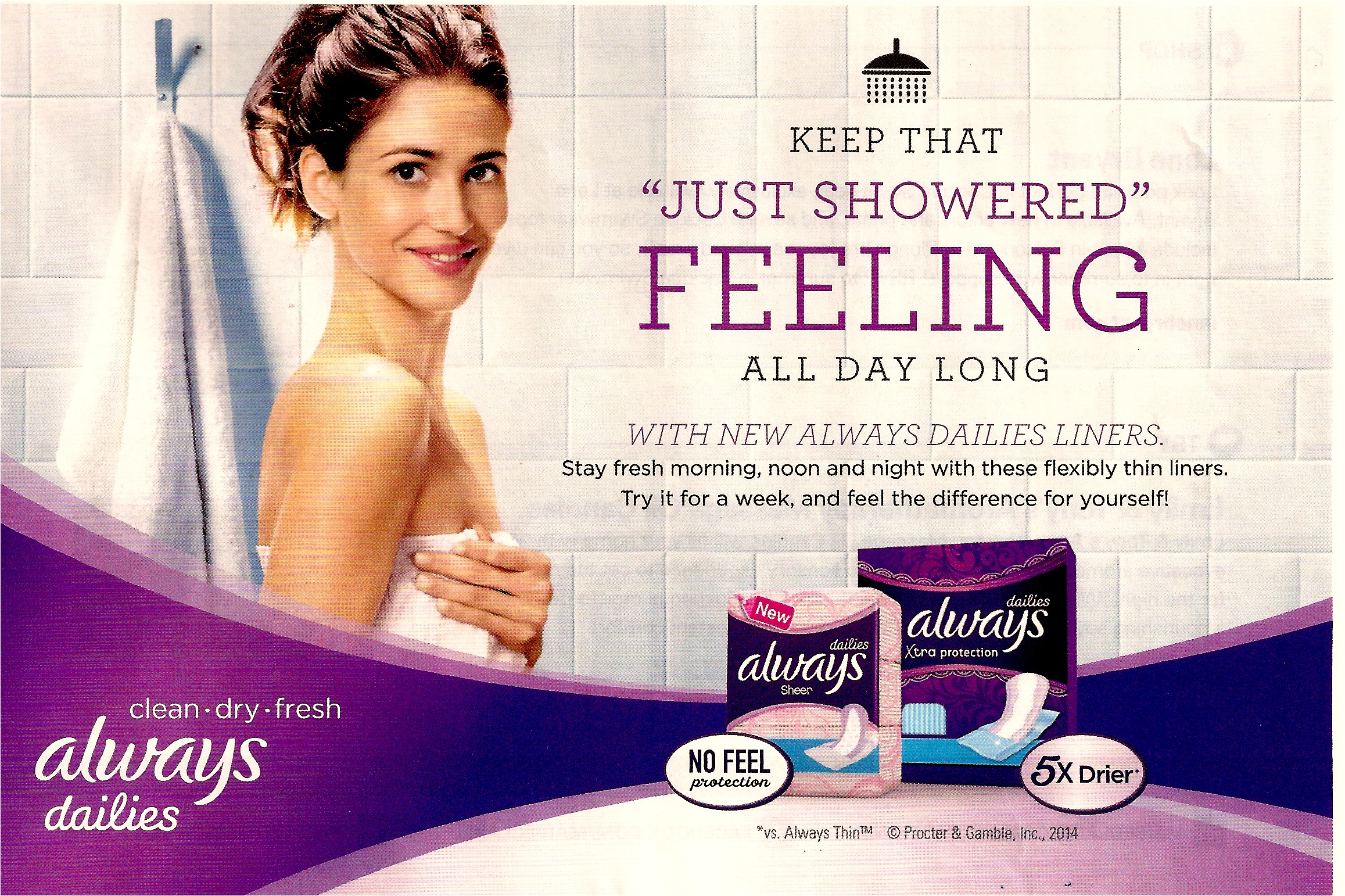
It’s not news that menstrual products are marketed with claims of how well they conceal menstruation. But usually from whom must it be concealed is implied, rather than made explicit. Not so in this new campaign for Whisper in southeast Asia. (Whisper maxi pads are known as Always in the U.S.)
This ad series does seem a little more explicit than those examples, with the men speaking directly to the camera, and the image of the woman wearing the Whisper pad sitting on the man’s shoulders. Can anyone provide a translation of what is being said? The ad is only partially in English.
The latest magazine ads for Always “Infinity” maxi pads remind me of this old joke:
Two young boys walk into a pharmacy one day, pick out a box of Tampax and proceed to the checkout counter.
The man at the counter asks the older boy, “Son, how old are you?”
“Eight,” the boy replies.
The man continues, “Do you know what these are used for?”
“Not exactly,” the boy says. “But they aren’t for me. They’re for him. He’s my brother. He’s four. We saw on TV that if you use these you would be able to swim and ride a bike. Right now he can’t do either one.”
So if I use Always, will I be able to be a contortionist like the acrobat in the picture? Because right now, I’m pretty sure I can’t do that.
This advert for Tampax appears in the February 2010 issue of Marie Claire, and probably other ladymags as well. It shows tennis star Serena Williams posing in a victory stance with clenched fist in the foreground, while security guards cart off Mother Nature, who is bearing a red-wrapped gift for Serena. The legend printed across the picture reads, “Serena shuts out Mother Nature’s monthly gift”.
As I said previously, I have some ambivalence about these ads. In today’s period-hating cultural climate, it takes some courage for a celebrity to appear in advertisement for a menstrual product. And it’s great to see acknowledgement that an athlete can win contests at any phase of her menstrual cycle (even the Boston Marathon).
But look closely at this ad, and read the copy. What’s missing?
That’s right – there’s no mention of blood or menstruation. The word period, itself a euphemism, isn’t even used. Only the flowery, secretive euphemism “Mother Nature’s monthly gift” represents menses.
And Mother Nature is reduced from the clever, wise-cracking Aunt Flo portrayed here to a kooky sitcom aunt reminiscent of Gladys Kravitz. Who wants to receive her gift?
We’ve mentioned Elizabeth Scharpf’s SHE (Sustainable Health Enterprises) at re:Cycling before. In 2009, Scharpf won the inaugural Harvard Business School Social Entrepreneurship Fellowship for her project helping local women in developing countries “jump-start their own businesses to manufacture and distribute affordable, quality, and eco-friendly sanitary pads.” This is a truly innovative program, combining microloans with the use of local raw materials (instead of imported materials) to ensure affordability and accessibility – quite different than Proctor & Gamble’s “Protecting Futures” campaign of a few years ago.
Scharpf is currently working in Rwanda, helping local women set up business making sanitary pads out of banana tree trunks. Using banana tree trunks – a part of the plant that is normally trashed – means more use is made of an existing cash crop while the expense of importing raw materials is eliminated.
A brief story about Scharpf and her work is featured in the February 2010 issue of Marie Claire magazine. I’m glad to see this project getting more publicity. (Story is not yet online, but you can view a PDF here.) The article is online here.
It’s common knowledge that international corporations use different slogans and sometimes different product names to sell the same items in different countries. Procter & Gamble’s femcare products provide many good illustrations of this; as we noted some time ago, the Always pad is known as Whisper in Asian markets. The same pad goes by the Always name in African nations, but P&G announced a new slogan for marketing the product in Nigeria: “Up to 8 hours, no check no stain“.
Explaining the slogan at the launch, at St. Mary’s Senior High School, Accra, Madam Patricia Obozuwa, Head of Corporate Communication and Brands Public Relations, said the “Always Care programme” offer superior feminine protection for eight hours, which eliminates the need for women to constantly check and change their pads during menstruation.
In the U.S., the giant Always maxi pads are advertised with the slogan, “Works Like Magic“.
I’m still mulling over what that indicates about how these corporate marketers view these two markets.
Looks like our friends at Always Infinity have ditched the skinny model,* but everything else in the ad is the same, right down to the copy about a disappearing act and the close-up shot of magic blue fluid.
That pad still looks disproportionately large to me: its width measures less than 1/2 inch (1.2 cm) the inside circumference of the hat!
*Or is she missing because this version of the ad appeared in Ebony magazine, and P&G found it cheaper to use half the image than to create a new ad with an African-American model?
Just when you think femcare ads can’t get any sillier . . . the new Always “Infinity” pad promises to “pull its own disappearing act”. Hmm . . . don’t we want pads to STAY where we PUT them?!
Oh, it’s the “fluid” that disappears. (That’s right, fluid. Not blood.) “It’s so amazing it makes fluid seem to POOF! disappear. Just like magic.”
That pad ought to be absorbent – it’s almost as large as an ironing board cover!
Seriously – something’s magic here. Maybe it’s PhotoShop, but that pad is almost as wide as her ribcage. It’s definitely bigger than her head. Do you suppose that P&G uses the same ad agency as Ralph Lauren?
Proctor and Gamble has just launched a new internet campaign in Singapore for their menstrual pads. The flash-heavy website tells why girls are Happy It’s Here :
Happy, confident, and loving life. You know what you want and where you want to go next. You feel wonderful about being a girl!
This is not a new product, but a new campaign for the pads known as “Always” in the U.S. Guess what they’re called in Asian markets.
Wait for it.
“Whisper“.
That’s right. P&G’s ad promotion “to instill a positive attitude in young Singaporean women about their menstrual periods, seeking to dispel some of the squeamishness toward the subject that persists in much of Asia” is for a product called Whisper, with all the connotations of menstrual silence that carries.
Apropos of Chris’ most recent post, the video of Serena Williams’ new ad for Tampax just popped up in my RSS feed. You can check it out at right.
I’m so torn on this. I’m pretty certain that this is the First. Time. Ever. that the word “blood” has been used in an ad for menstrual products. Do you know what a huge step forward for body acceptance and menstrual literacy that is? When I was growing up in the 1970s, pads were advertised by showing how well they absorbed BLUE fluid. (So were diapers, by the way.) Kotex was the first company to use the color red and the word “period” in ad campaign less than ten years ago. So there is a part of me that is delighted when Catherine Lloyd Burns, playing Mother Nature, smiles slyly and says, “Well, there is plenty of blood, but none of it’s bad”.
I also enjoy seeing a powerful woman say that she isn’t afraid of menstruation, and shown succeeding athletically while menstruating. Kinda reminds me of when Uta Pippig won the Boston Marathon while menstruating.
But the core message and most troubling element of this entire “Mother Nature” campaign is the idea that menstruation is the gift nobody wants. Can’t P&G (and Kotex, and every other femcare advertiser) just promote the damn products without promoting shame and body hatred? Women will buy menstrual products without being told that periods should make them feel “not so fresh”. In fact, the ads might be more compelling if they emphasized the absorbency of the product and treated menstruation as a fact of life, rather than a secret disaster. Just spare us the blue fluid, please.
6) I don’t know, but she will feel better in a week or less
5) Hormones
4) Women do that about every 28 days
3) Time for tampons
2)We gave up trying to figure that out a long time ago, but it will pass
1) PMS, of course.
I know I am not the only one exasperated with the easy dismissal of women’s anger as little more than PMS.
Sometimes (and I’d venture, MUCH of the time), an angry woman IS simply, well, an angry woman.
But WE (culturally-speaking), tend to immediately link women’s anger with PMS. This is lazy and effectively trivializes and silences women. While I don’t dispute that hormonal fluctuations can and often do explain the TIMING and/or SEVERITY of a woman’s emotional expression, I argue that is it important, no IMPERATIVE, that we resist the temptation to immediately attribute a woman’s rage to the biological. Continue reading...
Kristof picked up on the does-menstruation-keep-girls-out-of-school buzz that researchers and on-the-ground development workers have been asking for some time. This is the same link that opportunistic P&G picked up in 2007 with the launch of their cause marketing campaign “Protecting Futures.” The campaign involved Always-brand pad distribution, school bathroom construction and health education, yet, as far I can tell, “Protecting Futures” has ended with a whimper…I can’t find a thing about it on the web, save dated references.
Maybe the campaign has slipped into obscurity because the girls lack commercial products–girls miss school causal connection is being weakened by research like the study cited by Kristof.
Researchers Emily Oster and Rebecca Thorton supplied girls with menstrual cups (note: not single use pads) and measured whether their use of cups had an effect on school attendance and grades. Nope, they found, makes no difference; the girls with and without cups missed about the same number of days and performed about the same in school.
I have been infected by this viral video and I think I feel a little sick.
I cannot deny that advertising giant Leo Burnett’s campaign for client Procter & Gamble isn’t darn clever and at times touching (for those who aren’t yet convinced that “Zack at 16″ is advertising, see the list of P&G wins at this year’s Cannes Lions ADVERTISING festival–or take a look at the insultingly transparent product plugs peppering the comments).
But unlike others who may find this particular sex switcheroo a fabulous vehicle for generating sensitivity to girls and women and their periods, I find it, well, the same- old -same -old —capitulating to gender stereotypes to move product.
And this time, there’s the added twist of the (albeit, likely unintentional) trivialization of very real people whose bodies don’t align with their gender identity. You know, some people really DO have to sneak into that “other” bathroom to do their business. Some people ARE forced to keep the realities of their genitalia private or risk unwelcome medical intervention, ridicule or worse. Continue reading...
Readers should note that statements published in re: Cycling are those of individual authors and do not necessarily reflect the positions of the Society as a whole.