Blog of the Society for Menstrual Cycle Research

Searching for Menopause Blogs

January 6th, 2012 by Heather Dillaway

Lately re:Cycling has featured several posts on menopause, and I have begun to think about the other menopause blogs that might be out there. Turns out there are plenty – maybe not as many blogs as there are about reproductive experiences like pregnancy or childbirth but still a lot. There are even blogs that compile info on menopause blogs such as Menopause the Blog.

Blog Series 13 by Richard Smith // CC BY-NC 2.0

If you start searching for these blogs it becomes clear that many talk about hot flashes as a major sign or symptom of menopause (or perimenopause), and offer either strictly biomedical or more natural/alternative remedies for signs or symptoms (e.g., Menopause Symptom Report or I Hate Menopause). Other blogs are written primarily for their comedic value (e.g., Menopause Maniac), support value (e.g., Menopause Goddess Blog), or purely informational value (e.g., Menopause the Blog). (Menopause the Blog does a good job of summarizing some of the major blogs out there, just FYI for those who are interested.)

Many of these menopause blogs conflate the menopause transition with midlife in general (you only have to read a few blog entries to know that women talk as much about the bad and good of midlife as a life stage as they talk about menopause) but some are very specific to menopause. I find it very interesting that there can be so many different kinds of menopause blogs. I also find it interesting that so many of these menopause blogs seem to be trying to work out what midlife as a life stage means as well, which resonates with Paula Derry’s earlier post this week about how little we know about women’s midlife in general.

Perhaps what interests me the most, however, is that all of these menopause blogs seem to be either aligning with or struggling against very negative definitions of menopause. Based on my quick perusal, no blog seems to have moved past or risen above the constant negotiation of biomedical definitions. Even if bloggers are writing about how happy they are at menopause or how much they’ve learned about themselves at this life stage, blog entries still seem to be written in response to negative definitions (or at the very least, in response to the ghosts of negative definitions that still hang around menopause even when it is defined more positively).

To me this means that researchers Antonia Lyons and Christine Griffin are correct in proposing that there is only one “master narrative” of menopause and that women, doctors, women’s partners and children, medical institutions, workplaces, strangers, women’s friends, etc., have no choice but to deal with this master narrative in some way.  This also means that Abbey Hyde and her co-authors are correct in asserting that even when women aren’t using biomedical definitions to describe their menopause transition, these definitions still shape women’s perceptions of their experiences.

So, my question is, have others read these menopause blogs? And if so, does anyone have a different take on these blogs? Perhaps I’m being too harsh and using a very specific lens to look at these varied blogs. But perhaps not. What then? If you agree with me, is this what blogs are ultimately supposed to be in the end – a response (be it direct or indirect, conscious or unconscious) to the master narratives in our lives?


Post to Twitter Post to Plurk Post to Yahoo Buzz Post to Delicious Post to Digg Post to Facebook Post to MySpace Post to Reddit Post to StumbleUpon

Feeling Uncertainty, Confusion, and Frustration about Menopause

November 10th, 2011 by Heather Dillaway

Last Friday I attended a conference on autoethnography and was privileged enough to listen to Carolyn Ellis give the keynote speech on this new and upcoming qualitative methodology.  Sitting there and listening to Ellis talk about the need for all of us to be reflexive and put ourselves into our research projects, I realized that I probably do need to acknowledge my own feelings of uncertainty and frustration as I study menopause and midlife. Therefore, this blog entry is for you, Carolyn Ellis, as I am inspired by you to be better from now on about acknowledging the connections between me and my work and trying to understand myself as a research instrument as I seek to understand menopause and midlife better.

The reasons I really started studying menopause are the very reasons why I’m still studying it but also frustrated by it. In the mid to late 1990s, my experiences as a birth control counselor at Planned Parenthood in Delaware and Michigan led me to realize that plenty of middle-aged women don’t understand what’s happening to them when they start to have irregular periods in perimenopause. I also watched my mother begin perimenopause in the mid 1990s and be confused and embarrassed to talk about the experience when she had always been the first one who always wanted to talk about pregnancy, childbirth, breastfeeding, and birth control (“What was so confusing about menopause?,” I thought).  I’ve now formally studied and written about women’s thoughts and experiences of menopause since 1999. All along, the terminology and definitions of menopause have been as problematic for me as for the women I’ve studied. I’ve listened to menopausal women who tell me that they are completely confused about biomedical terminology for their life stage and completely baffled about what they’re going through.  I’ve heard them talk about how doctors and other women they talk to are just as confused as they are. What is this thing they’re going through? I’ve talked to other feminist social scientists and humanities scholars who think we should call menopause “reproductive aging” or “the menopause transition” to signify that variation over time is really the only guaranteed experience at this time of life. Endocrinologists and biologists turn around and tell me that the term “reproductive aging” is faulty because all that term signifies is that we are all maturing from birth on – that it is an empty term signifying nothing. I listen to endocrinologists, epidemiologists, public health educators, women’s health advocates, menstrual activist researchers, biologists, and clinical/biomedical researchers who are all ready with their own take on what terminology and definition is “best” for describing this time of life. Some argue that there is a strict three-phase model of perimenopause, menopause, and postmenopause that we should follow. Some argue for a five or even seven stage model for “menopause,” parsing out pre, post, early and late stages of the menstrual life course (such as early and late  premenopause, early and late perimenopause, menopause, early and late postmenopause, etc.). Some argue that perimenopause is really the only “stage” of “menopause” or late reproductive life that women really want to know about because that is when all the (negative) symptoms come. I hear others argue that “menopause” and “postmenopause” are the same thing, or are that these are conflated terms that mean nothing, and that both of these terms should be scrapped. (Yet then I hear individual women I interview tell me that postmenopause is as frustrating as perimenopause.) I hear other researchers say that EVERY term associated with menopause or reproductive aging is faulty. If I listen to individual menopausal women, they tell me the same. Two months ago, I did a presentation on midlife in general, and a feminist humanities scholar (whom I respect quite a bit) told me I shouldn’t be using the term “midlife” at all, because it is a non-term itself, defined by nothing. If I think about all of the terms I associate with menopause – menopause, the climacteric, the change, the change of life, perimenopause, postmenopause, the late reproductive years, the menopause transition, women’s midlife transition, reproductive aging, etc. – I don’t even know what terms I should be using. Over time I have thought that the best case scenario is just to use the term that women themselves use (therefore I used the word “menopause” a lot to describe a whole transition, or adopted the term “reproductive aging” when urged by feminist scholars to do so in order to define a broader transition). But, now, I’ve been critiqued recently for not correcting individual women when they use the “wrong” term to describe what they’re going through.

Menstruation Gets Blamed for Everything!

November 8th, 2011 by David Linton

© Bettman/CORBIS, Creative Commons 2.0

In Gore Vidal’s 2006 memoir, Point to Point Navigation, he name drops his way through more than four decades of a very interesting life with great stories about the famous and notorious folks who crossed his path. One tale is related by his stepmother, Kit, about her former husband and Gore Vidal’s father, Gene Vidal, and his relationship with the pioneering woman pilot, Amelia Earhart, with whom he apparently had a long-running affair. Gene Vidal was also a pilot as well as an innovative businessman involved in many aspects of what was then called air commerce.

According to Kit, her husband had a theory about the accident over the Pacific that killed Earhart. He believed that she had deliberately crashed the plane: “’She was going through a bad time with G.P. [George Palmer Putnam, her publisher husband]; she was also undergoing some sort of premature menopause.’”

Whew! It seems that no matter where you turn, if a woman is having a bad day, the menstrual explanation will be trotted out. But suicide by plane crash as a response to perimenopause?!?! Now, there’s a flight of fancy.

Post to Twitter Post to Plurk Post to Yahoo Buzz Post to Delicious Post to Digg Post to Facebook Post to MySpace Post to Reddit Post to StumbleUpon

Some Online Articles on Menopause ARE Worth Reading!

October 13th, 2011 by Heather Dillaway

I get Google Alerts on “menopause” every Wednesday because it’s important that I know about the new bits of information popping up about the topic I research most. Most of the time, though, I’m frustrated with the discussion of menopause online and don’t pay attention much to the alerts I get. Yet, amidst the endless biomedical debates about whether soy or other supplements and alternative therapies reduce hot flashes, whether hormone therapies (HT) are risky, and whether or not a male menopause exists, there ARE a few important things to notice in the online menopause world. For instance, a short article called “True or False: Test your menopause smarts” at SunHerald.com (a news sources for the “Biloxi-Gulfport and South Mississippi” region) represents what I see as a fairly positive contribution to the online readings on women’s health and, more specifically, menopause. For instance, in reviewing menopause the author proposes that:

1.       There ARE variations in women’s experiences, and that these variations are normal!

2.      Too often we see menopause as primarily negative, when there are positive things about menopause. Or, at the very least, women might be likely to feel indifferent about menopause.

3.      The menopause transition (perimenopause) can be a long-term process, and the author acknowledges that it could last as long as a decade or more. Women probably need to know this from the start!

4.      Hot flashes are normal despite being frustrating, and that it is likely that you might experience them.

5.      Women might not feel one particular way about sex during menopause – and no matter whether you feel good or bad about sex during menopause it’s probably okay (unless you personally would like it to be different, in which case there are probably things you can do to change your situation).

6.      The U.S. does not represent the best model for how to go through menopause (at least this is what the author infers). In fact, women in other countries may fair much better as they go through menopause, for a variety of reasons that the author does not get into.

7.      Recent breakthroughs in medical science might make women who are worried about having children get a blood test to see how long they have until perimenopause sets in (see my earlier blog post about this blood test last year!). The way in which the author wrote up this part of their article suggests to me that they can see the pros and cons of this blood test, which I like.

Many of my blog posts represent a critique of information out there for menopausal women, but I thought it might be nice to highlight a positive contribution to the online literature on women’s health. Despite my minor critiques of this article (e.g., the word “suffer” appears frequently, and there is a huge focus on sex over other topics, etc.), I think women should read this article. Which leads me to my main point in writing this blog post: there ARE some good things out there about menopause. Anyone else find a good example of positive health information lately?  :-)

Post to Twitter Post to Plurk Post to Yahoo Buzz Post to Delicious Post to Digg Post to Facebook Post to MySpace Post to Reddit Post to StumbleUpon

The Great Perimenopause Cover-Up

April 19th, 2010 by Elizabeth Kissling

Guest Post by Jerilynn C. Prior, Centre for Menstrual Cycle and Ovulation Research

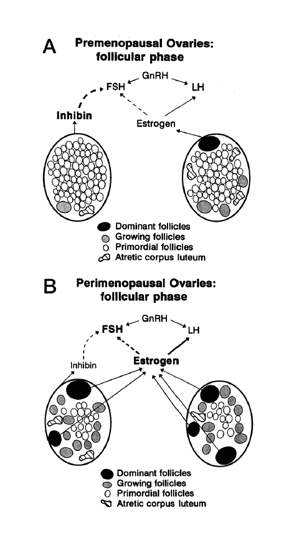
I just read “The Estrogen Dilemma” in Sunday’s New York Times Magazine,  and I feel like weeping—in sorrow and deep sadness. This article by Cynthia Gorney is about energetic, intelligent women who feel they must take estrogen in order to survive perimenopause yet have deep worries about its risks. I know personally the anguishing changes that erupt during perimenopause. “The Estrogen Dilemma” also evoked my frustration and even rage. It is wrong that symptomatic women in the midst of the long and stormy midlife transition have to face a conundrum—to take estrogen or not. It arises from a Nixonian-style cover-up of three proven and important-for-women truths: 1)    Perimenopause causes higher and not lower estrogen levels. (By perimenopause I mean the transition from fertile menstrual cycles to menopause, or the life phase beginning one year beyond the final menstrual flow.) 2)    Progesterone, estrogen’s essential partner hormone, in contrast to estrogen, truly is lower in perimenopause. 3)    Women survive perimenopause and “graduate” into a less symptomatic menopause.

Are estrogen levels low in perimenopause? No. Taking all perimenopausal women together (a meta-analysis of published levels comparing within-center young with perimenopausal women) estrogen levels are 26 percent higher (1). For symptomatic perimenopausal women like Cynthia Gormley and myself, estrogen swings to Everest-like peaks and may intermittently be a 1000-fold greater. Perimenopause, for some of us, is estrogen’s storm season (2).

Despite that, ever since estrogen was first discovered in 1926, anything ailing women has been deemed “estrogen deficiency.” And often inappropriately so treated. Thus, estrogen levels must be dropping and low in perimenopause when women become symptomatic—it makes sense because we know that perimenopausal women are running out of their store of ovarian follicles that, after all, make estrogen. That perimenopause-dropping-estrogen idea fits with the fact that perimenopausal women begin to have night sweats. But it doesn’t fit with the reality that night sweats begin while women are still having regular menstrual cycles (3) and thus still have adequate estrogen levels (but the misunderstanding of what causes hot flushes is yet another story).

The evidence that perimenopausal estrogen levels are higher than in the sexiest 20-something is strong and consistent (1;4-9). Why are media articles, consensus documents and authorized definitions still talking about dropping estrogen levels? A cover-up. The first clear evidence for higher estrogen was published from a Melbourne epidemiology study in 1995 (10). The back-story here is telling—the authors measured estrogen levels that were variable but at least a quarter of them were much higher than expected. However, their interpretation was that estrogen levels were dropping. That’s because levels in the 45-55 year old women with regular cycles (whom they wrongly called premenopausal) were higher than in those who’d been without flow for three to 12 months (10). That illustrates the power of what I call “the estrogen myth.” I, who at the time was suffering with puzzling sore breasts, heavy but regular flow and mood swings, was ecstatic to see data that explained my experiences. However, I was horrified at the erroneous interpretation—my colleagues and I wrote an impassioned letter to the editor demanding that the authors “let the data speak” (11).

Now to the second cover-up—lower perimenopausal progesterone. If this were a world where women’s health was guided by science rather than by power-over-women, we would all know that perimenopause, besides being a time of higher estrogen, is a life phase in which progesterone is too low. You ask, “Why are lower progesterone levels important? I thought it causes PMS and breast cancer.” This ignoring or blaming of progesterone is the second major cover-up, and not just for 15 years, but since estrogen’s discovery in the 1920s. Framing women’s reproduction only in terms of estrogen creates the postulate that “Estrogen’s what makes a girl, a girl.” The estrogen myth further asserts that estrogen is the female hormone, much as testosterone is the only important male hormone.

Time and Time Again

April 18th, 2010 by Elizabeth Kissling

Guest Post by Paula S. Derry, Ph.D.

Déjà vu

An article in today’s New York Times Magazine recounts the author’s experience with a debilitating depression that began during her perimenopause, the transitional time leading up to menopause.   For her, prescription estrogen was a life-saver that alleviated her symptoms.  The article places her experience in the context of research on the Timing Hypothesis, an idea that arose after the Women’s Health Initiative, or WHI, research project.  WHI clinical trials documented that hormone supplements after menopause did not, as had previously been assumed, lower a woman’s risk of heart disease.  Heart disease risk was not lower, and, in fact, when a number of chronic illnesses were considered together, the medication did more harm than good overall.  The Timing Hypothesis is the idea that the WHI was fundamentally flawed, because hormones must be started right around the time of menopause to have a health-promoting effect and the subjects in WHI were on average over 60; if started when a woman is older, when chronic illnesses have already started, the hormones are actually harmful rather than helpful.  The Sunday New York Times article presents this idea uncritically, without quoting any of the many experts who do not find it plausible or convincing, and, in addition, presents a lurid, unscientific  description of perimenopausal hormonal dynamics with words like “ricocheting hormones” and an “upheaval” that causes a “hellacious strain” on the brain. The author suggests that WHI was  a poorly planned study that asked the wrong questions with the wrong methodology.  The Timing Hypothesis, if true, might lead to a cure for Alzheimers and have other important health repercussions.


Time for a reality check.

Let’s go back in time to before the WHI research. Beginning in the 1980s, professionals asserted that hormone therapies were safe and effective to prevent chronic illnesses, especially heart disease, in postmenopausal women.   This idea was aggressively promoted, and it was not limited to women around the time of menopause.  Clinical trials are required to prove that a new medication is safe and effective before the Food and Drug Administration will approve that medication. However, once approved and available on the market, it is okay for doctors to use their judgment and prescribe the drug for whatever use they believe is reasonable.  Many of the claims for estrogen were for this kind of off-label use because there was no clinical trial proof that estrogens reduced heart disease, made women “feel better,” or improved their lives in many other ways being claimed.  However, other kinds of evidence made it seem plausible. There were “biologically plausible” mechanisms–this means that because of things we know about the body–like the fact that there are estrogen receptors in the brain–it is plausible, we can hypothesize a way that  estrogen would have a certain health effect.  There were the personal experiences of women. There was the idea that menopause was intrinsically unhealthy and that women were not meant to “outlive their ovaries.” Using estrogens was compared by some to using vitamin supplements or to a diabetic using insulin. There was a strong conviction among certain enthusiastic scientists and practitioners, some of them highly respected individuals, that it was all so. Professional groups of various sorts frequently issue opinions about medications; here, many groups offered the opinion that all women be offered hormone treatment.  Physicians were encouraged to prescribe hormones for disease prevention because it was so certain that it would help their patients, rather than waiting for the slow process of clinical trials to take place. Wyeth, a pharmaceutical company,  asked the FDA to approve estrogen for heart disease prevention even without clinical trials.

Readers should note that statements published in re: Cycling are those of individual authors and do not necessarily reflect the positions of the Society as a whole.