Blog of the Society for Menstrual Cycle Research

Midlife Muddle — Own the Power of Naming

May 17th, 2012 by Elizabeth Kissling

Guest Post by Jerilynn Prior, M.D. — Centre for Menstrual Cycle and Ovulation Research

By “midlife muddle” I don’t mean the trouble concentrating or remembering names that sometimes occurs for all of us (but more frequently if we’ve wakened with night sweats and not gotten back to sleep). I mean the condoned and official confusion about naming of women’s reproductive aging. Let me show you why I am upset.


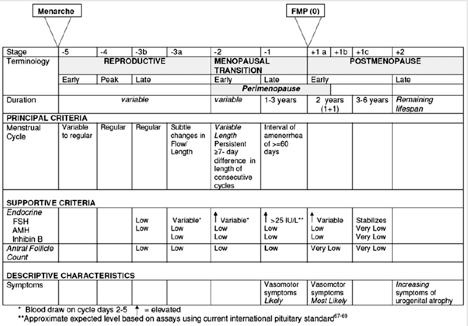
STRAW+10 staging system for reproductive aging in women

Stages of Reproductive Aging Workshop (STRAW) held a 10-year anniversary last summer. (As someone frustrated by not being “heard” at the original conference, I still think that the “W” in STRAW should stand for Women!) Despite that, STRAW+10 has made progress because at least some of the classification is now supported by population-based prospective data rather than based on what experts believe. The names that are now politically correct are summarized in the STRAW+10 Executive Summary1 and the diagram1 at right.


We in the Society for Menstrual Cycle Research have also had our say about nomenclature: “Naming Women’s Midlife Reproductive Transition”.  I wrote this (with revision and refinement by collective effort of SMCR members) because women keep getting left out of this naming business. For example:

  • a regularly menstruating woman with night sweats, heavy flow, and increased cramps could learn to call herself perimenopausal2 (not STRAW+10 Late Reproductive Phase -3b?!).
  • a woman who just finished her period can say, I’m in late perimenopause and have at least a year without further flow before I’ll be menopausal. Based on STRAW+10 she could be told that specific menstruation was her final menstrual period (nickname “FMP”) and the next day, according to STRAW+10 be told that she is now “postmenopausal”!!
  • a woman with sore breasts, irregular periods, and heavy flow could say, I’m in perimenopause. However, she may instead be told she is in the “Early Menopausal Transition.” Because she has heavy flow she is also likely to be prescribed the birth control pill (as is currently and commonly recommended). Usually she will not be told that The Pill will make her perimenopausal irregular flow worse—she may well start spotting in the middle of her cycle.3

This new and improved STRAW+10 still centers all of women’s reproduction on that mythical FMP. But to call the FMP “menopause”, as many women’s health experts do, is just unscientific. It takes at least a year without another menstruation in those of us over age 45 before nine out of ten of us will not get another period4. But one (out of ten) of us will get a further, normal period even though we’ve been that whole year without any4. We can tell that new flow is normal (in other words, does not need investigation for endometrial cancer) if we had cramps or bloating or sore breasts or moodiness—or all of these—that told us our period was coming.


So our new Naming position statement says don’t call it “menopause” until you’ve not had a period for a year. And do call it “perimenopause” if things are variable and changing even if you are still having regular flow2.  Three of nine changes can confirm for you that you are perimenopausal even if your flow is still regular:2

  1. Shorter cycles (25 days or less);
  2. Increased cramps;
  3. Heavier flow;
  4. Increased trouble sleeping—especially waking up in the middle of sleep;
  5. New or increased migraine headaches;
  6. Night sweats—especially if they tend to occur before or during flow;
  7. An increase in or new premenstrual mood swings;
  8. New sore, enlarging or nodular breasts; and
  9. Weight gain without changes in what you eat or the exercise you do.

If women can learn to call themselves perimenopausal, they will be saying they know that perimenopause is not the same as menopause—perimenopause is a midlife transition with higher and erratic estrogen levels. Menopause is a fairly stable life phase with normally low estrogen and progesterone levels that begins one year after their last menstrual flow.


Furthermore, by naming themselves accurately they will be able to tell whether a medication that is proposed for them has been tested and proven effective in perimenopausal women. Usually symptomatic women are treated with oral contraceptives (that are proven reasonably safe and useful for premenopausal contraception), or offered hormone therapy that has only been tested and shown effective for hot flushes/flashes in menopausal women.


So. . . I like the word, perimenopause and think if women understand and own it they will be on their way out of a midlife muddle.


References

  1. Harlow, S. Executive Summary of the Stages of Reproductive Aging Workshop +10: addressing the unfinished agenda of staging reproductive aging [pdf]. Fertility Sterility, 2012   doi: 10.1016/j.fertnstert.20012.01.128
  2. Prior JC. Clearing confusion about perimenopause. BC Med J 2005; 47(10):534-538.
  3. Casper RF, Dodin S, Reid RL, Study Investigators. The effect of 20 ug ethinyl estradiol/1 mg norethindrone acetate (MinestrinTM), a low-dose oral contraceptive, on vaginal bleeding patterns, hot flashes, and quality of life in symptomatic perimenopausal women. Menopause 1997; 4:139-147.
  4. Wallace RB, Sherman BM, Bean JA, Treloar AE, Schlabaugh L. Probability of menopause with increasing duration of amenorrhea in middle-aged women. Am J Obstet Gynecol 1979; 135(8):1021-1024.

Post to Twitter Post to Plurk Post to Yahoo Buzz Post to Delicious Post to Digg Post to Facebook Post to MySpace Post to Reddit Post to StumbleUpon

Searching for Menopause Blogs

January 6th, 2012 by Heather Dillaway

Lately re:Cycling has featured several posts on menopause, and I have begun to think about the other menopause blogs that might be out there. Turns out there are plenty – maybe not as many blogs as there are about reproductive experiences like pregnancy or childbirth but still a lot. There are even blogs that compile info on menopause blogs such as Menopause the Blog.

Blog Series 13 by Richard Smith // CC BY-NC 2.0

If you start searching for these blogs it becomes clear that many talk about hot flashes as a major sign or symptom of menopause (or perimenopause), and offer either strictly biomedical or more natural/alternative remedies for signs or symptoms (e.g., Menopause Symptom Report or I Hate Menopause). Other blogs are written primarily for their comedic value (e.g., Menopause Maniac), support value (e.g., Menopause Goddess Blog), or purely informational value (e.g., Menopause the Blog). (Menopause the Blog does a good job of summarizing some of the major blogs out there, just FYI for those who are interested.)

Many of these menopause blogs conflate the menopause transition with midlife in general (you only have to read a few blog entries to know that women talk as much about the bad and good of midlife as a life stage as they talk about menopause) but some are very specific to menopause. I find it very interesting that there can be so many different kinds of menopause blogs. I also find it interesting that so many of these menopause blogs seem to be trying to work out what midlife as a life stage means as well, which resonates with Paula Derry’s earlier post this week about how little we know about women’s midlife in general.

Perhaps what interests me the most, however, is that all of these menopause blogs seem to be either aligning with or struggling against very negative definitions of menopause. Based on my quick perusal, no blog seems to have moved past or risen above the constant negotiation of biomedical definitions. Even if bloggers are writing about how happy they are at menopause or how much they’ve learned about themselves at this life stage, blog entries still seem to be written in response to negative definitions (or at the very least, in response to the ghosts of negative definitions that still hang around menopause even when it is defined more positively).

To me this means that researchers Antonia Lyons and Christine Griffin are correct in proposing that there is only one “master narrative” of menopause and that women, doctors, women’s partners and children, medical institutions, workplaces, strangers, women’s friends, etc., have no choice but to deal with this master narrative in some way.  This also means that Abbey Hyde and her co-authors are correct in asserting that even when women aren’t using biomedical definitions to describe their menopause transition, these definitions still shape women’s perceptions of their experiences.

So, my question is, have others read these menopause blogs? And if so, does anyone have a different take on these blogs? Perhaps I’m being too harsh and using a very specific lens to look at these varied blogs. But perhaps not. What then? If you agree with me, is this what blogs are ultimately supposed to be in the end – a response (be it direct or indirect, conscious or unconscious) to the master narratives in our lives?


Post to Twitter Post to Plurk Post to Yahoo Buzz Post to Delicious Post to Digg Post to Facebook Post to MySpace Post to Reddit Post to StumbleUpon

The ‘Change of Life’ is More than Biology

July 7th, 2010 by Elizabeth Kissling
Photo by Ed Yourdon | CC 2.0

Photo by Ed Yourdon | CC 2.0

I hope my colleague Heather Dillaway feels at least at little vindicated when she reads this: A new study in the Journal of Health Psychology reports that social and psychological factors have the biggest influence upon women´s sexual behavior during menopause, rather than biological changes such as declining hormone levels. While most published research on menopause–especially about sex and sexuality with respect to menopause–is conducted within a biomedical framework, Sharron Hinchliff, Merryn Gott, and Christine Ingleton talked to women about their experiences. (Radical!)

They found that almost all of the women in their study had experienced changes in their sex lives, but they attributed these changes to external factors, such as caring for ill or elderly relatives, low sexual desire from their partners, issues of relationship quality, as well as to perceived changes in levels of hormones. (I appreciate the researchers’ qualifier of perceived changes, as most women never have their hormone levels measured.)

The researchers concluded that women go through many lifestyle changes at mid-life, only some of which are biological. Psychological and social factors, as well as the increasing medicalization of menopause, affect their sexuality just as powerfully.

Somehow, this study isn’t getting anywhere near the publicity of the ‘new blood test for menopause’ study received last week.


Post to Twitter Post to Plurk Post to Yahoo Buzz Post to Delicious Post to Digg Post to Facebook Post to MySpace Post to Reddit Post to StumbleUpon

Readers should note that statements published in re: Cycling are those of individual authors and do not necessarily reflect the positions of the Society as a whole.