Blog of the Society for Menstrual Cycle Research

Things We Don’t Talk About: Healing Narratives from the Red Tent

March 19th, 2012 by Chris Bobel

What would the world be like if young women were mentored by older women?

What would the world be like if we knew we had a place for our stories to be told?

So intones the voiceover at the start of the trailer of a forthcoming film.

And it is right on time.

The recent media attention paid to Tomi- Ann Roberts and Nikki Dunnavant’s research recent re: religious identification and menstrual traditions has got me thinking (more than usual) about women, bonding and menses. Roberts and Dunnavant’s religious women harbored more negative attitudes toward their periods than their secular counterparts, but they reported a sense of woman-to-woman connection during their menstruation that non-religious women did not.

So how do we create community and lose the shame?

Red tents anyone?

“Things We Don’t Talk About: Healing Narratives from the Red Tent” explores the increasing reach of the “Red Tent Temple Movement” seeded by women’s empowerment facilitator Alisa Starkweather and inspired by Anita Diamant’s 1997 bestselling novel The Red Tent – a rich fictionalized treatment of biblical character Dinah. In the novel, Dinah and her tribeswomen gather during their menses in a sacred women-only space.

The practice in a book became a movement.

Starkweather and others in more than 50 red tents across the nation and beyond (in 30 states and 6 countries) believe that the simple practice of gathering women and girls in a space dedicated ONLY to them (whatever their date on the menstrual calendar) is precisely what women and girls need to feel supported and nurtured. This is the stuff of healing, they say.

Red tents are an initiative within what I call the ‘feminist spiritualist’ wing of the menstrual activist movement — a loose collection of activists who emerged in the 1970s and share an earnest celebration of embodied womanhood. This style of activism, I’ve argued, has endured and innovated for more than 4 decades, but remains on the fringe of feminist movements as a mostly white middle class concern.  Liedenfrost’s film, however, may nudge an expansion of the movement (or perhaps, show that it is already slowly capturing a diverse following?). A commitment to inclusion rings through the voices of the women captured in “Things We Don’t Talk About….” Red tents, as one woman explains during the trailer, are safe, welcoming and invite each woman to “come as you are and who you are is enough.”

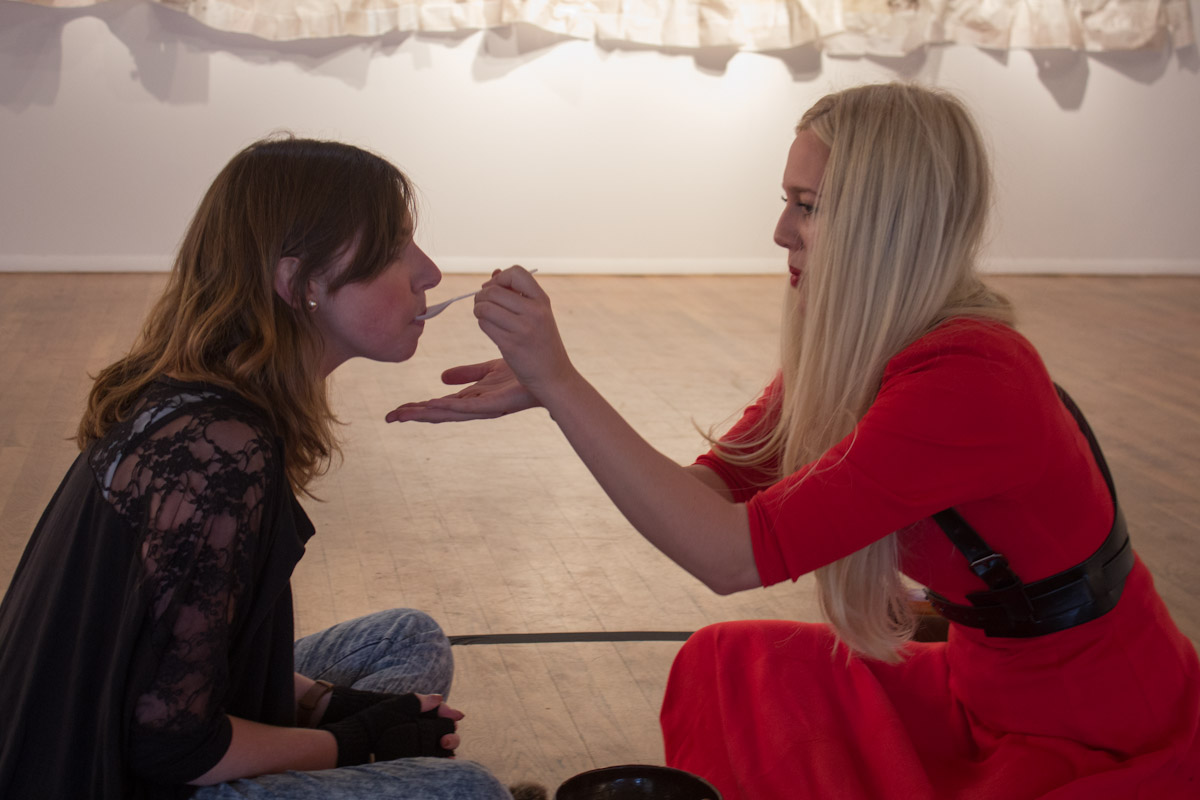
Filmmaker Isadora Gabrielle Liedenfrost, a seasoned filmmaker specializing in “multicultural motifs and embedded cultures and spiritual traditions” presents a rich palette of reds, auburns, and fuchsias and a haunting soundtrack in this piece. Her camera brings us images of small and large groups of women crying, laughing, dancing and hugging together woven with the heartfelt stories of the empowering benefits of women-in-community.

Photo credit: Isadora Gabrielle Liedenfrost (used with permission)


I am left asking: could red tents offer women—whatever their spiritual inclination—a shame-free community? Could they restore a lost tradition now updated in a contemporary body-positive context? Surely, the feminine intimacy offered here is not for every woman, but for many, it might feel like home is a lovely little tent.

Post to Twitter Post to Plurk Post to Yahoo Buzz Post to Delicious Post to Digg Post to Facebook Post to MySpace Post to Reddit Post to StumbleUpon

Tell me again, why can’t we talk about body stuff?

March 15th, 2012 by Alexandra Jacoby

Tell me again, why can’t we talk about body stuff?

Your body is your home.

It’s your medium of self-expression — your voice spoken and written, your hands gesturing, making things, touching someone, legs walking toward, running away from, hips dancing, butt sitting, with arms folded — are you bored, annoyed, worried, satisfied?

Your body is your receiver and interpreter of the world around you and the people in it with you.

It’s integral to your life.

How can it be weird, embarrassing, inappropriate, [tactless?] to talk about your bodylife?

What happens inside your body is literally defining your experience of the outside world, and of yourself, and your possibilities.

You can’t feel your blood moving, hair growing, cells changing…

…Some things you can feel as they happen inside you, and with those experiences, you interact directly.

Our bodies aren’t sealed containers. They are living— we are living beings.

Nutrition, hydration, elimination of waste, sweating, breathing, menstruating — these things happen in our bodies and outside them.

We make choices about our behavior, buy supplies, clothing, fixtures — we are involved in the care and maintenance associated with these aspects of our body lives.

Why wouldn’t you talk about it?

Why wouldn’t you be interested in ways to improve your experience, or someone else’s?

Why would it be unusual or unacceptable to share your experience, to ask questions, to get advice? (out loud, anywhere) — like you would when it came to any other aspect of your life.

Why wouldn’t it be normal to be interested in the quality of your body-life?

What exactly is more important than that?


Post to Twitter Post to Plurk Post to Yahoo Buzz Post to Delicious Post to Digg Post to Facebook Post to MySpace Post to Reddit Post to StumbleUpon

Menstrual Bonding, Birth Control Brouhaha, and other Weekend Links

March 10th, 2012 by Laura Wershler

Research by SMCR members Tomi-Ann Roberts and Nicki Dunnavan garnered a lot of attention this week. Stories showed up at Live Science – Why Why Women Should Bring Their Periods ‘Out of the Closet, popular ladyblog Jezebel – Your Period Is a Time for Deep Lady-Bonding, and the Daily Mail - Women, start talking about it. Period! Roberts and Dunnavan surveyed 340 religious and non-religious women about their experiences and attitudes about menstruation. As the Daily Mail reported: ”U.S. researchers say women across the world need to be more positive about menstruation – and that means talking about it in public.”

Credit: MK Carroll

There’s been lots of public discussion about contraception, some might say too much!  The birth control/medical insurance coverage brouhaha hit a boiling point last week with Rush Limbaugh’s egregious comments about Sandra Fluke, and the heated debate rages still. Maureen J Andrade at OpenSalon writes that Birth Control Is Not a Women’s Issue: It’s a Human Right, while Asma T. Uddin and Ashley McGuire, blogging at the Washington Post, insist It’s about religious liberty, not birth control.  A group of crafters has come up with a  unique protest action: sending “interfering” male government members a knitted or crocheted uterus, vagina or cervix, while feministing.com has invited readers to Talk About Birth Control For REAL.

Back to women’s experience of menstruation,  Enith Morillo in Menses’ non-sense: Menstruation and the Muslim Woman’s “Red Tent” and Carolyn West in Menstruation – Celebration or Taboo?, explore different cultural menstrual traditions.

Post to Twitter Post to Plurk Post to Yahoo Buzz Post to Delicious Post to Digg Post to Facebook Post to MySpace Post to Reddit Post to StumbleUpon

Coming Off The Pill: A Mind Map Guide

March 7th, 2012 by Laura Wershler

Everybody can use a good map to help them get to where they’re going. Why not women heading to the land of non-hormonal contraception?

In my post on January 11, 2012 I asked if coming off the pill was a growing trend. I proposed to write a series of posts about the issues associated with the decision to stop using hormonal birth control.  For the purposes of this discussion assume that “coming off the pill” refers to quitting any method of hormonal contraception including the pill, patch, ring, shot, implant or Mirena intrauterine system.

As I was preparing a list of possible topics, I realized that one way to represent the complexity of issues involved in this decision is with a mind map: “a diagram used to represent words, ideas, tasks, or other items linked to and arranged around a central key word or idea.” It also occurred to me that readers could then add to this schematic, filling in important points based on personal or professional experience. So I got out my colored markers, did a little brainstorming and came up with Coming Off the Pill: Mind Map 1.0. I invite readers to comment, offering additions under the key headings I’ve noted and suggesting other categories that should be included.  Could this become a talking, planning or process guide for women considering the transition to non-hormonal birth control methods?

If you’ve thought about or been through the experience of quitting hormonal contraception, or if you’ve helped others through the experience, please contribute to the development of Coming Off The Pill: Mind Map 2.0 by posting your comments and suggestions. (I’ve already thought about other headings I could have included.) Besides providing me with a guide for writing future posts, what other ways can you imagine this mind map might be used?

Post to Twitter Post to Plurk Post to Yahoo Buzz Post to Delicious Post to Digg Post to Facebook Post to MySpace Post to Reddit Post to StumbleUpon

Talking Makes Menopause Better — Anyone Surprised?

March 1st, 2012 by Heather Dillaway

Adapted from a photo by Ed Yourdon // CC 2.0

The results are in: if you talk to your friends more during menopause, then your menopausal symptoms will bother you less. A study reported in The Telegraph last week suggests that talking either lessens women’s symptoms or helps them cope better (or both). In one study, women undergoing breast cancer treatments who also participated in “talking cure group therapy” as part of a study at Kings’ College in London “coped much better” with menopausal symptoms. Half of the women in this study were asked to participate in workshops with other women for six weeks. Women in the study were encouraged to talk about signs and symptoms of menopause, such as hot flashes (or hot “flushes” in the UK) and night sweats; they were taught techniques for eliminating “negative thoughts” and stress as well. Researchers touted this “talking cure group therapy” as giving “people the mental tools to tackle problems more positively” and led to “improvement” in symptoms. The author of the article suggests that non-medical approaches to symptom relief not only work but also could be growing in popularity among women who can’t or don’t want to use prescribed hormone therapies.

This is not unlike what I’ve found in my own studies of menopause and what plenty of other feminist scholars have found about women’s experiences of reproductive health more generally. Women who have support networks and/or who talk to other women about their experiences do indeed feel better about their own experiences and do gain some symptom relief (or, at the very least, coping strategies) just from talking to people. Indeed, even women with severe symptoms can get relief from sharing and talking. SMCR’s very own Jerilynn Prior and Christine Hitchcock have also done studies of how women will rate the severity of their hot flashes differently once they hear other women talk about theirs. Hearing and then knowing that people around you are (a) experiencing the same thing and then (b) might have suggestions for how you could navigate the experience always helps. This isn’t specific to women’s health – anyone experiencing any bodily event, symptom, or process will probably feel better if they talk to others. And of course we could go on from there – anyone experiencing anything confusing or hard or long in duration will probably benefit from talking to others. Anyone who has failed a math test or survived a hard relationship knows that.

The question I have is, isn’t it sad that this is a finding? Shouldn’t we all know that talking to others is better for our health and our sanity? I’m as much of a culprit as anyone else: I don’t talk to anyone anymore. I’m too busy. I barely see my kids or partner, let alone tell people how I feel about menstruation, whether I really feel “done” having kids, whether I think menopause is near, whether I feel reproductively healthy (or healthy in any aspect of my life for that regard), etc.  Maybe some of you are much better than me about talking to others, but it’s pretty bad when major research journals have to remind us in their published findings that talking is good for us.

Feminist scholars have already documented the medicalization of women’s reproductive health and the fact that women now typically consult doctors as the “experts” on reproductive health and, by default, no longer trust themselves or other women for advice. Thus, to some extent, talking is stifled by the medicalization of women’s health experiences. But, ironically, now medical journals are reporting that we should talk more? Seems like we’ve made it full circle and women should consult other women as the real “experts” again.

Misogyny, Medicine, or Menstrual Madness?

February 29th, 2012 by Elizabeth Kissling

Guest Post by Lydia Aponte — Marymount Manhattan College

In Professor David Linton’s Social Construction and Images of Menstruation course, our class watched two documentaries involving menstruation and menstrual suppression. Both Period: The End of Menstruation? and Red Moon addressed what is becoming an increasingly concerning topic: now that menstrual suppression in the form of birth control is becoming more and more readily available – and is even being promoted to specifically stop or slow the menstrual cycle – is menstruation necessary?

Many women, including myself, have asked themselves this very question – some because of the monthly cramps that have reduced us to a fetal position, some because of the awkward situations that menstrual stigma has put us in. Yet, many women still do not question it because menstruation is believed to be a natural occurrence that must happen because, well, that’s just life. What happens, on the other hand, when a man questions the necessity of menstruation? Or even further, does something about it? Meet Dr. Elsimar Coutinho.

From São Paulo, Brazil, Dr. Coutinho appeared briefly in Red Moon avidly disputing the necessity of menstruation. He believes that it is not necessary, because “what is the use of an ovulation if it does not result in a pregnancy?” I was initially stunned by his intensity when it came to the subject, not only because of his stance against menstruation, but because of the role he seemed to be playing. It seemed as if Dr. Coutinho were playing the “mad scientist,” distributing birth control to women and spreading the word that menstruation was “unnecessary” and “unnatural.” So I decided to look up this “character,” and came upon Dr. Coutinho’s biography page. Of course, the first paragraph of his bio was nothing but praise: “Dr. Elsimar Coutinho is, unquestionably, a man born to make history. For more than 50 years, his research and discoveries in the fields of human health and reproduction have broken paradigms and brought down millenary concepts.” (For a man who made history, I had never heard his name before Red Moon.)

Yet, I was more taken aback by how he had been quoted regarding menstruation. “My greatest contribution to humanity was to realize that menstruation was unnecessary, a disposable phenomena.” (Coutinho, E.M.) Not only is a doctor refuting the biological necessity of menstruation, which alone is jarring, but a man is refuting the necessity of a cycle highly regarded by many women, including myself, as a symbol of womanhood and deeming it “disposable.” Not only is Dr. Coutinho refuting it, he is actively taking measures to suppress menstruation through his research and practices.

If menstruation equals womanhood to so many, and Dr. Coutinho believes that menstruation is unnecessary, what is he saying about the beliefs and values that many people hold in regards to femininity? According to his philosophy, those,too, would be disposable. Dr. Coutinho’s suggestions — although questionable — have caused me to ask these questions: has something I regarded a natural part of my female biology been unnecessary this entire time? Is the human body wrong, and is Coutinho seeking to correct it with medicine? Or is misogyny still a key player in the menstrual realm?

Post to Twitter Post to Plurk Post to Yahoo Buzz Post to Delicious Post to Digg Post to Facebook Post to MySpace Post to Reddit Post to StumbleUpon

Margaret Atwood’s Menstrual Dystopia

February 27th, 2012 by David Linton

The menstrual cycle has been of interest to novelists from time to time and some of their work has received critical attention by scholars, most notably in Dana Medoro’s Bleeding in America, a seminal study that assesses the menstrual elements in the novels of Faulkner, Pynchon, and Morrison (previously reviewed here).  But perhaps the novel that is devoted most completely to the social, political, religious, cultural and economic impact of disruptions in the healthy functioning of the menstrual cycle is Margaret Atwood’s 1985 depiction of a menstrual dystopia, The Handmaid’s Tale.

Now, 27 years after its publication, the novel resonates with relevance to the current circumstances of our lives.  As such, it deserves recognition along with those other prescient novels of a dysfunctional future, Fahrenheit 451, Brave New World, and 1984.

Atwood envisions a world in which, due to a combination of environmental disasters, most women have become incapable of conceiving, leading to the creation of a cadre of “handmaids” who still have normal menstrual cycles and who are assigned to the leaders (“Commanders”) of the nation to bear them children who are immediately turned over to their infertile wives.  They enact a weird form of surrogacy patterned after the story in Genesis of Rachel’s handmaid having sex with Jacob so that Rachel can have a child.  The handmaids (who do not have names of their own but instead are referred to as possessions of their Commanders with the prefix “of,” as in OfFred) have sex by lying between the legs of the Commander’s wife so as to pretend that the congress is “normal.”  The fiction is continued when a birth occurs with the wife simulating labor surrounded by other wives while the handmaid delivers the child elsewhere.

The novel is prescient on many levels.  Our own concerns with the potential effects of environmental contamination on reproduction are strikingly anticipated:

“The air got too full, once, of chemicals, rays, radiation, the water swarmed with toxic molecules, all of that takes years to clean up, and meanwhile they creep into your body, camp out in your fatty cells. . . . Women took medicines, pills, men sprayed trees, cows ate grass, all that souped-up piss flowed into the rivers.  Not to mention the exploding atomic power plants. . . and the mutant strain of syphilis no mold could touch.” (143-144)

As a result, the birth rate plummets far below replacement level, schools are closed for lack of children and fertility becomes a rare commodity that is carefully controlled as women still capable of conceiving are doled out as special benefits to the rulers of the state.  All of this occurs in the context of a culture of religious fanaticism with a full complement of hypocrisy and brutality common to extremes of any stripe.

Key scenes are built around gynecological exams, menstrual anxiety, failed attempts at impregnation: all aspects of cycle management.  Every moment of the narrator’s life centers on her identity as a potential producer: “Each month I watch for blood, fearfully, for when it comes it means failure. I have failed once again to fulfill the expectations of others, which have become my own.” (95)

As we experience today’s resurgence of efforts to control or limit women’s reproductive options and the tangled skein of regulations, insurance restrictions, religious assertions, and political posturing, The Handmaid’s Tale makes for timely reading.

Post to Twitter Post to Plurk Post to Yahoo Buzz Post to Delicious Post to Digg Post to Facebook Post to MySpace Post to Reddit Post to StumbleUpon

Sex Ed for Teens: Where’s the Mucus?

February 24th, 2012 by Laura Wershler

Guest Post by Lisa Leger

Teen girls are getting pregnant, in part, because they don’t understand their menstrual cycles. It’s time for sexual health educators to step up and teach girls the primary sign of fertility.

A recent report by The Centers for Disease Control and Prevention (CDC) on teen pregnancy in the U.S., based on a survey of close to 5,000 young mothers who got pregnant unintentionally, found that half of them had not used birth control.  When questioned further, a third of those said that they didn’t think they could get pregnant. Their reasoning ties in with previous research findings that girls who get pregnant in their teens have misconceptions about their menstrual cycles. They don’t seem to understand how ovulation works and are failing to correctly identify the fertile days in their monthly cycles.

Photo by Acaparadora // CC-BY-SA-2.5

My colleagues in sexual and reproductive health education should take notice. These findings reveal a knowledge gap in sex education: Teens don’t know about the easy-to-spot sign of fertility that precedes ovulation – cervical mucus secretions. Let’s fix it by adding one simple phrase to our sex ed classes: “When you have mucus, you can get pregnant.”

We would also need to explain the ovarian cycle, how estrogen promotes cervical mucus production, the role of mucus in sperm survival and how to check for it. This is arguably among the most useful information young women and men could receive before leaving high school.

If girls had this knowledge then I believe that at least some of them would more accurately identify fertile days in their cycles and at least some unintended pregnancies would be prevented. When a girl knows that mucus on the toilet tissue means she is fertile and able to get pregnant, she may be empowered to avoid intercourse, insist on a condom if she has sex, or know if she needs to seek out emergency contraception. Or she may decide to just hang out with her girl friends. I’m not saying that fertility awareness is a magic wand. Of course, many factors influence our decision-making. But teens are capable of making wise choices when they have accurate information on which to base them.

I’ve talked to many public health nurses throughout my 20-year career as a fertility awareness instructor. They usually quibble about the effectiveness of fertility awareness as a birth control method and seem reluctant to mention the existence of cervical mucus for fear that “a little bit of knowledge is a dangerous thing.” They worry that some students, if taught fertility awareness, might screw it up, thinking they were “safe” when they were not. But the CDC report tells us that garbled understanding about how ovulation works is doing more harm than good.

I hasten to reassure my public health colleagues that I am not proposing we teach teenagers natural birth control. What I’m proposing is the awareness part, that we correct this critical gap in teenagers’ knowledge by explaining that mucus is an obvious sign of fertility.

I won over my local sex educator to this idea by showing her the evidence-based Justisse Method of Fertility Awareness User’s Guide. She now teaches the meaning of mucus in her ovulation lessons.I predict her students will benefit. When they feel that slippery wetness when wiping, they will remember that it has something to do with being fertile. When they see clear, stretchy mucus on the tissue, they will know it’s a fertile day. It seems obvious that reducing confusion about the fertile phase would result in fewer unplanned pregnancies among girls who are currently confused about when they’re safe and when they’re fertile.

Instead of withholding useful information about what cervical mucus means, let’s tell teens that avoiding sex when they observe mucus can prevent pregnancy.

SMCR member Lisa Leger teaches the Justisse Method of Fertility Awareness & Body Literacy and is a Natural Health Consultant on Vancouver Island.

Post to Twitter Post to Plurk Post to Yahoo Buzz Post to Delicious Post to Digg Post to Facebook Post to MySpace Post to Reddit Post to StumbleUpon

Am I losing friends when I post menstrual cycle stuff on my Facebook page?

February 16th, 2012 by Alexandra Jacoby

Am I losing friends when I post menstrual cycle stuff on my Facebook page?

I wonder about that.

Actually, I worry about that. But I post anyway.

When someone “likes” a cycle post, every cell in my body tingles with glee, and sighs a little relief.

The other day, a particularly good post (that I learned about on Liz’s Weekend Links, written by Yashar Ali, “If Men Had Periods, Women Would Know All About It”) prompted a friend of mine to initiate a pre-yoga class period talk; we talked about the article – her thoughts on it and her boyfriend’s, and then she told me that she’d started using the Diva Cup. She liked it better than tampons, and was so happy to use a product that was not adding waste to the environment, and  and  and …how come she didn’t already know about this!!

Yeah. I know.

I’ve thought about this many times —

  1. how we don’t talk to each other as much as we could about body stuff in general, and cycle stuff in particular, because we’re embarrassed or ashamed…and how life-changing just getting to ask a question can be
  2. how information isn’t easy to find or understand, and so most of us are just not body literate…and what a difference to our quality of life increasing our body literacy would bring us
  3. as would menstrual products that fit well into our lifestyles, are good for our bodies and the environment improve our lives…and yet most of us don’t know what our options are or expect to have a say in them

I was thinking about that, all that, again, thinking…and then I realized that it was time. Time to take a significant step forward into that space that I worry about, where you can see me and hear what I’m thinking about. Time for me to choose among these three menstrual cycle subjects:

  1. stuff about our bodies we don’t talk about
  2. body literacy
  3. products

and to commit to exploring and writing about one of them for the next year.

Ok. I’m in. (eek)

Only…

I can’t decide on which one (a lifelong condition – I find everything to be interesting!) — so I’m asking you to choose for me.

Vote in the comments, or email me if you want privacy. In addition to your vote, I’d love to hear what prompts your choice, if there is anything in particular you’d like to read about, to better understand it, or change it, improve it… I will keep that in mind as I go forward.

Let’s say I’ll start on Feb. 29th, and you have until then to vote. In March, you can read my first installment in this to-be-named series here at Re: cycling.

Totally posting this on my Facebook page!


Post to Twitter Post to Plurk Post to Yahoo Buzz Post to Delicious Post to Digg Post to Facebook Post to MySpace Post to Reddit Post to StumbleUpon

Advertise Your Period Dot Com

February 15th, 2012 by Elizabeth Kissling

Today, in vintage femcare advertising, we bring you Tampax’s idea of menstrual shaming, 1990s style:


But Tampax doesn’t understand menstruation as well as they think they do. Sure, it might be a little tiresome to have a Mariachi band follow you around everywhere for most of a week, but as I’ve indicated before, I love the idea of a musical celebration of my monthly miracle.

Post to Twitter Post to Plurk Post to Yahoo Buzz Post to Delicious Post to Digg Post to Facebook Post to MySpace Post to Reddit Post to StumbleUpon

Menopause Tales

February 6th, 2012 by Paula Derry

The philosopher of science Mary Midgley (1995) doesn’t mince words.  She tells us:  “The theory of evolution is not just an inert piece of theoretical science.  It is, and cannot help being, also a powerful folk-tale about human origins.”  Along these lines, stories about reproductive physiology are important folk-tales about what’s natural for women and what their life course should be.

What are the stories about menopause?  One is that living beyond menopause is a biological puzzle. The argument goes like this: Most animals reproduce up until, or close to, the end of their natural life span.  This makes sense, because theoretical biology tells us that animals reproduce as much as possible to leave as many offspring as they can.   Why women live beyond menopause is therefore a puzzle.  One answer is that we can expect to live thirty years past menopause because technological innovations have resulted in the conquest of infectious disease, the generation of great food stores, and other advances. As recently as the turn of the century, the average woman lived 47 years.  Far longer, probably, than our prehistoric forebears:  prehistoric hunter-gatherers were probably old at thirty.  Living many years past menopause is therefore a recent historical development.  Not surprisingly, if aging women are “outliving their ovaries,” menopause is associated with a variety of unpleasant experiences and health problems.

What are some facts relevant to this story?  First, is living past menopause a new historical development?  Well, ….No.  Old age is not an invention of the twentieth century.  Betsy Ross died when she was eighty-four.  Classic Greek and Roman medical writers (including Hippocrates himself) and traditional Eastern medical systems all discuss menopause. In the Old Testament, Sarah laughed when God said she would bear a child even though it had “ceased to be with her after the manner of women.”  Might the Bible have been referring to menopause?

Sign from The Musée Mécanique, a for-profit interactive museum consisting of 20th-century penny arcade games and artifacts located at Fisherman's Wharf in San Francisco, California.

Photo by Thomas Hawk // CC-BY-SA 3.0

What about the idea that prehistoric humans died before menopause? Studies by anthropologists suggest that modern hunter-gatherers do live to old age.  Therefore, perhaps our prehistoric hunter-gatherer forebears did so as well.  Richard Lee (1985), for example, studied the !Kung San in Botswana.  About 10% of the population were over sixty years old, and it was not unusual to find !Kung aged 70 or 80.   Lancaster and King (1985) found, when twenty-four hunter-gatherer and horticulturalist groups were examined, that 53% of the women who lived to age fifteen could expect to still be alive at age 45.

If a small number of older people are found in simpler societies, is this important?   Is ten percent survival so small that for all intents and purposes fifty years is the real limit on lifespan?  Older people, as described by anthropologists, are not viewed by the members of their own societies as oddities.  That is, if living into middle-age and beyond were an anomaly, it is unlikely that people in a society would have expectations about what role an older person should play.  Older people might be viewed as curiosities.  However, older people more typically have important places in their societies.  At least through their fifties and sixties, they are relied on to do important things.  It is relatively common in nonindustrial societies for women to experience positive changes in status when they become middle-aged (Brown, 1985).  In cultures without written legal systems or CEOs, older people often have authority over younger people.  They can be decision-makers about the distribution of property, allocation of jobs, and other social behaviors.  Among the !Kung, for example, older women assign younger relatives what jobs they need to do, arrange marriages, decide on kinship classifications.  In cultures that don’t have books or the internet, older people may be sources of stored and accumulated knowledge, like the location of a watering hole that hasn’t been needed since the last drought thirty years ago (Diamond, 1996), or social and technical skills (Kaplan et al., 2010).

Christina Aguilera, Etta James, and a Lesson in Uncontrollable Bodies

February 2nd, 2012 by Heather Dillaway

It was Etta, Christina, Los Angeles. Was that menstrual blood or a melting spray-on tan running down Christina Aguilera’s legs during her performance at Etta James’ memorial service last Saturday? The verdict is still out. Regardless, word on the internet is that Aguilera’s bodily event, and not her heartfelt performance of James’ hit song At Last, stole the show.


When will we realize that bodies are sometimes uncontrollable? Think about all the ways our bodies demonstrate this, and often in public. Our noses run, our throats need clearing, we sweat when we’re nervous, burp after we eat, pass gas without meaning to, leak milk when we breastfeed, throw up when we have the flu, lose our balance, bump into walls, break out in acne, and yes, evil of all evils, maybe even menstruate.

Yet cultural norms suggest that we can, or should, control our bodies in all moments and that we can have the bodies we desire if we work hard enough. But when we really think about it, who can believe this is true?

Seriously, bodies are uncontrollable. They are leaky. They react to the things we do to them and inevitably carry on natural, physiological processes – like digestion and menstruation — even when we want to pretend that they don’t.

And we can be vicious in our response when real life drives this lesson home. Visit YouTube, celebrity news columns and even mainstream news sites and you can read about Aguilera’s outstanding performance at James’ memorial service, only to find out about the “disgrace” she caused while singing. The incident is being called Aguilera’s most recent “mishap”, a “wardrobe malfunction,” or a “disgusting accident,” depending on which article you’re reading.

I find it interesting that almost all commenters on this story imply that Aguilera should have been able to control her body. Says who?  What makes Aguilera so different than any of the rest of us who have been unable to control our bodies in public at times? Despite what cultural norms tell us, bodies are sometimes uncontrollable. The very event – Etta James’ memorial service – reminds us that bodies are at times in control of themselves, even telling us when life is done. The idea that we can completely control natural processes is ridiculous.  We can try to control our bodies as much as we want, but sometimes they just do what they want, when they want.

I also find it fascinating that Aguilera’s publicists (and plenty of commenters on this story) are so intent on discounting the idea that Aguilera might have started her period. To them, a dripping spray tan is the “better” story. Really? So, a natural process that almost all women experience for a good portion of their lives is more “embarrassing” and “gross” than spraying oneself with a fake tan?

Commenters on this story seem appeased by the possibility that Aguilera was simply trying to beautify (tan) herself, indicating to me that the natural (menstruation) has now become unnatural and the unnatural (fake tans) is the new natural. It is now more acceptable (“natural”) to fake a culturally condoned physical appearance than to menstruate? This seems a bit backwards. Why is evidence of a fake tan better than evidence of menstruation? Why has the unnatural become natural and more acceptable here?

Finally, the shaming of the individual (here, Aguilera) is so blatantly obvious that I am reminded of how distanced most of us are from our own bodies but how, simultaneously, we are so ready to gaze on others’ bodies to critique them for being just that, bodies!

Readers should note that statements published in re: Cycling are those of individual authors and do not necessarily reflect the positions of the Society as a whole.