Blog of the Society for Menstrual Cycle Research

Book Review: The Modern Period

February 8th, 2010 by Elizabeth Kissling

If I correctly understand the terms of SHM’s copyright agreement with Oxford University Press, I am permitted to publish this unedited version of my review as a “pre-print” article. The final version will be available only from Social History of Medicine.

Lara Freidenfelds, The Modern Period: Menstruation in Twentieth Century America, Baltimore: Johns Hopkins University Press, 2008. Pp. 242. £31/$60. ISBN 978 0-8018 9245 5.

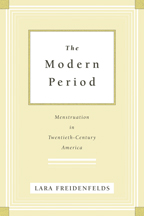
Book cover: The Modern Period by Lara Freidenfelds Lara Freidenfelds, an historian currently teaching in Women’s Studies at Wellesley College, has written a thorough and engaging history of menstruation in twentieth century USA. Her title, The Modern Period, is more than a succinct description; it cleverly references her discussion throughout of how advancing Progressive values shaped beliefs and practices surrounding menstruation. These Progressive values included faith in scientific rationality, belief in the value of education, and unqualified endorsement of technological progress. The ‘modern period’ also references the evolution of menstrual management practices into a coherent whole and the movement away from practices and beliefs considered old-fashioned, such as worries about catching a chill or the use of cloth pads. Her analysis throughout addresses the class implications of modernization; that is, the perceived need to adopt modern practices of bodily presentation and self-control for class mobility. Such modernization, asserts Friedenfelds, is a key component of Americans’ ability to see themselves as middle-class across great gaps in education and income.

Friedenfelds skillfully integrates a variety of historical sources, such as advertisements, promotional brochures, educational texts, and previous historical and sociological research on menstrual beliefs and practices with her own extended interviews with women and men of a range of ages, occupations, social standings, and ethnic backgrounds. This adroit synthesis helps Friedenfelds show how the modern period was created collectively by advertisers, health educators, manufacturers of menstrual products, and other ‘experts’, with the eager assistance of ordinary people.

The diversity of age and ethnicity among Friedenfelds’ interview participants is particularly striking and significant in a work such as this: the oldest informant was born before 1910, and the youngest after 1970. The 75 interviewees included white Americans in New England, African Americans in the rural South, Chinese Americans in California, as well as 13 people from other backgrounds. Examples from these interviews are well contextualized and grounded with historical research.

Friedenfelds’ choice to organize The Modern Period thematically rather than chronologically made the text a more appealing read as a whole while simultaneously making it possible for each chapter to stand alone. This organizational choice also makes clear how changes in the evolving modern period came about gradually and often in fragmented ways. The book is divided into five chapters, plus brief introduction and conclusion, around the themes of life before modern menstrual management, modern talk about menstruation, modern menstrual behavior, modern techniques of menstrual management, and a fifth chapter about tampons as a case study in controversy.

Some contemporary readers may find it difficult to believe that tampons were once controversial. But when they were first introduced as a commercial product in the 1930s and 1940s, both menstruators and physicians were skeptical about their safety and efficacy. There were also debates about the sexual implications of tampons, and whether it was advisable for sexually inexperienced women to use them. This chapter provides a keen example of how effectively Freidenfelds uses interview data to supplement documents-based research: Using tampons required women to cross boundaries of race, class, culture, and region, as well as learn different bodily practices required by tampon use compared to menstrual pads. Freidenfelds shows this with vivid interview narratives about women experimenting on their own to learn how to insert a tampon, modern daughters explaining to traditional, immigrant mothers that tampons were safe, and more. The frankness of these narratives is a testament to Freidenfelds’ skill as an interviewer.

The Etiquette of Menstrual Concealment Preserves Pain as well as Secrecy

October 9th, 2009 by Elizabeth Kissling

abdominal_painIt’s great that menstrual taboo and stigma is ‘over’, as Amanda Fortini informed us earlier this week (see Chris’ post about the menstrual activism shitstorm across several blogs this week). Now maybe all those women suffering from debilitating endometriosis can get some relief.

Kate Seear’s newly published study about the diagnostic delay in treating endometriosis finds that menstrual etiquette rules and the culture of concealment are among the most profound causes of the delay between the first experience of menstrual pain and the diagnosis of endometriosis, which then opens avenues for relief through either surgery or medical treatment. The delay is non-trivial: research estimates an average delay of 8 years in the UK and 11 years in the US. Reasons for the delay include minimizing of menstrual pain by doctors, family members, and others, and women’s inability to distinguish between ‘normal’ menstrual pain and abnormal pain, and, Seear argues, the social sanctioning women experience when they talk about menstruation in general or menstrual pain in particular.

Copyright restrictions prevent me from re-publishing the article that details her findings and analysis, but here is the abstract:

Endometriosis is a chronic gynaecological condition of uncertain aetiology characterised by menstrual irregularities. Several studies have previously identified a lengthy delay experienced by patients between the first onset of symptoms and eventual diagnosis. Various explanations have been advanced for the diagnostic delay, with both doctors and women being implicated. Such explanations include that doctors normalise women’s menstrual pain and that women might delay in seeking medical advice because they have difficulty distinguishing between ‘normal’ and ‘abnormal’ menstruation. It has been suggested that the diagnostic delay could be reduced if women were trained in how to distinguish between ‘normal’ and ‘abnormal’ menstrual cycles. In this paper I argue that whilst these may be factors in the diagnostic delay, women’s reluctance to disclose problems associated with their menstrual cycle may be a more significant and hitherto neglected factor. I argue women are reluctant to disclose menstrual irregularities because menstruation is a ‘discrediting attribute’ (Goffman, 1963) and disclosure renders women vulnerable to stigmatisation. Women actively conceal their menstrual irregularities through practices of the ‘menstrual etiquette’ (Laws, 1990) which involves the strategic concealment of menstrual problems. This argument is supported through an analysis of the experiences of 20 Australian women diagnosed with endometriosis. The ramifications of this analysis for chronic pain conditions more generally and for practical strategies designed to address the endometriosis diagnostic delay are considered.

If you have access to an academic library (or other source for Social Science & Medicine), I highly recommend reading this article.

Post to Twitter Post to Plurk Post to Yahoo Buzz Post to Delicious Post to Digg Post to Facebook Post to MySpace Post to Reddit Post to StumbleUpon

Readers should note that statements published in re: Cycling are those of individual authors and do not necessarily reflect the positions of the Society as a whole.