Blog of the Society for Menstrual Cycle Research

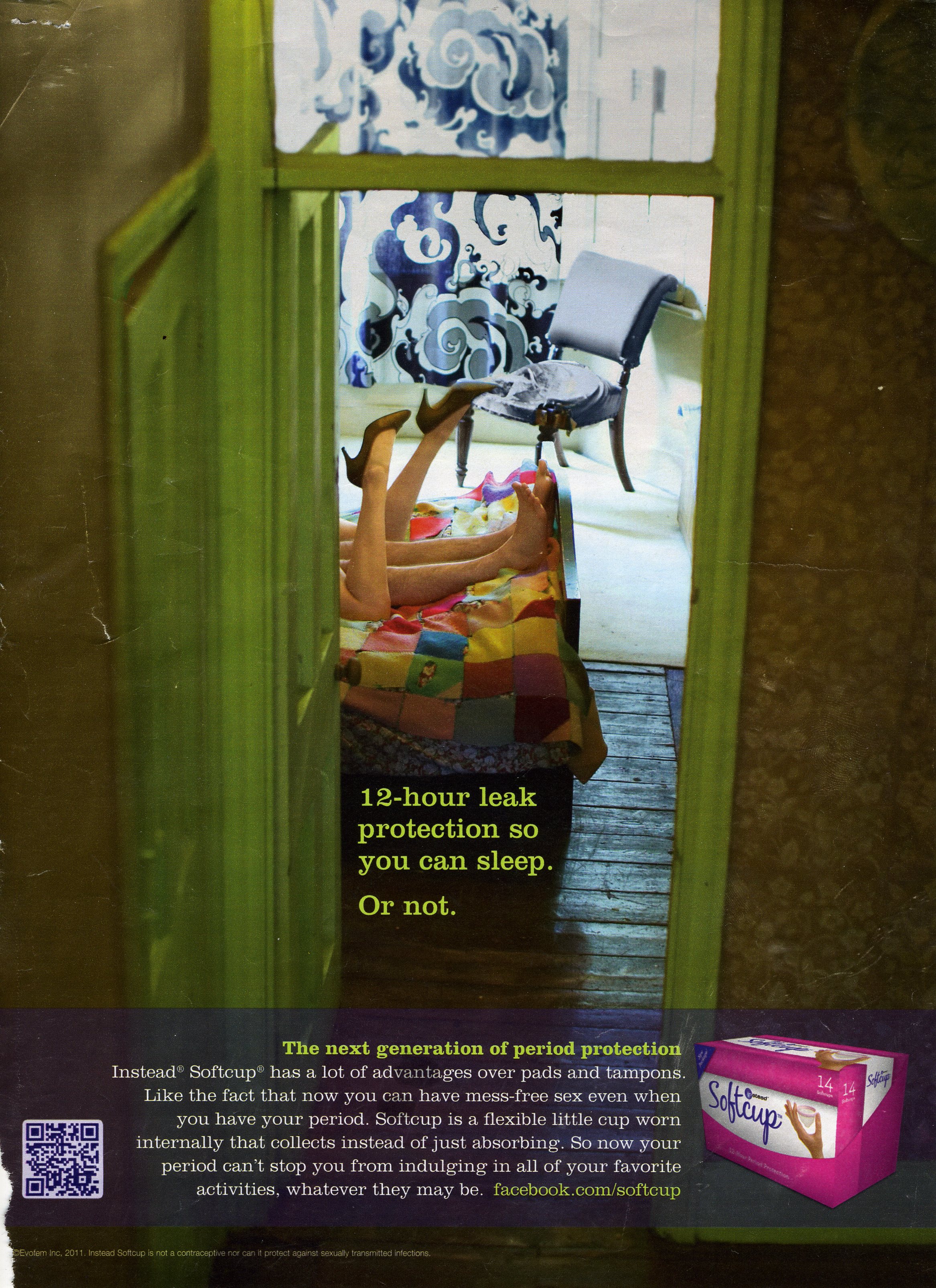
Menstrual Sex: The Last Taboo in Advertising?

December 6th, 2011 by David Linton

Click to view full-size image in another window.

For nearly a century, ads and other promotional materials for menstrual products have been based on claims that the pad, tampon or, more recently, cup or pill, would make it possible for women to participate in activities that their periods would otherwise have interfered with.  Furthermore, one would be able to do so without anyone knowing that a period was underway.  References to freedom and secrecy, expressed in a myriad of overt or euphemistic terms and images, have been ubiquitous.  Yet, there has been one constraint marketers have hesitated to defy.  Until now.

Surely the taboos against intercourse during menstruation are among the oldest and most wide-spread of all cultural prohibitions.  And while previously ads have suggested that one’s romantic engagements – dancing, dating, going to parties, etc. – could be continued or even enhanced by using the right pad or tampon, no company ever stated that women could have an active, joyful sex life regardless of, or even despite, a regular menstrual flow.  The new series of ads for Instead Softcup boldly challenges that taboo.

But not only does it reject the taboo, in doing so it depicts women in a sexually assertive way that makes menstrual sex look like fun.  The ad on this page is one in a series that playfully mocks one of the claims usually made for feminine hygiene products: “12-hour leak protection so you can sleep.  Or not.”

The photograph is striking for many reasons.  There’s a voyeuristic quality as we gaze from a high angle at an intimate sexual encounter narrowly framed by dark walls and an open door.  Though we only see the couple’s naked legs, the image is made particularly titillating by the fact that the woman has kept on her somewhat spiky heeled shoes, suggesting urgency and spontaneity as well as a hint of kinkiness.  What’s more, the woman is on top, an image of assertiveness and power reflected in the text, “So now your period can’t stop you from indulging in all your favorite activities, whatever they may be.”  Furthermore the “woman superior” position (as it used to be called in sex manuals) also implies that the cup is so effective that there’s no danger of having your blood stream out onto your partner, even when you’re straddling him.

Another ad in the series uses a similar framing technique showing a young couple who are kissing.  They are glimpsed against a window through dark, heavy drapes in a dimly lit living room decorated in an old-fashioned style with flowered wall paper and a formal mantle upon which rests a delicate tea pot.  Here the image suggests the rejection of old (parental) ways that held that women could not enjoy sex while menstruating.

And then there’s the clever name of the product: Instead Softcup.  The first word is a little dig at the competition; the second aims to reassure the customer that the product is comfortable and easy to use.  The company’s web site also takes a little shot at the chief competitor with the slogan, “No Strings,” but otherwise it’s a fairly straight-forward, even sober, site with video interviews with reassuring doctors and the usual endorsements and images of happy, young women of widely varied ethnic origins.

The marketing campaign is multi-faceted including teams of women staffing tables outside colleges giving away free samples.

Time will tell if Softcup succeeds in dislodging pads and tampons from their market dominance.  Readers are invited to comment on the likely outcomes of the campaign.

Post to Twitter Post to Plurk Post to Yahoo Buzz Post to Delicious Post to Digg Post to Facebook Post to MySpace Post to Reddit Post to StumbleUpon

Sustainable Cycles

October 31st, 2011 by Chris Bobel

Sarah Konner and Toni Craigie Bicycle Down the West Coast, Live on $4 a Day, and Talk to People about Sustainable Menstrual Products.

Hear, in their own words, what they did and why it matters.

These gals are our menstrual sheroes!

Our Project

Over a lifetime, the average woman spends about 2,000 dollars on single-use pads and tampons, creating an enormous truckload of trash. There are more affordable and sustainable options that very few people seem to know about. We left Seattle on bikes on August 18th and arrived in LA on October 10th, and we will be continuing this work off-bicycle in the coming months. Along the way, we are meeting women, community organizers, health professionals, business owners, and people of all stripes, and having conversations about the benefits of reusable menstrual products.

For this project, we have been focusing on reusable menstrual cups—made of natural gum rubber latex or medical-grade silicon; they catch, rather than absorb menstrual flow. One cup costs $35 and can last up to 10 years—quite a deal. There are three companies that sell menstrual cups in the US, all approved as safe by the FDA. Each company has donated cups, totaling over 200, for us to give as gifts along the way. We also have a small number of reusable pads to give away.

There are powerful environmental impacts from this lifestyle switch and also important health benefits. For every woman who leaves behind single-use disposable pads and tampons, you can imagine a truckload of trash not going into the landfills, the decreased carbon footprint from production and shipping of these products, the trees saved, and all of the environmental toxins not going into our air, water, and bodies.

The Trouble with Disposables (Pads and Tampons)

Conventional pads and tampons are made of chlorine-bleached wood pulp, with some cotton (generally grown with tons of pesticides), rayon, plastic, and glue mixed in. They also contain bleach and dioxins, carcinogenic chemicals that are harmful to your body and to the environment. The vagina – wet, warm, and porous – seems like the last place you’d want those chemicals. Tampons, especially the super absorbent kinds, can create a perfect breeding ground for Toxic Shock Syndrome, caused by the deadly bacteria known as Staph (Staphylococcus aureus). These disposable products are not easily biodegradable, which is why they often clog septic systems and long outstay their welcome in our oceans and landfills.

The most immediate concern for many women is the cost of single-use products, every month, until menopause. Pads and tampons are an economic burden on all women BUT prove especially difficult for low-income women since they are not covered by food stamps.

The Scoop on Reusables

Using a menstrual cup puts a woman in more intimate contact with her body: she needs to figure out the mechanics of inserting and removing the cup and sees the color and consistency of her menstrual fluid each time she empties the cup.  Once you get over the learning curve, cups seems easier, more hygienic, and believe it or not, less gross than pads and tampons.  Many users come to value the increased knowledge of their body and cycle that they get from their cup.

Contact lenses make a great analogy: at first people are worried about touching their eye or may experience some irritation as they figure out the best way to put the lenses in.  Quickly, however, most people develop an easy routine around their contacts, and it’s no big deal.

Cycling for Cycling Change

September 12th, 2011 by Chris Bobel

Sarah Konner and Toni Craige begin their trip in Seattle.

Sarah Konner and Toni Craige are two impressive women. They are biking all the way down the west coast and living on $4/day while spreading the word of sustainable menstrual care.

Menstrual activism in motion!

Theirs is a great model of seeing a need and doing SOMETHING! Here are two young women with a passion, strong legs and endless energy and that’s enough.  They are willing to sleep and eat on a shoestring so that they can share their stories of doing right by the earth and getting back in touch with their bodies.

And for those willing to try a cup, they’ve got a sack of donated products.

Check our their progress and consider supporting them. They welcome financial support AND emails to the ELLEN show where they hope to make an appearance.

Post to Twitter Post to Plurk Post to Yahoo Buzz Post to Delicious Post to Digg Post to Facebook Post to MySpace Post to Reddit Post to StumbleUpon

Love Your Body, Love Your Beach, Love Your Cup

September 5th, 2011 by Chris Bobel

Mooncup, the British reusable menstrual cup makers, just launched their Love Your Beach? Love Your Vagina campaign—a compelling attempt to connect the care for your body/care for your planet messages at the root of the push for alternative menstrual care.

My first reaction: that deliciously sensual vulva has HAIR! ‘Atta girls!’ This body-positive, earth-loving feminist is on board.

Then I read British journalist/commentator (and self described “broad-minded broad”) Julie Burchill’s piece in The Independent about the Mooncup ad and was brought back to reality, that is, the reality that is colored by menstrual taboos and woman-body-hating. Oh geez, really, Julie? Et tu?

In short, Burchill rails against not only the soft cup, but also the sponge and reusable pads, and by extension “breastfeeding, small shopping, slow eating”—other movements, she concludes that “conspire to straight up KEEP WOMEN AT HOME FOR AS MUCH AS POSSIBLE” (yes, her words, her emphasis). Words like gory, inappropriate, and vile pepper her indictment against options she rejects before she tried them. Her basis? Her “best ex-hippie friend, happily brought back to the land of the living.”

If you strip away her regrettable squeamishness at trying something new (single use pads and tampons FTW!), we find a rather clumsy critique of eco-feminism. Though I can’t be sure since I keep tripping over Burchill’s ignorance and the REAL public enemy.

I, too, shudder, when a product is sold to women (or anyone) because THEY MUST or THEY SHOULD. When this US national breastfeeding awareness campaign heavy-handedly warned women that NOT breastfeeding effectively meant selfish mothering, lots of feminists protested.

Give me info, support, and compassion, not a big finger wagging in my face.

So I hear Burchill’s frustration with ‘Go green, you bitch’ messages, but here, it doesn’t stick. She is mad at a cup maker for promoting a product she thinks sets women back. But for me, the scoundrel is not MORE options, but rather our old nemesis the menstrual taboo which grows out of a long standing discomfort with women’s bodies ON THEIR OWN TERMS. We are cursed with an egregious inconsistency bred out of sexism: Women’s bodies on display? Cool. Women’s bodies as commodities? Score! Women’s bodies lactating, menstruating, doing what bodies do. Eeewww!

Exposed breasts and reusable cups and a expanding field of options—these aren’t the problems limiting women’s potential.  No, deep-seated discomfort with women’s bodies in their natural state–that’s one that really keeps us back.

Post to Twitter Post to Plurk Post to Yahoo Buzz Post to Delicious Post to Digg Post to Facebook Post to MySpace Post to Reddit Post to StumbleUpon

Menstrual Cups for African Girls

January 5th, 2011 by Elizabeth Kissling
Rhoune Ochako, a research officer at APHRC, explains how the cup works in this photo from the APHRC web site.

Rhoune Ochako, a research officer at APHRC, explains how the cup works in this photo from the APHRC web site.

At re:Cycling, we’re interested in all kinds of menstruation and women’s health issues, all over the world. We have written several times about the need for menstrual pads for girls and women in developing nations, like the Kasissi Project Girls Program producing M.A.K.A. pads in Uganda and Sustainable Health Enterprises making pads from banana trees for women in Rwanda, and LunaPads’ Pads4Girls program, which collects and donates reusable pads to girls in several African nations as well as Mexico and South America. We’ve also suggested that cramps and menstrual pain may cause girls to miss school as much as lack of menstrual supplies.

So it was with great interest that we read about a new pilot program of the African Population and Health Research Center (APHRC) that will distribute menstrual cups to girls in Nairobi.

Women and girls in Korogocho slums have been identified who will use the cup for up to four months, after which they will be interviewed about their experiences,” explained Rhoune Ochako, a research officer at APHRC.

The study will also assess acceptability of the cup, as many girls were intimidated to use the cup. A teacher at Our Lady of Fatima Secondary school initially queried 400 students, of whom only three were willing to participate in the study.

Celestine Awino [age 17] is among girls who agreed to participate in the project that started about a year and a half ago and has been using the cup since then. “At first I was afraid. I waited until a friend used it, then I tried. I have now been using it for over ten months,” she says.

Awino says she is able to engage in school activities during her periods while wearing the cup. “I take part in sports, cleaning and learning activities without any problem. It is better than missing school because one lacks sanitary pads,” she says.

Given the economic and environmental advantages of menstrual cups (not to mention their reliability), this experiment has great potential to make a big difference.


Post to Twitter Post to Plurk Post to Yahoo Buzz Post to Delicious Post to Digg Post to Facebook Post to MySpace Post to Reddit Post to StumbleUpon

Cup U

December 4th, 2010 by Elizabeth Kissling

Vanessa Tolkin Meyer recently published her thesis film on Vimeo: it’s a short film about the menstrual cup. It’s also about attitudes toward menstruation and how we talk about it.


Post to Twitter Post to Plurk Post to Yahoo Buzz Post to Delicious Post to Digg Post to Facebook Post to MySpace Post to Reddit Post to StumbleUpon

And now a femcare ad campaign that’s not afraid to say VAGINA

March 18th, 2010 by Elizabeth Kissling

Triangle of flowers labeled "Lady Garden".Or coochie, or bajingo, or vajayjay, or any other term for female genitalia. The big news in U.S. femcare this week is the launch of Kotex’s new “Break the Cycle” campaign, and the refusal of American television to air commercials that use the word vagina. As Amanda Hess put it, “you know, the place where the fucking tampon goes.” Meanwhile, Mooncup has launched new ads for their menstrual cups with a “Love Your Vagina” campaign in the UK. The campaign includes posters all over the place with different names women have for their vaginas – fru-fru, bajingo, coochie, lady garden and vajayjay – and the domain name LoveYourVagina.com.

According to this article in Marie-Claire,

Mooncup intend[s] to stimulate debate and encourage women to care about their vaginal health as much as they care for their hair, nails and make up. Kath Clements, Campaigns Manager for Mooncup, says: ‘We hope the ads will get women thinking, smiling and talking about their vaginas.’

No word yet on whether British media are permitting television ads.

Post to Twitter Post to Plurk Post to Yahoo Buzz Post to Delicious Post to Digg Post to Facebook Post to MySpace Post to Reddit Post to StumbleUpon

Readers should note that statements published in re: Cycling are those of individual authors and do not necessarily reflect the positions of the Society as a whole.