Blog of the Society for Menstrual Cycle Research

Midlife Muddle — Own the Power of Naming

May 17th, 2012 by Elizabeth Kissling

Guest Post by Jerilynn Prior, M.D. — Centre for Menstrual Cycle and Ovulation Research

By “midlife muddle” I don’t mean the trouble concentrating or remembering names that sometimes occurs for all of us (but more frequently if we’ve wakened with night sweats and not gotten back to sleep). I mean the condoned and official confusion about naming of women’s reproductive aging. Let me show you why I am upset.


STRAW+10 staging system for reproductive aging in women

Stages of Reproductive Aging Workshop (STRAW) held a 10-year anniversary last summer. (As someone frustrated by not being “heard” at the original conference, I still think that the “W” in STRAW should stand for Women!) Despite that, STRAW+10 has made progress because at least some of the classification is now supported by population-based prospective data rather than based on what experts believe. The names that are now politically correct are summarized in the STRAW+10 Executive Summary1 and the diagram1 at right.


We in the Society for Menstrual Cycle Research have also had our say about nomenclature: “Naming Women’s Midlife Reproductive Transition”.  I wrote this (with revision and refinement by collective effort of SMCR members) because women keep getting left out of this naming business. For example:

  • a regularly menstruating woman with night sweats, heavy flow, and increased cramps could learn to call herself perimenopausal2 (not STRAW+10 Late Reproductive Phase -3b?!).
  • a woman who just finished her period can say, I’m in late perimenopause and have at least a year without further flow before I’ll be menopausal. Based on STRAW+10 she could be told that specific menstruation was her final menstrual period (nickname “FMP”) and the next day, according to STRAW+10 be told that she is now “postmenopausal”!!
  • a woman with sore breasts, irregular periods, and heavy flow could say, I’m in perimenopause. However, she may instead be told she is in the “Early Menopausal Transition.” Because she has heavy flow she is also likely to be prescribed the birth control pill (as is currently and commonly recommended). Usually she will not be told that The Pill will make her perimenopausal irregular flow worse—she may well start spotting in the middle of her cycle.3

This new and improved STRAW+10 still centers all of women’s reproduction on that mythical FMP. But to call the FMP “menopause”, as many women’s health experts do, is just unscientific. It takes at least a year without another menstruation in those of us over age 45 before nine out of ten of us will not get another period4. But one (out of ten) of us will get a further, normal period even though we’ve been that whole year without any4. We can tell that new flow is normal (in other words, does not need investigation for endometrial cancer) if we had cramps or bloating or sore breasts or moodiness—or all of these—that told us our period was coming.


So our new Naming position statement says don’t call it “menopause” until you’ve not had a period for a year. And do call it “perimenopause” if things are variable and changing even if you are still having regular flow2.  Three of nine changes can confirm for you that you are perimenopausal even if your flow is still regular:2

  1. Shorter cycles (25 days or less);
  2. Increased cramps;
  3. Heavier flow;
  4. Increased trouble sleeping—especially waking up in the middle of sleep;
  5. New or increased migraine headaches;
  6. Night sweats—especially if they tend to occur before or during flow;
  7. An increase in or new premenstrual mood swings;
  8. New sore, enlarging or nodular breasts; and
  9. Weight gain without changes in what you eat or the exercise you do.

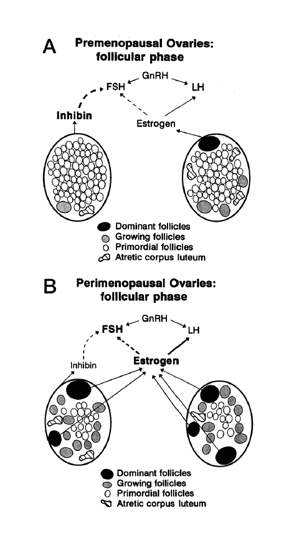
If women can learn to call themselves perimenopausal, they will be saying they know that perimenopause is not the same as menopause—perimenopause is a midlife transition with higher and erratic estrogen levels. Menopause is a fairly stable life phase with normally low estrogen and progesterone levels that begins one year after their last menstrual flow.


Furthermore, by naming themselves accurately they will be able to tell whether a medication that is proposed for them has been tested and proven effective in perimenopausal women. Usually symptomatic women are treated with oral contraceptives (that are proven reasonably safe and useful for premenopausal contraception), or offered hormone therapy that has only been tested and shown effective for hot flushes/flashes in menopausal women.


So. . . I like the word, perimenopause and think if women understand and own it they will be on their way out of a midlife muddle.


References

  1. Harlow, S. Executive Summary of the Stages of Reproductive Aging Workshop +10: addressing the unfinished agenda of staging reproductive aging [pdf]. Fertility Sterility, 2012   doi: 10.1016/j.fertnstert.20012.01.128
  2. Prior JC. Clearing confusion about perimenopause. BC Med J 2005; 47(10):534-538.
  3. Casper RF, Dodin S, Reid RL, Study Investigators. The effect of 20 ug ethinyl estradiol/1 mg norethindrone acetate (MinestrinTM), a low-dose oral contraceptive, on vaginal bleeding patterns, hot flashes, and quality of life in symptomatic perimenopausal women. Menopause 1997; 4:139-147.
  4. Wallace RB, Sherman BM, Bean JA, Treloar AE, Schlabaugh L. Probability of menopause with increasing duration of amenorrhea in middle-aged women. Am J Obstet Gynecol 1979; 135(8):1021-1024.

Post to Twitter Post to Plurk Post to Yahoo Buzz Post to Delicious Post to Digg Post to Facebook Post to MySpace Post to Reddit Post to StumbleUpon

Searching for Good News about Menopause

April 26th, 2012 by Heather Dillaway

Lately I’m fed up with the kinds of articles and news items that cross my desk (or computer screen) about perimenopause and menopause. So much of the news on this midlife transition seems negative. I hear about the new treatments for (unbearable) hot flashes or a new movie saying how terrible menopause is (remember my blog entry on Hot Flash Havoc? That movie is still getting a ton of press for better or worse). The most neutral reports seem to be about lifestyle changes (exercise, diet, quitting smoking, etc.) women can make to lessen “problematic” symptoms.

So, I’m starting to wonder: Is there any purely good news about menopause? Any news that will make women feel good about their midlife transitions?

To answer my own question, I typed “good news about menopause” into google, bing, and yahoo search engines. Readers of this blog should try it themselves. Type it in and see what you get.

When I typed this phrase into different search engines, right away the same sorts of news articles described above popped up. There is “good news” for menopause “sufferers” who want to try out new medical treatments for menopausal symptoms (you too can lessen your hot flashes!), “good news” that menopausal women can reverse aging (read: aging is bad!), “good news” that perimenopausal women can change their diet, “good news” that women can take supplements that will make sex better after menopause, etc. In my opinion, most of these articles have a negative undertone – that menopause is something to be suffered and endured and disliked overall. While these articles might be offering solutions to make life better, the underlying message is still that this life stage sucks for women. There were few exceptions to this, but the exceptions are worth mentioning. For instance a blog about the wisdom and freedom that women can find at menopause did pop up, as did another “menopause goddess” blog that gave a much more positive spin to this midlife transition. I personally wish I had seen more items like the latter two. For me, most of the “good news” that popped up is not so good.

I think about the perimenopausal or menopausal women who might be looking for “good news” about their life stage and I wonder what they might be looking for. If you are perimenopausal or menopausal and you’re reading this, what “good news” are you looking for? And how do you feel about the “good news” you’re getting?

Post to Twitter Post to Plurk Post to Yahoo Buzz Post to Delicious Post to Digg Post to Facebook Post to MySpace Post to Reddit Post to StumbleUpon

Fog Warning Ahead

March 29th, 2012 by Heather Dillaway

As I embark on my 40th year I look ahead to menopause. I guess there is a good chance I’m approaching some foggy years. Brain fog, that is.

In the past week a flurry of online news articles review new research findings on the “brain fog” that many perimenopausal women experience. The brain fog is more easily understood as a slight memory problem, if you take the time to read through the various news stories. A new study analyzed how 75 individual women, aged 40 to 60, rated their memory performance based on factors like how often they forgot details and how serious their forgetfulness was. Researchers also gathered information about the women’s overall health, mood and hormone levels, as well as other menopausal symptoms, and tried to figure out the extent to which this “brain fog” exists. According to news reports, about 41 percent of the women in the study reported having forgetfulness that was “serious,” and those who felt that their memory problems were serious were more likely to score poorly on tests of working memory and attention. Some women who rated their memory problems as serious also reported some depression and other symptoms like hot flashes and sleeping problems. Other researchers suggest that the memory problems women experience are related to changing levels of estrogen in a woman’s body at menopause, but interestingly this new study did not find links to changing hormone levels.

The whole notion of “brain fog” is interesting, and I am suspicious of it as a strictly menopausal symptom. What about the brain fog we all experience when we’re tired or sick or just way too busy? Defining brain fog as a “menopausal” (really, perimenopausal) symptom further defines middle-aged women as somehow less than functional and set them up to be taken less seriously.

Putting this issue aside, though, what I actually find most interesting about all of the news coverage of this study is just how different each report of the study is. I am reminded that we should all be careful of which report we read about a study. For example, the first article I read on this study was placed in the Los Angeles Times and focused on the possible connections between menopausal brain fog, depression, and dementia. I was left feeling like the author of the article inferred that all menopausal women might have depression or dementia and that they should seek treatment. After reading this article I was angry because I felt as if I had been warned that midlife brain fog was the beginning of an inevitable decline for all women. Then I read a WedMD piece that simply described the study and did not concentrate on depression, dementia, or the need for treatment, and I wasn’t really sure what to make of the research study. Finally I read an article by a HealthDay reporter which quoted one of our own, SMCR member Nancy Wood, who reminds readers that “a number of other stressors in life, from work to taking care of children and parents, that pile up around the same time as menopause can hinder memory and ability to concentrate.” In addition, this article’s author states that “memory problems are not necessarily an early sign of dementia” and cognitive ability is regained after other perimenopausal symptoms subside. This third article concluded that the research study is helpful because findings suggest that brain fog is real – that women aren’t crazy – but that it is normal and not that detrimental to women’s long-term cognitive abilities.

Talking Makes Menopause Better — Anyone Surprised?

March 1st, 2012 by Heather Dillaway

Adapted from a photo by Ed Yourdon // CC 2.0

The results are in: if you talk to your friends more during menopause, then your menopausal symptoms will bother you less. A study reported in The Telegraph last week suggests that talking either lessens women’s symptoms or helps them cope better (or both). In one study, women undergoing breast cancer treatments who also participated in “talking cure group therapy” as part of a study at Kings’ College in London “coped much better” with menopausal symptoms. Half of the women in this study were asked to participate in workshops with other women for six weeks. Women in the study were encouraged to talk about signs and symptoms of menopause, such as hot flashes (or hot “flushes” in the UK) and night sweats; they were taught techniques for eliminating “negative thoughts” and stress as well. Researchers touted this “talking cure group therapy” as giving “people the mental tools to tackle problems more positively” and led to “improvement” in symptoms. The author of the article suggests that non-medical approaches to symptom relief not only work but also could be growing in popularity among women who can’t or don’t want to use prescribed hormone therapies.

This is not unlike what I’ve found in my own studies of menopause and what plenty of other feminist scholars have found about women’s experiences of reproductive health more generally. Women who have support networks and/or who talk to other women about their experiences do indeed feel better about their own experiences and do gain some symptom relief (or, at the very least, coping strategies) just from talking to people. Indeed, even women with severe symptoms can get relief from sharing and talking. SMCR’s very own Jerilynn Prior and Christine Hitchcock have also done studies of how women will rate the severity of their hot flashes differently once they hear other women talk about theirs. Hearing and then knowing that people around you are (a) experiencing the same thing and then (b) might have suggestions for how you could navigate the experience always helps. This isn’t specific to women’s health – anyone experiencing any bodily event, symptom, or process will probably feel better if they talk to others. And of course we could go on from there – anyone experiencing anything confusing or hard or long in duration will probably benefit from talking to others. Anyone who has failed a math test or survived a hard relationship knows that.

The question I have is, isn’t it sad that this is a finding? Shouldn’t we all know that talking to others is better for our health and our sanity? I’m as much of a culprit as anyone else: I don’t talk to anyone anymore. I’m too busy. I barely see my kids or partner, let alone tell people how I feel about menstruation, whether I really feel “done” having kids, whether I think menopause is near, whether I feel reproductively healthy (or healthy in any aspect of my life for that regard), etc.  Maybe some of you are much better than me about talking to others, but it’s pretty bad when major research journals have to remind us in their published findings that talking is good for us.

Feminist scholars have already documented the medicalization of women’s reproductive health and the fact that women now typically consult doctors as the “experts” on reproductive health and, by default, no longer trust themselves or other women for advice. Thus, to some extent, talking is stifled by the medicalization of women’s health experiences. But, ironically, now medical journals are reporting that we should talk more? Seems like we’ve made it full circle and women should consult other women as the real “experts” again.

“Death Loves Menopause”: Heart and Stroke Foundation Sends Wrong Message

February 8th, 2012 by Laura Wershler

The Heart and Stroke Foundation of Canada has inaccurately branded menopause as a killer of women. I will not be sending them a donation.

Last October, the foundation launched a fundraising campaign called Make Death Wait. Magazine and TV ads personify death as a man with a disembodied voice (he sounds like a stalker) who says he loves women (and men) and is coming to get them.

Eileen Melnick McCarthy, director of communications for the foundation, wrote to me in an email that the intent of the campaign is to “wake up Canadians to the threat of heart disease and stroke.” The campaign – urging viewers to “make death wait” by making a donation – has drawn both support and criticism.

Note the stereotypical hot flash reference: The thermostat is set at 15 C (60 F) but reads 23 C (73 F).

Photos of the ad by Laura Wershler

I think the TV ads are creepy, but what disturbed me more was the Death Loves Menopause message in the December issue of Chatelaine, Canada’s oldest women’s magazine. The small print reads: “He loves that menopause makes women more vulnerable to heart disease and stroke.” But is this statement defendable?

Dr. Jerilynn Prior, endocrinologist and scientific director of the Centre for Menstrual Cycle and Ovulation Research, wrote in an article about women’s risk for cardiovascular disease that the assumption heart disease in women is caused by estrogen deficiency associated with menopause  is a myth:

The reasoning behind this notion goes like this—young women have lots of estrogen and don’t get heart attacks. Older menopausal women are “estrogen deficient” and get heart attacks. Therefore, lack of estrogen causes women’s heart disease. That is like saying that headache is an aspirin-deficiency disease!


It is true that heart disease and stroke is the #1 killer of women, but the ad’s assertion that it is menopause that makes women more vulnerable raised the ire of women’s health experts I asked for comment.

Joan Starker, a PhD clinical social worker specializing in midlife, menopause, and aging issues, called it “an appalling and shocking advertisement.” Starker says she and her colleagues have “worked hard to shatter negative conceptualizations of menopause and aging. When I viewed this ad, I was left with only one horrifyingly toxic message – menopause equals death – which is ageist and sexist.”

Barbara Mintzes, assistant professor at the University of British Columbia, calls the ad “misleading and inaccurate” and says “there is no sudden shift in the rate of heart disease post- versus pre-menopause (or around age 50), as would be expected if menopause was a major risk factor for heart disease.  As women age our risks of heart disease gradually increase, similarly to ageing in men.”

My fellow blogger, Paula Derry, is a PhD health psychologist who critiques, analyzes, and theorizes about menstruation research/theory, with menopause being one of her specialties. “The idea that women’s risk of heart disease increases after menopause is a common one, yet there is little evidence for any increase in risk, much less that menopause is a key cause of heart disease and death,” she says.

Derry cites a 2011 paper in the British Medical Journal - Ageing, menopause, and ischaemic heart disease mortality in England, Wales, and the United States – that concluded aging rather than menopause was key: “Heart disease mortality in women increased exponentially throughout all ages, with no special step increase at menopausal ages.”

Last March, the American Heart Association issued the Effectiveness-based Guidelines for the Prevention of Cardiovascular Disease in Women—2011 Update. These guidelines present a long list of risk factors such as obesity, poor diet, physical inactivity, high cholesterol, hypertension and diabetes. Menopause is not included as a risk factor and is mentioned in just one sentence in the document.

As Derry says, “If I were going to donate money to an organization it would not be to one that tried to scare me with what I understand to be inaccurate facts.”

The Heart and Stroke Foundation of Canada should “wake up” to the truth about heart disease and menopause.

Post to Twitter Post to Plurk Post to Yahoo Buzz Post to Delicious Post to Digg Post to Facebook Post to MySpace Post to Reddit Post to StumbleUpon

Menopause Tales

February 6th, 2012 by Paula Derry

The philosopher of science Mary Midgley (1995) doesn’t mince words.  She tells us:  “The theory of evolution is not just an inert piece of theoretical science.  It is, and cannot help being, also a powerful folk-tale about human origins.”  Along these lines, stories about reproductive physiology are important folk-tales about what’s natural for women and what their life course should be.

What are the stories about menopause?  One is that living beyond menopause is a biological puzzle. The argument goes like this: Most animals reproduce up until, or close to, the end of their natural life span.  This makes sense, because theoretical biology tells us that animals reproduce as much as possible to leave as many offspring as they can.   Why women live beyond menopause is therefore a puzzle.  One answer is that we can expect to live thirty years past menopause because technological innovations have resulted in the conquest of infectious disease, the generation of great food stores, and other advances. As recently as the turn of the century, the average woman lived 47 years.  Far longer, probably, than our prehistoric forebears:  prehistoric hunter-gatherers were probably old at thirty.  Living many years past menopause is therefore a recent historical development.  Not surprisingly, if aging women are “outliving their ovaries,” menopause is associated with a variety of unpleasant experiences and health problems.

What are some facts relevant to this story?  First, is living past menopause a new historical development?  Well, ….No.  Old age is not an invention of the twentieth century.  Betsy Ross died when she was eighty-four.  Classic Greek and Roman medical writers (including Hippocrates himself) and traditional Eastern medical systems all discuss menopause. In the Old Testament, Sarah laughed when God said she would bear a child even though it had “ceased to be with her after the manner of women.”  Might the Bible have been referring to menopause?

Sign from The Musée Mécanique, a for-profit interactive museum consisting of 20th-century penny arcade games and artifacts located at Fisherman's Wharf in San Francisco, California.

Photo by Thomas Hawk // CC-BY-SA 3.0

What about the idea that prehistoric humans died before menopause? Studies by anthropologists suggest that modern hunter-gatherers do live to old age.  Therefore, perhaps our prehistoric hunter-gatherer forebears did so as well.  Richard Lee (1985), for example, studied the !Kung San in Botswana.  About 10% of the population were over sixty years old, and it was not unusual to find !Kung aged 70 or 80.   Lancaster and King (1985) found, when twenty-four hunter-gatherer and horticulturalist groups were examined, that 53% of the women who lived to age fifteen could expect to still be alive at age 45.

If a small number of older people are found in simpler societies, is this important?   Is ten percent survival so small that for all intents and purposes fifty years is the real limit on lifespan?  Older people, as described by anthropologists, are not viewed by the members of their own societies as oddities.  That is, if living into middle-age and beyond were an anomaly, it is unlikely that people in a society would have expectations about what role an older person should play.  Older people might be viewed as curiosities.  However, older people more typically have important places in their societies.  At least through their fifties and sixties, they are relied on to do important things.  It is relatively common in nonindustrial societies for women to experience positive changes in status when they become middle-aged (Brown, 1985).  In cultures without written legal systems or CEOs, older people often have authority over younger people.  They can be decision-makers about the distribution of property, allocation of jobs, and other social behaviors.  Among the !Kung, for example, older women assign younger relatives what jobs they need to do, arrange marriages, decide on kinship classifications.  In cultures that don’t have books or the internet, older people may be sources of stored and accumulated knowledge, like the location of a watering hole that hasn’t been needed since the last drought thirty years ago (Diamond, 1996), or social and technical skills (Kaplan et al., 2010).

Menstrual Moments in Modelland

January 25th, 2012 by Elizabeth Kissling

Guest Post by Jaime Hough


Tyra Banks wrote a young adult fantsy novel. And it’s a NYT bestseller. The book, titled Modelland, is about the journey of one awkward-looking girl who is whisked away to a magical boarding school which trains girls to become supermodels with superpowers, known as Intoxibellas. It’s kind of like Harry Potter, if Harry Potter revolved around modeling and was a battle between conventional and unconventional beauty rather than good and evil.

But I’m probably making it sound bad and it’s not, really. Modelland is the story of Tookie de la Crème,1 a girl unnoticed by her classmates and mostly ignored by her family, whose life is turned upside down when she is recruited for Modelland. The reader follows Tookie to and through her first year at Modelland as she, along dozens of other girls, trains for the chance to become one of seven Intoxibellas, supermodels with superpowers, in her graduating class. At Modelland Tookie makes her first real friends while becoming embroiled in a mystery involving the school’s headmistress, known as the BellaDonna, and the world’s mysteriously missing foremost supermodel, Ci~L.2

I read Modelland because I was curious and because I have long been fascinated by the public persona of Tyra Banks. What can I say? We all have our guilty pleasures. Most of Modelland is, for the most part, what you would expect, especially if you’re familiar with Tyra’s moneymaker, America’s Next Top Model. However, I was completely surprised by the fact that Banks chose to use menstruation as a key plot device to develop Tookie’s character. Below are excerpts from the book dealing with menstruation and my brief analysis of how these menstrual moments [MMs] function in the novel and could potentially function for the intended reader.


MM1: Not Yet A Woman

Menstrual Moment One comes near the beginning of the book when Tookie has just come home from her day at school and the readers are being introduced to her dysfunctional family. In particular, we’ve just met Tookie’s younger, dumb blonde little sister, Myrracle.

“Don’t laugh at me!” Myrracle said, frustrated. “I’m on my periodical right now! It makes me forgetful!”

“It’s period, not periodical!” Tookie growled.

Myrracle smirked. “How do you know? You haven’t even gotten yours yet!”

Tookie turned away, her face flooded with heat. Myrracle never resisted the urge to reminder her that she had gotten her period already, even though she was two years younger.3


MM2: Menarche

In Menstrual Moment Two Tookie has just spent her first night at Modelland and is about to start her first day of classes. We follow her as she prepares for class.


Disoriented, Tookie stumbled into the large, sterile-looking community bathroom. As she did, a dull pain shot through her legs, hips, and stomach. She doubled over, feeling as though she was about to vomit. Perfect, she though. I’m sick on the first day of school. . .All at once , every single girl in the bathroom doubled over in pain, gripping her stomach and back just as Tookie had. . .Tookie shut her eyes, wincing again with another pain. “Piper, my back and tummy are killing me!” she whispered.

Piper shrugged. “Join the club, Tookie. Every new Bella started menstruating at the exact same time this morning.”

“Wait. What?

“You’ve never heard of menstrual synchrony, or the dormitory effect?” Piper asked. “Menstrual synchrony is a theory that suggest that the menstruation cycles of women who cohabitate-think army barracks, female penitentiaries, convents, and university dormitories—synchronize over time. It usually takes months for the alignment to occur but her at Modelland, it seems to have happened in twenty-four hours.”

Searching for Menopause Blogs

January 6th, 2012 by Heather Dillaway

Lately re:Cycling has featured several posts on menopause, and I have begun to think about the other menopause blogs that might be out there. Turns out there are plenty – maybe not as many blogs as there are about reproductive experiences like pregnancy or childbirth but still a lot. There are even blogs that compile info on menopause blogs such as Menopause the Blog.

Blog Series 13 by Richard Smith // CC BY-NC 2.0

If you start searching for these blogs it becomes clear that many talk about hot flashes as a major sign or symptom of menopause (or perimenopause), and offer either strictly biomedical or more natural/alternative remedies for signs or symptoms (e.g., Menopause Symptom Report or I Hate Menopause). Other blogs are written primarily for their comedic value (e.g., Menopause Maniac), support value (e.g., Menopause Goddess Blog), or purely informational value (e.g., Menopause the Blog). (Menopause the Blog does a good job of summarizing some of the major blogs out there, just FYI for those who are interested.)

Many of these menopause blogs conflate the menopause transition with midlife in general (you only have to read a few blog entries to know that women talk as much about the bad and good of midlife as a life stage as they talk about menopause) but some are very specific to menopause. I find it very interesting that there can be so many different kinds of menopause blogs. I also find it interesting that so many of these menopause blogs seem to be trying to work out what midlife as a life stage means as well, which resonates with Paula Derry’s earlier post this week about how little we know about women’s midlife in general.

Perhaps what interests me the most, however, is that all of these menopause blogs seem to be either aligning with or struggling against very negative definitions of menopause. Based on my quick perusal, no blog seems to have moved past or risen above the constant negotiation of biomedical definitions. Even if bloggers are writing about how happy they are at menopause or how much they’ve learned about themselves at this life stage, blog entries still seem to be written in response to negative definitions (or at the very least, in response to the ghosts of negative definitions that still hang around menopause even when it is defined more positively).

To me this means that researchers Antonia Lyons and Christine Griffin are correct in proposing that there is only one “master narrative” of menopause and that women, doctors, women’s partners and children, medical institutions, workplaces, strangers, women’s friends, etc., have no choice but to deal with this master narrative in some way.  This also means that Abbey Hyde and her co-authors are correct in asserting that even when women aren’t using biomedical definitions to describe their menopause transition, these definitions still shape women’s perceptions of their experiences.

So, my question is, have others read these menopause blogs? And if so, does anyone have a different take on these blogs? Perhaps I’m being too harsh and using a very specific lens to look at these varied blogs. But perhaps not. What then? If you agree with me, is this what blogs are ultimately supposed to be in the end – a response (be it direct or indirect, conscious or unconscious) to the master narratives in our lives?


Post to Twitter Post to Plurk Post to Yahoo Buzz Post to Delicious Post to Digg Post to Facebook Post to MySpace Post to Reddit Post to StumbleUpon

Making Money from Menopause

January 3rd, 2012 by David Linton


No, I don’t mean all those drugs aimed at relieving the “symptoms” associated with the hormonal shifts that sometimes trigger a variety of physical or mood changes nor even the expenses that accompany joining a Red Hat Society (somebody’s making a little change on that flashy head wear!).

Rather, it’s the way Gennifer Flowers has packaged herself following her brief brush with fame as a participant in one of President Bill Clinton’s sex scandals.  A recent NY Times op-ed piece by Gail Collins (December 7, 2011) informs us that Flowers is now working as an entertainer and motivational speaker and that one of her favorite topics is “The ‘M’ Years . . . Surviving Menopause Mania!”  And, indeed, a visit to the Gennifer Flowers web site reveals that her talk “is a humorously-presented speech about the experiences of menopause while giving very current and important medically documented information to women on how to get through these ‘M’ years with the greatest of ease and dignity.”

Unfortunately, the site does not explain just what makes menopause (we presume she means perimenopause) worthy of being called “Mania!” – with an exclamation, no less – nor what makes it so daunting that one needs advice on how to “survive” nor why she feels it’s necessary to be coy with that use of “M” as some sort of code.  But perhaps it’s those unknowns that make one want to pay the fee and invite her to one’s event.

The site also includes a lot of glamorous photos and some teasing references to her other favorite topic, “Surviving Sex, Power and Propaganda.”  There’s that notion of surviving again.  But surviving sex?  There’s something touchingly sad about that.

Post to Twitter Post to Plurk Post to Yahoo Buzz Post to Delicious Post to Digg Post to Facebook Post to MySpace Post to Reddit Post to StumbleUpon

On Menopause Definitions

December 28th, 2011 by Paula Derry

Guest Post by Paula S. Derry, Ph.D.

In a recent blog post, Heather Dillaway commented on the uncertainty, confusion, and frustration she felt as a menopause researcher, given the lack of consensus about the most basic aspects of the menopause transition. Researchers don’t agree about their definitions, and can’t even agree on what needs to be defined. She asked for reactions to her entry; I’ve found that my reaction has grown into this separate post.

Fire in the Head by Beate Knappe // CC 2.0

I, unlike Heather, am not a sociologist. I’m a health psychologist. My training and current work include analyzing, critiquing, and making sense of experimental research and theories. I have also developed workshops for community women and for professionals whose aim is to provide health-promoting information and decision-making heuristics. I have given a lot of thought to the issues that Heather raises, and this is as far as I’ve gotten with them.

To me, there are many layers of issues involved. The first is the fact that the science — about the physiology of menopause and the processes leading up to it — is limited and incomplete. Part of the reason that professionals disagree about whether the life course of menstruation has five stages or seven, or why women have hot flashes, or even why women have a menopause, is that we don’t actually know. We simply do not have the scientific facts. We don’t understand what the underlying process is or how it works. Given this uncertainty, professionals must make judgments about how to define terms and what their hypotheses (or best guesses) are about underlying processes. A second fact, along with our limited real knowledge, is the tenacity with which professionals assert their judgments and argue against competing views. People disagree and they hold strongly to their positions—about language and the facts. To me, it makes sense to have definitions of stages of menstrual life that are objective and easily measurable (like the STRAW staging system) for researchers who need to compare results with each other. It doesn’t make sense to assert that this system, based on expert opinion and not on experimental facts, actually defines when a particular stage really “begins.” It makes sense to say that experimental research supports the idea that changes in the thermoregulatory center of the hypothalamus are important processes if you’re trying to understand hot flashes.  It does not make sense to conclude that these brain changes in themselves explain hot flashes; other factors must also be involved.

I think another source of confusion is that menopause is not one thing, but many. It is a circumscribed biological change (lack of periods and what leads up to them physiologically) and also a psychosociocultural matter. We have a term for when girls begin to menstruate (menarche), a separate term for the larger biological changes of which menarche is a part (puberty), and another term for the biopsychosociocultural changes of which puberty is a part (adolescence). I think these kinds of distinctions are confused with regard to understanding menopause in part because there is cultural confusion about midlife (or mature adulthood or whatever term you use) as a life stage.  There is no cultural consensus about this stage of life.  And, indeed, this isn’t surprising.  Some women are planning retirement while others are training for a new job or career.  Some are grandmothers while others are raising a young child.  My opinion, also, is that we as a culture have a paucity of concepts of mature, responsible adulthood and what it means.

Everything you need to know about the menstrual cycle in less than 3000 words

December 26th, 2011 by Chris Bobel

The Research Pile by Krista Kennedy // CC 2.0

What happens when get a bunch of interdisciplinary menstrual cycle researchers together and give them each a topic or two and a word count?


You get a pithy document called “The Menstrual Cycle: A Feminist Lifespan Perspective” available to anyone who needs to put their finger on the state of menstrual cycle research today. Readers of re:Cycling know there is deep complexity swirling around the menstrual cycle (indeed, that’s why this blog exists!)  so it sure is helpful to have a resource that collects the key info in one tidy place.

The Fact Sheet –four pages of content and two pages of must-have references—was collaboratively written by a team of members of the Society for Menstrual Research. It is available for download here [pdf]. Sections include menstrual attitudes and representations, menarche, peri/menopause, menstrual care, problems associated with menstruation and more. Something for everybody.


The Fact Sheet is commissioned and published by Sociologists for Women and Society (SWS), who, since 2002, has been publishing several fact sheets each year on topics ranging from Women & Size to Title IX to Women, Poverty and Welfare Reform. These resources are immensely helpful to scores of folks—teachers, activists, clinicians, the interminably curious—anyone , really, who needs concise accurate info.


Impress your friends. Go grab the Fact Sheet!

Post to Twitter Post to Plurk Post to Yahoo Buzz Post to Delicious Post to Digg Post to Facebook Post to MySpace Post to Reddit Post to StumbleUpon

How do YOU define reproductive health?

December 8th, 2011 by Heather Dillaway

By Justine Siegemundin, 1723. Public Domain, via Wikimedia Commons.

Menstruation and menopause are reproductive health experiences, aren’t they? At least that’s what I think. But I’m starting to wonder how many people agree. I’ve been thinking a lot lately about how people define the things they experience and how researchers define the things they research. The last blog entry I wrote was on the confusing and frustrating definitions of the menopause transition. Today I thought I’d zoom out a bit more and think about what “reproduction” and/or “reproductive health” means. I personally think of reproductive health as encompassing a woman’s entire life course and including a whole range of experiences (and the pursuit and achievement of individual wellbeing throughout all of these experiences) but I don’t know if others do. For instance, about two weeks ago I was on the phone with a potential coauthor, and she and I had a misunderstanding because I was talking about “reproductive health” as including prevention of HIV and other STDs and she was thinking of “reproductive health” as just about conception, pregnancy, and birth.  I’ve been studying what I think of as women’s normal reproductive processes and experiences (e.g., menopause, menstruation, pregnancy, childbirth, and breastfeeding) for a long time, so I thought I would use this blog entry to tell readers what I think about “reproductive health” and see if anyone agrees with me.

Adrienne Rich, in her 1986 edition of Of Woman Born, proposes that biological reproduction has been defined narrowly by most people (feminist or otherwise). Thus, for many, “reproduction” is equated with just two female processes: pregnancy and childbirth.  While it may not have been the goal of any one person to define reproduction so narrowly, this seems to be a reality.  At various points throughout history, conception and contraception – at times, even abortion – have been added to the definition of what “reproduction” meant, or what “reproductive rights” women were owed, but “reproduction” and “reproductive health” still refers to a very short list of experiences.

I believe we should acknowledge, however, that women’s “reproductive” experiences include more than just conception, contraception, pregnancy, and birth. Reproduction includes an entire range of reproductive experiences, including: menstruation and menopause, use of and problems with contraceptives, choosing whether to become a mother/father, breastfeeding, HIV and other sexually-transmitted diseases/infections, prostate and breast cancer, awareness of and access to reproductive health care, protection against sterilization abuse, vasectomy and hysterectomy experiences, the rights of single and/or lesbian mothers, the rights of single and/or gay fathers, donor insemination, cloning and other new advancements in reproductive technology, adoption, infertility treatments and experiences, gynecological practices, alternative reproductive health movements, decisions over whether to engage in heterosexual intercourse, and making informed “choices” in any of these instances. This is just a partial list, and I could go on and on. I propose that we think of “reproduction” (and, by default, “reproductive health” experiences) as the collection of (a) biological, physiological and/or embodied processes and (b) emotional, social, economic, and political decisions and/or actions that individuals — along with their families and other social groups — participate in (either voluntarily or sometimes through some sort of coercion), as they transition in and out of certain stages of their life course, decide whether or not to be sexually-active, and/or decide whether or not to become genetic, gestational and/or social “parents” or caregivers of children.  Any one reproductive experience – for example, menstruation or menopause – can also really be a set of processes and decisions and actions that women make/take/experience/pass through over an indefinite period of time – usually not happening in just one moment. Thus, menstruation or menopause are full-fledged and complicated reproductive experiences in and of themselves, as much as pregnancy or childbirth or any other “reproductive” experiences are, that the majority of women pass through, albeit in different ways, throughout their lifetimes. So are all of the other processes and experiences I’ve named above, and more I haven’t named. “Reproductive health” would then refer to a state of physical and mental wellbeing, indeed biopsychosocial wellbeing, while experiencing any of these sets of processes or decisions or actions.

Readers should note that statements published in re: Cycling are those of individual authors and do not necessarily reflect the positions of the Society as a whole.