In a review article in the journal Trends in Ecology and Evolution, University of Sheffield researchers Alexandra Alvergne and Virpi Lummaa [1] present a range of evidence that using oral contraceptives influences women’s preferences for mates, and men’s sexual interest. Some of the research shows that women’s preference for human odors while taking the pill are for odors from men who are more likely to be close relatives, with similar variants of the majorhistocompatibility locus (MHC), but that women who are ovulating prefer odors from men who are less similar. There is speculation that the degree of similarity in the MHC locus may affect fertility.
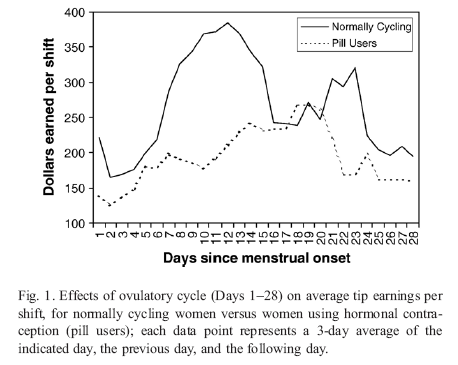
Further evidence comes from a study by Geoffrey Miller and colleagues, looking at men’s willingness to pay professional lap-dancers for sexual access over the menstrual cycle. This was a difficult study to do, and assumed that ovulation occurred on a standard day during the menstrual cycle, which we know is not valid, because women vary in ovulatory timing and may not ovulate in otherwise normal menstrual cycles. Nonetheless, the average curves for women selling sexual access through lap-dancing show a menstrual pattern in profits that is strikingly similar to the pattern of estrogen over the menstrual cycle. Women taking oral contraceptives both made less money, and did not show the same pattern as those who were naturally cycling.

RSS