Blog of the Society for Menstrual Cycle Research

The Wandering Uterus

December 5th, 2009 by Elizabeth Kissling
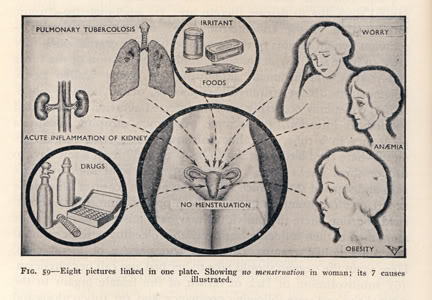
Image from Illustrated Encyclopedia of Sex, 1950, Cadillac Publishing Company

Image from Illustrated Encyclopedia of Sex, 1950, Cadillac Publishing Company

Guest Post By Elissa Stein

Cross-posted at Wonders & Marvels

While the uterus is a remarkable part of a woman’s anatomy—it can house a growing baby, then shrink back to its original size, work month after month for 40 or so years regenerating its lining, keeping hormones in check—it is part of a greater whole.

But ancient Egyptians believed the uterus was a free-floating, independent, autonomous organ that wandered the body, its traveling ways causing all sorts of mental and physical maladies, disturbing and disrupting women from the inside out. A visit upward created respiratory issues, with anxiety thrown in, too much movement down south—intestinal distress.

To combat these problems doctors tried solutions at both ends, either feeding noxious substances to women, hoping to force the uterus away from the lungs and throat, or placing sweet smelling substances on the vulva, trying to coax the errant traveler back into place. Another solution? Marriage. Actually, sex. But, back then, sex alone was not prescribed by doctors as a viable treatment.

The ancient Greeks also blamed the female-centric organ for everything from seizures to depression. Their word for uterus, hystera, is the root of both hysterical and hysteria. From the beginning of recorded history, hysterical behavior—out of control emotions, irrational fears, unregulated, over-the-top conduct—was associated with women, the uterus the epicenter of blame. In fact, for centuries, a hysterectomy, or removal of the uterus, was thought to cure emotional instability, as well as a host of other unrelated symptoms.

Hysteria was a medical diagnosis in the United States until 1951. 1952? The term PMS was coined, a catchall diagnosis that picked up where hysteria left off. And while people no longer believe the uterus has a mind of its own, it’s still used as the hapless scapegoat for countless unexplainable symptoms.

Elissa Stein’s latest book, with Susan Kim, is Flow: The Cultural Story of Menstruation. Other projects include visual histories of iconic pop culture, New York City adventures with kids, and interactive thank you notes. She lives in New York City with her family.

Post to Twitter Post to Plurk Post to Yahoo Buzz Post to Delicious Post to Digg Post to Facebook Post to MySpace Post to Reddit Post to StumbleUpon

Hysteria: It’s HIS, too

November 15th, 2009 by Elizabeth Kissling

There’s a brief article in the current issue of The Lancet (free registration required) about the history of hysteria. Although I was aware of the history of the word referring to women’s health and behavior being determined by the uterus (hystera is Greek for womb), I did not know of the ancient belief that “retained sperm could contribute to male hysteria, igniting a debate which was to run for centuries over whether men could indeed suffer hysteria.” I’ve only heard of – and seen – the concept used against women. The article also references Elaine Showalter’s analysis of hysterical epidemics as a cultural phenomenon, but offers little analysis of its own.

Post to Twitter Post to Plurk Post to Yahoo Buzz Post to Delicious Post to Digg Post to Facebook Post to MySpace Post to Reddit Post to StumbleUpon

Of the womb: That’s hysterical

October 13th, 2009 by Elizabeth Kissling

Blogger Abby Jean has a great post up today at the new Feminists with Disabilities blog about the etymology of the word hysterical, and how it is used against both women and people with disabilities.

The word itself is derived from the Latin word hystericus, meaning “of the womb,” and from the Greek word hysterikos, meaning “of the womb, suffering in the womb,” from the Greek word hystera, meaning “womb.” And they understood the uterus to be the direct cause of hysteria.

[. . . . ]

So when someone on a blog tells me to chill out because it sounds like I’m hysterical about an issue,  the etymological meaning is that my failure to put a baby in my uterus (which has independent will and agency inside my body) has caused it to become angry, loose itself from its mooring, and start floating around inside of my body until it bangs into my brain and starts making me unreasonably upset.

[. . . . ]

When I am told I am hysterical, there is both 1) the implication that I am excessively or unreasonably emotional AND 2) the implication that my condition is unique to my femaleness. It’s also 3) implied that hysterical statements (or even statements from hysterical people) should be discounted and hysterical people need to change in order to participate in the discussion, or should be removed from it entirely.

There’s really sharp analysis and insight here, and an obvious connection to our work here at re: Cycling. As the kids say, go read the whole thing.

Post to Twitter Post to Plurk Post to Yahoo Buzz Post to Delicious Post to Digg Post to Facebook Post to MySpace Post to Reddit Post to StumbleUpon

Readers should note that statements published in re: Cycling are those of individual authors and do not necessarily reflect the positions of the Society as a whole.