Blog of the Society for Menstrual Cycle Research

Hymen Seek; or, Good Blood, Bad Blood

August 18th, 2011 by David Linton

The cultural taboo against male contact with menstrual blood can be traced all the way back to the Biblical book of Leviticus, and there have been various attempts to explain its origins, including the Freudian notion that male avoidance of menstrual blood stems from the fear that blood on the penis evokes fears of castration.

However, the contrary social value that prizes the presence of the hymen and, therefore, the evidence of its having been broken being blood on the penis, suggests a more complicated dynamic.*  James Joyce identified the conflict in the long stream of conscious ramble by Molly Bloom in Ulysses when she reflects on the connections she sees between the blood of her period and that produced by the broken hymen.

I bet the cat itself is better off than us have we too much blood up in us or what O patience above its pouring out of me like the sea anyhow he didn’t make me pregnant as big as he is I don’t want to ruin the clean sheets the clean linen I word brought it on too damn it damn it and they always want to see a stain on the bed to know youre a virgin for them all that’s troubling them theyre such fools too you could be a widow or divorced 40 times over a daub of red ink would do or blackberry juice no that’s too purply. . .

Today, rather than resorting to red ink or berry juice, as Molly Bloom suggests, women who can afford a surgical solution can purchase a hymen reconstruction operation.  But for those with fewer resources there are available fake hymen kits marketed under the name Joan of Arc Red.  Aside from the unfortunate image of poor Joan of Arc whose blood was shed at the burning stake rather than in a sexual encounter, these devices promise cheap and effective means of “passing” as a virgin.

When they first appeared, even the New York Times reported on the product, but not because of interest in quaint notions of virginity.  Rather, the focus was on the political ramifications.  The Times headline read, “Egyptian Lawmakers Want to Ban Fake Hymen.”  (10/5/2009) A member of the Muslim Brotherhood, Sheik Sayed Askar, was quoted as saying, “It will be a mark of shame on the ruling party if it allowed this product to enter the market.”  Other individuals interviewed for the article called for the exile of those who import the kits or some other forms of punishment.  The medical procedure that reconstructs a broken hymen by stitching is already illegal in Egypt.  It remains to be seen if the recent upheaval in Egyptian society will lead to changes in hymen values.

For more information on the story, a more detailed report is available at the Huffington Post.

*Editor’s note: For more on the just the anatomical eomplexity of this dynamic, see our December 8, 2009, post about the re-naming of the hymen as the vaginal corona.

Post to Twitter Post to Plurk Post to Yahoo Buzz Post to Delicious Post to Digg Post to Facebook Post to MySpace Post to Reddit Post to StumbleUpon

Recognizing the Vaginal Corona

December 8th, 2009 by Elizabeth Kissling

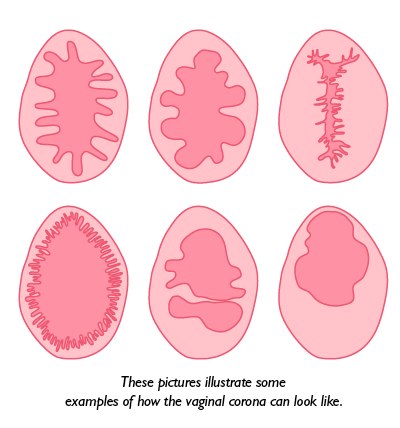
Vaginal_coronaVia the fabulous Scarleteen (best sex education resource on the web), I’ve just learned of the English translation of a remarkable booklet from Swedish Association for Sexuality Education: Vaginal corona: Myths surrounding virginity – your questions answered.

The mythical status of the hymen has caused far too much harm for far too long. Last spring, RFSU published an information booklet in Swedish intended to dispel some of the myths surrounding the hymen and virginity.

The booklet describes what the female genitals look like and what the vaginal corona actually is. It also dispels many of the myths surrounding female sexuality and the misconceptions concerning the hymen and virginity. Etymologically, the term hymen comes from the Greek word for membrane. In Swedish, the hymen used to be called mödomshinna, which translates literally as “virginity membrane.” In fact, there is no brittle membrane, but rather multiple folds of mucous membrane. A vaginal corona, in other words.

“The vaginal corona is a permanent part of a woman’s body throughout her life. It doesn’t disappear after she first has sexual intercourse, and most women don’t bleed the first time,” said Ms Regnér.

This is important work, and should be widely disseminated. At the link above, you can download the booklet in PDF form in Arabic, English, and Sorani, or order a print copy via email.

Post to Twitter Post to Plurk Post to Yahoo Buzz Post to Delicious Post to Digg Post to Facebook Post to MySpace Post to Reddit Post to StumbleUpon

Readers should note that statements published in re: Cycling are those of individual authors and do not necessarily reflect the positions of the Society as a whole.