Blog of the Society for Menstrual Cycle Research

Have You Had HPV? Tweet It Today!

September 16th, 2011 by Elizabeth Kissling

The Village Voice has declared today, Friday, September 16, ‘Tweet That You Have Had HPV Day’.

U.S. readers probably know that on Monday, Congresswoman Michele Bachmann upbraided Texas governor Rick Perry for requiring girls in his state to have the vaccine during a Tea Party sponsored debate among Republican candidates for the presidential nomination, and then claimed the HPV vaccine causes ‘mental retardation’.

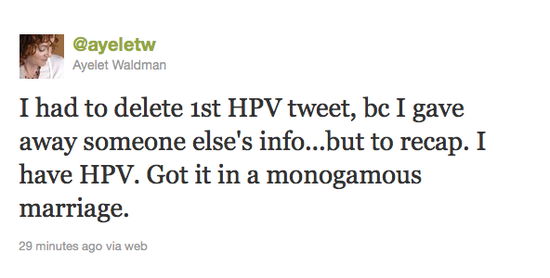
One dramatic response came on Twitter from writer Ayelet Waldman, who wrote that she got HPV from her husband in a monogamous marriage, and had to have cervical lesions removed. She was promptly told to keep that to herself, it was TMI, and that it was probably her fault for being slutty. (For an excellent critical summary of the whole kerfuffle, read Jill’s post at Feministe.)

HPV is easy to spread and hard to detect. From the CDC:

HPV is passed on through genital contact, most often during vaginal and anal sex. HPV may also be passed on during oral sex and genital-to-genital contact. HPV can be passed on between straight and same-sex partners–even when the infected partner has no signs or symptoms.

A person can have HPV even if years have passed since he or she had sexual contact with an infected person. Most infected persons do not realize they are infected or that they are passing the virus on to a sex partner. It is also possible to get more than one type of HPV.

HPV is easily spread, but can be prevented and treated. As the Village Voice article asserts, “Perhaps the greatest danger in the battle against HPV is one of PR. People are ashamed (after all, it’s an STD), and women in particular are shamed. No one wants to admit it, no one talks about it, and when people do, it’s in whispers and there’s a lot of misinformation.”

So talk about it, tweet about it, and don’t be ashamed. Fight sex negativity.

Post to Twitter Post to Plurk Post to Yahoo Buzz Post to Delicious Post to Digg Post to Facebook Post to MySpace Post to Reddit Post to StumbleUpon

S.A.N.E Vax Objects to FDA Ruling Gardasil Use for Anal Cancer

December 29th, 2010 by Elizabeth Kissling

Guest post by Leslie Botha, S.A.N.E. Vax

Increasing Number of Consumers are Concerned over HPV Vaccine Safety

The FDA’s December 22, 2010 ruling to expand the use of Gardasil for anal cancer prevention is unacceptable, according to Norma Erickson, President of S.A.N.E Vax. Last Wednesday, the U.S. Food and Drug Administration approved Gardasil for the prevention of anal cancer and associated pre-cancer lesions due to human papillomavirus (HPV) types 6, 11, 16, and 18 in people ages 9 through 26 years. Immediately, the news flooded the media – with many postings on HIV/AIDS sites.

However, medical consumers are unaware the 2010 Gardasil® Patient Product Information (PPI) states if a woman has “…immune problems, like HIV infection, cancer, or takes medicines that affect the immune system” they must be reported to the health care provider. This should be of grave concern to HIV/AID patients and their physicians who may consider the vaccine to “prevent” anal cancer.

Gardasil is already approved for the same age population for the prevention of cervical, vulvar, and vaginal cancer and the associated precancerous lesions caused by HPV types 6, 11, 16, and 18 in females, and for the prevention of genital warts caused by types 6 and 11 in both males and females in the same age group. 
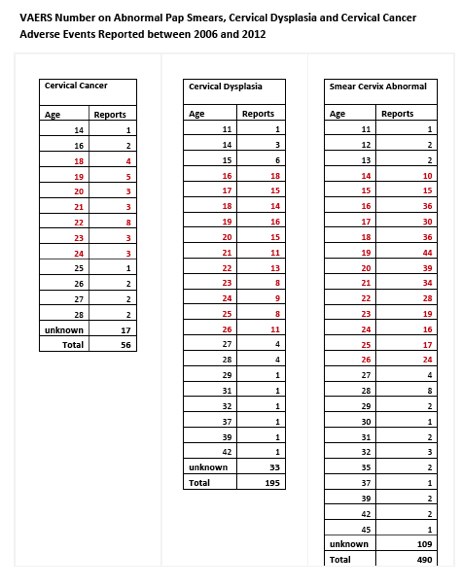
This same demographic has reported over 20,915 adverse reactions – mostly from Gardasil to VAERS – the Vaccine Adverse Event Reporting System. In addition, 89 deaths and 382 abnormal pap tests post vaccination have been reported with an estimated 1 to 10% of the population filing, according to the National Vaccine Information Center. The rate of deaths and adverse reactions are reported as a percentage of doses distributed, not doses actually administered, and therefore CDC statistics on reported injuries likely misrepresent their frequency.

Data on adverse reactions from males ages 9 to 26 are just starting to be reported to VAERS. Hundreds of social media sited, journalists, researchers and educators have joined forces to publicly decry the faulty science, data, research and fast-tracking of this vaccine through the FDA.

Of course, Merck & Co. denies a causal relationship between the adverse reactions and deaths to their award-winning vaccine. However, on December 20, the QMI News Agency in Canada reported a Quebec coroner can’t explain why a 14-year-old girl died after receiving a dose of the Gardasil vaccine. Even though coroner Michel Ferland’s report concludes the adolescent girl died from drowning, and while there is no evidence the shot killed the teenager, he is refusing to rule out a link between Gardasil and her death. On December 13, Michael Smith, North American Correspondent, MedPage Today wrote an article titled: Many Fail to Finish HPV Series as Recommended stating that “…Many girls and young women may not be completing all three doses of the quadrivalent human papillomavirus vaccine in a timely fashion…” According to Dr. Lea Widdice, Cincinnati Children’s Hospital Medical Center; in a single-institution retrospective analysis, only 14% of girls and young women completed all three doses within seven months of the first, and only 28% did so within 12 months.

Although statistical data was cited for non-compliance, SANE VAX wants to know if the girls were surveyed for their reasons in not completing the vaccine series. Until the true reasons are known, consumers must remain wary about the potential health dangers from the administration of Gardasil and Cervarix.

According to the FDA there are limitations on the use and effectiveness of Gardasil:

  • GARDASIL does not eliminate the necessity for women to continue to undergo recommended cervical cancer screening.

Cervical Cancer Vaccine NOT Recommended for Older Women

March 2nd, 2010 by Elizabeth Kissling
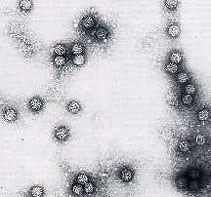
HPV virus magnified.

HPV virus magnified.

Although it pains me to see how low the threshold is for defining “older women” in this research, I am glad to see that the findings of this longitudinal study confirm that the HPV vaccine is of little to no benefit to older women. The study was published in Journal of the National Cancer Institute last month.

In a 7-year population-based cohort study in Costa Rica, the researchers looked at more than 9000 women in four age groups: ages 18–25, 26–33, 34–41, and ≥42 years to assess whether women’s age and the duration of carcinogenic HPV infections influenced subsequent persistence of infection and risk of cervical cancer. They found that regardless of the woman’s age, newly detected infections were associated with very low absolute risks of persistent infection or cancer.

Although cervical cancer is more common in older women, it usually develops many years – even decades – after exposure to a carcinogenic virus. The research team found that the rate of newly detected infections dropped with age — to 13.5 percent in women 42 and older, from 35 percent in women 18 to 25. In younger and older women alike, new infections generally cleared up without treatment.

The researchers concluded that the potential benefitof prophylactic vaccination or frequent HPV screening to prevent or detect new carcinogenic HPV infections is low in women aged 34 years and older.

Post to Twitter Post to Plurk Post to Yahoo Buzz Post to Delicious Post to Digg Post to Facebook Post to MySpace Post to Reddit Post to StumbleUpon

Readers should note that statements published in re: Cycling are those of individual authors and do not necessarily reflect the positions of the Society as a whole.