March 7th, 2010 by Elizabeth Kissling
Guest Post by Jerilynn C. Prior, Centre for Menstrual Cycle and Ovulation Research
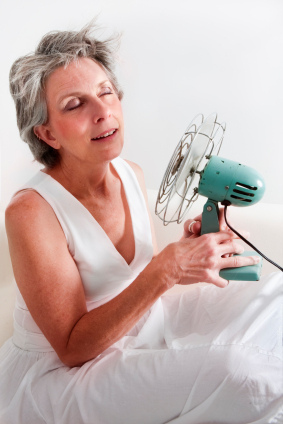
A hot flush causes failure on a lie detector test! The same galvanic skin response (in simple terms—clammy skin) is positive in both. Why? Because—with every flush—there is massive dogs’ breakfast of neurotransmitters and brain stress hormones released. These are the same brain chemicals that are produced as we struggle to create a plausible falsehood. Both arise from a fundamental, brain pathway that mediates both our physical and emotional responses to “threats” (be they nutritional, emotional, physical or some combination of stressors).
Some years ago a psychologist from London Ontario showed that menopausal women’s hot flushes were increased by stressful environment (1). Menopausal women who regularly experienced eight hot flushes a day attended two randomly-ordered 4-hour sessions a week apart. During the sessions they had flushes objectively documented by galvanic skin response. When they were forced to experience a chaotic environment, loud noises, unpleasant videos and bright lights, each of these women experienced more hot flushes; they did not in the alternative calm and pleasant session (1). Likewise, the large Study of Women Across the Nation showed that perimenopausal women who reported “trouble paying for basics” (like food and shelter) had more hot flushes than did those with economic and social security (2). Continue reading...
Tags: anatomy, bioidentical hormone therapy, guest post, hot flashes/flushes, Menopause, placebo effect
Posted in Health Care, Menopause, New Research | No Comments »
March 4th, 2010 by Elizabeth Kissling
The Indianapolis Star has a short interview today with Professor Janet S. Carpenter of Indiana University’s School of Nursing. Dr. Carpenter is conducting a study of whether menopausal women can control hot flashes through breathing techniques.
She told the Star:
Breathing techniques are something nurses use all the time. After surgery, we teach patients to inhale and take deep breaths to clear the lungs of anesthesia. We also teach patients slow, deep breathing to decrease anxiety. Because the study is blinded, I can’t talk specifically about what the two breathing programs are.
Some research seemed to show that it helped hot flashes. We actually think breathing techniques change a woman’s physiology so she will have fewer hot flashes, and if she has the same number of hot flashes, she will cope with them better.
I’ll look forward to seeing the results of her study (maybe I can talk her into presenting them at the next meeting of the Society for Menstrual Cycle Research!). If her hypothesis is correct, we’ll have an easy, cheap, and medication-free method for helping women cope with the discomfort of hot flashes.

Tags: hot flashes/flushes, Menopause, news
Posted in DIY, Menopause, New Research | 1 Comment »
November 5th, 2009 by Elizabeth Kissling
Guest Post by Jerilynn Prior, Centre for Menstrual Cycle and Ovulation Research
As a clinician scientist with expertise in hormones and women’s health, I sit in Canada and look at the hype and dis-sing going on about “bio-identicals” in the USA and shake my head. If we don’t want estrogen that is not FDA approved to be used to treat hot flushes, the simple answer is to regulate appropriately. The perpetual debate about bio-identical hormones has now hit USA Today with a headline: “Bioidenticals: Estrogen without FDA approval for menopause?”
In Canada, all hormonal preparations require a prescription. Full stop. And the pharmacists who compound estriol or progesterone do so with my prescription for a specific dose and clear purpose. Those compounding pharmacists are also regulated the same way as pharmacists who dispense FDA/Health Canada approved medications. End of story.
What bothers me is that I believe there is an intrinsic advantage to hormones that are molecularly the same as our bodies produce. They are certainly better, a priori than those that are natural for horses or are “similar-but-different.” When oral micronized progesterone (molecularly identical, Prometrium®) is prescribed with estradiol (there are multiple FDA-approved brands of molecularly identical estrogen), there is no increased breast cancer risk.[1] On the other hand, medroxyprogesterone (a similar synthetic derivative of progesterone) with estradiol increases the risk for breast cancer by 79%.[1] That’s called a nasty surprise. Continue reading...
Tags: estriol, estrogen, guest post, hot flashes/flushes, progesterone
Posted in Menopause, New Research, Pharmaceutical | 1 Comment »
Readers should note that statements published in re: Cycling are those of individual authors and do not necessarily reflect the positions of the Society as a whole.