Blog of the Society for Menstrual Cycle Research

The Smithsonian Menstrual Archive

November 6th, 2012 by David Linton

Down the Washington Mall from the popular National Air and Space Museum and the National Gallery of Art lies the sprawling National Museum of American History with its fascinating collections of the history of American material culture: early plows, bicycles, mail boxes, tobacco tins, thimbles, shoes, harnesses, tools, stoves, and every other imaginable artifact from every aspect of American life.  The collection spans domestic, economic, military, technological, media, educational, and virtually every other realm of human endeavor.

And, locked away in a climate-controlled room next to cabinets full of objects associated with medical, disability, reproductive and health concerns are drawers full of items that woman have used to manage their periods.

Photo by David Linton

I was given a private tour of the collection by Dr. Katherine Ott, a curator of Science, Medicine, and Society at this branch of the Smithsonian and lead editor of Artificial Parts, Practical Lives: Modern Histories of Prosthetics. Her knowledge of the collection, its content, sources, and significance was coupled with a generous enthusiasm in sharing it.  The item we both marveled at most was a package of sanitary napkins made of sphagnum moss. Sphagnum moss is a substance commonly used today to line hanging pots of ferns and other plants to absorb and hold excess moisture.  It was also used by native American mothers who stuffed the moss into papoose back packs — early environmentally friendly disposable diapers. This menstrual management device consisted of a strip of moss wrapped in gauze and provided with safety pins to attach it inside an undergarment.

The packaging itself contained several details that revealed much about the menstrual ecology of the times. The demure picture of the “Sphagnum Moss Girl” dressed in a uniform echoing Clara Barton’s Red Cross nurses was coupled with a line that reinforced the picture, “Sphagnum Moss was used by the American Red Cross in the manufacture of surgical dressings for war time use”. This is strikingly similar to the descriptions used in the earliest advertisements for Kotex, which the company claimed was originally produced for use in front-line hospitals during World War I (or “the World War”, as it was described at the time before a second came along).

Photo by David Linton

And, in true ad-speak fashion, the product was given a catchy name: “SFAG-NA-KINS”. The package included a folded page titled, “A Short History About Sphagnum Moss From Which Sfag-na-kins Are Made”. The pamphlet includes details about how the substance was used by the Japanese army during their war with Russia and how it was perfected by various doctors and medical researchers, including one Dr. J.B. Porter of McGill University. Apparently competition from wood pulp-based products such as Kotex was already starting to take shape, as the pamphlet goes on to claim, “The SFAG-NA-KINS will be found to be greatly superior to anything else now on the market, and one of them should be equvilent to three or more of the Cotton Sanitary Napkins. The complete elimination of any stain to garments is only one of the many superior features of the SFAG-NA-KINS”. The fact that pulp products won out in the market may be due to the fact that “Kotex”, with its resonance to “cotton”, a substance more familiar and acceptable than moss, is a catchier name than the hard-to-pronounce and “sfag-na-kins,” not to mention the unsavory image of walking around with a wad of moss between one’s legs.

In addition to this rare mass marketed moss product, the collection contains every imaginable brand of pad, tampon, cup, and belt as well as drawers full of cycle management drug products including one of the original circular birth control pill dispensers. Adjacent cabinets were filled with hundreds of condom packages, pessaries, IUD’s, cervical caps, devices for containing a prolapsed uterus, and related marketing and educational posters, flyers, and brochures.

My tour of the Smithsonian collection and Dr. Ott’s insightful narration of its history enhanced my understanding of the complex connection between the biological characristics of the menstrual cycle and the social and economic context in which it exists.

Vintage FemCare Advertising

January 20th, 2011 by Elizabeth Kissling

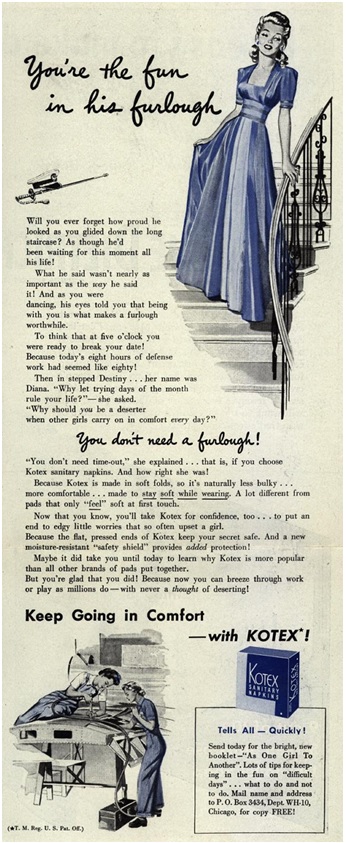
In my visual communication class this week, I used several femcare ads (along with a couple of cell phone commercials and other images) to illustrate Althusser’s concept of interpellation. My students got more of a lesson than they bargained for, as I ended up also talking a little about the history of advertising for femcare products. I mentioned but did not show this historically significant ad, notable to my students for the appearance of pre-Friends Courtney Cox, but more important because it was the first time the word “period” was uttered on television in a menstrual product ad.

It aired in 1985.

Book Review: The Modern Period

February 8th, 2010 by Elizabeth Kissling

If I correctly understand the terms of SHM’s copyright agreement with Oxford University Press, I am permitted to publish this unedited version of my review as a “pre-print” article. The final version will be available only from Social History of Medicine.

Lara Freidenfelds, The Modern Period: Menstruation in Twentieth Century America, Baltimore: Johns Hopkins University Press, 2008. Pp. 242. £31/$60. ISBN 978 0-8018 9245 5.

Book cover: The Modern Period by Lara Freidenfelds Lara Freidenfelds, an historian currently teaching in Women’s Studies at Wellesley College, has written a thorough and engaging history of menstruation in twentieth century USA. Her title, The Modern Period, is more than a succinct description; it cleverly references her discussion throughout of how advancing Progressive values shaped beliefs and practices surrounding menstruation. These Progressive values included faith in scientific rationality, belief in the value of education, and unqualified endorsement of technological progress. The ‘modern period’ also references the evolution of menstrual management practices into a coherent whole and the movement away from practices and beliefs considered old-fashioned, such as worries about catching a chill or the use of cloth pads. Her analysis throughout addresses the class implications of modernization; that is, the perceived need to adopt modern practices of bodily presentation and self-control for class mobility. Such modernization, asserts Friedenfelds, is a key component of Americans’ ability to see themselves as middle-class across great gaps in education and income.

Friedenfelds skillfully integrates a variety of historical sources, such as advertisements, promotional brochures, educational texts, and previous historical and sociological research on menstrual beliefs and practices with her own extended interviews with women and men of a range of ages, occupations, social standings, and ethnic backgrounds. This adroit synthesis helps Friedenfelds show how the modern period was created collectively by advertisers, health educators, manufacturers of menstrual products, and other ‘experts’, with the eager assistance of ordinary people.

The diversity of age and ethnicity among Friedenfelds’ interview participants is particularly striking and significant in a work such as this: the oldest informant was born before 1910, and the youngest after 1970. The 75 interviewees included white Americans in New England, African Americans in the rural South, Chinese Americans in California, as well as 13 people from other backgrounds. Examples from these interviews are well contextualized and grounded with historical research.

Friedenfelds’ choice to organize The Modern Period thematically rather than chronologically made the text a more appealing read as a whole while simultaneously making it possible for each chapter to stand alone. This organizational choice also makes clear how changes in the evolving modern period came about gradually and often in fragmented ways. The book is divided into five chapters, plus brief introduction and conclusion, around the themes of life before modern menstrual management, modern talk about menstruation, modern menstrual behavior, modern techniques of menstrual management, and a fifth chapter about tampons as a case study in controversy.

Some contemporary readers may find it difficult to believe that tampons were once controversial. But when they were first introduced as a commercial product in the 1930s and 1940s, both menstruators and physicians were skeptical about their safety and efficacy. There were also debates about the sexual implications of tampons, and whether it was advisable for sexually inexperienced women to use them. This chapter provides a keen example of how effectively Freidenfelds uses interview data to supplement documents-based research: Using tampons required women to cross boundaries of race, class, culture, and region, as well as learn different bodily practices required by tampon use compared to menstrual pads. Freidenfelds shows this with vivid interview narratives about women experimenting on their own to learn how to insert a tampon, modern daughters explaining to traditional, immigrant mothers that tampons were safe, and more. The frankness of these narratives is a testament to Freidenfelds’ skill as an interviewer.

Readers should note that statements published in re: Cycling are those of individual authors and do not necessarily reflect the positions of the Society as a whole.