Blog of the Society for Menstrual Cycle Research

“Death Loves Menopause”: Heart and Stroke Foundation Sends Wrong Message

February 8th, 2012 by Laura Wershler

The Heart and Stroke Foundation of Canada has inaccurately branded menopause as a killer of women. I will not be sending them a donation.

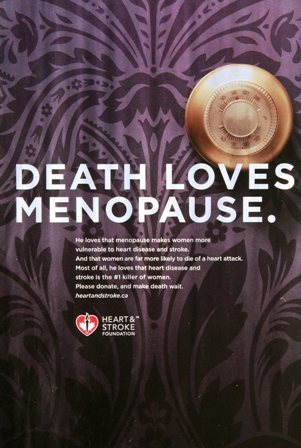
Last October, the foundation launched a fundraising campaign called Make Death Wait. Magazine and TV ads personify death as a man with a disembodied voice (he sounds like a stalker) who says he loves women (and men) and is coming to get them.

Eileen Melnick McCarthy, director of communications for the foundation, wrote to me in an email that the intent of the campaign is to “wake up Canadians to the threat of heart disease and stroke.” The campaign – urging viewers to “make death wait” by making a donation – has drawn both support and criticism.

Note the stereotypical hot flash reference: The thermostat is set at 15 C (60 F) but reads 23 C (73 F).

Photos of the ad by Laura Wershler

I think the TV ads are creepy, but what disturbed me more was the Death Loves Menopause message in the December issue of Chatelaine, Canada’s oldest women’s magazine. The small print reads: “He loves that menopause makes women more vulnerable to heart disease and stroke.” But is this statement defendable?

Dr. Jerilynn Prior, endocrinologist and scientific director of the Centre for Menstrual Cycle and Ovulation Research, wrote in an article about women’s risk for cardiovascular disease that the assumption heart disease in women is caused by estrogen deficiency associated with menopause  is a myth:

The reasoning behind this notion goes like this—young women have lots of estrogen and don’t get heart attacks. Older menopausal women are “estrogen deficient” and get heart attacks. Therefore, lack of estrogen causes women’s heart disease. That is like saying that headache is an aspirin-deficiency disease!


It is true that heart disease and stroke is the #1 killer of women, but the ad’s assertion that it is menopause that makes women more vulnerable raised the ire of women’s health experts I asked for comment.

Joan Starker, a PhD clinical social worker specializing in midlife, menopause, and aging issues, called it “an appalling and shocking advertisement.” Starker says she and her colleagues have “worked hard to shatter negative conceptualizations of menopause and aging. When I viewed this ad, I was left with only one horrifyingly toxic message – menopause equals death – which is ageist and sexist.”

Barbara Mintzes, assistant professor at the University of British Columbia, calls the ad “misleading and inaccurate” and says “there is no sudden shift in the rate of heart disease post- versus pre-menopause (or around age 50), as would be expected if menopause was a major risk factor for heart disease.  As women age our risks of heart disease gradually increase, similarly to ageing in men.”

My fellow blogger, Paula Derry, is a PhD health psychologist who critiques, analyzes, and theorizes about menstruation research/theory, with menopause being one of her specialties. “The idea that women’s risk of heart disease increases after menopause is a common one, yet there is little evidence for any increase in risk, much less that menopause is a key cause of heart disease and death,” she says.

Derry cites a 2011 paper in the British Medical Journal - Ageing, menopause, and ischaemic heart disease mortality in England, Wales, and the United States – that concluded aging rather than menopause was key: “Heart disease mortality in women increased exponentially throughout all ages, with no special step increase at menopausal ages.”

Last March, the American Heart Association issued the Effectiveness-based Guidelines for the Prevention of Cardiovascular Disease in Women—2011 Update. These guidelines present a long list of risk factors such as obesity, poor diet, physical inactivity, high cholesterol, hypertension and diabetes. Menopause is not included as a risk factor and is mentioned in just one sentence in the document.

As Derry says, “If I were going to donate money to an organization it would not be to one that tried to scare me with what I understand to be inaccurate facts.”

The Heart and Stroke Foundation of Canada should “wake up” to the truth about heart disease and menopause.

Post to Twitter Post to Plurk Post to Yahoo Buzz Post to Delicious Post to Digg Post to Facebook Post to MySpace Post to Reddit Post to StumbleUpon

Cardiovascular deaths increase with steady aging, not menopause

September 27th, 2011 by Chris Hitchcock

Earlier this month, researchers published a statistical analysis of mortality data in England, Wales and the United States, disproving the common statement that, after menopause, women face increased rates of mortality from heart disease. There are other studies that have come to similar conclusions, but there are a few things that make this study different. One is that it drew on epidemiological data from three different parts of the world, which reduces the likelihood of a local coincidence. A second is that they took care to create longitudinal data sets, comparing women born in different birth decades with the appropriate mortality over time. In doing so, they avoided the problems of cross-sectional data.

The authors found that there was a steady exponential increase in risk with age, and that there was no sign of accelerated risk at the typical age of menopause (50). They compared different versions of mortality curves, and were able to show that a two-stage model of mortality with a hinge at menopause was not a good fit to the data.

These findings have received national and international coverage, and are a major blow to the argument that menopausal women require premenopausal hormones to retain premenopausal protection from cardiovascular risk. Menopausal women are older than premenopausal women, and that is why they are more likely to die from cardiovascular disease, not because of the hormonal changes of menopause.

Post to Twitter Post to Plurk Post to Yahoo Buzz Post to Delicious Post to Digg Post to Facebook Post to MySpace Post to Reddit Post to StumbleUpon

More news about irregular cycles

November 22nd, 2010 by Elizabeth Kissling

Last week, we reported that new research shows a relationship between irregular menstrual cycles and sleep difficulties. Now we learn that irregular menstrual cycles are associated with a higher risk of both type 2 diabetes and coronary disease.  As we’ve said many times, the menstrual cycle doesn’t happen just in the uterus and vagina; it is part of a complex system, affecting nearly every other bodily system, and a window into women’s health.

Post to Twitter Post to Plurk Post to Yahoo Buzz Post to Delicious Post to Digg Post to Facebook Post to MySpace Post to Reddit Post to StumbleUpon

Time and Time Again

April 18th, 2010 by Elizabeth Kissling

Guest Post by Paula S. Derry, Ph.D.

Déjà vu

An article in today’s New York Times Magazine recounts the author’s experience with a debilitating depression that began during her perimenopause, the transitional time leading up to menopause.   For her, prescription estrogen was a life-saver that alleviated her symptoms.  The article places her experience in the context of research on the Timing Hypothesis, an idea that arose after the Women’s Health Initiative, or WHI, research project.  WHI clinical trials documented that hormone supplements after menopause did not, as had previously been assumed, lower a woman’s risk of heart disease.  Heart disease risk was not lower, and, in fact, when a number of chronic illnesses were considered together, the medication did more harm than good overall.  The Timing Hypothesis is the idea that the WHI was fundamentally flawed, because hormones must be started right around the time of menopause to have a health-promoting effect and the subjects in WHI were on average over 60; if started when a woman is older, when chronic illnesses have already started, the hormones are actually harmful rather than helpful.  The Sunday New York Times article presents this idea uncritically, without quoting any of the many experts who do not find it plausible or convincing, and, in addition, presents a lurid, unscientific  description of perimenopausal hormonal dynamics with words like “ricocheting hormones” and an “upheaval” that causes a “hellacious strain” on the brain. The author suggests that WHI was  a poorly planned study that asked the wrong questions with the wrong methodology.  The Timing Hypothesis, if true, might lead to a cure for Alzheimers and have other important health repercussions.


Time for a reality check.

Let’s go back in time to before the WHI research. Beginning in the 1980s, professionals asserted that hormone therapies were safe and effective to prevent chronic illnesses, especially heart disease, in postmenopausal women.   This idea was aggressively promoted, and it was not limited to women around the time of menopause.  Clinical trials are required to prove that a new medication is safe and effective before the Food and Drug Administration will approve that medication. However, once approved and available on the market, it is okay for doctors to use their judgment and prescribe the drug for whatever use they believe is reasonable.  Many of the claims for estrogen were for this kind of off-label use because there was no clinical trial proof that estrogens reduced heart disease, made women “feel better,” or improved their lives in many other ways being claimed.  However, other kinds of evidence made it seem plausible. There were “biologically plausible” mechanisms–this means that because of things we know about the body–like the fact that there are estrogen receptors in the brain–it is plausible, we can hypothesize a way that  estrogen would have a certain health effect.  There were the personal experiences of women. There was the idea that menopause was intrinsically unhealthy and that women were not meant to “outlive their ovaries.” Using estrogens was compared by some to using vitamin supplements or to a diabetic using insulin. There was a strong conviction among certain enthusiastic scientists and practitioners, some of them highly respected individuals, that it was all so. Professional groups of various sorts frequently issue opinions about medications; here, many groups offered the opinion that all women be offered hormone treatment.  Physicians were encouraged to prescribe hormones for disease prevention because it was so certain that it would help their patients, rather than waiting for the slow process of clinical trials to take place. Wyeth, a pharmaceutical company,  asked the FDA to approve estrogen for heart disease prevention even without clinical trials.

Readers should note that statements published in re: Cycling are those of individual authors and do not necessarily reflect the positions of the Society as a whole.