Blog of the Society for Menstrual Cycle Research

Things We Don’t Talk About: Healing Narratives from the Red Tent

March 19th, 2012 by Chris Bobel

What would the world be like if young women were mentored by older women?

What would the world be like if we knew we had a place for our stories to be told?

So intones the voiceover at the start of the trailer of a forthcoming film.

And it is right on time.

The recent media attention paid to Tomi- Ann Roberts and Nikki Dunnavant’s research recent re: religious identification and menstrual traditions has got me thinking (more than usual) about women, bonding and menses. Roberts and Dunnavant’s religious women harbored more negative attitudes toward their periods than their secular counterparts, but they reported a sense of woman-to-woman connection during their menstruation that non-religious women did not.

So how do we create community and lose the shame?

Red tents anyone?

“Things We Don’t Talk About: Healing Narratives from the Red Tent” explores the increasing reach of the “Red Tent Temple Movement” seeded by women’s empowerment facilitator Alisa Starkweather and inspired by Anita Diamant’s 1997 bestselling novel The Red Tent – a rich fictionalized treatment of biblical character Dinah. In the novel, Dinah and her tribeswomen gather during their menses in a sacred women-only space.

The practice in a book became a movement.

Starkweather and others in more than 50 red tents across the nation and beyond (in 30 states and 6 countries) believe that the simple practice of gathering women and girls in a space dedicated ONLY to them (whatever their date on the menstrual calendar) is precisely what women and girls need to feel supported and nurtured. This is the stuff of healing, they say.

Red tents are an initiative within what I call the ‘feminist spiritualist’ wing of the menstrual activist movement — a loose collection of activists who emerged in the 1970s and share an earnest celebration of embodied womanhood. This style of activism, I’ve argued, has endured and innovated for more than 4 decades, but remains on the fringe of feminist movements as a mostly white middle class concern.  Liedenfrost’s film, however, may nudge an expansion of the movement (or perhaps, show that it is already slowly capturing a diverse following?). A commitment to inclusion rings through the voices of the women captured in “Things We Don’t Talk About….” Red tents, as one woman explains during the trailer, are safe, welcoming and invite each woman to “come as you are and who you are is enough.”

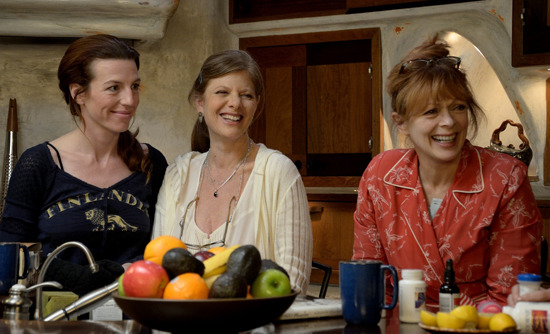
Filmmaker Isadora Gabrielle Liedenfrost, a seasoned filmmaker specializing in “multicultural motifs and embedded cultures and spiritual traditions” presents a rich palette of reds, auburns, and fuchsias and a haunting soundtrack in this piece. Her camera brings us images of small and large groups of women crying, laughing, dancing and hugging together woven with the heartfelt stories of the empowering benefits of women-in-community.

Photo credit: Isadora Gabrielle Liedenfrost (used with permission)


I am left asking: could red tents offer women—whatever their spiritual inclination—a shame-free community? Could they restore a lost tradition now updated in a contemporary body-positive context? Surely, the feminine intimacy offered here is not for every woman, but for many, it might feel like home is a lovely little tent.

Post to Twitter Post to Plurk Post to Yahoo Buzz Post to Delicious Post to Digg Post to Facebook Post to MySpace Post to Reddit Post to StumbleUpon

“It means there’s blood flowing out of my uterus!”

November 4th, 2011 by Elizabeth Kissling

So says 15-year-old Judy to her boyfriend Johnny on the occasion of her first period, in this vintage film about menstruation, Linda’s Film About Menstruation. This 18-minute treasure was produced in 1974 by the Creative Artists Public Service Program of the New York State Council of the Arts (CAPS), a program that ran from 1970 to 1981.

Would that cities and states still had arts budgets for these kinds of projects!

Post to Twitter Post to Plurk Post to Yahoo Buzz Post to Delicious Post to Digg Post to Facebook Post to MySpace Post to Reddit Post to StumbleUpon

Golly! Molly is growing up.

February 14th, 2011 by Elizabeth Kissling

Molly Grows Up _ screenshotPreparing for class discussions this week about sex education policy in the U.S. found me flipping through the Prelinger Archives, where I found this gem: Molly Grows Up. It’s a menstrual education film apparently intended for girls in about the sixth grade, made in 1953. Along with a basic explanation of the physiology of menstruation and puberty, the school nurse assures the girls that no one can tell when they are menstruating. But then she offers them this advice visible in this screen shot — and recommends the girls wear their best dresses and take extra care with “hygiene”.

You can view the film here.

Post to Twitter Post to Plurk Post to Yahoo Buzz Post to Delicious Post to Digg Post to Facebook Post to MySpace Post to Reddit Post to StumbleUpon

Cup U

December 4th, 2010 by Elizabeth Kissling

Vanessa Tolkin Meyer recently published her thesis film on Vimeo: it’s a short film about the menstrual cup. It’s also about attitudes toward menstruation and how we talk about it.


Post to Twitter Post to Plurk Post to Yahoo Buzz Post to Delicious Post to Digg Post to Facebook Post to MySpace Post to Reddit Post to StumbleUpon

Menarche at the Movies

June 1st, 2010 by Elizabeth Kissling

Only Yesterday DVD cover/movie posterI’m not an expert in Japanese anime films, but I am pretty knowledgeable about the representation of menstruation and menarche in films in the English-speaking world, especially the U.S. So I was surprised to read in this review/story about the Isao Takahata film, Only Yesterday, that the reason the film won’t be distributed on DVD in the U.S. because there is a menarche scene.

The reason Only Yesterday has not been released on DVD in the United States, and never will be in the near future, is because it includes references to menstruation. Disney has a distribution deal with Studio Ghibli, but decided it could not release the film because of this. And Studio Ghibli included a clause in their contract which stated the scene could not be altered. Removing this scene would have been detrimental to the film, also foolish. This is I’m sure a fundamental part of growing up for females, and the point of its insertion is that the ’82 Taeko is changing just as she was changing in 1966. She must learn to accept these changes, not reject them, and it is an issue she faces at both periods in her life. (no pun intended)

Menarche has been used in other films to communicate the same kinds of messages; as I argued in Capitalizing on the Curse, that was part of the purpose of Vada’s menarche in My Girl. This is a turning point in the film, in which Vada realizes that she is a girl, will develop into a woman, and must abandon her childhood pastimes – including her friendship with Thomas J.

Menarche scenes occur in other films as well, with similar plot functions, but usually the actual bleeding takes places off-camera, as in My Girl. (A Walk on the Moon is a notable exception.) I can’t tell from the review how explicit menstruation is in Only Yesterday, but given the description of the rest of the film, it’s hard to believe it justifies blocking U.S. release of the movie.

Post to Twitter Post to Plurk Post to Yahoo Buzz Post to Delicious Post to Digg Post to Facebook Post to MySpace Post to Reddit Post to StumbleUpon

Strawberries and Spinach: Menstrual Monday 2010

May 3rd, 2010 by Elizabeth Kissling

Guest Post by Geneva Kachman, MOLT: The Museum of the Menovulatory Lifetime

Back in 2000, when my Menstrual Monday journey began, an ever-reasonable friend had pointed out it took 13 years for Julia Ward Howe to establish Mother’s Day. Being a holidaymaker, and more on the creative side than reasonable, I poo-poo’d my friend’s caution. Seriously – Julia Ward Howe didn’t have the Internet! Thirteen years is two centuries in Internet time!

Eleven Menstrual Mondays later, I humbly look forward to the year 2012, and raising a glass (of tomato juice) to Julia Ward Howe, unmoved by any doomsday scenarios erroneously attributed to the Mayan calendar. Holidaymaking is just not as easy as it looks!

Display of Uterine Flying Objects (UFOs)

Display of Uterine Flying Objects (UFOs)

On the other hand, Menstrual Monday parties are rather easy to throw. Here’s all you need to do:

  1. Check out the official mission statement for Menstrual Monday – of note, the first goal is to create “a sense of fun around menstruation.” One benefit of “silly” party favors and decorations, such as the U.F.O. (Uterine Flying Object), PMS Blowt-Out, and Tampose (tampon + rose = tampose), is that women from all walks of life are put at ease, wondering “what is that?” rather than being focused on menstrual negativity (taboo and shame are such heavy words, aren’t they?).
  2. Ask everyone to bring something from the Five Menstrual Monday Food Groups: Green stuff, red stuff, chocolate, poppy seed, egg. Or serve a spinach salad with tomatoes, hard-boiled eggs and poppy seed dressing, with chocolate for dessert. Before sitting down to eat, why not chant “green stuff, red stuff, chocolate, poppy seed, egg” a few times, just for fun?
  3. To get the discussion going, you can download A Cuppa Questions from MOLT – the questions are printed on drawings of human ova. Cut the ova out, drop them into a cup, and let each guest select a question. Make sure to download the answer sheet as well. You can also cut out extra circles, for guests to write their own questions on.
  4. If you haven’t tried reusable menstrual pads or menstrual cups before, a Menstrual Monday party is a good time to learn about them. Two such companies are LunaPads and Glad Rags. You and your friends can decide to try these products yourselves – as well as donate pads to young women, who would otherwise be kept out of school.
  5. Display of MOLTwheels and red packaging.

    Display of MOLTwheels and FloFlags

    If you like working with fabric, check out Have a Hester at MOLT, and learn about scarlet letters and flow-dyeing. Right now I’m enamored of red shop rags – I add glitter glue, and use them to package MOLTwheels – the mini-frisbees in the photo. See what ideas you and your guests can come up with.

  6. Individuals can purchase a DVD copy of the documentary Period: The End of Menstruation? for $29.95. For more film suggestions for your party, see the FloFilm Index at MOLT.

I notice I’ve mentioned a couple of things that require spending money – the most intriguing question to me this Menstrual Monday is: Where is the intersection of feminism, menstruation, and entrepreneurship? I’m wondering: How can there be a transformation in attitudes toward the red stuff, without a corresponding transformation in where women’s green stuff (money) is being spent?

Strawberries and spinach: Food for thought, indeed.

Post to Twitter Post to Plurk Post to Yahoo Buzz Post to Delicious Post to Digg Post to Facebook Post to MySpace Post to Reddit Post to StumbleUpon

Bravery and Intellect Over Easy: Scrambled

March 12th, 2010 by Giovanna Chesler

(This post also published at the blog g6pix.)

I’ll try not to sound too fan-girlish here as I write about the documentary Scrambled: A Journey through PCOS by Randi Cecchine, but admittedly, it is a difficult task. For in this film, which chronicles Cecchine’s struggle with Polycystic Ovarian Syndrome, we meet a filmmaker brave enough to show us, wart-hairs and all, the challenges inherent in this disease embodied. She does so with humor, with information, and with space for personal reflection.

As Cecchine and the health practitioners she speaks with share, PCOS is a condition that affects 8% of women but that goes under-diagnosed. Though largely undetected in the women who have PCOS, the first sign of something wrong is the absence or change in the menstrual period. According to Cecchine’s participant Dr. Geoffrey Redmond, an endocrinologist who has studied female hormone problems for over twenty years, PCOS generally shows up during puberty or shortly during the menarche period. In his interview, he argues that a delay of fifteen years in diagnosis typically occurs because “people who care for teenagers are typically not clued into this condition.”

In popular rhetoric on menstruation and menstrual suppression, there are many voices who have argued that having a menstrual period is unnecessary and should be done away with through hormonal birth control regimens (for example, Lybrel, Depo-Provera and Seasonale.) These drugs are often presented as choices to girls and young women close to menarche. Scrambled serves to intercept this discourse by demonstrating how the cycle becomes a sign of imbalance and illness. This film reminds us of the value of attending to the menstrual cycle. In Cecchine’s case, as in the case of the many women she interviews in her film, the lack of a period is a personal introduction to the disease.

Cecchine works with a light yet serious tone. A visit to Harry Finley’s Museum of Menstruation underscores the connections between menstruation, body awareness and PCOS. Yet we are able to marvel and smirk at Finley’s collection of menstrual advertising and decades old menstrual protection products which now live in his basement. As her lived investigation continues, Cecchine meets up with the Polycystic Ovarian Association (PCOSA) at their conference. There her film does remarkable work, as it invites the viewer to join in the conversation. In the scenes around the conference, we see how this film works to invite fellow PCOS women into the information Cecchine has gleaned. Though knowledge will not cure one from the illness, certain techniques shared in the film (like limiting carbohydrate intake) will result in reduced symptoms.

In the recent release of the film, which is self distributed, Scrambled is a two disc set. The first disc includes the documentary, but the second disc is chock-full of informative interviews on a variety of topics. Cecchine profiles Redmond along with many other health workers practicing western, eastern and alternative medicine who speak of the options for treatment. These include diet alterations, drug regimens, psychotherapy, acupuncture and others. In this disc, Cecchine provides the tools for a viewer with PCOS to address her syndrome through many methods. By providing information in this manner, Scrambled becomes a guide and a tool for holistic health on a personal level.

But these treatments comes at an expense. Here Cecchine’s humor bubbles up again when she shares the different techniques, like hair removal, pills, acupuncture treatments and their resulting costs. Yet, the feeling that comes afterward: “Priceless!” Bitingly Cecchine reminds us that being a patient also involves being a consumer. Therein she complicates these treatments as choices and necessities simultaneously.

Readers should note that statements published in re: Cycling are those of individual authors and do not necessarily reflect the positions of the Society as a whole.