Blog of the Society for Menstrual Cycle Research

Figure Girl Fertility

January 18th, 2012 by David Linton

Guest Post by Lianne McTavish — University of Alberta

(aka Feminist Figure Girl)

While working out at the gym yesterday—something I do on a daily basis—I felt a strangely familiar pressure in my lower abdomen and noticed that it was protruding, despite the strong elastic of my Lululemon pants. ‘Oh I know what is going on,’ I said to my fit workout partner. ‘I am getting my period!’ She too was bloated and crampy, and we wondered if our cycles had synchronized during strenuous sets of wide grip chin ups and heavy dead lifts. Deciding that we were probably romanticizing our ovarian activity, we stopped talking and returned to our tabata-inspired drills, grunting out 50 burpees. Life was good.

Feminist Figure Girl poses in competition (Used with permission)

I was pleased with my body and its potential fertility, which made me feel younger than my 44 years. Just a few months ago I thought I might have entered menopause, though without any accompanying symptoms, except for amenorrhea. I had stopped menstruating while training and dieting for a bodybuilding competition. After being promoted to full professor at the University of Alberta, writing a couple of books, and publishing numerous articles, I needed a new challenge. Already a dedicated gym rat, I decided to enter a bodybuilding competition, doing so as a form of research. I began reading feminist theories of embodiment and cultural accounts of weight lifting, hired an established diet coach, took posing lessons, and learned how to walk in high heels. I entered a local contest in the category called ‘Figure,’ which favours muscular physiques with wide, capped shoulders, broad upper backs, and well defined quads, but requires a softer appearance than traditional forms of bodybuilding. Adopting a beauty pageant aesthetic, the exclusively female participants in Figure—known colloquially as ‘Figure girls’—wear blinged out bikinis and four-inch high plastic shoes while performing mandatory four-quarter turns to display every angle of their bodies to a panel of judges. I wanted to know why women found such contests empowering, even though these events might initially seem both oppressive and sexist. I also wanted to experience what it felt like to compete.

One physical result was the loss of my period. Six months before my show I had weighed 145 pounds and had my body fat carefully measured at 17%, but when I hit the stage at the Northern Alberta Bodybuilding Championships on June 4, 2011, I was 118 pounds and had only about 6% body fat. During that diet-down phase I had ceased taking birth control pills because the estrogen could soften my body, at odds with my goals. Although I used alternative forms of contraception, I feared that they would be less effective and began taking monthly pregnancy tests. The single blue line on the plastic stick was a relief to me, replacing the role of menstrual blood by providing visual evidence of my non-pregnant state.

My period had not returned three months after my competition, though I had gained about 15 pounds by eating larger amounts of healthy, high protein food. I was training just as hard at the gym; indeed I was lifting much heavier weights. During a routine physical in September, I reluctantly told my sensible-shoes doctor that I had not had a period in quite some time. ‘If I have already gone through menopause,’ I exclaimed, ‘it’s the bomb and I say bring it!’ ‘Oh no,’ she chuckled, ‘most of my athletic female patients no longer menstruate. Plus, you are only 44 and can probably squeeze out a few more eggs.’  Horrified by this news I cried out: ‘No, no more eggs!’ I had been hoping to wear the crown of sterility for the rest of my life.

New Technology, Same Mistakes

July 22nd, 2010 by Elizabeth Kissling

Screen shot from iOvulation appWe’ve written previously about some of the apps for tracking menstruation and PMS, but this new iPhone/Pad app for tracking ovulation is problematic.

iOvulation is an application that calculates the time of ovulation and generates your personal fertility calendar. Simply enter the length of your menstrual cycle and the date of your last period, and iOvulation will calculate your fertile days.

The web site suggests it useful both for trying to conceive and for trying to prevent conception. However, I wouldn’t recommend the latter, as its algorithm appears to predict ovulation based on dates of menstruation: “The ovulation dates are calculated based on normal menstruation calculation logic for women having regular periods.”

In other words, it perpetuates what Toni Weschler, author of Taking Charge of Your Fertility: The Definitive Guide to Natural Birth Control, Pregnancy Achievement and Reproductive Health and Cycle Savvy: The Smart Teen’s Guide to the Mysteries of Her Body, labeled the two biggest myths about menstruation in this interview with Scarleteen: (1) the idea that ovulation occurs on Day 14, and (2) A normal menstrual cycle is 28 days.

Also of interest is how squeamish the creators appear to be about sex and reproduction: the web site refers to “unprotected i*********e” and notes that the probability of conception is calculated “based on your ovulation time and other factors such as lifespan of the egg and s***m”. (For those of you unaccustomed to the practice of concealing obscenity with asterisks, that’s “intercourse” and “sperm”.)

As someone who studies and teaches sociolinguistics and writes about menstruation, I’ve seen a lot of euphemistic language over the years. But marking intercourse and sperm as unfit for print is a first.

Post to Twitter Post to Plurk Post to Yahoo Buzz Post to Delicious Post to Digg Post to Facebook Post to MySpace Post to Reddit Post to StumbleUpon

A New Blood Test to “Predict” “Menopause”? Is this What Women Really Want?

June 28th, 2010 by Elizabeth Kissling
Collage by Merlinprincesse | Creative Commons 2.0

Collage by Merlinprincesse | Creative Commons 2.0

Guest Post by Heather Dillaway, Wayne State University

I keep seeing news articles about a “new Iranian study” that hopes to better predict “age at menopause” for women, and the authors of this study supposedly discovered a “blood test” that will be able to “predict menopause” within the next few years. It is touted as a way to judge when women will be “done” or be at the “end” of “menopause” and also to predict by default when they will be at the “end” of their “fertile” years (so that maybe they can know when they have to pop out that first or last baby). After seeing so many references to this study over the last week and having studied how women feel about the “beginning” and “end” of menopause for the last ten years myself, I can’t just sit back and not critique the underlying assumptions that are part of this study and air some of the concerns that I have about this impending blood test.

First, there is an assumption that the cessation of menstruation (as biomedical researchers define it) is the defining moment of “menopause.” Thus, what these scientists are trying to predict is the age when women might reach “menopause” (or 12 months past their last menstrual period). Yet, not all women judge the “end” of menstruation as the most important aspect of their menopause experience, in fact many women are much more concerned about when other signs and symptoms of “menopause” will begin and/or how long they will last, for instance, irregular bleeding or heavy bleeding in “perimenopause” or hot flashes, night sweats, etc. Can a test predict when irregular bleeding might start and how long it might last? And if a test predicts that a woman might reach her “age at menopause” right after her 54th birthday, will that make a 45-year-old woman with irregular bleeding feel assured that she has only 9 years left? In addition, can a test predict how soon a woman might start experiencing hot flashes and how long they might last, if that is instead to be her most worrisome sign or symptom?  If a test predicts that a woman’s age at menopause will be around age 49, will that woman feel assured about her hot flashes at age 48, having no idea how long those hot flashes will last but maybe hoping that they’ll end right alongside her last menstrual period? While the authors of this study (like most other biomedical studies) want to continue to uphold the definition of “menopause” as the official “end” of menstruation and ultimately the “end” of fertility, and hold this up as the most important part of menopause that we should know about, I beg to differ. Women want to know more than just their “age at menopause” or the final end to their fertility.

Can you make a baby with a bottle of cough syrup?

April 13th, 2010 by Chris Hitchcock

In a story featuring a photo of a lovely couple holding a beautiful newborn, the Globe and Mail (a reputable Canadian national newspaper) has an article this week about using Robitussin as a fertility aid. According to the article, the TTC (trying to conceive) community is abuzz with this.

How an off-label application of over-the-counter cold medicine found a shelf life as a conception tool widely promoted online is a story marked with skepticism and disbelief. Robitussin’s effectiveness has been debated on chat forums, and references to its impact can be found in bestselling pregnancy books. In a time when fertility treatments cost thousands of dollars, it’s not surprising that a $5 solution has intrigued women for more than 20 years. But it is unusual that despite almost three decades of word-of-mouth debate, there’s little scientific evidence to prove that it works – or that it doesn’t – leaving it in a strange realm somewhere between old wives’ tale and unsung miracle drug.

The article later describes the published support for the active ingredient in aiding conception:

A Pennsylvania doctor, Jerome Check, published an article called “Improvement of cervical factor with guaifenesin” in the Journal of Fertility and Sterility in 1982. It documented a study of 40 couples who had been attempting unsuccessfully to conceive for at least 10 months.

The women were given 200 milligrams of guaifenesin three times a day, from the fifth day of menstruation through to ovulation. Dr. Check found that 23 of the women showed “marked improvement in postcoital tests after treatment, while seven showed slight improvement,” meaning that their cervical mucus was noticeably thinner.

More important, of those 23 couples, Dr. Check wrote that 15 became pregnant while testing the regimen. One patient with only mild improvement in her mucus levels also conceived. Dr. Check concluded that guaifenesin is “one of the simplest and cheapest treatment methods of addressing the cervical factor.”

I see that JH Check has published 3 further articles mentioning guaifenesin fertility, but he is a lone voice, aside from the TTC community of women, and some authors of lay books on becoming pregnant. A spokeswoman for the manufacturer said in e-mail, “We do not have any data for the use of Mucinex [the US product name] for fertility issues nor do we recommend its use for this purpose.” There’s no pharmaceutical interest driving (and funding) the research, so individual researchers need to somehow fund this themselves (would a national health granting agency fund such work?).

And apparently things like the quality of cervical mucous (which is part of how oral contraceptives block pregnancy) are no longer relevant, because

… the medical community has moved on, propelled by advances in technology that have seen in-vitro fertilization become standard treatment for fertility problems. “Cervical mucus can be overcome by doing insemination, so it doesn’t even matter,” Dr. Cheung said of Robitussin’s possible effect.

The article also describes the serious issues with ethics of research on infertility treatments, given the desperation of people seeking help:

“We see people who come to the support group who seem to be rushed into IVF without a real assessment,” she [Diane Allen, who runs the Canada-based Infertility Network] said. “They feel so desperate that if somebody told them to stand in the corner or cut off their arm or something – if they thought they’d have a child out of it – maybe they’d do it.”

Study links reduced fertility to flame retardant exposure

February 4th, 2010 by Elizabeth Kissling

Exposure to polybrominated diphenyl ether (PBDE) flame retardants is widespread, with 97% of Americans having detectable levels. Yet there have been no published studies of their effects on human fertility – until now. A study to be published in the January 26 issue of Environmental Health Perspectives reports that four PBDE congeners  were correlated with longer times to  pregnancy.

While this finding is expected and unsurprising, it does seem surprising that researchers have found no correlations with the presence of PBDEs and menstrual irregularity.

Post to Twitter Post to Plurk Post to Yahoo Buzz Post to Delicious Post to Digg Post to Facebook Post to MySpace Post to Reddit Post to StumbleUpon

How (and When) to Make a Baby

October 29th, 2009 by Chris Hitchcock

According to this article, a surprising number of women seeking infertility care don’t know when to effectively focus their efforts. Australian researcher (and SMCR member) Kerry Hampton asked women seeking infertility advice about the normal ovulatory menstrual cycle, and found that most women lack basic knowledge about the menstrual cycle, ovulation, and when the optimal time is to conceive.

A study of 204 women who attended assisted-reproduction clinics in Melbourne during 2007 and 2008 showed only 13 per cent had a good knowledge of the ”fertility window” in their monthly menstrual cycle when pregnancy can occur.

Fertility nurse specialist and Monash University researcher, Kerry Hampton, told the Fertility Society of Australia’s annual scientific meeting yesterday that 11 per cent of the women had no knowledge of the fertility window and 52 per cent had poor levels of awareness.

Ms Hampton said most of the women had been trying to conceive for one year or more when they were surveyed, and that if they had of known more about natural conception, they would have had a better chance of success.

”A lot of these women were not able to optimise their chance of natural conception because they didn’t understand the window,” she said.

Quote from Australian publication The Age (link above)

The article goes on to quote a number of infertility specialists who remark that timing conception to a woman’s menstrual cycle is too stressful, arguing that the stress of precise timing can itself cause fertility problems.

But does withholding information about a woman’s own fertility signs really reduce stress? And how stressful is it to learn to read the signs?

Using a daily charting tool, such as CeMCOR’s free Menstrual Cycle Diary, can help women to become aware of the cyclic changes that precede ovulation. You can spend a lot of money on LH kits, waiting for a one-day window that tells you that ovulation is impending. Or you can track changes in your own body, and get to know what will predict ovulation.

Keeping the diary itself can be interesting and informative, and also gives you some sense of predictability and understanding. Here are some signs to look for:

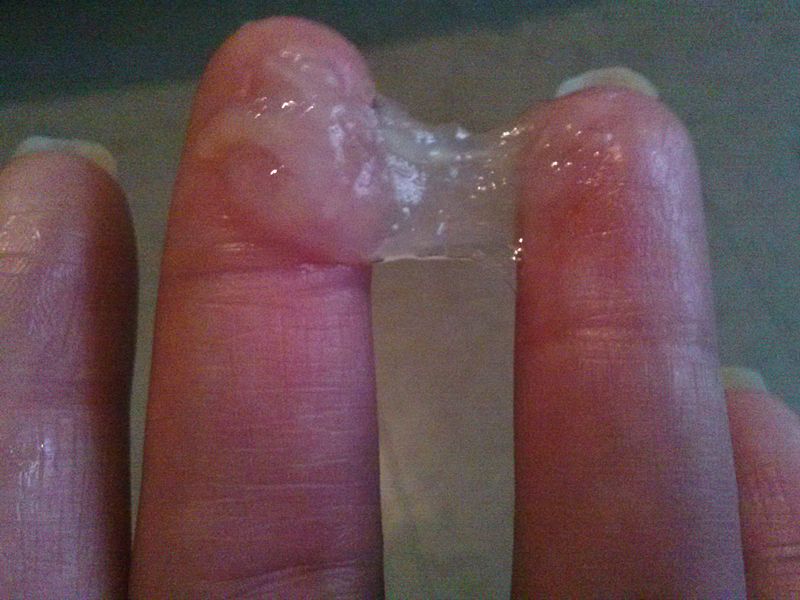
    Mid-cycle stretchy mucous (like egg-white), followed by a change to more tacky mucous. The mucous is a response to the estrogen produced by a growing follicle surrounding the egg. Peak mucous precedes the release of an egg, and the mucous itself helps with sperm motility and conception. Following ovulation, progesterone changes the mucous texture to a drier, tackier secretion.
    Menstrual Cycle Diary records – Over time, by comparing your own patterns of experience with the date of ovulation estimated by the basal temperature, you will come to understand your own fertility signs. Some women find that breast tenderness is helpful, most will find stretchy mucous helpful.
    To understand how these patterns are related to ovulation, the least expensive reliable method is to use Basal Body Temperature. Body temperature rises slightly following ovulation, which is a direct effect of the progesterone that is produced following ovulation. Using a basal thermometer (one that reads to 2 digits) each morning before rising, and writing down the temperatures each day gives the information needed to estimated when ovulation occurred. Digital thermometers with a memory for the previous temperature are an inexpensive investment.
    To formally calculate the date of likely ovulation, calculated the average value (add them up & divide by the number), then look for whether there was a shift from below the average to above the average. A “normally ovulatory” menstrual cycle needs to have at least 10 days of higher temperatures at the end of the cycle. This period of higher temperatures is called the luteal phase, it is generated by the progesterone that is made following the release of an egg, and if the interval is too short, there is not enough time for the fertilized egg to get started in the uterus (implanted) before your period starts. That’s pretty common, especially related to stress, and also to ageing (more common in perimenopause).

If you keep the diary for a few months, you will start to see patterns in your own body, and get to predict when you will ovulate. The temperature rise follows progesterone rise, which follows ovulation – ovulation likely occurred within 1-2 days prior to the temperature rise.

Readers should note that statements published in re: Cycling are those of individual authors and do not necessarily reflect the positions of the Society as a whole.