Blog of the Society for Menstrual Cycle Research

My Cycle Made Me Do It

October 19th, 2010 by Elizabeth Kissling

g2241hormonesThis morning, ladymag The Stir posted an article titled, “5 Weird Things Our Menstrual Cycles Make Us Do”. Over the weekend, science site Live Science featured an article about the recent surge in ovulation-related research (with the unfortunate title, “Booty Call: How to Spot a Fertile Woman”). As a quick perusal of re:Cycling archives will reveal, these are only the most recent mass media reports of research on how ovulation and female hormones purportedly determine women’s behavior. Recent research has linked hormones and/or ovulation to women’s preferences for masculine faces, why there are so few women sushi chefs, fluctuating cholesterol levels, chocolate cravings, and competitive bidding in online auctions.

I find myself increasingly weary of such stories, especially when they’re uncritically accepted and advanced.  I’m not so naïve as to argue that there aren’t any biological differences between women and men,* but in isolation, hormones explain very little about human behavior. Ovulation is part of a complex endocrine system, which is part of an even more complex body, which exists in a social world with complicated, byzantine, ever-evolving norms, rules, and consequences for our choices. Why are overly simple explanations so popular? Is the current embrace of biological determinism a marker of a new backlash?


*I will argue, however, that most of those differences aren’t as important as they’ve been made out to be.


Post to Twitter Post to Plurk Post to Yahoo Buzz Post to Delicious Post to Digg Post to Facebook Post to MySpace Post to Reddit Post to StumbleUpon

Estrogen is the New Ritalin. NOT.

May 10th, 2010 by Elizabeth Kissling

Guest Post by Barbara Sommer, University of California-Davis

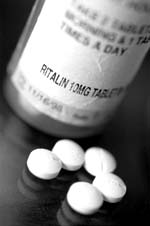
Ritalin bottle with tabletsWhy is it that assertions about hormones and behavior lead us to readily suspend our capacity for critical thought? It seems like folks will accept just about any assertion with regard to the power of estrogen and the fluctuation of the menstrual cycle.

My observations over several decades (I am nearly forty years post-doctorate) have been reassuring. I have not seen women crushed in the working and professional worlds by the demands of their physiology. In fact it looks like women might be moving towards running the world, at least in those areas where they have access to education. Nevertheless, it rankles when a journal of some credibility makes assertions based on scanty evidence.

It is difficult to evaluate the quality of the research underlying the claims of the article “Is Estrogen The New Ritalin?” in the current issue of Scientific American: Mind. The title is cute. A writer for the New Yorker recently claimed that “White is the New Black.” Do we believe it? The article was provocative, and did not pretend to be a scientific piece of work. In contrast, the estrogen piece, by appearing under the prestigious banner of the Scientific American, carries an imprint of scientific credibility. The first paragraph claims the menstrual cycle might affect the brain as much as caffeine, methamphetamines, and Ritalin. Nowhere in the study is there any indication that estrogen levels or even menstrual fluctuation effects were actually compared with the above substances. The author also claims that this study is “the first to show that cognition is tied to estrogen levels in people” – perhaps the first because no one else has done a good job of it, but certainly not for a failing to try. There are many published studies claiming that estrogen affects cognitive function.

The central problem with this report is that the scientific community has not vetted the research. There is nothing to suggest that it was subject to review. It has not been published – at least nowhere that could be found by this writer with access to a university library. I don’t expect a popular version of scientific research to include information about whether there were adequate controls for subject selection, for practice effects on the task performance, or that the claim of population dopamine levels was accurate, and whatever measure was used to estimate estrogen levels was reliable. But someone needs to have looked at those aspects of the research. Without that, we end up with questionable conclusions at best, and junk science at worst.

Post to Twitter Post to Plurk Post to Yahoo Buzz Post to Delicious Post to Digg Post to Facebook Post to MySpace Post to Reddit Post to StumbleUpon

And 58.4% of statistics are made up on the spot

April 18th, 2010 by Elizabeth Kissling

April 2010 magazine ad for Always Infinity maxi-padsThe latest magazine ad for Always pads (pictured at right) reads, “97% of women who tried Always Infinity said they’d recommend it to their friends.” Smaller print notes that these data are from a survey at Always.com — suggesting a self-selected population of women who like Always. Respondents who won’t recommend the product are dismissed as women who never like anything.

Sounds like someone’s been reading Darrell Huff’s classic book, How to Lie with Statistics!

Post to Twitter Post to Plurk Post to Yahoo Buzz Post to Delicious Post to Digg Post to Facebook Post to MySpace Post to Reddit Post to StumbleUpon

Time-limited opportunity! Don’t delay!

February 2nd, 2010 by Elizabeth Kissling

Cartoon: I can't believe I forgot to have childrenThere’s been quite a bit of internet buzz during the last week or so about a study conducted at University of St Andrews and Edinburgh University by Tom Kelsey, in which he and his colleagues develop a computer model of how a woman’s supply of eggs declines over time. The scaremongering accompanying news reports of this study is reminiscent of the 1980s kerfuffle about how women over 40 were more likely to be killed by a terrorist than to be married. Some headlines are proclaiming “Women lose 90% of eggs by age 30″ and advising women who want to be parents to act quickly. Some are even recommending fertility screening analogous to cancer screening.

Before you ladies under 30 rush off to get impregnated, let me point out a few things. First, this study is a computer model. It is not definitive evidence that women cannot conceive after 30. Second, there has been ongoing new research in the last several years that suggests mammals may be able to produce new ova, contrary to conventional doctrine that females have a fixed reserve of egg cells enclosed in the ovaries at birth. Although there are many skeptics, there is still a great deal that is unknown about how the ovaries work.

Third, it only takes one egg cell to make a baby.

Post to Twitter Post to Plurk Post to Yahoo Buzz Post to Delicious Post to Digg Post to Facebook Post to MySpace Post to Reddit Post to StumbleUpon

Bioidentical Balderdash

January 1st, 2010 by Chris Hitchcock

The bioidentical hormone therapy industry has been getting a bad rap lately in the US, and this press release is an example of why. Among other things, the writer confuses estrogen and progesterone, in one paragraph saying their product is a “safe and scientifically-proven, all-natural estrogen delivery cream[]“, and in the next describing it as a “natural progesterone cream” (emphasis is mine). Moreover, the press release springboards from another estrogen-positive press release that claims that estrogen may be the cure for female depression, citing an ob/gyn author of a book, and promoting a soon-to-be-launched web page.

So, in one breath the product is an estrogen delivery cream that will help with low estrogen, but in the next breath (on the linked product page) it is argued that it will help with estrogen that is too high (which is more accurate). The product website emphasizes that  it is “without dangerous pharmaceuticals”:

This remarkable product contains NO risky synthetic estrogens or progestins. [Product] Cream is similar to the progesterone your body naturally produces, so there are no worries about dangerous interactions or nasty side effects.

It’s been said that there are no side effects, there are just effects. It is odd to marry this claim that their product won’t have nasty side effects (because it is like the progesterone in your body) with the claim that progesterone cream will balance out the nasty effects of your own high estrogen levels.

Progesterone cream may well be better tolerated, but just because it’s natural, doesn’t make it so.

And, interestingly, despite being anti-big Pharma, the article adopts the pharmaceutical industry’s language of menopause as “estrogen deficiency” that has been so helpful to those who would market “hormone replacement therapy” as a cure for all female ageing. As is still common, it is assumed that perimenopause (the transition leading up to the last period) is a time of dropping estrogen. There’s also the assumption that the challenging issues of midlife are necessarily hormonal (rather than multi-faceted, including not only biological changes, but also cultural views of ageing, social context, socioeconomic issues, divorce-related poverty, even spiritual and psychological development).

It’s unfortunate that bioidentical has come to be associated with fuzzy thinking and poorly supported claims, because there are good, solid, well-researched arguments in favour of using naturally occurring molecules for therapy, particularly for hot flushes and night sweats. We’re analyzing data from the first randomized placebo-controlled trial of oral micronized progesterone for hot flushes and night sweats in early menopause, and we should have some data later this year to report.

It’s also worth noting that other countries do it differently – Canadians can buy progesterone cream such as this, but they do it with a prescription, at a specified dose, and for a particular issue. And people who try to sell it over the counter in a health store are prosecuted.


Post to Twitter Post to Plurk Post to Yahoo Buzz Post to Delicious Post to Digg Post to Facebook Post to MySpace Post to Reddit Post to StumbleUpon

Readers should note that statements published in re: Cycling are those of individual authors and do not necessarily reflect the positions of the Society as a whole.