The study [PDF] surveyed American singles ages 18–29 about their perceptions about and use of contraception. Twenty-eight percent of young men think that wearing two condoms at a time is more effective than just one. Twenty-five percent think that women can prevent pregnancy by douching after sex. Eighteen percent believe that they can reduce the chance of pregnancy by doing it standing up.
A staggering 42% of men and 40% of women believe that the chance of getting pregnant within a year while using the birth control pill is 50% or greater (despite research suggesting that the pill is typically 92% effective).
And many unmarried young adults believe they are infertile. Although available data suggest that about 8.4% of women 15–29 have impaired fecundity (measured as an inability to conceive or carry a baby to term): 59% of women and 47% of men say it is at least slightly likely they are infertile (19% of women and 14% of men describe it as quite or extremely likely.
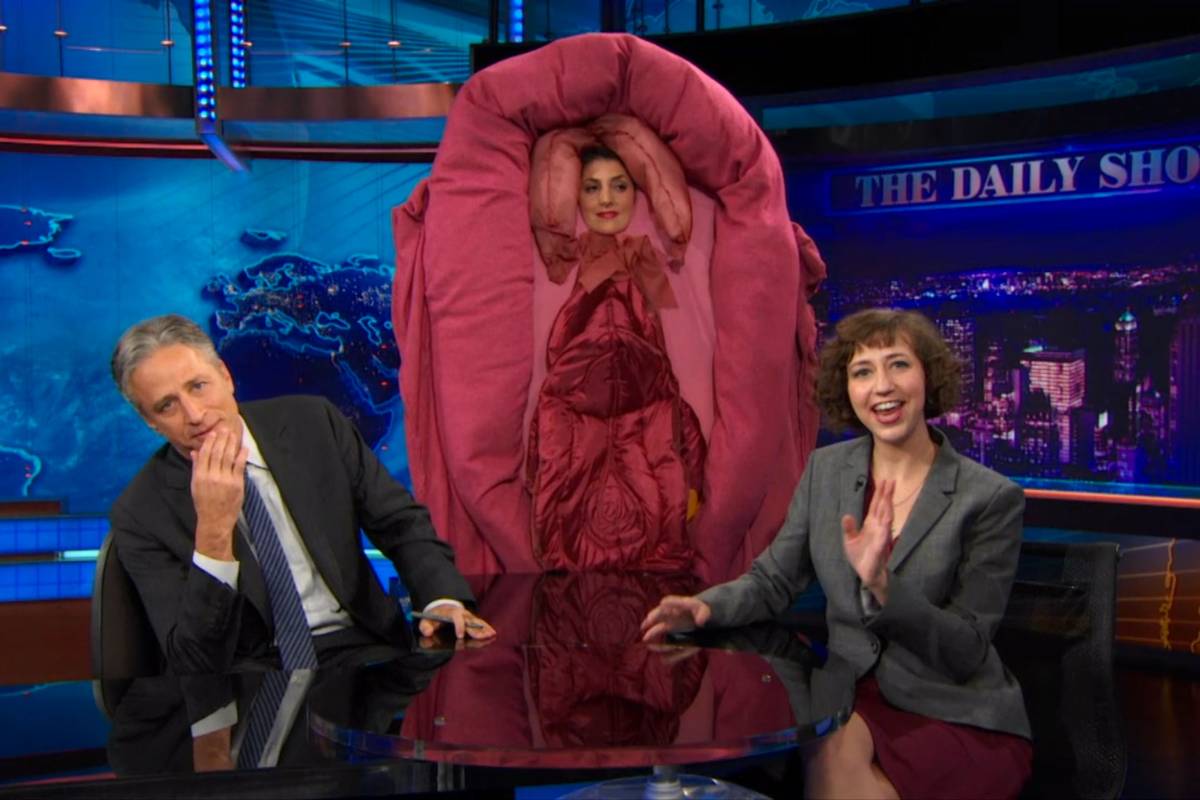
In a very good short essay about the study at The Sexist, Amanda Hess links men’s lack of knowledge about contraception to their lack of knowledge about menstruation and physiology more generally, and illustrates with some telling anecdotes. There are a few more examples in the video at right, in which Amanda corners several men and asks them to explain how hormonal birth control works.
It all seems quite shocking, until one remembers that abstinence-only sex education that includes lessons about the ineffectiveness of condoms and other contraceptives has been standard in the U.S. since 1996. (See here for U.S. Government definitional criteria for abstinence-only sex education. At present, 22 states have opted out of receiving federal funding, so that they may provide accurate and comprehensive sex education.)
If you watched the Super Bowl this year, you likely saw the new Dodge Charger ad “Man’s Last Stand.” If not, drop what you are doing and watch it right this minute and sound the gender panic alarm!
There’s a crisis!
Masculinity is endangered! The women are taking over!
Men are-day in and day out–emasculated by the nagging, demanding, self-centered women in their lives and their trivial concerns (vampire lust! hairless sinks! fruit for breakfast! civility toward family members!)
It is so bad out there, apparently, that men need to recapture their manliness by “driving the car (they) want to drive.” (I don’t know what’s more offensive here, women-as-problem or car-as-solution)
The blogosphere and its environs is a-buzz with the work of MacKenzie Fegan who found, in her words, the commercial uh….“oft-putting”. She posted this response. Not sure I would have chosen the same complaints to highlight, but I did cheer with this dig:
“I will get angry and you will ask if it’s that time of the month.”
Crisis? If only there were oneand that tired old excuse for not taking women seriously was on the way out!
It’s not news that menstrual products are marketed with claims of how well they conceal menstruation. But usually from whom must it be concealed is implied, rather than made explicit. Not so in this new campaign for Whisper in southeast Asia. (Whisper maxi pads are known as Always in the U.S.)
This ad series does seem a little more explicit than those examples, with the men speaking directly to the camera, and the image of the woman wearing the Whisper pad sitting on the man’s shoulders. Can anyone provide a translation of what is being said? The ad is only partially in English.
Guest Post by David Linton, Marymount Manhattan College
Four years ago I published an article in Sex Roles (March 2006) about the twists and turns of the media coverage of a scandal that came to be known as “Camillagate.” It concerned the publication of a surreptitiously recorded phone chat between Prince Charles, heir to the British throne, and his lover, Camilla Parker-Bowles, that occurred in 1993. The reason the mild sex banter between two horny middle-aged royals got so much attention was that at one point they made joking references to tampons in an erotic context. The exchange was widely misreported with a distorted claim that Charles expressed a desire to be transformed into a tampon. It even became the basis for a skit on Saturday Night Live (only a small portion of it is available now online).
At the time I predicted that Charles would never get away from the tampon association. What I could not predict was how nuanced the forms of mockery would be. Who could possibly have guessed that the story would play out as a means of bolstering George W. Bush’s faltering reputation by contrasting his macho style with the more effete image of The Prince of Wales? Continue reading...
We’ve had a couple of productive discussions recently here at re:Cycling about men and menstrual humor, so it seems a good time to introduce Vinnie D’Angelo, creator of Vinnie’s Tampon Case. Therese Shecter has graciously shared this clip from her thought-provoking film, I Was A Teenage Feminist.
I’ve written about Vinnie and the role of men in menstrual activism before, in the “Menstrual Counterculture” chapter of my book, Capitalizing on the Curse: The Business of Menstruation. Here is a brief excerpt from that chapter:
According to interviews, D’Angelo’s motivation in developing his tampon cases was to help out his female friends. He would see them fishing in purses or backpacks for a tampon and retrieve “a mangled applicator and a lump of cotton with old gum stuck to the string” (quoted in Raappana). He also liked the idea of changing attitudes toward menstruation. . . . Interviews with D’Angelo reveal a feminist sensibility that extends beyond providing menstrual support.
[ . . . .]
I confess to some ambivalence here: I am uncertain what men’s role should be in celebrating menstruation. I appreciate [Harry] Finley’s genuine curiosity, and I admire D’Angelo’s feminist approach and his lack of squeamishness. I’m glad to see men talking about menstruation and not insisting that it remain hidden. I like D’Angelo’s playful, accepting attitude toward menstruation, but at the same time I find the fact that he has built a cottage industry of it vaguely exploitive. No one is harmed by his products, of course, but it is more than a little ironic that someone who doesn’t menstruate launched this successful line of whimsical, self-conscious menstrual products. On the other hand, perhaps D’Angelo’s masculinity adds a social legitimacy (as well as a humorous novelty element, as he has noted in interviews) that a woman’s name would not carry in the current cultural climate. And he’s great with the clever slogans: He owns the domain name knowyourflow.com, and recent ads for his tampon case say, “Don’t let your period cramp your style.”
What do you think, re:Cycling readers? How do you feel about the fact that two of the most visible examples of menstrual activism in the U.S., Vinnie’s Tampon Case and Harry Finley’s Museum of Menstruation, are created and promoted by nonmenstruators? Does it matter if these ventures are commercially successful? (Just for the record, Finley has received no financial benefit – only internet notoriety – from the Museum of Menstruation. Since introducing his eponymous tampon case in the late 1990s, D’Angelo has also developed Vinnie’s Giant Roller Coaster Period Chart and Sticker Book, and Vinnie’s Cramp Relieving Bubble Bath, which is also available packaged with Vinnie’s Soothing Bubble Beats CD of “music to menstruate by”. I do not know how profitable these products are for him.)
The latest magazine ads for Always “Infinity” maxi pads remind me of this old joke:
Two young boys walk into a pharmacy one day, pick out a box of Tampax and proceed to the checkout counter.
The man at the counter asks the older boy, “Son, how old are you?”
“Eight,” the boy replies.
The man continues, “Do you know what these are used for?”
“Not exactly,” the boy says. “But they aren’t for me. They’re for him. He’s my brother. He’s four. We saw on TV that if you use these you would be able to swim and ride a bike. Right now he can’t do either one.”
So if I use Always, will I be able to be a contortionist like the acrobat in the picture? Because right now, I’m pretty sure I can’t do that.
The primary objections to the new inclusiveness are the possibility of minute radiation affecting chromosomes in pregnancy; screening equipment in submarine toilets that may not be capable of dealing with items like tampons; and the belief that having women and men working in close, cramped quarters could “create tension.” Plus, “it might worry submariners’ wives if women go on subs,” according to one merchant seaman who is a Petty Officer in the Sea Cadet corps.
However, it’s the Ministry of Defense that will be making the decision. A spokesperson told the paper, “The UK is bound by law to reassess occupations from which women are excluded every eight years. We expect the review will be completed in early 2010 and once the results have been evaluated we will publish our conclusions.”
Until then, I’ll join the Evening Mail in letting local businessperson Sally Broom have the last word.
“As far as I am aware, the only ‘official’ reasons for women not being allowed to spend time in submarines at depth are lack of facilities, and medical concerns surrounding pregnancy. In this case facilities should be made available and there should be no issue for women who are not pregnant.
“A traditional and ‘unofficial’ viewpoint is that the presence of women leads to lack of focus. But the idea that, as soon as a woman sets foot on a submarine with a team of highly drilled, disciplined men, the whole thing would collapse into a lustful mess is an absurd insult to both male and female sailors.
Gender jealousy was spelled out by Freud with his concept of “penis envy” and rebutted by Karen Horney who claimed that “womb envy” was an even stronger psychosocial phenomenon that expressed male anxiety at their inability to give birth. Then the term “menstrual envy” came along in an attempt to explain a variety of male attractions to behaviors including sports and war.
Recently there has been a rise in use of the term “male menopause,” probably a reflection of demographic shifts and concern for the well being of the aging American male. An early advocate of this syndrome was Jed Diamond whose 1998 book, Male Menopause, claims that the purpose of the hypothesized phenomenon (also called viropause or andropause) “is to signal the end of First Adulthood and prepare men for Second Adulthood.”
Another web site identifies eight “symptoms of male menopause,” but reading the list reveals that what is now being called male menopause used to be called simply “getting old,” as it includes items such as declining sex drive, forgetfulness, weight gain, and irritability.
The Fox news network has also gotten behind the idea with testimony from the “Foxsexpert,” Yvonne Fulbright, who sports a sexy pose to support her title under a headline that reads, “NOT SUCH A MYTH: MALE MENOPAUSE” The Sexpert goes on to state, “He’s feeling hot flashes — and they have nothing to do with desire. Like a woman, his body is letting him know it’s going through “male menopause.” Far from being a myth, this hotly debated experience really does exist. Yet few people know about the condition more formally known as andropause.”
Actually, once the article turns its attention to the medical circumstances surrounding andropause, it raises some very important issues that men would be well advised to know about.
Today I want to point to two important articles about women’s health from our friends at Women’s eNews:
Yesterday, they published a story about Myriad Genetics and their firm grasp on the patents for diagnostics tests for BRCA1 and BRCA2 genes, which are known to place women at high risk for breast and ovarian cancers. Until the patents expire in 2014 and 2015, its laboratory is the only place in the country where diagnostic testing for the BRCA genes can be performed. A lawsuit representing patients, women’s health groups, medical professionals and four organizations has been filed bythe American Civil Liberties Union, or ACLU, and the Public Patent Foundation.
Today, Women’s eNews published a story about the need for more research on Gardasil, the HPV vaccine recommended for young women and recently approved for boys and young men too.
It is not a coincidence that a blog centering on disability (specifically the consequences of living with blindness) hosts a narrative like this, one that makes strikingly clear the importance of challenging the denigration of SOME bodies.
We at re:Cycling are heartened whenever we hear that we are not alone speaking up in the aisles of grocery stores (and everywhere else women’s (and their bodies) serve as the punchline).
I love shopping at Trader Joe’s late in the evening right before it closes. The crowds thin out, restocking of shelves begins, and the employees start pumping some raucous dance music. They also start gossiping, about their shifts and managers, about which area is the most boring assignment, about budding employee romances and new products.
I’m guessing many re:Cycling readers are familiar with Frank Warren’s Post Secret project. Every Sunday, Frank publishes online a collection of confessional postcards he’s received. He’s also curated several larger collections into best-selling books. The postcards are fascinating, both sociologically and artistically.
If you follow Frank on Twitter, you are privy to additional secrets posted mid-week via his Twitter stream. That’s how I came across the secret posted at right: “I sign men who I don’t like up for every single pad and tampon sample I can find.”
Apparently menstruation is so disgusting, so shameful, so dirty, that the writer of this secret believes that receipt of new, clean menstrual products is a good way to humiliate a man.
Note, however, that this revenge strategy works only on men; perhaps women are in a state of perpetual humiliation from dealing with femcare products on a regular basis. This message reinforces the core feature of hegemonic masculinity: the worst insult to a man’s masculinity is to suggest that he is female.
Readers should note that statements published in re: Cycling are those of individual authors and do not necessarily reflect the positions of the Society as a whole.