Blog of the Society for Menstrual Cycle Research

Vagina Vérité

March 3rd, 2010 by Elizabeth Kissling

Vagina Vérité logoArtist (and friend of re:Cycling) Alexandra Jacoby is working on a project for women called Vagina Vérité®. She’s making vulva portraits, proud and unabashed, straight-up documentary photographs-so that we can see ourselves for ourselves. The project began as a response to a friend who “didn’t like the way her vagina looked”. Alexandra wanted her friend to know that there was no one right way to look, and it became something of a mission for her to create a document of respect and appreciation for our vaginas, our vulvas, our bodies, ourselves… Alexandra’s been working on vagina vérité® since 2000, and is looking for our help toward completing photography. From there, she plans to publish a book of v-portraits & to exhibit widely. You can learn more about the project and how we can help here [pdf].

Post to Twitter Post to Plurk Post to Yahoo Buzz Post to Delicious Post to Digg Post to Facebook Post to MySpace Post to Reddit Post to StumbleUpon

Blood on the Page: Book Review

February 22nd, 2010 by Elizabeth Kissling

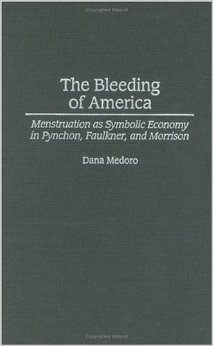
Book Cover: The Bleeding of America, by Dana MedoroGuest Post by David Linton, Marymount Manhattan College

Dana Medoro, The Bleeding of America: Menstruation as Symbolic Economy in Pynchon, Faulkner and Morrison, Greenwood/Praeger, 2002. Pp. 198. $98. ISBN 0313320594.

One of the ways the taboos surrounding menstruation find expression is through absence.  For instance, until recently menstrual references in American novels were rare.  Contemporary writers, particularly women novelists such as Joyce Carol Oates (The Tattooed Girl, 2003) and Erica Jong (Parachutes and Kisses, 1984) and occasional men such as  John Updike (The Widows of Eastwick, 2008)  and Philip Roth (The Dying Animal, 2001), have more frequently used period reference to advance a plot or to symbolize something or other, but historically the menstrual cycle has generally been off limits.  Similarly, literary criticism has tended to ignore or avoid an examination of the social, cultural and psychological significance of the cycle within the literary marketplace.  There is, however, in the area of scholarship one significant exception.

In 2002 Dana Medoro published a seminal study of menstrual references and symbolic allusions titled, The Bleeding of America: Menstruation as Symbolic Economy in Pynchon, Faulkner and Morrison.

Here’s the way the publisher describes the book:

Book Review: The Modern Period

February 8th, 2010 by Elizabeth Kissling

If I correctly understand the terms of SHM’s copyright agreement with Oxford University Press, I am permitted to publish this unedited version of my review as a “pre-print” article. The final version will be available only from Social History of Medicine.

Lara Freidenfelds, The Modern Period: Menstruation in Twentieth Century America, Baltimore: Johns Hopkins University Press, 2008. Pp. 242. £31/$60. ISBN 978 0-8018 9245 5.

Book cover: The Modern Period by Lara Freidenfelds Lara Freidenfelds, an historian currently teaching in Women’s Studies at Wellesley College, has written a thorough and engaging history of menstruation in twentieth century USA. Her title, The Modern Period, is more than a succinct description; it cleverly references her discussion throughout of how advancing Progressive values shaped beliefs and practices surrounding menstruation. These Progressive values included faith in scientific rationality, belief in the value of education, and unqualified endorsement of technological progress. The ‘modern period’ also references the evolution of menstrual management practices into a coherent whole and the movement away from practices and beliefs considered old-fashioned, such as worries about catching a chill or the use of cloth pads. Her analysis throughout addresses the class implications of modernization; that is, the perceived need to adopt modern practices of bodily presentation and self-control for class mobility. Such modernization, asserts Friedenfelds, is a key component of Americans’ ability to see themselves as middle-class across great gaps in education and income.

Be part of the next edition of Our Bodies, Ourselves

January 26th, 2010 by Elizabeth Kissling

Cover of OUR BODIES, OURSELVESOur Bodies, Ourselves is seeking up to two dozen women to participate in an online discussion on sexual relationships.

Stories and comments may be used anonymously in the next edition of Our Bodies, Ourselves, which will be published in 2011 by Simon & Schuster.

We are seeking the experience and wisdom of heterosexual, lesbian, bisexual, queer and trans women. Perspectives from single women are encouraged, and you may define relationship as it applies to you, from monogamy to multiple partners. We are committed to including women of color, women with disabilities, and women of many ages and backgrounds.

In the words of the brilliant anthology “Yes Means Yes,” how can we consistently engage in more positive experiences? What issues deserve more attention? And how do we address social inequities and violence against women? These are some of the guiding questions that will help us to update the relationships section in “Our Bodies, Ourselves.”

The conversation will start Sunday, Feb. 14 (yes, Valentine’s Day) and stay open through Friday, March 12.

Participants will be invited to answer relevant questions (see sample below) and build on the responses of other participants. We’ll use a private Google site to post questions and responses.

Open Call: Medical Screening Procedures Unique to Women

December 27th, 2009 by Elizabeth Kissling

One of the reviewers for the forthcoming edition of Our Bodies, Ourselves, who blogs anonymously at Mom’s Tinfoil Hat, is seeking contributions for the chapter she is reviewing.

I am busy reviewing and contributing to the second chapter of Our Bodies, Ourselves that was assigned to me. It is called “Unique to Women” and is about screening tests and medical procedures. I am trying to get through the technical side of writing this: checking on new screening guidelines, new screening tools, and such scientific type things. But, I really want to take into account the needs and points of view of many women, including disabled women, women of color, women from different cultural and religious backgrounds, women who are trans, men who are trans, women who are survivors of sexual abuse and/or assault, women who work in the sex industry, women who are polyamorous, women who are gay, women with piercings and tattoos, women of size, etc.

Her deadline is New Year’s Eve, so please contact her ASAP if you can contribute.

Post to Twitter Post to Plurk Post to Yahoo Buzz Post to Delicious Post to Digg Post to Facebook Post to MySpace Post to Reddit Post to StumbleUpon

Who in their right mind wants to read about menstruation?!?

October 27th, 2009 by Elizabeth Kissling
From November 2009 Redbook magazine

From November 2009 Redbook magazine

Well, we do, of course. But the editors of Redbook magazine assume that the topic is not of even the slightest interest to their readers.

The clipping at the left is from the November, 2009, issue, which I found at my neighborhood laundromat. It’s from a larger sidebar that lists three books for the month with capsule reviews: Lit by Mary Karr is headed “With the Club”; Lauren Grodstein’s A friend of the family is headed “In the Tub”; and Elissa Stein and Susan Kim’s Flow: The cultural history of menstruation receives the heading “One to Snub”. In case the text is too small or the image isn’t visible in your browser, the review reads as follows:

You welcome it, bemoan it, or just live with it. However you feel about your period, we’re pretty sure most of you would rather spend your cash on a three- to five-day supply of Ben & Jerry’s than this 250-plus-page tome that teaches you about menstruation in the animal kingdom and the origin of tampons.

Apparently Redbook editors know their readers; one only has to travel about 15 pages further into this issue to find the featured cover story about questions you’re too embarrassed to ask your doctor. You know, questions about periods and other things down there.

Post to Twitter Post to Plurk Post to Yahoo Buzz Post to Delicious Post to Digg Post to Facebook Post to MySpace Post to Reddit Post to StumbleUpon

An Autonomous Kingdom of Women

September 20th, 2009 by Elizabeth Kissling

That’s how Varda Polak-Sahm, writing in today’s Washington Post, describes her visit to the Mikveh in preparation for her second wedding. The Mikveh is the ritual purification bath Halakha, the Jewish law, requires of women after each menstrual cycle and prior to an Orthodox wedding ceremony.

According to Orthodox rabbinic law, immersion in the mayyim hayyim, or living waters, removes the impurity left by menstruation and transforms the woman’s status from contaminated to pure. This is an essential element of Jewish existence. Before a synagogue is built, Jewish communities install a Mikveh. Without purification, Orthodox men cannot even touch their wives. Thus, without purification in the Mikveh, there is no future for the Jewish people.

Polak-Sahm writes about her own changing understanding of the Mikveh in this brief essay, making her new book, The House of Secrets: The Hidden World of the Mikveh, sound like a worthwhile read for those of us interested in traditions and beliefs surrounding menstruation.

Post to Twitter Post to Plurk Post to Yahoo Buzz Post to Delicious Post to Digg Post to Facebook Post to MySpace Post to Reddit Post to StumbleUpon

Readers should note that statements published in re: Cycling are those of individual authors and do not necessarily reflect the positions of the Society as a whole.