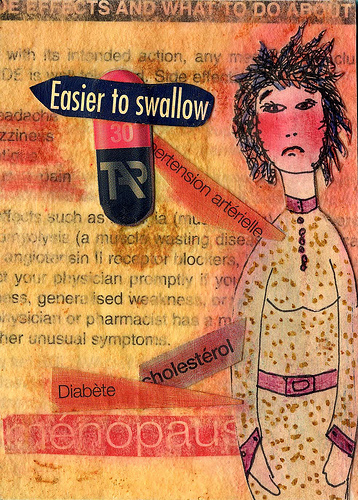
Guest Post by Heather Dillaway, Wayne State University
I keep seeing news articles about a “new Iranian study” that hopes to better predict “age at menopause” for women, and the authors of this study supposedly discovered a “blood test” that will be able to “predict menopause” within the next few years. It is touted as a way to judge when women will be “done” or be at the “end” of “menopause” and also to predict by default when they will be at the “end” of their “fertile” years (so that maybe they can know when they have to pop out that first or last baby). After seeing so many references to this study over the last week and having studied how women feel about the “beginning” and “end” of menopause for the last ten years myself, I can’t just sit back and not critique the underlying assumptions that are part of this study and air some of the concerns that I have about this impending blood test.
First, there is an assumption that the cessation of menstruation (as biomedical researchers define it) is the defining moment of “menopause.” Thus, what these scientists are trying to predict is the age when women might reach “menopause” (or 12 months past their last menstrual period). Yet, not all women judge the “end” of menstruation as the most important aspect of their menopause experience, in fact many women are much more concerned about when other signs and symptoms of “menopause” will begin and/or how long they will last, for instance, irregular bleeding or heavy bleeding in “perimenopause” or hot flashes, night sweats, etc. Can a test predict when irregular bleeding might start and how long it might last? And if a test predicts that a woman might reach her “age at menopause” right after her 54th birthday, will that make a 45-year-old woman with irregular bleeding feel assured that she has only 9 years left? In addition, can a test predict how soon a woman might start experiencing hot flashes and how long they might last, if that is instead to be her most worrisome sign or symptom? If a test predicts that a woman’s age at menopause will be around age 49, will that woman feel assured about her hot flashes at age 48, having no idea how long those hot flashes will last but maybe hoping that they’ll end right alongside her last menstrual period? While the authors of this study (like most other biomedical studies) want to continue to uphold the definition of “menopause” as the official “end” of menstruation and ultimately the “end” of fertility, and hold this up as the most important part of menopause that we should know about, I beg to differ. Women want to know more than just their “age at menopause” or the final end to their fertility.