Blog of the Society for Menstrual Cycle Research

Alongside Scientists Exploring Why Women Menstruate

January 19th, 2012 by Alexandra Jacoby

I read a blog post about a paper (that I have not read). The post is “Why do women menstruate?“ by PZ Myers, a biologist and associate professor at the University of Minnesota, Morris, blogging at Pharyngula. The paper is “The evolution of menstruation: A new model for genetic assimilation: Explaining molecular origins of maternal responses to fetal invasiveness.” by Emera D, Romero R, Wagner G.

I’m not a scientist and don’t routinely have access to papers like these. Usually, by the time ideas raised  in them reach me, they would be solid-feeling facts, authoritative and done — not inspiring questions and wonderings that I can pursue in my way.

They might be about the products that were developed in response to, or as a side-effect of the research, or maybe I’d hear about newly discovered dangers to my health.

Rarely, do I get to be in on the “why.” To think about the story of it–my body–alongside the scientists when they are exploring what might be the origin of, or deciding factors in, why we are the way we are. As human bodies.

(So, thank you, internet. Thank you, bloggers).

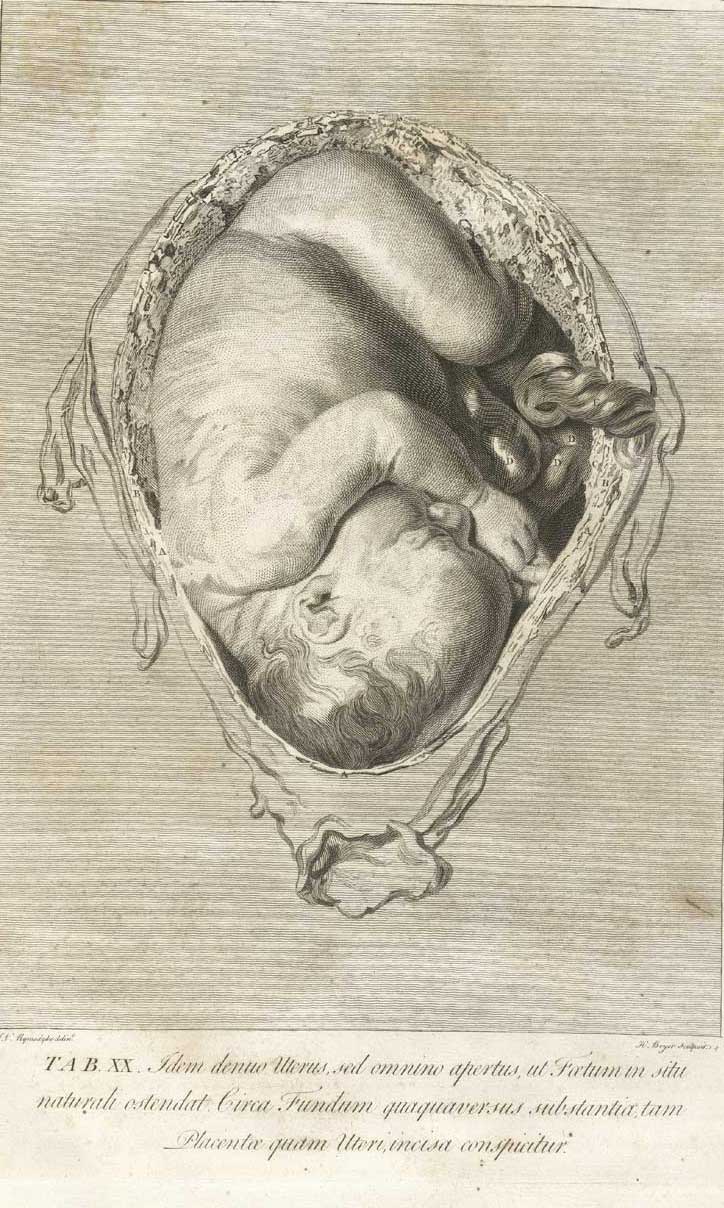
"The anatomy of the human gravid uterus exhibited in figures" by William Hunter, Public domain.

This paper (as I understand it via the Pharyngula post) focuses on the conflicting interests of the relationship between a fetus and the woman carrying it: the fetus acting for its survival and development, and the woman as agent for her life, health, and the ability, should she want to, to carry more pregnancies to term.

The research notes a difference among mammals who spontaneously initiate the process of building up the uterine lining, regardless of whether there’s an implanted embryo (like us, with our monthly-ish menstrual cycles) and those who build up the lining only when triggered by an embryo, and asks why do we do this? Why not wait until you need it?

The answer seems to be because you won’t be ready if you wait. Maybe it’s like having guests over last-minute. You might have food and drink enough for all, but you might not. And, you might have stuff laying around that is more personal than you want guests to see. Or, maybe it’s all fine enough. Last-minute is frequently doable, but it’s better to be prepared. Prepared gives you options. Prepared gives you a chance to make it really comfortable and welcoming. Prepared sets you up to have the experience you wanted to have.

Women menstruate to be body-ready to handle the situation of pregnancy in the context of their whole lives, and their family’s whole life.

The monthly preparation of the uterine lining establishes optimal conditions for the relationship, the active give-and-take, between woman and fetus. And, while there are conflicting interests in this shared space of blood and nutrients, I see it as like any relationship between any things living — on a continuum of interaction between self-expressing creatures, cells or trees. There are intricate, elegant processes taking place to make it all happen. There is preparation and desire on both parts — blood, nutrients, and soil, air and water being exchanged and used up among us. There are points of contact, expected and understood, or surprising, or painful, or deadly. We’re in it together for better or worse. All of our relationships are active. Everything is interrelated and contingent and based on routines and cycles. On those we build, change, evolve…

I think only we are impatient about it — want it done  faster, with less work and no mess. The stuff of life is messy, though.

For me, when I understand the purpose of the mess, the effort required, the time and attention, become meaningful — I am able to recognize participants (rather than adversaries), to value the work we do and remember the vision and desire that infuse it all.

Post to Twitter Post to Plurk Post to Yahoo Buzz Post to Delicious Post to Digg Post to Facebook Post to MySpace Post to Reddit Post to StumbleUpon

Is Coming Off the Pill a Growing Trend?

January 11th, 2012 by Laura Wershler

The Internet abounds with articles, posts and forum discussions about coming off the birth control pill. Women are looking for information and advice. Many are trying to get pregnant, others are just done with hormonal contraception.

It’s a topic that interests many of us connected to the Society for Menstrual Cycle Research (SMCR) because of

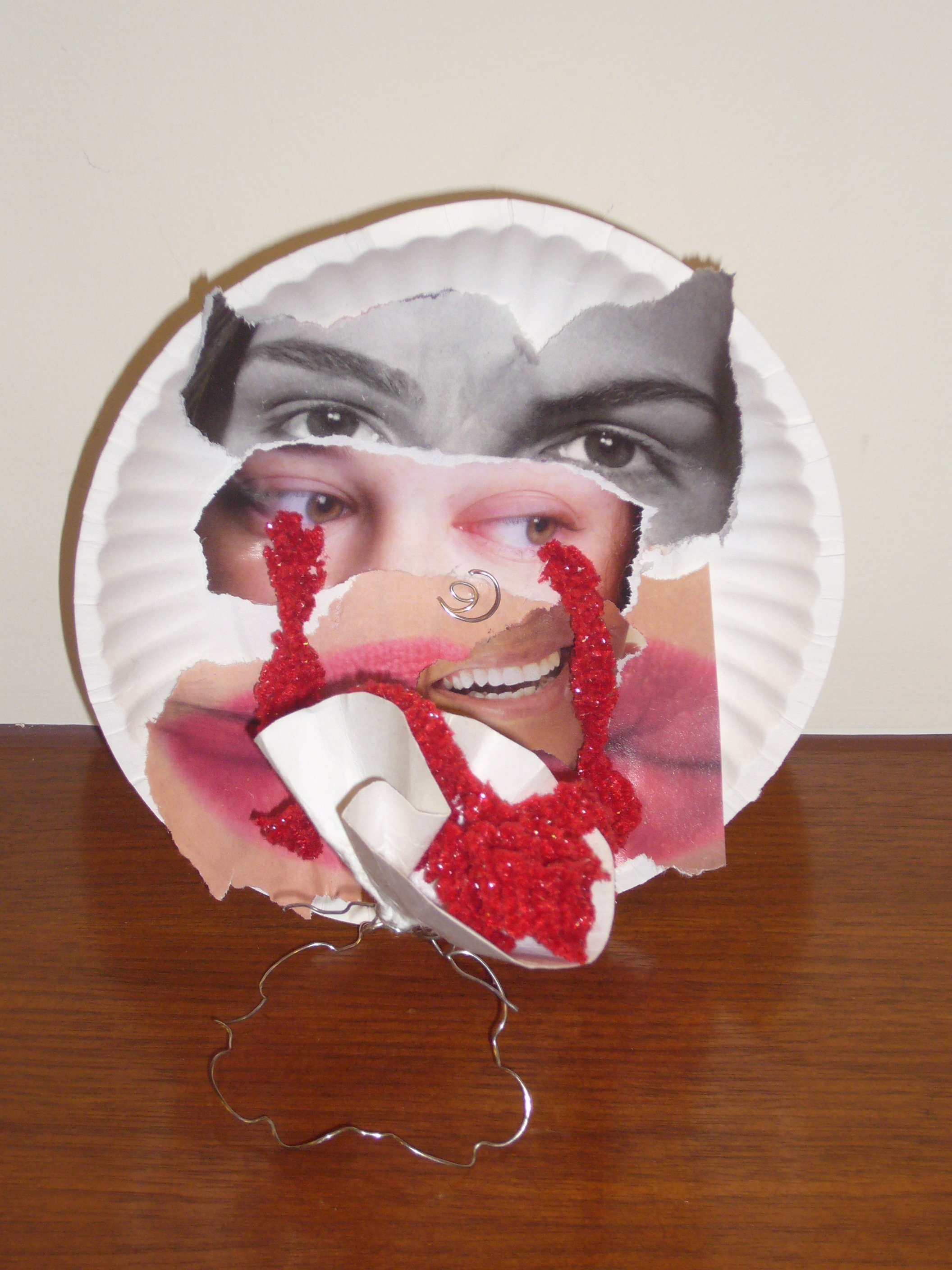
Created at an a menstrual arts and crafts event, Andrea, 25, said this piece depicts the multiple emotions she feels around menstruation. Photo by Laura Wershler

how the pill and other forms of hormonal contraception impact the menstrual cycles of the women who take these medications. Some of us are experts in menstrual cycle function and dysfunction, most are advocates for healthy, positive menstrual cycle experiences from menarche to menopause.

A recent blog post at nomoredirtylooks.com on the topic of quitting the pill caught our members’ attention.  Re: Cycling blogger Elizabeth Kissling included the post in Weekend Links on November 19.

A young woman in Paris was looking for advice and comments from other blog readers about how to manage the effects of coming off the pill. Siobhan O’Connor, the blog co-editor, shared Paris girl’s story with a graceful, inclusive invitation to readers:

There’s no judgment—implicit or explicit—on anyone who is on or has been on birth control pills. Some people love them, some people have to take them for medical reasons, some people abhor them. Here, we want to talk candidly about what happens when you go off them. Because, whoa. That can be hectic.

The post drew over 80 comments, with a few coming from SMCR members. What struck me was how many women:

1)  had already ditched the pill or were planning to
2) expressed a desire for the return of regular, normal menstrual cycles
3)  were concerned about their skin (it often breaks out after quitting the pill).

SMCR member, endocrinologist and guest blogger Dr. Jerilynn Prior answered the concerns about acne and bad cramps in a comment posted on November 22, and included a link to Centre for Menstrual Cycle and Ovulation Research website where readers can find information about all things related to menstrual cycle health.

Holistic Reproductive Health Practitioner Geraldine Matus, another member, commented on November 26 that it was concerns and experiences like those expressed by posters that prompted her and colleague Megan Lalonde to write the guide: Coming Off the Pill, the Patch, the Shot and Other Hormonal Contraception.

I invited No More Dirty Looks readers to visit this blog to learn more about the menstrual cycle and the issues raised by their online discussion.

Regular visitors to re: Cycling know that we cover a broad range of topics, but bloggers frequently address hormonal contraception as it relates to women’s health issues.

Check out this sampling from the re: cycling archive:

Several of the women who responded to the Paris girl post at nomoredirtylooks.com expressed eagerness to reclaim healthy, ovulatory menstruation and a willingness to learn how to  manage their fertility without the aid of hormonal contraception.

Searching for Menopause Blogs

January 6th, 2012 by Heather Dillaway

Lately re:Cycling has featured several posts on menopause, and I have begun to think about the other menopause blogs that might be out there. Turns out there are plenty – maybe not as many blogs as there are about reproductive experiences like pregnancy or childbirth but still a lot. There are even blogs that compile info on menopause blogs such as Menopause the Blog.

Blog Series 13 by Richard Smith // CC BY-NC 2.0

If you start searching for these blogs it becomes clear that many talk about hot flashes as a major sign or symptom of menopause (or perimenopause), and offer either strictly biomedical or more natural/alternative remedies for signs or symptoms (e.g., Menopause Symptom Report or I Hate Menopause). Other blogs are written primarily for their comedic value (e.g., Menopause Maniac), support value (e.g., Menopause Goddess Blog), or purely informational value (e.g., Menopause the Blog). (Menopause the Blog does a good job of summarizing some of the major blogs out there, just FYI for those who are interested.)

Many of these menopause blogs conflate the menopause transition with midlife in general (you only have to read a few blog entries to know that women talk as much about the bad and good of midlife as a life stage as they talk about menopause) but some are very specific to menopause. I find it very interesting that there can be so many different kinds of menopause blogs. I also find it interesting that so many of these menopause blogs seem to be trying to work out what midlife as a life stage means as well, which resonates with Paula Derry’s earlier post this week about how little we know about women’s midlife in general.

Perhaps what interests me the most, however, is that all of these menopause blogs seem to be either aligning with or struggling against very negative definitions of menopause. Based on my quick perusal, no blog seems to have moved past or risen above the constant negotiation of biomedical definitions. Even if bloggers are writing about how happy they are at menopause or how much they’ve learned about themselves at this life stage, blog entries still seem to be written in response to negative definitions (or at the very least, in response to the ghosts of negative definitions that still hang around menopause even when it is defined more positively).

To me this means that researchers Antonia Lyons and Christine Griffin are correct in proposing that there is only one “master narrative” of menopause and that women, doctors, women’s partners and children, medical institutions, workplaces, strangers, women’s friends, etc., have no choice but to deal with this master narrative in some way.  This also means that Abbey Hyde and her co-authors are correct in asserting that even when women aren’t using biomedical definitions to describe their menopause transition, these definitions still shape women’s perceptions of their experiences.

So, my question is, have others read these menopause blogs? And if so, does anyone have a different take on these blogs? Perhaps I’m being too harsh and using a very specific lens to look at these varied blogs. But perhaps not. What then? If you agree with me, is this what blogs are ultimately supposed to be in the end – a response (be it direct or indirect, conscious or unconscious) to the master narratives in our lives?


Post to Twitter Post to Plurk Post to Yahoo Buzz Post to Delicious Post to Digg Post to Facebook Post to MySpace Post to Reddit Post to StumbleUpon

Weekend Links

March 27th, 2011 by Elizabeth Kissling

It’s been a couple of weeks since we did this, so some of these recommendations are lacking freshness. They’re still good, though.

Post to Twitter Post to Plurk Post to Yahoo Buzz Post to Delicious Post to Digg Post to Facebook Post to MySpace Post to Reddit Post to StumbleUpon

Weekend Links

February 26th, 2011 by Elizabeth Kissling

Snow on the ground and subzero temperatures this week, so I’m doing nothing but reading:

Post to Twitter Post to Plurk Post to Yahoo Buzz Post to Delicious Post to Digg Post to Facebook Post to MySpace Post to Reddit Post to StumbleUpon

Weekend Links

February 13th, 2011 by Elizabeth Kissling

Post to Twitter Post to Plurk Post to Yahoo Buzz Post to Delicious Post to Digg Post to Facebook Post to MySpace Post to Reddit Post to StumbleUpon

Weekend Links

January 23rd, 2011 by Elizabeth Kissling

Post to Twitter Post to Plurk Post to Yahoo Buzz Post to Delicious Post to Digg Post to Facebook Post to MySpace Post to Reddit Post to StumbleUpon

Weekend Links

January 16th, 2011 by Elizabeth Kissling

Post to Twitter Post to Plurk Post to Yahoo Buzz Post to Delicious Post to Digg Post to Facebook Post to MySpace Post to Reddit Post to StumbleUpon

Weekend Links

January 8th, 2011 by Elizabeth Kissling

Post to Twitter Post to Plurk Post to Yahoo Buzz Post to Delicious Post to Digg Post to Facebook Post to MySpace Post to Reddit Post to StumbleUpon

Weekend Links to Wrap Up 2010

December 26th, 2010 by Elizabeth Kissling

A few things that crossed my screen during my week-long holiday:

Post to Twitter Post to Plurk Post to Yahoo Buzz Post to Delicious Post to Digg Post to Facebook Post to MySpace Post to Reddit Post to StumbleUpon

Weekend Links

December 18th, 2010 by Elizabeth Kissling

re:Cycling will probably be pretty quiet over the next couple of weeks, as several of us are traveling and celebrating various winter holidays. Look for us to be back in full force after the first of the year.

Post to Twitter Post to Plurk Post to Yahoo Buzz Post to Delicious Post to Digg Post to Facebook Post to MySpace Post to Reddit Post to StumbleUpon

Weekend Links

December 11th, 2010 by Elizabeth Kissling
  • The National Women’s Law Center issued the 2010 national and state-by-state report card on women’s health, evaluating criteria such as percentage of women with health insurance, access to abortion providers, causes of death, frequency of annual mammograms and pap smears, and many more. As a nation, the U.S. meets just three benchmarks: the percentage of women getting mammograms regularly, the percentage of women visiting the dentist annually, and the percentage of women getting screened for colorectal cancer. FAIL.
  • As U.S. readers know, Elizabeth Edwards died of breast cancer this week, at age  61. Amanda Hess takes on the body shaming she experienced from the press, in life and in death.
  • More on new TSA (Transportation Security Administration) screening procedures and gender: Judith Levine explains why she’d rather be gazed at than groped.
  • Congratulations to everyone at LunaPads on ten years of eco positive periods!
  • Tips on avoiding shark attacks: “until controlled tests involving non-menstruating and menstruating women occur, there is no definitive or scientifically proven data that states women are at more risk of shark attack during menstruation.”


Post to Twitter Post to Plurk Post to Yahoo Buzz Post to Delicious Post to Digg Post to Facebook Post to MySpace Post to Reddit Post to StumbleUpon

Readers should note that statements published in re: Cycling are those of individual authors and do not necessarily reflect the positions of the Society as a whole.