Today’s post was created using the web tool Storify, and may take an extra moment to load in some browsers. If the page fails to load, please use your refresh/reload button
Blog of the Society for Menstrual Cycle Research
Today’s post was created using the web tool Storify, and may take an extra moment to load in some browsers. If the page fails to load, please use your refresh/reload button
The Internet abounds with articles, posts and forum discussions about coming off the birth control pill. Women are looking for information and advice. Many are trying to get pregnant, others are just done with hormonal contraception.
It’s a topic that interests many of us connected to the Society for Menstrual Cycle Research (SMCR) because of

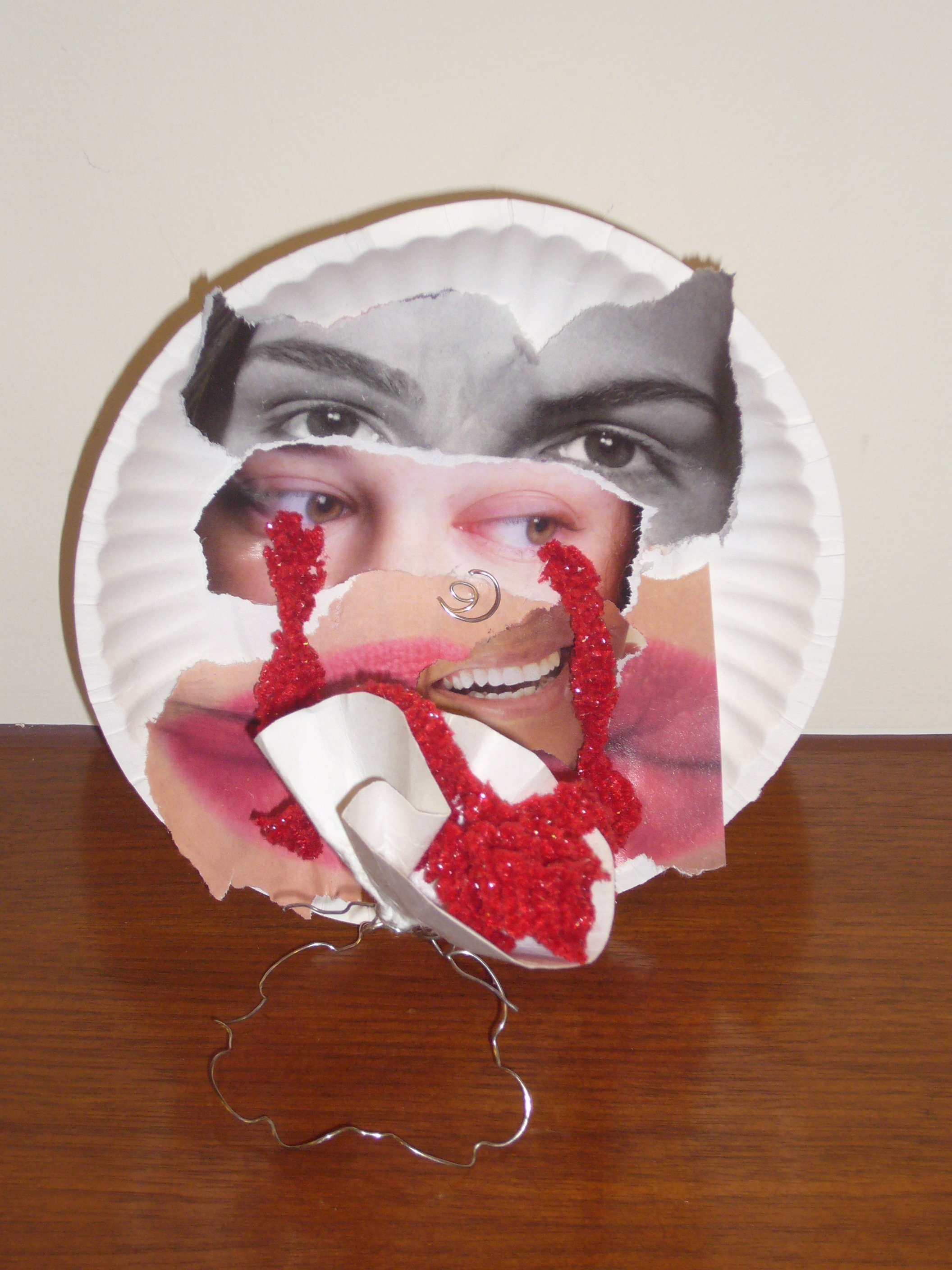
Created at an a menstrual arts and crafts event, Andrea, 25, said this piece depicts the multiple emotions she feels around menstruation. Photo by Laura Wershler
how the pill and other forms of hormonal contraception impact the menstrual cycles of the women who take these medications. Some of us are experts in menstrual cycle function and dysfunction, most are advocates for healthy, positive menstrual cycle experiences from menarche to menopause.
A recent blog post at nomoredirtylooks.com on the topic of quitting the pill caught our members’ attention. Re: Cycling blogger Elizabeth Kissling included the post in Weekend Links on November 19.
A young woman in Paris was looking for advice and comments from other blog readers about how to manage the effects of coming off the pill. Siobhan O’Connor, the blog co-editor, shared Paris girl’s story with a graceful, inclusive invitation to readers:
There’s no judgment—implicit or explicit—on anyone who is on or has been on birth control pills. Some people love them, some people have to take them for medical reasons, some people abhor them. Here, we want to talk candidly about what happens when you go off them. Because, whoa. That can be hectic.
The post drew over 80 comments, with a few coming from SMCR members. What struck me was how many women:
1) had already ditched the pill or were planning to
2) expressed a desire for the return of regular, normal menstrual cycles
3) were concerned about their skin (it often breaks out after quitting the pill).
SMCR member, endocrinologist and guest blogger Dr. Jerilynn Prior answered the concerns about acne and bad cramps in a comment posted on November 22, and included a link to Centre for Menstrual Cycle and Ovulation Research website where readers can find information about all things related to menstrual cycle health.
Holistic Reproductive Health Practitioner Geraldine Matus, another member, commented on November 26 that it was concerns and experiences like those expressed by posters that prompted her and colleague Megan Lalonde to write the guide: Coming Off the Pill, the Patch, the Shot and Other Hormonal Contraception.
I invited No More Dirty Looks readers to visit this blog to learn more about the menstrual cycle and the issues raised by their online discussion.
Regular visitors to re: Cycling know that we cover a broad range of topics, but bloggers frequently address hormonal contraception as it relates to women’s health issues.
Check out this sampling from the re: cycling archive:
Several of the women who responded to the Paris girl post at nomoredirtylooks.com expressed eagerness to reclaim healthy, ovulatory menstruation and a willingness to learn how to manage their fertility without the aid of hormonal contraception.
Lately re:Cycling has featured several posts on menopause, and I have begun to think about the other menopause blogs that might be out there. Turns out there are plenty – maybe not as many blogs as there are about reproductive experiences like pregnancy or childbirth but still a lot. There are even blogs that compile info on menopause blogs such as Menopause the Blog.
If you start searching for these blogs it becomes clear that many talk about hot flashes as a major sign or symptom of menopause (or perimenopause), and offer either strictly biomedical or more natural/alternative remedies for signs or symptoms (e.g., Menopause Symptom Report or I Hate Menopause). Other blogs are written primarily for their comedic value (e.g., Menopause Maniac), support value (e.g., Menopause Goddess Blog), or purely informational value (e.g., Menopause the Blog). (Menopause the Blog does a good job of summarizing some of the major blogs out there, just FYI for those who are interested.)
Many of these menopause blogs conflate the menopause transition with midlife in general (you only have to read a few blog entries to know that women talk as much about the bad and good of midlife as a life stage as they talk about menopause) but some are very specific to menopause. I find it very interesting that there can be so many different kinds of menopause blogs. I also find it interesting that so many of these menopause blogs seem to be trying to work out what midlife as a life stage means as well, which resonates with Paula Derry’s earlier post this week about how little we know about women’s midlife in general.
Perhaps what interests me the most, however, is that all of these menopause blogs seem to be either aligning with or struggling against very negative definitions of menopause. Based on my quick perusal, no blog seems to have moved past or risen above the constant negotiation of biomedical definitions. Even if bloggers are writing about how happy they are at menopause or how much they’ve learned about themselves at this life stage, blog entries still seem to be written in response to negative definitions (or at the very least, in response to the ghosts of negative definitions that still hang around menopause even when it is defined more positively).
To me this means that researchers Antonia Lyons and Christine Griffin are correct in proposing that there is only one “master narrative” of menopause and that women, doctors, women’s partners and children, medical institutions, workplaces, strangers, women’s friends, etc., have no choice but to deal with this master narrative in some way. This also means that Abbey Hyde and her co-authors are correct in asserting that even when women aren’t using biomedical definitions to describe their menopause transition, these definitions still shape women’s perceptions of their experiences.
So, my question is, have others read these menopause blogs? And if so, does anyone have a different take on these blogs? Perhaps I’m being too harsh and using a very specific lens to look at these varied blogs. But perhaps not. What then? If you agree with me, is this what blogs are ultimately supposed to be in the end – a response (be it direct or indirect, conscious or unconscious) to the master narratives in our lives?
This site is tracked by Google Analytics, WordPress’ StatPress, and at least one other web tracker. But instead of digging through all of our statistics of most commented, most linked, most page loads, etc., when I was recently asked about the best posts of 2011, I went through the archives and picked my own subjective list of favorites.
What do YOU think were the best posts of 2011 at re:Cycling? What were the best menstrual cycle posts at other blogs?
Widely distributed U.S. comic strip “Zits” — the ongoing story of the life and times of 16-year-old Jeremy Duncan — began a storyline about menopause this week. Apparently, Jeremy’s mom has begun experiencing signs of perimenopause. So far, it’s not awful. The humor is based on the unpredictability of hot flashes and Jeremy’s apparent embarrassment at seeing his mother spontaneously remove her blouse.
It’s open to interpretation, of course, but so far (see yesterday’s strip), it seems to me that we’re invited to laugh at how easily the teenage boy is embarrassed, and to sympathize with the menopausal woman.
In case you missed these stories this week:
Your weekly links:
Originally posted at Jalopnik (part of the Gawker network) , where they speculate that it’s intended to mean “Monster V8″.
In case you missed these stories of the week:
We posted with a few warm-up entries last summer, but re:Cycling officially launched on September 15, 2009. So we’ve been period-blogging for six months! Here are some of our milestones:
And this weekend we added a Facebook page.
There are Tupperware parties, Passion Parties, Pampered Chef parties, and…Mirena IUD parties? Yes, apparently these events popped up early last year and were a joint effort from Bayer Pharmaceuticals and the mom marketing site Mom Central.
Here’s one mom blogger’s description of the Mirena party that she hosted:
Then tonight I hosted a party at my house with Mom Central. Mom Central had found me through this blog and asked me if I would be interested in hosting an event sponsored by Mirena. As I welcome any opportunity to sit down with some girlfriends with some free food and drink, I was happy to accept. Before the party started, I walked around nervously, terrified that only a couple of people would show up. We’re all so busy, and I worried that people would end up skipping a strange commercial-sounding event. But one by one, they rolled in and I began to relax.
We had an amazing evening, talking about sex, fashion, and living a simpler life. I realized that we don’t actually spend a lot of time talking about sex and relationships. We laughed a lot but also went home with some great tips.
If you’re thinking that “strange commercial-sounding event” sounds like an accurate description for a party like this, you won’t be surprised by what comes next. What this mom didn’t mention, possibly because she wasn’t aware, was the fact that the script used at these parties didn’t comply with FDA implementing regulations or the Federal Food, Drug, and Cosmetic Act, prompting the FDA to send a warning letter to Bayer at the end of last year. (Bayer is no stranger to FDA warnings – they recently had to “correct” ads for their Yaz/Yasmin birth control pills, which are also the subject of several lawsuits, after the FDA said they were unclear and misleading.)
Before I get into the specifics of the FDA violations in this case, let’s take a look at some more details about these events. First, let’s look at Mom Central. The main Mom Central site has forums, blogs, parenting tips, a product testing panel, giveaways, and so on, but it’s the Mom Central Consulting site that we’re really interested in. Here are some quotes from the site about what they do:
Our two-pronged targeted approach connects clients with our vast proprietary network of leading Mom Experts and Opinion Leaders and then activates Moms to become trusting, loyal advocates and consumers of your brand, product or service, making us experts at marketing to women.
So maybe the goal of the hosts and attendees at these parties was to have a fun night eating free food and talking about sex and relationships, but it’s important to keep in mind that that’s not the main goal of Mom Central or the product that they’ve been hired to represent. What they want to do is “activate” some Mirena evangelists.