Blog of the Society for Menstrual Cycle Research

Food insecurity is associated with later puberty

December 20th, 2011 by Chris Hitchcock

Many girls in Africa have insecure access to food, that is, they worry about getting enough food, and they sometimes eat less than they want, or go without food. There are two theories about how this might affect the onset of menstruation (menarche). One is that the limitations in energy and nutrition might slow development, resulting in a later menarcheal age. The other evolutionary theory is that early life stressors trigger a shift in so-called life history strategy, leading to accelerated development and an earlier menarche. In a recent article in the journal Reproductive Biology and Endocrinology, researchers from Ethiopia, Belgium and the USA presented data from the first two years of the Jimma Longitudinal Family Survey of Youth to contrast these two theories. The survey was conducted in southwest Ethiopia, sampling across rural, urban and small town areas and including boys and girls. Data about the household and the girls’ experience of food insecurity were assessed by questionnaire in the first year, and in the second year girls were asked whether and how old they were when they first menstruated. 900 girls, with an average age of 14.8 at baseline, participated in both of the first two years of the five year study.

Overall, girls who reported some degree of food insecurity (n=225/900) were similar in age, region (urban, semi-urban, rural), and nutritional status (whether they were short for age). However, they were more likely to be in a male-headed household, tended to be in middle income rather than high income households, and reported more domestic work than those reporting food security. Overall, girls with moderate to severe food insecurity were significantly less likely to have undergone menarche. The estimate of the age at menarche was one year older for Ethiopian girls who have insecure access to food.

Girls in the developing world experience menarche at an older age than those in the developed world, and, with development, other countries are experiencing the secular change of earlier age at menarche. In this study, the estimated age at menarche was younger in urban centres (14) than in semi-urban or urban areas (15), and girls in high income households had an earlier menarche, suggesting that improved food security may be part of the puzzle explaining these changes.

Post to Twitter Post to Plurk Post to Yahoo Buzz Post to Delicious Post to Digg Post to Facebook Post to MySpace Post to Reddit Post to StumbleUpon

Menstrual Cups for African Girls

January 5th, 2011 by Elizabeth Kissling
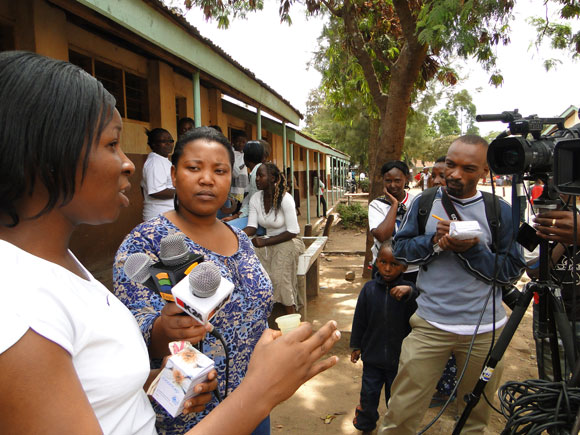
Rhoune Ochako, a research officer at APHRC, explains how the cup works in this photo from the APHRC web site.

Rhoune Ochako, a research officer at APHRC, explains how the cup works in this photo from the APHRC web site.

At re:Cycling, we’re interested in all kinds of menstruation and women’s health issues, all over the world. We have written several times about the need for menstrual pads for girls and women in developing nations, like the Kasissi Project Girls Program producing M.A.K.A. pads in Uganda and Sustainable Health Enterprises making pads from banana trees for women in Rwanda, and LunaPads’ Pads4Girls program, which collects and donates reusable pads to girls in several African nations as well as Mexico and South America. We’ve also suggested that cramps and menstrual pain may cause girls to miss school as much as lack of menstrual supplies.

So it was with great interest that we read about a new pilot program of the African Population and Health Research Center (APHRC) that will distribute menstrual cups to girls in Nairobi.

Women and girls in Korogocho slums have been identified who will use the cup for up to four months, after which they will be interviewed about their experiences,” explained Rhoune Ochako, a research officer at APHRC.

The study will also assess acceptability of the cup, as many girls were intimidated to use the cup. A teacher at Our Lady of Fatima Secondary school initially queried 400 students, of whom only three were willing to participate in the study.

Celestine Awino [age 17] is among girls who agreed to participate in the project that started about a year and a half ago and has been using the cup since then. “At first I was afraid. I waited until a friend used it, then I tried. I have now been using it for over ten months,” she says.

Awino says she is able to engage in school activities during her periods while wearing the cup. “I take part in sports, cleaning and learning activities without any problem. It is better than missing school because one lacks sanitary pads,” she says.

Given the economic and environmental advantages of menstrual cups (not to mention their reliability), this experiment has great potential to make a big difference.


Post to Twitter Post to Plurk Post to Yahoo Buzz Post to Delicious Post to Digg Post to Facebook Post to MySpace Post to Reddit Post to StumbleUpon

The Cloth Pad Gets Around the African Continent

February 17th, 2010 by Chris Bobel

Ghana girls_with kitsWe at re: Cycling have been tracking the African-girls-miss-school-because-they-menstruate equation  for a while now.

Specifically, we’ve questioned the assumption that menstrual FLOW management is girls’ biggest menstrual problem  (it is not, says at least one recent study–cramps are!). And we’ve been  MORE critical of so-called altruistic solutions that are, underneath the (silent?) disposable wrapper,  little-more than consumer socialization. Menstrual shame, sexism and poverty are not ameliorated though the cultivation of brand loyalty. Girls need information, support and the tools to develop awareness of their bodies while learning to live sustainably–this does not come in the shape of a box of single-use products that ends up clogging landfills.

Making green products available to girls while supporting economic growth and self-sufficiency in the Global South seems a more enduring and girl-centered initiative and there are number of projects that are doing just that. There Elizabeth Scharpf’s SHE initaitive in Rwanda and Lunapads donation program in collaboration with a number of related initiatives:

Yesterday, the NYTimes reported on a new study of Ghanian girls that found: ” Many schoolgirls from poor families stay home up to five days each month when they have their period.” (but could cramps be the culprit as they were in the study released in December 2009?)

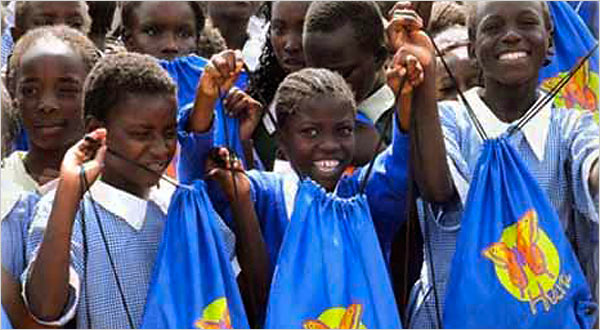
The same piece described  another cloth- pads- for- girls outreach effort, this one organized by a group called Huru International and supported by this eclectic list of backers:  President’s Emergency Plan for AIDS Relief, the Elton John AIDS Foundation, Johnson & Johnson, Sunflag Steel, Warner Brothers. Huru International  developed washable cloth pads and packaged them together with a few pairs of panties, laundry soap and HIV/AIDS info into kits for school girls in Kenya. Cloth pads–though admittedly not every menstruator’s preferred menstrual care option, does make sense especially for girls who lack the resources to buy single use products  (one Kenyan girls reports that a box of pads costs is equivalent to the cost of a bag of corn flour).

It seems that the good ole’ time-tested cloth pad is emerging as a viable option for girls throughout Africa.

We think that’s encouraging news, for the planet AND for girls.

Post to Twitter Post to Plurk Post to Yahoo Buzz Post to Delicious Post to Digg Post to Facebook Post to MySpace Post to Reddit Post to StumbleUpon

Readers should note that statements published in re: Cycling are those of individual authors and do not necessarily reflect the positions of the Society as a whole.