Blog of the Society for Menstrual Cycle Research

Hooked on Estrogen

May 13th, 2010 by Elizabeth Kissling

Guest Post by Jerilynn Prior, M.D.,  Centre for Menstrual Cycle and Ovulation Research

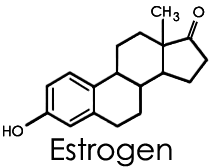
Estrogen moleculeYes! I’m sure you can hear my whoop of excitement and vindication. Finally, something negative about estrogen and positive about progesterone in the mainstream media. According to this article by Emily Anthes in the current issue of Scientific American: Mind,  women’s risk for addiction, and potential for successful withdrawal, are both linked to our menstrual cycle hormones. Estrogen increases women’s addictive behaviors while progesterone assists with successful addiction recovery.

Why am I feeling vindicated? Because I recently declared that hot flushes/flashes and night sweats are estrogen addiction (1). That wild but supportable hypothesis is based on the evidence that prolonged or high-dose estrogen exposure is required for hot flushes to occur. But, it is the subsequent abrupt decrease in estrogen levels that triggers vasomotor symptoms. Drug exposure—drug withdrawal symptoms. And do women feel high on estrogen? Perhaps. Clearly the withdrawal is miserable—as one woman said, “I continued to take it only because I couldn’t stand being off the hormone. I really couldn’t function.” (p. 2130 (2). Just ask any woman taking estrogen for hot flushes who has tried to stop it.

Rat brains are not the focus of my research—and I generally think rodents aren’t much like women. However, the animal evidence showing that estrogen increases addictive behaviours is strong and extensive. About a year ago I had occasion to visit a recovery facility for women with addictions—it suddenly struck me that most of the women there were perimenopausal. They were experiencing estrogen’s highs and the roller coasters and because normal ovulation is rare in perimenopause they were not having enough progesterone—and battling drug dependence. Sure enough, as Anthes states, hundred of experiments show that female rats become addicted more quickly than male rats, are less likely to become addicted without their ovaries but the quick-dependence problem returns when they are given estrogen (3).

As Anthes reports, it is exciting from animal data that progesterone assists to prevent or treat addictions. However, even more important is the notion that progesterone can assist in addiction recovery—not just in rats but in women. The data strongly suggest that progesterone aids women trying to stop cigarettes (4). Progesterone also appears to decrease the drug “high,” and certain actions of cocaine such as fast heart rate in women who are addicted (5). That was true whether cocaine was administered in the luteal phase (when progesterone is normally high) compared with the estrogen-dominant follicular phase, or when progesterone or placebo were administered to women in the follicular phase (5).

The effect of stress can add another layer of understanding to the addiction arena. We know that estrogen amplifies the responses of the stress hormones ACTH, cortisol and norepinephrine to social stress (ironically, based on a randomized, placebo-controlled trial in men) (6). Could that be one of the reasons estrogen increases women’s addiction susceptibility? It is known but rarely discussed that stress makes both addictive behaviors and hot flushes worse. Progesterone’s positive role in both addictions and hot flush treatment may be because of its effects to improve sleep and decrease anxiety. Two different randomized, placebo-controlled, double masked (neither researchers nor participants knew the identity of the pills) trials show that oral micronized progesterone (Prometrium—300 mg at bedtime) improves sleep without a morning hangover (7), and decreases anxiety in women with premenstrual symptoms (8). These actions may play important roles in progesterone’s potential use as a treatment for addictions and for hot flushes.

Estrogen is the New Ritalin. NOT.

May 10th, 2010 by Elizabeth Kissling

Guest Post by Barbara Sommer, University of California-Davis

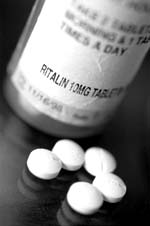
Ritalin bottle with tabletsWhy is it that assertions about hormones and behavior lead us to readily suspend our capacity for critical thought? It seems like folks will accept just about any assertion with regard to the power of estrogen and the fluctuation of the menstrual cycle.

My observations over several decades (I am nearly forty years post-doctorate) have been reassuring. I have not seen women crushed in the working and professional worlds by the demands of their physiology. In fact it looks like women might be moving towards running the world, at least in those areas where they have access to education. Nevertheless, it rankles when a journal of some credibility makes assertions based on scanty evidence.

It is difficult to evaluate the quality of the research underlying the claims of the article “Is Estrogen The New Ritalin?” in the current issue of Scientific American: Mind. The title is cute. A writer for the New Yorker recently claimed that “White is the New Black.” Do we believe it? The article was provocative, and did not pretend to be a scientific piece of work. In contrast, the estrogen piece, by appearing under the prestigious banner of the Scientific American, carries an imprint of scientific credibility. The first paragraph claims the menstrual cycle might affect the brain as much as caffeine, methamphetamines, and Ritalin. Nowhere in the study is there any indication that estrogen levels or even menstrual fluctuation effects were actually compared with the above substances. The author also claims that this study is “the first to show that cognition is tied to estrogen levels in people” – perhaps the first because no one else has done a good job of it, but certainly not for a failing to try. There are many published studies claiming that estrogen affects cognitive function.

The central problem with this report is that the scientific community has not vetted the research. There is nothing to suggest that it was subject to review. It has not been published – at least nowhere that could be found by this writer with access to a university library. I don’t expect a popular version of scientific research to include information about whether there were adequate controls for subject selection, for practice effects on the task performance, or that the claim of population dopamine levels was accurate, and whatever measure was used to estimate estrogen levels was reliable. But someone needs to have looked at those aspects of the research. Without that, we end up with questionable conclusions at best, and junk science at worst.

Post to Twitter Post to Plurk Post to Yahoo Buzz Post to Delicious Post to Digg Post to Facebook Post to MySpace Post to Reddit Post to StumbleUpon

Readers should note that statements published in re: Cycling are those of individual authors and do not necessarily reflect the positions of the Society as a whole.