Blog of the Society for Menstrual Cycle Research

Cycling for Cycling Change

September 12th, 2011 by Chris Bobel

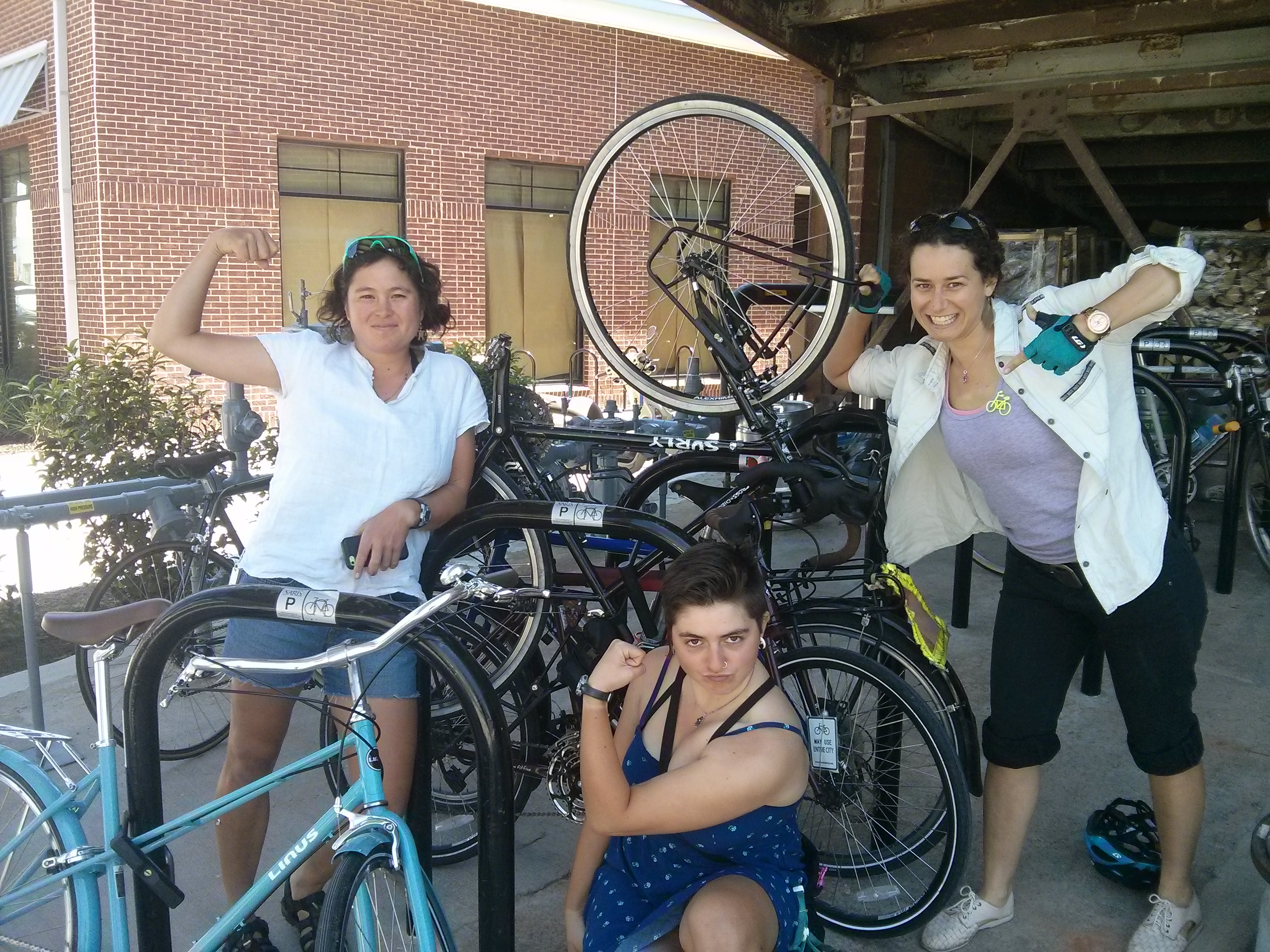
Sarah Konner and Toni Craige begin their trip in Seattle.

Sarah Konner and Toni Craige are two impressive women. They are biking all the way down the west coast and living on $4/day while spreading the word of sustainable menstrual care.

Menstrual activism in motion!

Theirs is a great model of seeing a need and doing SOMETHING! Here are two young women with a passion, strong legs and endless energy and that’s enough.  They are willing to sleep and eat on a shoestring so that they can share their stories of doing right by the earth and getting back in touch with their bodies.

And for those willing to try a cup, they’ve got a sack of donated products.

Check our their progress and consider supporting them. They welcome financial support AND emails to the ELLEN show where they hope to make an appearance.

Post to Twitter Post to Plurk Post to Yahoo Buzz Post to Delicious Post to Digg Post to Facebook Post to MySpace Post to Reddit Post to StumbleUpon

Not Having A Happy Period

August 10th, 2011 by Elizabeth Kissling

Editor’s note, August 10, 2011: Procter & Gamble has responded that this video was NOT produced or commissioned by them, and is in fact a spoof. While it is still offensive and worthy of criticism as such and your comments are welcome here, please do not direct your ire toward Procter & Gamble.


Edited again, August 10, 2011: I’m beginning to doubt the veracity of the unsigned P&G claim that the company is unaffiliated with this video. The same anonymous quote, attributed only to “Procter & Gamble”, is starting to show up in nearly every online discussion of this ad — at least in discussion of how offensive and un-funny it is. I’ve traced the video back to the Ads of the World site, which provides the following credits:

Advertising Agency: Leo Burnett, London, UK
Creative: Jim Thornton
Director: Ben Jones
Production Company: Helimax Films
DoP: George Steel
Producer: Sherry Collins

I note that P&G has not posted their denial at Ads of the World, or at Jezebel – two blogs with *considerably* larger audiences than re:Cycling. Color me suspicious. I’d like to hear what others think.


Final edit, August 11, 2011: Many thanks to blogger Jane Fae, who phoned both P&G office and Leo Burnett UK, and received the following statement from a senior representative at Leo Burnett:

“All creative agencies will look at different creative ideas to push boundaries and engage consumers. We will occasionally make test films to try and bring an idea to life without a request from the client. These films are for internal use only, for us to understand the power of an idea and are not for publication. This creative was never commissioned nor approved by P&G. We regret this has been made public without our approval or authorization and apologise for any offence caused.”


Procter & Gamble have finally responded to consumer complaints about their patronizing “Have a Happy Period” slogan, with a disturbing video showcasing what they term “some of East London’s finest transvestites”. This is so many kinds of wrong, starting with the conflation of transsexuality and drag performance. But instead of re-inventing the wheel and taking it apart myself, I’m going to re-direct re:Cycling readers to the excellent analysis Shakesville’s EastSideKate did yesterday.

I pulled this P&G contact information and sample letter from commenter “Teaspoon” over there:

Toll-free phone number in the U.S. (Always brand specific): (800) 888-3115
Web form for U.S. contact: http://pg.custhelp.com/app/ask

A sample letter that anyone may feel free to adopt or adapt as they like:

Dear P&G representative:

I was recently directed to a web video ad for your Always brand products intended for airing in England and possibly wider audiences, featuring London “drag queens” in tears over an ostensible inability to menstruate.  Quite aside from the errors inherent with conflating cross-dressing performance with transsexuality, this sort of advertising is cruel to transwomen who do feel incomplete, and it helps create a hostile situation for transsexual individuals.  These individuals already face a greater risk of violence simply for being who they are, and your advertising promotes further dehumanization of those who are different.

As a long-time loyal purchaser of Always brand products, I am dismayed by such mocking and harmful advertising.  Until the ad is pulled and a public apology that acknowledges the harmful nature of the ad is issued, I will no longer purchase Always brand products, and I will be reviewing my other purchases to avoid other Proctor and Gamble products as well.

Sincerely,
A former customer

Post to Twitter Post to Plurk Post to Yahoo Buzz Post to Delicious Post to Digg Post to Facebook Post to MySpace Post to Reddit Post to StumbleUpon

Summer’s Eve Campaign Targets Wrong Body Part

August 2nd, 2011 by Laura Wershler

The print ad for the Summer's Eve campaign refers to the "V" but not the vagina.

If a product manufacturer or its advertising company, or both, cannot figure out which part of the female body their new line of feminine hygiene products can be used for, then both are in big trouble.

There has been much hoopla over the recently launched Summer’s Eve campaign. Links to stories about and response to the campaign can be found in my fellow blogger Elizabeth Kissling’s July 27th post. The most serious backlash to the campaign resulted in three videos perceived as “racially insensitive” being pulled from the campaign website late last week.

What rankles me about the campaign – beyond its patronizing, unsophisticated and euphemistically silly approach to the female genital area - is that it appears to target the vagina when it is clear that none of these products are actually intended for use in the vagina.

Regardless of what one might think about the value of or necessity for these femcare products, an advertising campaign for such products must convey accurate information. Like where to use them.

The product line includes: cleansing wash, cleansing cloths, deodorant spray, body powder, and bath and shower gel. Click on the OUR PRODUCTS box on the website home page and you’ll see this: Meet the products that love your vagina. Oh, really?

These products are not intended, I repeat, not intended for use in the vagina. One would think that the product manufacturer knows this. Why then did they choose a talking vagina, and across-the-board references to the vagina, to convey their product message on the website?

Interestingly, the print and TV ads hold no direct reference to the vagina. The website coyly advises viewers that they can call it “V” for short. It is this moniker and the tagline ” Hail to the V” that crosses over to print and television.

Maybe this was intended as a subtle reference to the other “V” word – vulva . It’s pretty clear this is the body part for which the Summer’s Eve products are intended.

I wanted to know why the creative team at The Richards Group, the ad company responsible for the campaign, chose to use the word vagina instead of vulva. My request for an interview to ask this question was turned down, so instead I asked two colleagues what they thought the reason might be.

Valerie Barr, veteran sexual health educator and training centre manager at Calgary Sexual Health Centre, suspects it’s because vagina is assumed to mean what is actually the vulva. She says, “I believe this assumption, or taken-for-granted use of the term, serves to avoid discussion of the clitoris and therefore, female sexual response.”  Barr says she thinks it demonstrates that in our culture we continue to be unconsciously uncomfortable with women being sexual beings.

Rebecca Chalker, female anatomy expert and author of The Clitoral Truth, also believes that fear of the word clitoris has much to do with it. ”Clitoris is the most toxic word in the English language, and to this day is considered obscene and too offensive to be used in the media. Just try it on people,” she says.

“Eve Ensler (author of The Vagina Monologues) made the vagina safe for the general public – even she did not use the C–word. Vagina has now become the default reference for everything ‘down there.’ Those ad guys are no different. Perhaps they’re just using the default because that’s what they think people can relate to most readily,” Chalker says.

Although vulva is the accurate word to describe the female body part intended to benefit from the Summer’s Eve product line, Chalker says, “It would be a tragedy if vulva becomes the new default. In anatomical parlance vulva just means covering.”

For those with Vaginas

March 17th, 2011 by Chris Hitchcock

Here’s an interesting political approach. While there are hairs to split (do all women have vaginas? do all people with vaginas consider themselves women? and what about those of us with no sexual partners, or sexual partners without penises?), there’s something to be said for appealing to the majority. After all, those of us who already get it, get it, no?

I do wish it came with an action plan, though. Links to a site for people to contact their congresscritters would be good.

Post to Twitter Post to Plurk Post to Yahoo Buzz Post to Delicious Post to Digg Post to Facebook Post to MySpace Post to Reddit Post to StumbleUpon

Menstrual Cups for African Girls

January 5th, 2011 by Elizabeth Kissling
Rhoune Ochako, a research officer at APHRC, explains how the cup works in this photo from the APHRC web site.

Rhoune Ochako, a research officer at APHRC, explains how the cup works in this photo from the APHRC web site.

At re:Cycling, we’re interested in all kinds of menstruation and women’s health issues, all over the world. We have written several times about the need for menstrual pads for girls and women in developing nations, like the Kasissi Project Girls Program producing M.A.K.A. pads in Uganda and Sustainable Health Enterprises making pads from banana trees for women in Rwanda, and LunaPads’ Pads4Girls program, which collects and donates reusable pads to girls in several African nations as well as Mexico and South America. We’ve also suggested that cramps and menstrual pain may cause girls to miss school as much as lack of menstrual supplies.

So it was with great interest that we read about a new pilot program of the African Population and Health Research Center (APHRC) that will distribute menstrual cups to girls in Nairobi.

Women and girls in Korogocho slums have been identified who will use the cup for up to four months, after which they will be interviewed about their experiences,” explained Rhoune Ochako, a research officer at APHRC.

The study will also assess acceptability of the cup, as many girls were intimidated to use the cup. A teacher at Our Lady of Fatima Secondary school initially queried 400 students, of whom only three were willing to participate in the study.

Celestine Awino [age 17] is among girls who agreed to participate in the project that started about a year and a half ago and has been using the cup since then. “At first I was afraid. I waited until a friend used it, then I tried. I have now been using it for over ten months,” she says.

Awino says she is able to engage in school activities during her periods while wearing the cup. “I take part in sports, cleaning and learning activities without any problem. It is better than missing school because one lacks sanitary pads,” she says.

Given the economic and environmental advantages of menstrual cups (not to mention their reliability), this experiment has great potential to make a big difference.


Post to Twitter Post to Plurk Post to Yahoo Buzz Post to Delicious Post to Digg Post to Facebook Post to MySpace Post to Reddit Post to StumbleUpon

Maka Pads help girls and women in Uganda

November 12th, 2010 by Elizabeth Kissling

The Kasiisi Project Girls Program is now the first producer of locally manufactured sanitary pads in Uganda. Their M.A.K.A. pads (Menstruation Administration Knowledge Affordability) are made of papyrus. A package of ten sells for 650 shillings — one-third of the cost of imported pads. The availability of MakaPads helps women miss work and girls miss school less frequently.

Post to Twitter Post to Plurk Post to Yahoo Buzz Post to Delicious Post to Digg Post to Facebook Post to MySpace Post to Reddit Post to StumbleUpon

Love Your Cycle

October 20th, 2010 by Elizabeth Kissling

patelToday is Love Your Body Day, a program instigated by NOW to counter the media-fostered ideal of slender, white, long-haired, able-bodied, perpetually happy femininity. We here at re:Cycling are all about self-love, Health At Every Size, and fat acceptance, but we’d like to encourage you to celebrate your cycle while you’re basking in all that body love.

“The menstrual cycle is a window into the general health and well-being of women, and not just a reproductive event,” according to Paula Hillard, M.D., Professor of Obstetrics & Gynecology and Pediatrics at Stanford University. You don’t have to “have a happy period” (as one femcare brand likes to say) to appreciate your cycle. Whether you welcome or despair the arrival of your flow each period, you can recognize menstruation as a vital sign of health, letting you know that your endocrine system is functioning as it should. Of course, symptoms of pain and excessive menstrual flow should be monitored, and can be treated with medications or lifestyle changes as warranted, to be determined by you and your health care professionals.

So as you’re celebrating your beautiful body and all it can do, share the love!

Post to Twitter Post to Plurk Post to Yahoo Buzz Post to Delicious Post to Digg Post to Facebook Post to MySpace Post to Reddit Post to StumbleUpon

“Think Before You Pink”

October 1st, 2010 by Laura Wershler

breast cancer actionIt’s October again: breast cancer awareness month.  Women’s magazines are featuring stories about breast cancer, charitable events all over North America are raising money for breast cancer research, and retailers are urging you to shop to cure breast cancer.  

Read those stories, run for the cure, but – at the behest of Breast Cancer Action - think before you pink.  National chains and brand names aside, some of the more questionable vendors, hawking wares to consumers, leave one wondering how breast cancer became such ”big business”.  Who will want a cure, or effective prevention strategies, if it will mean putting a lot of people out of work? Including manufacturers who make mammography machines, and pharmaceutical companies that focus on breast cancer drugs.

Breast Cancer Action positions itself as ”the watchdog of the breast cancer movement“. They are the only national breast cancer organization in the United States that does not accept money from any source that profits from breast cancer. Their position on shopping in support of breast cancer awareness is clear:

Think Before You Pink™, a project of Breast Cancer Action, launched in 2002 in response to the growing concern about the number of pink ribbon products on the market. The campaign calls for more transparency and accountability by companies that take part in breast cancer fundraising, and encourages consumers to ask critical questions about pink ribbon promotions.

This October, consider carefully how you will demonstrate your breast cancer awareness.  “After all”, as Breast Cancer Action notes, “ if shopping could cure breast cancer, it would be cured by now.”

Post to Twitter Post to Plurk Post to Yahoo Buzz Post to Delicious Post to Digg Post to Facebook Post to MySpace Post to Reddit Post to StumbleUpon

Ditch the Disposables

August 24th, 2010 by Elizabeth Kissling

The lovely ladies of LunaPads have made a sweet little video that explains why you should make the switch from paper products to cloth pads – in less than 90 seconds!

If you’ve already made the switch, this is an easy way to persuade your friends. You can email it, Tweet, share it on Facebook, heck, cue it up on your smartphone and show it to ‘em!

Post to Twitter Post to Plurk Post to Yahoo Buzz Post to Delicious Post to Digg Post to Facebook Post to MySpace Post to Reddit Post to StumbleUpon

Should the pill be available over-the-counter?

June 25th, 2010 by Elizabeth Kissling

The New York Times published an op-ed piece a few days ago about making the birth control pill available without a prescription. Kelly Blanchard, president of Ibis Reproductive Health, offers the following rationale:

Women don’t need a doctor to tell them whether they need the pill — they know when they are sexually active and want to avoid pregnancy. Pill instructions are easy to follow: Take one each day. There’s no chance of becoming addicted. Taking too many will make you nauseated, but won’t endanger your life, in contrast to some over-the-counter drugs, like analgesics.

I have mixed feelings, myself. I’m in favor of just about anything that makes contraceptives more accessible to the people who need them, but I fear that the likely increase in cost of OTC pills means the availability won’t benefit those who most the need them – the young and the poor. Also, there are some contraindications for pill use, such as high blood pressure, history of migraine, and use of certain anti-seizure drugs for epilepsy. And despite the happy, shiny images of Yaz and Seasonique commercials, some women just can’t tolerate the side effects, for any number of reasons.

What do you think, re:Cycling readers?

Post to Twitter Post to Plurk Post to Yahoo Buzz Post to Delicious Post to Digg Post to Facebook Post to MySpace Post to Reddit Post to StumbleUpon

How the Pill Gave Birth to the Women’s Health Movement

May 25th, 2010 by Elizabeth Kissling
Photo from http://www.flickr.com/photos/blmurch/486046904/  // CC BY 2.0

Photo from http://www.flickr.com/photos/blmurch/486046904/ // CC BY 2.0

Only a latter-day Rip Van Winkle could avoid knowing that this month marks the 50th anniversary of the FDA’s approval of Enovid, the world’s first birth control pill. Hundreds of newspaper and magazine articles have marked this anniversary.

Many incorrectly credit the pill with giving birth to feminism. As Elaine Tyler May notes in the current issue of Ms., the pill didn’t start the feminist movement but was in the right place at the right time:

The timing could not have been better. The feminist movement gained momentum just as the Pill became available. With the ability to control their fertility, women could take full advantage of new opportunities for education, careers and participation in public life.

But in the midst of all this celebrating, we’ve neglected another anniversary: 2010 marks the 40th anniversary of U.S.  Senator Gaylord Nelson’s congressional hearings about the pill’s safety profile, which arguably did launch the women’s health movement.

That launch received a giant shove from Barbara Seaman, a magazine writer who published a book called The Doctor’s Case Against the Pill in 1969, and Alice Wolfson, a then-student and feminist activist. Seaman’s book documented medical risks of the pill–such as blood clots, decreased sex drive, mood disorders and certain cancers, and she alleged that the pharmaceutical industry had suppressed such information. Sen. Nelson was investigating other allegations against the pharmaceutical industry and read Seaman’s book, which motivated him to take on the pill as well.

At the time of the hearings, Wolfson was part of an activist collective known as D.C. Women’s Liberation. In discussing whether or not to attend the hearings, Wolfson and several other members discovered they all had experienced negative side effects of the pill, which their physicians had not warned them about. That revelation led to something bigger. As Wolfson later wrote in her memoir, “We went to the Hill to get information. We left having started a social movement.”

At the Nelson pill hearings, as they soon became known, medical experts delivered testimony about the known risks of synthetic estrogen, one of the main ingredients in birth control pills. No pill users were on the agenda. The only woman who testified was Dr. Elizabeth Connell, who expressed the fear that if dangers of the pill were publicized, women would give up birth control entirely. Connell said she worried that would lead to an explosion of unwanted pregnancies, or “Nelson babies.”

Alice Wolfson says she doesn’t remember the exact tipping point in the hearings that prompted her to speak up, but I like to think it was the moment when a medical researcher testified, “Estrogen is to cancer what fertilizer is to wheat.” Wolfson and other women raised their hands politely to comment, but when Sen. Gaylord refused to recognize them, they began shouting their questions.

Why weren’t we told about side effects?

Why aren’t any women testifying?

What happened to the women in the Puerto Rico study?

Why are you using women as guinea pigs?

Why are you letting the drug companies murder us for their profit and convenience?

The feminists immediately had the attention of reporters, and a movement was born. Seaman and Wolfson met during one of the breaks in testimony, and eventually worked together to create the National Women’s Health Network – still a vibrant and vital advocacy organization for women’s health.

Colored Tampons: For Whites Only?

May 5th, 2010 by Elizabeth Kissling

Guest Post by Nicole Luna, Marymount Manhattan College

"Try Something BOLD"Elizabeth Kissling’s March 16 post on the launch of the U by Kotex campaign and the comments that followed touched on the implications of the “new” Kotex products and their accompanying empowerment crusade. Comments ranged from how the new tampon applicators resemble glow sticks to how, with the new “menstruation optional” pills and implants, tampon and pad manufacturers are grasping any marketing ploy to keep girls menstruating and buying their products. Indeed, “empowering” women about their menstrual cycle and encouraging women to “celebrate their bodies” is a smart marketing move by Kotex in the face of the menstrual suppression option. The following comment from Giovanna Chesler’s on Kissling’s March 16 post sums up my own opinion about the “radical new product”.:

“Might I add that when I heard that Kotex was bringing a new, radical product to market, I assumed it would be a menstrual cup. What’s new about painting a tampon applicator? Still plastic. Still disposable. Shows how naive I am. Kotex selling menstrual cups… that would be the day!”

Let us not forget, these products still have the same pesticide-infused cotton and the same one-time-use, land fill-bound plastic applicators and wrappers.

At first, Kotex had successfully baited me with their empowerment rhetoric (although I do not buy their products), because YES I want the shame and embarrassment that surrounds the menstrual cycle to be banished, and YES I want “vagina” to be taken off of the list of “dirty words”, and YES I think tampon and pad commercials are ridiculous. Thus, the Kotex marketing campaign is remarkably cleaver, since it speaks, at least on some level, to those of us who want what is on the “U by Kotex Declaration of real Talk” pledge, which is as follows:

I Will…

  • Celebrate my body and my period as natural, normal, and important
  • Respect my vagina, and know that ‘vagina’ is not a dirty word
  • Challenge society to think differently about what it means to be a woman
  • Talk openly and without embarrassment about periods and vaginal care with my friends and family
  • Take good care of myself and encourage my girlfriends to do the same

If you think this is a progressive step in the direction of menstrual activism, visit the U by Kotex website, where you will find a woman to show you, with the aid of a vulva pillow, how to insert a tampon. She mercifully doesn’t make any reference to freshness or boys; instead, she just gives you straight-forward tampon instructions using candid language and anatomy books (although the images she uses are depictions and not actual human genitalia). Also, the U by Kotex site makes the connection that women who are not ashamed about their periods are more likely to have a positive self-image. My own research has shown me that the more educated a woman is about the logistics of her menstrual cycle, the more likely she is to be assertive about safe sex practices and actually enjoy sex more. She is also less likely to fall for age-old myths like “you can’t get pregnant on your period”.

Readers should note that statements published in re: Cycling are those of individual authors and do not necessarily reflect the positions of the Society as a whole.