Blog of the Society for Menstrual Cycle Research

The Many Faces of Cervical Fluid

May 7th, 2013 by Elizabeth Kissling

Guest Post by Kati Bicknell, Kindara

It has been brought to my attention several times that not all women’s cervical fluid matches the usual descriptions of sticky, creamy, egg white, or watery. This means some women are having a hard time charting their fertility, because they don’t know how to categorize their cervical fluid for their chart.

So today I’ll give you very detailed descriptions of the different types of cervical fluid, and how to classify them.

I’m going to be incorporating vaginal sensation into the mix here. Vaginal sensation is the way your vagina *feels* when different types of cervical fluid are present. You know how you can tell if the inside of your nose is wet, like when you have a runny nose? And you know how you can tell if the inside of your nose feels dry, like when you are in a dusty desert? You can tell the same things about your vagina as well, if you pay attention. The way your vagina feels can give you a lot of insight on the state of your fertility and what kind of cervical fluid you’re likely to find.

One thing to keep in mind when it comes to cervical fluid is that there is a baseline level of moisture that will always be present in the vagina. After all, it’s a mucus membrane, like your mouth. If you touched the inside of your cheek, it would be damp — same thing with the vagina. Don’t let that normal vaginal moisture confuse you. Unless there is a physical substance on your fingers or toilet paper, it doesn’t count as cervical fluid. (The exception here is watery cervical fluid: sometimes the water content is so high that there is nothing that will hold together, and it’s just plain wet. But in those cases there is usually so much of it that there is no question about whether or not it’s cervical fluid.)

Cervical fluid is measured above that baseline level of moisture. It tends to start out on the drier end of the spectrum, and it increases in water content as a woman approaches ovulation. Generally, the higher the water content, the more fertile the cervical fluid. After ovulation the water content will decrease.

Note: all cervical fluid is potentially fertile. If you are charting to avoid pregnancy, any cervical fluid you notice before ovulation means that your fertile window has begun. But for women who are trying to achieve pregnancy, there are definitely types of cervical fluid that are more optimal for getting pregnant. So, shall we launch our boat onto the sea of cervical fluid exploration? Lets!

These are the different categories of cervical fluid.

None:

  • What it feels like (vaginal sensation): dry, or like “nothing’s going on.”
  • What it looks like: nothing! Maybe a slight dampness on your fingers that will quickly evaporate.
  • What it feels like on your fingers: a slight dampness.
  • What it looks like on your underpants: nothing. Squeaky clean. You could wear those underpants again tomorrow if you wanted to (ain’t no one gots to know about it!).

Sticky:

  • What it feels like (vaginal sensation): dry, sticky, or like “nothing’s going on.”
  • What it looks like: whitish or yellowish, tiny bits of clear gummy bears, tiny pieces of drying rubber cement, grade school paste, wet Elmer’s glue, wet wood glue, crumbly off-white Play-doh, thick white or yellow cream, clumpy, pasty, tacky, gummy.
  • What it feels like on your fingers: springy, sticky, crumbly, dry, pasty.
  • What it looks like on your underpants: white or yellowish lines or areas that tend to sit on the top of the fabric, as opposed to soaking in. When it dries it forms a crust that can hard to wash out on laundry day.

Creamy (similar to sticky, but with a higher water content.):

  • What it feels like (vaginal sensation): cool, slightly damp, or may not feel like anything.
  • What it looks like: milky, cloudy, like hand lotion, yogurt, whole milk, or heavy cream.
  • What it feels like on your fingers: smooth, creamy.
  • What it looks like on your underpants: white or yellowish lines or areas that tend to sit on the top of the fabric, as opposed to soaking in. When it dries it forms a crust that can be hard to wash out on laundry day.

Eggwhite:

  • What it feels like (vaginal sensation): slippery, lubricative.
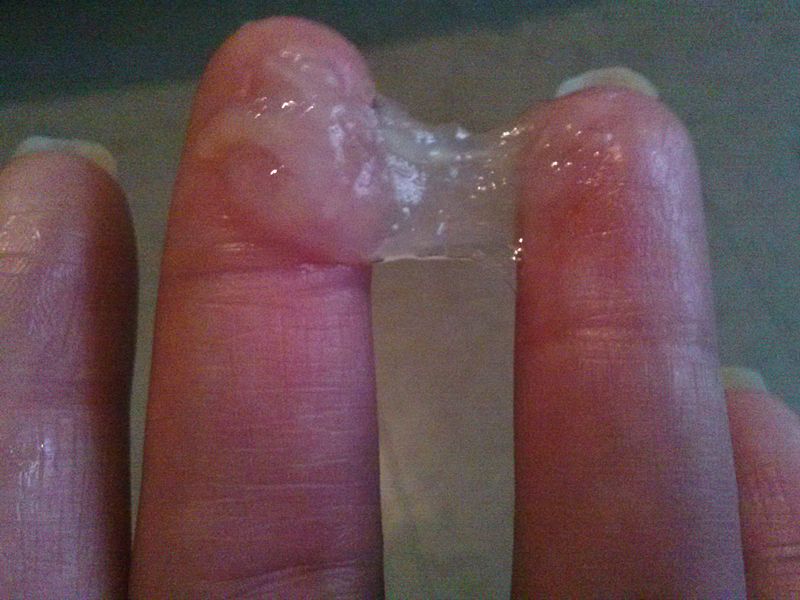
  • What it looks like: raw egg whites, wet rubber cement, clear, stretchy.
  • What it feels like on your fingers: slippery or lubricative or stretches an inch or more between thumb and forefinger.
  • What it looks like on your underpants: slippery, wet, may sit on top of the fabric, or soak in slightly.

Watery:

  • What it feels like (vaginal sensation): water rushing, dripping or gushing out of your vagina; cold, wet sensation.
  • What it looks like: clear or milky/clear, about the consistency of water or skim milk.
  • What it feels like on your fingers: wet, slippery.
  • What it looks like on your underpants:  leaves round wet patches that soak into your underpants.

I’m sure I left out some possible descriptions of cervical fluid here. If I didn’t name one that you’ve personally experienced, let me know in the comments. I’ll add in more descriptors as needed, so we can make the most thorough cervical fluid compendium known to humankind!

Cross-posted at Kindara, February 20, 2013.

Little Girls! Just Say Yes to Your Dreams!

March 18th, 2013 by Chris Bobel

Seen this one yet? (or the (eerily) related “Birth Control on the Bottom“?)

We posted “Sassy Girlz Candy Birth Control Pills” (written by Carissa Leone in 2011) in our regular installment Weekend Links on Feb 2. I had a mixed reaction. And when a couple re:Cycling readers described the video as “nasty,” I knew we needed to dig in a bit.

Let’s discuss.

There’s something very absurdly funny about eating birth control, even if the women are still tweens and the birth control is merely mulit- colored jelly beans intended to get young girls in the pill-popping groove before they are saddled with a baby and an half-finished high school education.

First of all, women CAN eat their birth control, donchaknow… Warner Chilcott brought to market their chewable, spearmint flavor oral contraceptive, Femcon Fe, for women who have difficulty swallowing pills and apparently, find stopping for 30 seconds to swallow water.

But I digress (I guess I just want to be clear that we are ALREADY munching our pills).

It is hard not to love how this sketch takes down the pandering to the girl tween market. Oh lordy. There’s so much potential there! (one estimate figures that kids aged 8-12 years are spending $30 billion OF THEIR OWN MONEY and nagging their parents to spend another $150 billion annually!) Little girls quickly move from Disney to diets, from fingerpaint to fake eyelashes, from tutus to belly shirts…..I have seen it with my own girls and it feels, frankly, like an inexorable force.

Viral sketch writer Carissa Leone graciously replied to my questions regarding the piece. When I asked her what inspired her, she channeled her Women’s Studies training (go team!) and supplied her two main reasons:

(1) “I saw a little girl on the subway,holding a baby doll in one of those pretend baby slings…and I thought, “If only she really knew what motherhood was like. I wonder if anyone has explained the authentic experience. I wish she were carrying a briefcase and reading a teeny issue of Ms. magazine instead… “

AND

(2) “The idea that women can/should have it all, in terms of relationships and families and career still seems to be put forth as a tangible (and”correct”) goal in Western culture. It’s a pressure I and many other peers feel, and one that I don’t think is truly possible, or necessarily awesome.”

And Big Pharma takes a hit, too, per the spot’s director, Brian Goetz, who offered this when I asked him about what led to the sketch:

“I wanted to do the video because the script spoke so well to the branding of pharmaceutical commercials, where no matter what the product, as long as you say there’s a problem and that you have the solution, throw some happy people and fun b-roll in it, you’ve got a successful campaign. On top of that, it’s always fun to legitimize terrible ideas in sketch comedy. And if that means having multi-colored jelly bean birth control pills, all the better.”

But I think there’s more to it that that.

Why do I find myself laughing and crying at the same time? Well, I just finished my advance copy of Holly Grigg-Spall’s forthcoming Sweetening the Pill  or How We Became Hooked on Hormonal Birth Control (out this Spring with Zero Books). In it (and here as well, on this blog), Grigg-Spall makes the case the hormonal contraceptives have become so normative that we, as consumers, permit an imperfect (at best) product to flourish even while other options may be more appropriate. The one-pill-fits-all mindset is so pervasive and bores in so deep, so young, Grigg-Spall argues, that when someone says, ‘hey! I don’t want to be on the pill,’ these—what she calls “pill refugees” — are hastily branded as irresponsible, antifeminist, or just plain dumb. That is, the pill gets constructed as our savior, our liberator, our saving grace, even when its not.

And that’s where this spoof enters….since the pill IS all these things, let’s get those girlies on board NOW! Why wait? Good habits start young, after all. And product loyalty is not just for toothpaste and laundry detergent….

And so, “Sassy Girlz Candy Birth Control Pills” is super smart feminist critique. It calls out the enduring wrongheadnessness of romanticizing motherhood and co-opting what I would call a tragically hollowed-out pseudo feminism harnessed to push product:

  • Little girls playing Mommy is cute, and kinda bullshit!
  • Its never too early to teach little girls about options!
  • She’ll know that birth control means winning a college scholarship

Yup. There’s lots of problems with that. Thanks to the feminist satirists to help us see.

But I have to say one more thing.

Leone and I discussed (what I consider) the unfortunate below-the-belt invocation of gender dysphoria to as she put it, “most absurd, heightening beat” in the sketch (here’s another, more recent example of same, on SNL). I don’t think trans or gender queer or otherwise gender variant people should ever serve as punchlines, as I told Leone so in our email exchange. When I inquired about this moment in an otherwise spot-on sketch, she said that is was never intended it as a negative perception of transgendered kids. But still  it is, and I think it points with a big fat finger at how much work we still need to do to move trans issues from margin to center.

Let’s push forward without leaving anyone behind. Let’s laugh at feminist satire that avoids (even unintended) transphobia. Let’s keep our targets clear and our allies clearer. Let’s say YES to that dream, for real.

Does it matter that hormonal contraceptives are endocrine disrupting chemicals?

March 6th, 2013 by Laura Wershler

I’ve been wading through State of the Science of Endocrine Disrupting Chemicals – 2012. The 289-page report was prepared by a group of experts for the United Nations Environmental Programme and World Health Organization.

It is dense and complex, but what I’ve been looking for is any acknowledgement that hormonal contraceptives are endocrine disrupting chemicals (EDCs).

Hormonal contraceptives clearly act as EDCs according to the definition used in this report:

An endocrine disruptor is an exogenous substance or mixture that alters function(s) of the endocrine system and consequently causes adverse health effects in an intact organism, or its progeny, or (sub) populations. A potential endocrine disruptor is an exogenous substance or mixture that possesses properties that might be expressed to lead to endocrine disruption in an intact organism, or its progeny, or (sub) populations.

Adverse health effects would include, in this context, anything that disrupts the reproductive systems of humans (and wildlife) or contributes to other health problems such as hormone-related cancers, thyroid-related disorders, cardiovascular disease, bone disorders, metabolic disorders and immune function impairment. Hormonal contraceptives certainly disrupt the reproductive system and have been associated with increased risk of cardiovascular events, loss of bone density, decreased immune function and, in some studies, increased risk for breast cancer. Metabolic disorders? Recent research suggests that long-acting progestin-based birth control may increase risk in obese women for Type 2 diabetes.

The only mention I could find of specific contraceptive chemicals is in section 3.1: The EDCs of concern. In a table under the sub-heading Pesticides, pharmaceuticals and personal care product ingredients, two key components of hormonal contraceptives are listed: Ethinyl estradiol, the synthetic estrogen used in most oral contraceptive formulations, and Levonorgestrel, a synthetic progesterone used in combined oral contraceptive pills, emergency contraception, the Mirena IUD, and  progestin-only birth control pills. Levonorgestrel is considered of “specific interest.”

The concern with these chemicals is not the effects they may have on women taking them, but on the possible reproductive impact on wildlife from the excretion of these chemicals into the aquatic environment. It seems ethinyl estradiol and levonorgestrel are considered safe contraceptive drugs when taken by choice to disrupt fertility, but EDCs worthy of concern when such disruption is unintended.

How would it change our perception of hormonal contraceptives if we acknowledged them as endocrine disrupting chemicals? Would we wonder why there is no discussion of how these EDCs might contribute to the health issues considered in the report? Would we ask why hormonal contraceptive EDCs are routinely used to “treat” (meaning only to alleviate symptoms of) endometriosis, fibroids and PCOS – conditions potentially caused by other EDCs?

Another relevant concern addressed in the report is the effect of “estrogenic agents, and their role in breast cancer.” The report states there “is good experimental evidence that estrogenic chemicals with diverse features can act together to produce substantial combination effects.” I have to wonder how hormonal contraceptive EDCs fit into this mix.

Here’s something to ponder. Last week news stories reported that the incidence of advanced breast cancer among young American women, ages 25 to 39, has risen steadily since 1976. Lead researcher Rebecca Johnson was quoted as saying, “We think it is a real trend and, in fact, it seems to be accelerating.” The increase is small in relative numbers, only 850 cases in 2009, but the “trend shows no evidence for abatement.”

Researchers can’t explain the increase. Lifestyle changes, obesity, sedentary lifestyle and toxic exposure to environmental chemicals are offered as possible factors. But what about the hormonal contraceptives many women of this generation have been taking since they were 15 or 16 years old? Surely these EDCs must be considered as potentially contributing factors.

This Time With Feeling! Making the Menstrual-Reproductive Justice Connection

December 24th, 2012 by Chris Bobel

Rejection stings.

A couple weeks ago, I received  the following ‘thanks, but no’ to a  proposal I sent to a reproductive justice conference,

Dear Chris Bobel,

Thank you for submitting your proposal, “How Menstruation Matters to the Reproductive Justice Movement”…..Our staff has spent the last few months evaluating proposals and building an initial workshop list. We were inspired by the volume of quality proposals that we received. All of them helped us in the planning process.

 At this time, however, we are not accepting your proposal for the 2013 conference.

Ouch.

As I typically do, I immediately headed to the deep dark brooding place of self-recrimination. That’s where I go. But as I set afoot on this well-worn path to my special ugly place,  I did something I don’t usually do; I paused, lifted my head and looked around.

As I did, I wondered, if just maybe, the rejection was not the result of the deficits in my proposal, but rather, a reflection of the broken link between menstrual awareness and the broader movement for embodied autonomy.

In other words, maybe the rejection was not as much about me (and my failings) but more about the world around me, and ITS (meaning OUR)  failings as a culture to see how a certain bodily reality is part of a larger whole.  Maybe the fact that a team of progressive reproductive justice activists and scholars saying NO THANKS to an opportunity to make the essential linkages between the menstrual cycle across the lifespan and reproductive justice is an indication that WE still have SO MUCH WORK TO DO to help people see this crucial connection.

I know I am not alone in feeling like the spotted elephant on the Island of Misfit Toys (seasonal reference: DONE!). Sister menstrual warrior Laura Wershler recently wrote the following when I this blog post-in-progress:

Caring about menstruation and the menstrual cycle makes me almost a freak in the pro-choice world. I get ignored or criticized a lot because people don’t want to ask or answer some of the questions I keep trying to pose about choice around non-hormonal contraceptive methods. 

So what’s a freak to do? We could stamp our feet and curse those who don’t see what’s pretty obvious to us, but that won’t raise the awareness.

This is on us.

Yes. Rejection stings, but maybe this time, I can take something away far more productive than the usual self-flagellation. Maybe this time, I can take it in as a clarion call, a motivation for a deeper commitment to help others make the menstrual connection, to, spread the #menstruationmatters message (thanks again Laura Wershler).

This means more conference proposals (and a thicker skin for more rejections). More writing. More blogging. More teaching. More radio interviews. More everything.

Who’s with me?


In a fertility flap? Five things you need to know

August 22nd, 2012 by Laura Wershler

Your fertility is not a deep, dark mystery only your doctor can unravel. It’s yours to own, understand and manage. Forget the ticking biological clock, it’s the wrong metaphor. Fertility ebbs and flows, like the phases of the moon. It’s about the cycle – not the clock.

Are you wondering about your fertility status? Will you be able to have a baby when you want to?

Seems these questions are on the rise for 20- and 30-something women who are finally getting the message that putting off motherhood may not be a good idea. Recent news stories report that young adults don’t know the facts of fertility decline and overestimate the success of reproductive technologies.

But as the message gets through, the response makes my eyes roll.

Judith Timsom, one of my favorite columnists, recently pondered the fertility fears many young women are having.  Among them:

A third woman, turning 30, with a committed partner and a great job, made fertility sound like the new “f” word as she glumly remarked to a friend ,“My doctor told told me my fertility just dropped 50 per cent. Crap.”

This is crap. It misrepresents how fertility works. Timson writes that “young women – and men – are crying out for more factual, emotionally neutral information on how their fertility works.”  Forgive me if I, and at least 700,000 others – the number of people who have purchased Toni Weschler’s  Taking Charge of Your Fertility since it was first published in 1995 shake our heads in frustration.

What women need is body literacy, the know-how to observe, chart and interpret our menstrual cycle events so that we – not the doctor, not the lab tech – can confirm our fertility status. Yes, it’s called fertility awareness, and, since the late 60s, millions  of women world-wide, including me – a bonafide pro-choice feminist, have used this life skill to both avoid and achieve pregnancy.

If you’re worried about your fertility, here are five things you need to know:

  1. You can learn to observe and chart three key signs of fertility: a) fertile cervical mucus b) basal body temperature shift  c) adequate luteal phase, or number of days from ovulation to next period.
  2. If you use hormonal contraception (HC), you have been infertile for as long as you’ve been using it. When you stop HC, your body has to establish healthy ovulatory menstrual cycles before you become fertile. Health and environmental factors may impact this process. Factor recovery time into your baby plans.
  3. If you began using HC as a teenager for heavy bleeding, painful periods  or irregular cycles chances are your reproductive system has not fully matured. When you quit HC this maturation process will resume. Depending on the method you used, it could take months before you have ovulatory, fertile cycles. Be patient. Holistic Reproductive Health Practitioners can assist in recovering fertility.
  4. If you began using HC for PCOS or endometriosis, expect symptoms to resume when you stop. The Centre for Menstruation and Ovulation Research describes treatments that manage PCOS  and endometriosis while helping to preserve fertility.
  5. Fertility is individually, not statistically, determined. It can ebb and flow from cycle to cycle. Diet, stress, travel and trauma can result in anovulatory, or infertile, cycles. When it comes to getting pregnant, the more you know about your own menstrual cycle, the better.

Fertility awareness is empowering, but Toni Weschler says that in her decades long experience she has repeatedly seen the sense of excitement that women feel evolve into anger. “Women want to know why they weren’t taught this when they were teenagers.”

The young women Judith Timson writes about have yet to acquire this knowledge. When they do, will they be angry enough to teach their own daughters? Weschler has a book for them, too - Cycle Savvy: The Smart Teen’s Guide to the Mysteries of Her Body Fertility isn’t a mystery if you know where to look for the clues.

The Eternal Feminine: Focused, Goal-Oriented, Practical, and Loving

April 30th, 2012 by Paula Derry

Visiting colleges became part of our repertoire of family trips back when my daughter was a senior in high school.   We visited many schools to get a sense of the range of possibilities that existed.   As was typical, Vassar offered a tour of the campus for groups of prospective students and their parents, led by tour-guides who were undergraduate students.  Vassar’s tour had one unique feature.  An original campus building, which dated to the post-civil war era, had an exceptionally wide hallway.  This, we were told, was because the all-woman student body needed to be able to walk back and forth repeatedly in the halls in their wide skirts, as part of a college program in physical fitness. Vassar, founded on the idea that the education of women should equal that of men, had a program of physical culture to offset criticisms that the school was endangering women’s health by educating them.

Sheila Rothman describes Vassar’s history in her book “Woman’s Proper Place,” published by Basic Books in 1978.  The common wisdom in the second half of the 19th century was that people have a limited amount of biological “vital energy.”  Rothman (p.24) quotes a contemporary physician:  ”Woman has a sum total of nervous force equivalent to a man’s” but the force is “distributed over a greater multiplicity of organs…The nervous force is therefore weakened in each organ…it is more sensitive, more liable to derangement.”  Menstruation and pregnancy were times of special danger, when the demands on her system were greater and the possibility of physical and mental disorder increased.  Menstruation was a time when women were irrational, even insane.  Caution, however, was always called for, as when intellectual activity or other exertion used up nervous energy.  Thus, when Vassar was founded, a program was put in place to overcome women’s predisposition to illness through a structured environment and programs of physical exercise.  Later, the Association of Collegiate Alumnae conducted a survey to provide research evidence as to whether female college graduates were normal.

Image by Thiophene_Guy // CC 2.0

Back in the Vassar of the present, our student tour guide wondered:  “How could anyone believe anything so silly?” It’s true that we no longer talk about a “vital force.”  Yet, broad generalizations about the nature of women and reproductive physiology continue to exist that have an air of plausibility, based today on a different scientific language, one of hormones, neurotransmitters, and other players.   Not very long ago, menopause was defined as an “estrogen deficiency disease” that had a uniquely powerful effect on health.  Heart disease was a disease of civilization for men and a disease of the ovaries for women.   The idea that the menstrual cycle destabilizes women’s minds, creating mood and intellectual changes, continues to exist.

One of my favorites is the idea that women are somehow receptive, loving, and self-denying because of their maternal role, which is somehow mediated by estrogen.  Thus menopause may be said to be a time that women regain the ability to focus more on themselves, liberated from a physiological preparedness for reproduction and its needs.   Pregnancy is a dreamy time when women are moody and unable to think clearly.

Sure, mothers are receptive, loving, self-denying, but they are also many other things.  I love being a mother.  My relationship with my daughter has been powerful, unique, and wonderful.  However, I know that a mother who is lost in a dreamy connectedness to her child or reflexively puts her child before herself can’t do everything she needs to do.   A mother is emotionally connected to her child but also must be an individual who perceives the child accurately, as a separate person, in terms of the child’s motivation and perspective, in order to provide both a sense of connection and the mirroring needed for a child’s emotional development.   Further, children misbehave, make mistakes, and must be taught all kinds of things; mothers must have clear-headed, pragmatic, problem-solving skills.

Menstrual Bonding, Birth Control Brouhaha, and other Weekend Links

March 10th, 2012 by Laura Wershler

Research by SMCR members Tomi-Ann Roberts and Nicki Dunnavan garnered a lot of attention this week. Stories showed up at Live Science – Why Why Women Should Bring Their Periods ‘Out of the Closet, popular ladyblog Jezebel – Your Period Is a Time for Deep Lady-Bonding, and the Daily Mail - Women, start talking about it. Period! Roberts and Dunnavan surveyed 340 religious and non-religious women about their experiences and attitudes about menstruation. As the Daily Mail reported: ”U.S. researchers say women across the world need to be more positive about menstruation – and that means talking about it in public.”

Credit: MK Carroll

There’s been lots of public discussion about contraception, some might say too much!  The birth control/medical insurance coverage brouhaha hit a boiling point last week with Rush Limbaugh’s egregious comments about Sandra Fluke, and the heated debate rages still. Maureen J Andrade at OpenSalon writes that Birth Control Is Not a Women’s Issue: It’s a Human Right, while Asma T. Uddin and Ashley McGuire, blogging at the Washington Post, insist It’s about religious liberty, not birth control.  A group of crafters has come up with a  unique protest action: sending “interfering” male government members a knitted or crocheted uterus, vagina or cervix, while feministing.com has invited readers to Talk About Birth Control For REAL.

Back to women’s experience of menstruation,  Enith Morillo in Menses’ non-sense: Menstruation and the Muslim Woman’s “Red Tent” and Carolyn West in Menstruation – Celebration or Taboo?, explore different cultural menstrual traditions.

Coming Off The Pill: A Mind Map Guide

March 7th, 2012 by Laura Wershler

Everybody can use a good map to help them get to where they’re going. Why not women heading to the land of non-hormonal contraception?

In my post on January 11, 2012 I asked if coming off the pill was a growing trend. I proposed to write a series of posts about the issues associated with the decision to stop using hormonal birth control.  For the purposes of this discussion assume that “coming off the pill” refers to quitting any method of hormonal contraception including the pill, patch, ring, shot, implant or Mirena intrauterine system.

As I was preparing a list of possible topics, I realized that one way to represent the complexity of issues involved in this decision is with a mind map: “a diagram used to represent words, ideas, tasks, or other items linked to and arranged around a central key word or idea.” It also occurred to me that readers could then add to this schematic, filling in important points based on personal or professional experience. So I got out my colored markers, did a little brainstorming and came up with Coming Off the Pill: Mind Map 1.0. I invite readers to comment, offering additions under the key headings I’ve noted and suggesting other categories that should be included.  Could this become a talking, planning or process guide for women considering the transition to non-hormonal birth control methods?

If you’ve thought about or been through the experience of quitting hormonal contraception, or if you’ve helped others through the experience, please contribute to the development of Coming Off The Pill: Mind Map 2.0 by posting your comments and suggestions. (I’ve already thought about other headings I could have included.) Besides providing me with a guide for writing future posts, what other ways can you imagine this mind map might be used?

Sex Ed for Teens: Where’s the Mucus?

February 24th, 2012 by Laura Wershler

Guest Post by Lisa Leger

Teen girls are getting pregnant, in part, because they don’t understand their menstrual cycles. It’s time for sexual health educators to step up and teach girls the primary sign of fertility.

A recent report by The Centers for Disease Control and Prevention (CDC) on teen pregnancy in the U.S., based on a survey of close to 5,000 young mothers who got pregnant unintentionally, found that half of them had not used birth control.  When questioned further, a third of those said that they didn’t think they could get pregnant. Their reasoning ties in with previous research findings that girls who get pregnant in their teens have misconceptions about their menstrual cycles. They don’t seem to understand how ovulation works and are failing to correctly identify the fertile days in their monthly cycles.

Photo by Acaparadora // CC-BY-SA-2.5

My colleagues in sexual and reproductive health education should take notice. These findings reveal a knowledge gap in sex education: Teens don’t know about the easy-to-spot sign of fertility that precedes ovulation – cervical mucus secretions. Let’s fix it by adding one simple phrase to our sex ed classes: “When you have mucus, you can get pregnant.”

We would also need to explain the ovarian cycle, how estrogen promotes cervical mucus production, the role of mucus in sperm survival and how to check for it. This is arguably among the most useful information young women and men could receive before leaving high school.

If girls had this knowledge then I believe that at least some of them would more accurately identify fertile days in their cycles and at least some unintended pregnancies would be prevented. When a girl knows that mucus on the toilet tissue means she is fertile and able to get pregnant, she may be empowered to avoid intercourse, insist on a condom if she has sex, or know if she needs to seek out emergency contraception. Or she may decide to just hang out with her girl friends. I’m not saying that fertility awareness is a magic wand. Of course, many factors influence our decision-making. But teens are capable of making wise choices when they have accurate information on which to base them.

I’ve talked to many public health nurses throughout my 20-year career as a fertility awareness instructor. They usually quibble about the effectiveness of fertility awareness as a birth control method and seem reluctant to mention the existence of cervical mucus for fear that “a little bit of knowledge is a dangerous thing.” They worry that some students, if taught fertility awareness, might screw it up, thinking they were “safe” when they were not. But the CDC report tells us that garbled understanding about how ovulation works is doing more harm than good.

I hasten to reassure my public health colleagues that I am not proposing we teach teenagers natural birth control. What I’m proposing is the awareness part, that we correct this critical gap in teenagers’ knowledge by explaining that mucus is an obvious sign of fertility.

I won over my local sex educator to this idea by showing her the evidence-based Justisse Method of Fertility Awareness User’s Guide. She now teaches the meaning of mucus in her ovulation lessons.I predict her students will benefit. When they feel that slippery wetness when wiping, they will remember that it has something to do with being fertile. When they see clear, stretchy mucus on the tissue, they will know it’s a fertile day. It seems obvious that reducing confusion about the fertile phase would result in fewer unplanned pregnancies among girls who are currently confused about when they’re safe and when they’re fertile.

Instead of withholding useful information about what cervical mucus means, let’s tell teens that avoiding sex when they observe mucus can prevent pregnancy.

SMCR member Lisa Leger teaches the Justisse Method of Fertility Awareness & Body Literacy and is a Natural Health Consultant on Vancouver Island.

Menopause Tales

February 6th, 2012 by Paula Derry

The philosopher of science Mary Midgley (1995) doesn’t mince words.  She tells us:  “The theory of evolution is not just an inert piece of theoretical science.  It is, and cannot help being, also a powerful folk-tale about human origins.”  Along these lines, stories about reproductive physiology are important folk-tales about what’s natural for women and what their life course should be.

What are the stories about menopause?  One is that living beyond menopause is a biological puzzle. The argument goes like this: Most animals reproduce up until, or close to, the end of their natural life span.  This makes sense, because theoretical biology tells us that animals reproduce as much as possible to leave as many offspring as they can.   Why women live beyond menopause is therefore a puzzle.  One answer is that we can expect to live thirty years past menopause because technological innovations have resulted in the conquest of infectious disease, the generation of great food stores, and other advances. As recently as the turn of the century, the average woman lived 47 years.  Far longer, probably, than our prehistoric forebears:  prehistoric hunter-gatherers were probably old at thirty.  Living many years past menopause is therefore a recent historical development.  Not surprisingly, if aging women are “outliving their ovaries,” menopause is associated with a variety of unpleasant experiences and health problems.

What are some facts relevant to this story?  First, is living past menopause a new historical development?  Well, ….No.  Old age is not an invention of the twentieth century.  Betsy Ross died when she was eighty-four.  Classic Greek and Roman medical writers (including Hippocrates himself) and traditional Eastern medical systems all discuss menopause. In the Old Testament, Sarah laughed when God said she would bear a child even though it had “ceased to be with her after the manner of women.”  Might the Bible have been referring to menopause?

Sign from The Musée Mécanique, a for-profit interactive museum consisting of 20th-century penny arcade games and artifacts located at Fisherman's Wharf in San Francisco, California.

Photo by Thomas Hawk // CC-BY-SA 3.0

What about the idea that prehistoric humans died before menopause? Studies by anthropologists suggest that modern hunter-gatherers do live to old age.  Therefore, perhaps our prehistoric hunter-gatherer forebears did so as well.  Richard Lee (1985), for example, studied the !Kung San in Botswana.  About 10% of the population were over sixty years old, and it was not unusual to find !Kung aged 70 or 80.   Lancaster and King (1985) found, when twenty-four hunter-gatherer and horticulturalist groups were examined, that 53% of the women who lived to age fifteen could expect to still be alive at age 45.

If a small number of older people are found in simpler societies, is this important?   Is ten percent survival so small that for all intents and purposes fifty years is the real limit on lifespan?  Older people, as described by anthropologists, are not viewed by the members of their own societies as oddities.  That is, if living into middle-age and beyond were an anomaly, it is unlikely that people in a society would have expectations about what role an older person should play.  Older people might be viewed as curiosities.  However, older people more typically have important places in their societies.  At least through their fifties and sixties, they are relied on to do important things.  It is relatively common in nonindustrial societies for women to experience positive changes in status when they become middle-aged (Brown, 1985).  In cultures without written legal systems or CEOs, older people often have authority over younger people.  They can be decision-makers about the distribution of property, allocation of jobs, and other social behaviors.  Among the !Kung, for example, older women assign younger relatives what jobs they need to do, arrange marriages, decide on kinship classifications.  In cultures that don’t have books or the internet, older people may be sources of stored and accumulated knowledge, like the location of a watering hole that hasn’t been needed since the last drought thirty years ago (Diamond, 1996), or social and technical skills (Kaplan et al., 2010).

Do You Trust Women?

January 23rd, 2012 by Chris Bobel

Do you see the connections between menstrual health awareness and reproductive justice?

At re: Cycling, we sure do, because being critical of how menstruation is regarded (and managed)—from menarche forward—is one way we loosen the social control of women’s bodies.

My body, my choice, my whole life long.

And that’s exactly what reproductive justice is about—fighting for everyone’s access to affordable, quality reproductive health care of their choosing. That’s a fight to get behind, not the stupid “War on Women” advanced by certain presidential hopefuls (Hello Rick Santorum).

We are excited about this creative campaign organized by The Trust Women/Silver Ribbon Campaign, a coalition of 42 national and local organizations (the Bay Area Coalition for Our Reproductive Rights (BACORR), Catholics for Choice, NARAL-ProChoice California, Planned Parenthood Shasta Pacific, and SisterSong/Trust Black Women.

The campaign takes aim at “extremist politicians elected with a mandate to fix the current economic crisis instead chose to divert the public’s attention with policy battles about these private decisions.”

So why are our legislators and presidential candidates hell-bent on denying access to basic health care services –including contraception and abortion?

Really, why do we let them get away with this?

In San Francisco, The Trust Women/ Silver Ribbon campaign is literally taking the message of reproductive justice to the streets by flying banners—colorful, clear and decisive—all over the city. The banners are more than a defensive operation in the battle against women’s autonomy; they seek to end the offensive by reminding us that most Americans are, after all, pro-choice.

The banners read:

  • Her Decision, Her Health
  • U.S. Out of My Uterus
  • Fix the Economy, Support My Autonomy
  • Reproductive Rights are Human Rights
  • San Francisco is Pro-Choice

That’s all very good, you might say, but I don’t live in San Francisco.

During Trust Women Week, January 20-27, the campaign is staging a Virtual March (with  MoveOn)—a time for reproductive justice supporters to express their support online.

So go here and take action.  Let’s end the War on Women.

How do YOU define reproductive health?

December 8th, 2011 by Heather Dillaway

By Justine Siegemundin, 1723. Public Domain, via Wikimedia Commons.

Menstruation and menopause are reproductive health experiences, aren’t they? At least that’s what I think. But I’m starting to wonder how many people agree. I’ve been thinking a lot lately about how people define the things they experience and how researchers define the things they research. The last blog entry I wrote was on the confusing and frustrating definitions of the menopause transition. Today I thought I’d zoom out a bit more and think about what “reproduction” and/or “reproductive health” means. I personally think of reproductive health as encompassing a woman’s entire life course and including a whole range of experiences (and the pursuit and achievement of individual wellbeing throughout all of these experiences) but I don’t know if others do. For instance, about two weeks ago I was on the phone with a potential coauthor, and she and I had a misunderstanding because I was talking about “reproductive health” as including prevention of HIV and other STDs and she was thinking of “reproductive health” as just about conception, pregnancy, and birth.  I’ve been studying what I think of as women’s normal reproductive processes and experiences (e.g., menopause, menstruation, pregnancy, childbirth, and breastfeeding) for a long time, so I thought I would use this blog entry to tell readers what I think about “reproductive health” and see if anyone agrees with me.

Adrienne Rich, in her 1986 edition of Of Woman Born, proposes that biological reproduction has been defined narrowly by most people (feminist or otherwise). Thus, for many, “reproduction” is equated with just two female processes: pregnancy and childbirth.  While it may not have been the goal of any one person to define reproduction so narrowly, this seems to be a reality.  At various points throughout history, conception and contraception – at times, even abortion – have been added to the definition of what “reproduction” meant, or what “reproductive rights” women were owed, but “reproduction” and “reproductive health” still refers to a very short list of experiences.

I believe we should acknowledge, however, that women’s “reproductive” experiences include more than just conception, contraception, pregnancy, and birth. Reproduction includes an entire range of reproductive experiences, including: menstruation and menopause, use of and problems with contraceptives, choosing whether to become a mother/father, breastfeeding, HIV and other sexually-transmitted diseases/infections, prostate and breast cancer, awareness of and access to reproductive health care, protection against sterilization abuse, vasectomy and hysterectomy experiences, the rights of single and/or lesbian mothers, the rights of single and/or gay fathers, donor insemination, cloning and other new advancements in reproductive technology, adoption, infertility treatments and experiences, gynecological practices, alternative reproductive health movements, decisions over whether to engage in heterosexual intercourse, and making informed “choices” in any of these instances. This is just a partial list, and I could go on and on. I propose that we think of “reproduction” (and, by default, “reproductive health” experiences) as the collection of (a) biological, physiological and/or embodied processes and (b) emotional, social, economic, and political decisions and/or actions that individuals — along with their families and other social groups — participate in (either voluntarily or sometimes through some sort of coercion), as they transition in and out of certain stages of their life course, decide whether or not to be sexually-active, and/or decide whether or not to become genetic, gestational and/or social “parents” or caregivers of children.  Any one reproductive experience – for example, menstruation or menopause – can also really be a set of processes and decisions and actions that women make/take/experience/pass through over an indefinite period of time – usually not happening in just one moment. Thus, menstruation or menopause are full-fledged and complicated reproductive experiences in and of themselves, as much as pregnancy or childbirth or any other “reproductive” experiences are, that the majority of women pass through, albeit in different ways, throughout their lifetimes. So are all of the other processes and experiences I’ve named above, and more I haven’t named. “Reproductive health” would then refer to a state of physical and mental wellbeing, indeed biopsychosocial wellbeing, while experiencing any of these sets of processes or decisions or actions.

Readers should note that statements published in re: Cycling are those of individual authors and do not necessarily reflect the positions of the Society as a whole.