August 11th, 2010 by Elizabeth Kissling
Fascinating new research from the National Institutes of Health finds that women’s cholesterol levels correspond with cyclic changes in estrogen levels. Total cholesterol levels can vary by as much as 19% over the course of the cycle.
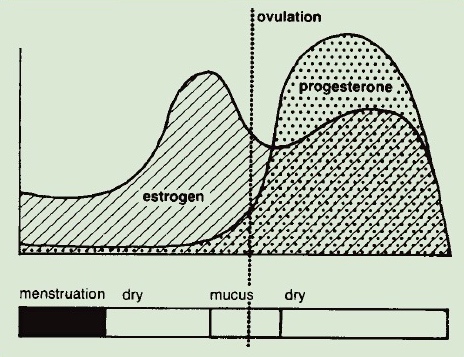
The researchers found that as the level of estrogen rises, high-density lipoprotein (HDL) cholesterol also rises, peaking at the time of ovulation.
In a typical cycle, estrogen levels steadily increase as the egg cell matures, peaking just before ovulation. Previous studies have shown that taking formulations which contain estrogen — oral contraceptives or menopausal hormone therapy — can affect cholesterol levels. However, the results of studies examining the effects of naturally occurring hormone levels on cholesterol have not been conclusive. According to the NIH’s National Heart, Lung and Blood Institute, high blood cholesterol levels raise the risk for heart disease.
. . . .
In contrast, total cholesterol and low-density lipoprotein (LDL) cholesterol levels — as well as another form of blood fat known as triglycerides — declined as estrogen levels rose. The decline was not immediate, beginning a couple of days after the estrogen peak at ovulation.
These findings provide another reason for girls and women to learn to track their cycles, so their blood tests can be interpreted more precisely.
It also gives more weight to the frequent assertion of members of the Society for Menstrual Cycle Research that menstruation matters — and is worthy of our study — in part because it is not an event isolated in the uterus and vagina, but a complex part of the endocrine system that has effects on health and well-being throughout a woman’s body.

Tags: cholesterol, endocrine system, estrogen, hormones, menstrual cycle, ovulation
Posted in Health Care, Menstruation, New Research, ovulation | 1 Comment »
July 22nd, 2010 by Elizabeth Kissling
We’ve written previously about some of the apps for tracking menstruation and PMS, but this new iPhone/Pad app for tracking ovulation is problematic.
iOvulation is an application that calculates the time of ovulation and generates your personal fertility calendar. Simply enter the length of your menstrual cycle and the date of your last period, and iOvulation will calculate your fertile days.
The web site suggests it useful both for trying to conceive and for trying to prevent conception. However, I wouldn’t recommend the latter, as its algorithm appears to predict ovulation based on dates of menstruation: “The ovulation dates are calculated based on normal menstruation calculation logic for women having regular periods.”
In other words, it perpetuates what Toni Weschler, author of Taking Charge of Your Fertility: The Definitive Guide to Natural Birth Control, Pregnancy Achievement and Reproductive Health and Cycle Savvy: The Smart Teen’s Guide to the Mysteries of Her Body, labeled the two biggest myths about menstruation in this interview with Scarleteen: (1) the idea that ovulation occurs on Day 14, and (2) A normal menstrual cycle is 28 days.
Also of interest is how squeamish the creators appear to be about sex and reproduction: the web site refers to “unprotected i*********e” and notes that the probability of conception is calculated “based on your ovulation time and other factors such as lifespan of the egg and s***m”. (For those of you unaccustomed to the practice of concealing obscenity with asterisks, that’s “intercourse” and “sperm”.)
As someone who studies and teaches sociolinguistics and writes about menstruation, I’ve seen a lot of euphemistic language over the years. But marking intercourse and sperm as unfit for print is a first.

Tags: birth control pill, calendar, contraception, fertility, internet, iPad, sociolinguistics, technology
Posted in Birth Control, Internet, Language, ovulation | 5 Comments »
April 20th, 2010 by Chris Hitchcock
It’s starting. With the approaching 50th anniversary of the birth control pill, there will be a flood of anniversary celebrations and reviews of birth control methods. Which is good. We should have those discussions more often. Just say “no” (on the part of parents who don’t want to hear about it) is a big contributor to unwanted teen pregnancy.
Today’s Wall Street Journal is running an article called The Birth-Control Riddle. The riddle is apparently the high rate of unwanted pregnancy, despite the availability of a range of effective birth control methods. And, as befits the Wall Street Journal, each birth control method is accompanied by a price tag, so you can make an informed consumer decision.
But what I noticed was that there is no real awareness of what we at SMCR feel is an important consideration: Does your birth control method stop your cycle?
Some methods do – they deliver progestins and/or estradiol in high enough doses to act on the parts of the brain that normally make the hormones that talk to the ovaries that stimulate growth of a follicle, then trigger its release. This is a complex, whole body system, that normally we only notice because of uterine effects (that would be menstrual bleeding or pregnancy). And as a culture we have fairly casually accepted the idea that it is optional, and perhaps even optimally replaced by a pill made by a drug company. Continue reading...
Tags: birth control pill, contraception, IUD, Mirena, oral contraceptive pills
Posted in Birth Control, Health Care, Menstruation, Pharmaceutical, Reproduction, Sex, ovulation | 4 Comments »
February 21st, 2010 by Chris Hitchcock
The American Psychiatric Association has pushed back their timeline for the 5th version of the Diagnostic and Statistics Manual. The new psychiatric bible was originally scheduled to come out in 2011, but has now been delayed to 2013 .
Initial drafts have been posted to the web page, but the controversial and provisional (that is, not yet officially accepted) diagnosis of premenstrual dysphoric disorder (PMDD) does not yet appear ready for comment. Which is a shame, because traditionally SMCR and its members have had a lot to say about PMDD, and we’re looking forward to the opportunity to consider and critique its new incarnation. Here’s a recent post as an example.
PMDD was first introduced in the DSM-III-R as Late Luteal Phase Dysphoric Disorder. The “late luteal” was meant to include cycling women who did not bleed, for example, those with a hysterectomy but preserved ovaries, but was criticized because “luteal phase” implies ovulation, and assessing ovulation was not part of the diagnosis.
Paula Caplan (e.g. this article) and other members of the SMCR were vocal in their challenge to the psychiatric label. Paula Caplan wrote a book about her experiences with the DSM process (They Say You’re Crazy), and the SMCR produced the following position statement: Continue reading...
Tags: American Psychiatric Association, APA Diagnostic and Statistics Manual, DSM, DSM-V
Posted in Activism, Health Care, Menstruation, PMDD, PMS, Pharmaceutical, ovulation | Comments Off
February 2nd, 2010 by Elizabeth Kissling
Tags: anatomy, Communication, critical thinking, ovaries
Posted in Communication, Internet, New Research, Newspapers, Reproduction, anatomy, ovulation | 3 Comments »
January 11th, 2010 by Chris Bobel
The definitive women’s health sourcebook, Our Bodies, Ourselves written by the Boston Women’s Health Book Collective is undergoing revisions for its 40th anniversary (and 9th) edition. Lots of folks in the women’s health community are involved in the revision and that’s a good thing—multiple voices, multiple perspectives.
I am among those reviewing the chapter on Sexual Anatomy, Reproduction, and the Menstrual Cycle in collaboration with others, such as health educator and activist, Esther Morris Leidolf, founder of the MRKH organization (MRKH=Mayer Rokitansky Kuster Hauser Syndrome, a.k.a. congential absence of the vagina) For years, Esther has been nudging me to be more inclusive in my research, writing and teaching of people with variant sexual anatomy. And she did it again.
While reviewing the content on MENOPAUSE in this chapter, she questioned the definition of this biosocial transtion used (that is, the cessation of menstruation, specifically, 12 months after the last menstrual period (LMP)).
She asked: What about women who don’t menstruate?
What about women who may not have vaginas or others with variant sexual anatomy that prevents menstuation. Many of these women still experience other menopausal symptoms, such as hot flashes and mood swings. Continue reading...
Tags: Menopause
Posted in Language, Menopause, Menstruation, ovulation | 4 Comments »
December 10th, 2009 by Laura Wershler

Mammograms showing healthy (left) and (right) cancerous breast. Courtesy of the National Cancer Institute.
Can having too many menstrual cycles give you breast cancer? That’s what one might conclude from two unrelated articles that appeared in national newspapers this week.
First was Nicholas D. Kristof’s Op-Ed in the New York Times. Kristof had recently attended a symposium exploring whether certain common chemicals are linked to breast cancer and other ailments. The role of estrogen – both the real thing our bodies produce and the pseudo-estrogens – in breast cancer was his major example.
The real thing:
One theory starts with the well-known fact that women with more lifetime menstrual cycles are at greater risk for breast cancer, because they’re exposed to more estrogen. For example, a woman who began menstruating before 12 has a 30 percent greater risk of breast cancer than one who began at 15 or later.
The pseudo-estrogens:
One class of chemicals that creates concern — although the evidence is not definitive — is endocrine disruptors, which are often similar to estrogen and may fool the body into setting off hormonal changes. This used to be a fringe theory, but it is now being treated with great seriousness by the Endocrine Society the professional association of hormone specialists in the United States. …These endocrine disruptors are found in everything from certain plastics to various cosmetics. Continue reading...
Tags: birth control pill, breast cancer, drugs, estrogen, hormones, Menarche, Menopause
Posted in Birth Control, Health Care, Media, Menarche, Menopause, Menstruation, Newspapers, ovulation | Comments Off
November 25th, 2009 by Elizabeth Kissling
re:Cycling readers may be interested in this story in the current issue of Macleans about the declining interest in oral contraceptives among Canadian women, particularly among women in their 20s who’ve been using The Pill for a decade.
[O]ral contraceptive prescriptions in Canada levelled off in 2008, reports pharmaceutical industry analyst IMS Health Canada. Health care workers are seeing a growing demand for non-hormonal methods. Spurred by concerns about their health, the environment, or even frustration with family doctors, who sometimes seem to push the pill as a modern-day cure-all, Canadian women are looking for other options.
The report echoes a couple of recent discussions here at re:Cycling, such as our guest post from Holly Grigg-Spall and Laura Wershler’s response, guest post from Moira Howe about the quiescent uterus, and discussion of risks of YAZ.
And Dr. Jerilynn Prior, scientific director of the Centre for Menstrual Cycle and Ovulation Research (and past president of the Society for Menstrual Cycle Research) is quoted in the article: “There’s an emotional identity attached to achieving your own menstrual cycle, and being able to read your body,” she says. “When you’re on the pill, it’s the doctor who’s controlling your cycle. You don’t own it.”
It’s good to see this issue getting some attention in mainstream media.
[via Sexual Health Access Alberta]

Tags: big pharma, birth control pill, hormones
Posted in Birth Control, Menstruation, Pharmaceutical, magazines, ovulation | 2 Comments »
November 7th, 2009 by Chris Bobel
Guest Post by Moira Howes, Trent University
Uterus Vase by The Plug and Stephanie Rollin
Over thirty years ago, Roger V. Short argued that regular menstrual cycling is probably a health hazard and thus, we should try to “keep the ovaries and the female reproductive tract in a state of quiescence when reproduction is not desired” [1]
More recently, Timothy Rowe, Head of Reproductive Endocrinology & Infertility, University of British Columbia, claims that “the pill keeps a woman’s reproductive organs quiet and healthy”[2]
As a philosopher of science, I find the concept of a “quiescent” bodily organ fascinating, troubling and great fodder: there is nothing so tempting to a philosopher of science as a vague, unscientific and value-laden concept.
Short and Rowe use the concept of “quiescence” to describe a presumably defined state of the uterus, but the concept is vague. It’s also unscientific—it calls to mind the promises made for “stimulated” immune systems and “cleansed” livers at my local health food store. And, the quiescent uterus raises old value-laden associations between women and passivity. If the dormant, quiet, and weak uterus is healthy, is the active, energetic, and strong uterus unhealthy? Continue reading...
Tags: birth control pill, guest post, ovulation, philosophy of science, Reproduction, reproductive immunology, uterus
Posted in Birth Control, Language, New Research, Reproduction, ovulation | 3 Comments »
Readers should note that statements published in re: Cycling are those of individual authors and do not necessarily reflect the positions of the Society as a whole.