Frequent re:Cycling contributor David Linton was profiled last week in The Online Rocket, the student newspaper of Slippery Rock University. Professor Linton gave a talk on campus about the role of men in advertising for menstrual products.
“Prince Charles made me do it.”
March 15th, 2010 by Elizabeth KisslingJesus: A Menstrual Hero?
March 10th, 2010 by Elizabeth KisslingGuest Post by David Linton, Marymount Manhattan College
Debates about Christianity’s attitudes toward women sometimes focus on Jesus’ relationship with Mary Magdalene and isolated engagements with other unnamed women encountered during his travels. Little is made of a healing scene in the book of Luke(8:43-48) where Jesus had momentary contact with a woman who, in all likelihood, had a severe case of menorrhagia. Here’s how the translation is described in the Revised Standard Version”
“As he went, the people pressed round him. And a woman who had a flow of blood for twelve years and could not be healed by any one came up behind him, and touched the fringe of his garment; and immediately her flow of blood ceased. And Jesus said, “Who was it that touched me?” When all denied it, Peter said, “Master, the multitudes surround you and press upon you!” But Jesus said, “Some one touched me; for I perceive that power has gone forth from me.” And when the woman saw that she was not hidden, she came trembling, and falling down before him declared in the presence of all the people why she had touched him and how she had been immediately healed. And he said to her, “Daughter, your faith has made you well; go in peace.”
The story is rendered with remarkable efficiency. The stealth of the woman was motivated by her clear understanding that she was a pariah in her community,that she was forbidden by the rigid rules of Leviticus from having contact with others lest she contaminate them. Peter’s response is particularly interesting. Rather than acknowledging the severe violation of the rules and dealing with its consequences (Jesus would have had to go away from everyone to be cleansed), Peter denied that any contact had even occurred. (Does this foreshadow his later denial of even knowing Jesus?)
But Jesus seems utterly indifferent to the rules as he places the well being of a suffering woman above the demands of his cultural prohibitions.
The fact that Jesus’ heroic menstrual encounter has been expunged from the narrative of his life reveals, yet again, just how pernicious the taboos and prejudices are. Wouldn’t it be wonderful if Sunday School classes set the menstrual record straight?
To make matters worse, the wonderful gospel song that extols the woman’s faith, first recorded by Sam Cooke and the Soul Stirrers, “The Hem of His Garment” has been similarly sanitized so that she is simply “sick.” The YouTube link that contains the song takes on extra layers of meaning when you listen to it with the thought in mind that it is an unacknowledged story of reactons to the menstrual taboo. The YouTube link also contains an additional Soul Stirrers recording, “Jesus Wash Away My Troubles” – a bonus!
What do men know about birth control and periods?
March 4th, 2010 by Elizabeth KisslingHere’s a hint: the title of the new study by the National Campaign to Prevent Teen and Unplanned Pregnancy is How Misperceptions, Magical Thinking, and Ambivalence Put Young Adults at Risk for Unplanned Pregnancy.
The study [PDF] surveyed American singles ages 18–29 about their perceptions about and use of contraception. Twenty-eight percent of young men think that wearing two condoms at a time is more effective than just one. Twenty-five percent think that women can prevent pregnancy by douching after sex. Eighteen percent believe that they can reduce the chance of pregnancy by doing it standing up.
A staggering 42% of men and 40% of women believe that the chance of getting pregnant within a year while using the birth control pill is 50% or greater (despite research suggesting that the pill is typically 92% effective).
And many unmarried young adults believe they are infertile. Although available data suggest that about 8.4% of women 15–29 have impaired fecundity (measured as an inability to conceive or carry a baby to term): 59% of women and 47% of men say it is at least slightly likely they are infertile (19% of women and 14% of men describe it as quite or extremely likely.
In a very good short essay about the study at The Sexist, Amanda Hess links men’s lack of knowledge about contraception to their lack of knowledge about menstruation and physiology more generally, and illustrates with some telling anecdotes. There are a few more examples in the video at right, in which Amanda corners several men and asks them to explain how hormonal birth control works.
It all seems quite shocking, until one remembers that abstinence-only sex education that includes lessons about the ineffectiveness of condoms and other contraceptives has been standard in the U.S. since 1996. (See here for U.S. Government definitional criteria for abstinence-only sex education. At present, 22 states have opted out of receiving federal funding, so that they may provide accurate and comprehensive sex education.)
Pain Don’t Hurt
February 25th, 2010 by Elizabeth KisslingA small study recently published in the European Journal of Pain found that women’s sensitivity to pain does not appear to be increased by the menstrual cycle. The study did not assess perceptions of menstrual pain, but measured pain sensitivity to cold pressor, heat, and ischemic pain at different points throughout the cyle: the early follicular, late follicular, and luteal phases. Men were also tested three times, controlling for number of days between testing sessions. The researchers found that the phase of the menstrual cycle did not affect women’s pain sensitivity, nor did it affect gender differences in pain. (Contrary to popular belief, research indicates that in general, healthy women are more sensitive to pain than healthy men.)
Whose “Last Stand?”
February 19th, 2010 by Chris BobelIf you watched the Super Bowl this year, you likely saw the new Dodge Charger ad “Man’s Last Stand.” If not, drop what you are doing and watch it right this minute and sound the gender panic alarm!
There’s a crisis!
Masculinity is endangered! The women are taking over!
Men are-day in and day out–emasculated by the nagging, demanding, self-centered women in their lives and their trivial concerns (vampire lust! hairless sinks! fruit for breakfast! civility toward family members!)
It is so bad out there, apparently, that men need to recapture their manliness by “driving the car (they) want to drive.” (I don’t know what’s more offensive here, women-as-problem or car-as-solution)
The blogosphere and its environs is a-buzz with the work of MacKenzie Fegan who found, in her words, the commercial uh….“oft-putting”. She posted this response. Not sure I would have chosen the same complaints to highlight, but I did cheer with this dig:
“I will get angry and you will ask if it’s that time of the month.”
Crisis? If only there were one and that tired old excuse for not taking women seriously was on the way out!
Charlie’s Tampon
February 10th, 2010 by Elizabeth KisslingGuest Post by David Linton, Marymount Manhattan College
Four years ago I published an article in Sex Roles (March 2006) about the twists and turns of the media coverage of a scandal that came to be known as “Camillagate.” It concerned the publication of a surreptitiously recorded phone chat between Prince Charles, heir to the British throne, and his lover, Camilla Parker-Bowles, that occurred in 1993. The reason the mild sex banter between two horny middle-aged royals got so much attention was that at one point they made joking references to tampons in an erotic context. The exchange was widely misreported with a distorted claim that Charles expressed a desire to be transformed into a tampon. It even became the basis for a skit on Saturday Night Live (only a small portion of it is available now online).
At the time I predicted that Charles would never get away from the tampon association. What I could not predict was how nuanced the forms of mockery would be. Who could possibly have guessed that the story would play out as a means of bolstering George W. Bush’s faltering reputation by contrasting his macho style with the more effete image of The Prince of Wales?
In October 2005 as Charles was about to visit the U.S., he told an interviewer in London that he hoped to speak with President Bush about improving relations with Muslims. The thought of a Brit having the temerity to advise Bush so enraged some in the right wing that they attacked with menstrual guns blazing. A blog called “The Citizen Journal: Conservative Political Forum, Articles & Resources” headlined a brief screed, “’Prince Tampon’ aka Prince Charles to lecture Bush on Muslims!!” (exclamations in original). The next day (Halloween!), the blog of a woman named Debbie Schlussel, a self-described “conservative political commentator,” echoed the same theme and in a far more vicious tone. Her piece was titled “Another Halloween Costume: Tampon Man Now Islam’s Envoy to U.S.” She repeated the phrase “Tampon Man,” “Prince Tampon,” “Prince Charles of Tampon” or “Tampon Prince” eight times and also included a crude cartoon depicting a box of Tampax with legs and arms and several tampons sticking out of the top, one with a crown and Charles’ face with the caption, “Sweet Camilla, Your wish is granted.”
Whew! What a lesson! Would it be any wonder that men, particularly any men exposed to this kind of vitriol, would conclude that menstrual contact of any kind must be avoided at all cost? The threat to one’s social standing is too great. If the reputation of an heir apparent of a great nation can be so publicly bashed over an innocent and misreported sex joke, can any man escape menstrual mockery?
The public’s fascination with the story has manifested itself in curious ways as it has settled into the realm of popular myth. In 2006 a British paper, the Daily Star, ran a survey to mark the 130th anniversary of Alexander Graham Bell’s invention of the telephone asking its readers to select “the biggest phone scandals of all time.” To the paper’s surprise, Prince Charles and Camilla’s “saucy” chat edged out all others including soccer super star David Beckham’s text sex exchanges with Rebecca Loos (number two on the list) and Richard Nixon’s Watergate recordings (number four). Further evidence of how well entrenched the tale has become is revealed by how efficiently and subtly it can be evoked. An episode of the cartoon program The Family Guy once had the lead character say on the phone “I want to be your tampon,” and a ballet performance titled “Diana the Princess” choreographed by Peter Schaufuss in London in 2005 featured dancing tampons. Is it possible that one day “Charlies’ tampon” will be as familiar an allusion as “Achilles’ heel?” It would be shorthand for any man who even toyed with the thought of voluntarily exposing himself to anything menstrual.
Men in Menstruation: Vinnie’s Tampon Case
February 3rd, 2010 by Elizabeth KisslingWe’ve had a couple of productive discussions recently here at re:Cycling about men and menstrual humor, so it seems a good time to introduce Vinnie D’Angelo, creator of Vinnie’s Tampon Case. Therese Shecter has graciously shared this clip from her thought-provoking film, I Was A Teenage Feminist.
I’ve written about Vinnie and the role of men in menstrual activism before, in the “Menstrual Counterculture” chapter of my book, Capitalizing on the Curse: The Business of Menstruation. Here is a brief excerpt from that chapter:
According to interviews, D’Angelo’s motivation in developing his tampon cases was to help out his female friends. He would see them fishing in purses or backpacks for a tampon and retrieve “a mangled applicator and a lump of cotton with old gum stuck to the string” (quoted in Raappana). He also liked the idea of changing attitudes toward menstruation. . . . Interviews with D’Angelo reveal a feminist sensibility that extends beyond providing menstrual support.
[ . . . .]
I confess to some ambivalence here: I am uncertain what men’s role should be in celebrating menstruation. I appreciate [Harry] Finley’s genuine curiosity, and I admire D’Angelo’s feminist approach and his lack of squeamishness. I’m glad to see men talking about menstruation and not insisting that it remain hidden. I like D’Angelo’s playful, accepting attitude toward menstruation, but at the same time I find the fact that he has built a cottage industry of it vaguely exploitive. No one is harmed by his products, of course, but it is more than a little ironic that someone who doesn’t menstruate launched this successful line of whimsical, self-conscious menstrual products. On the other hand, perhaps D’Angelo’s masculinity adds a social legitimacy (as well as a humorous novelty element, as he has noted in interviews) that a woman’s name would not carry in the current cultural climate. And he’s great with the clever slogans: He owns the domain name knowyourflow.com, and recent ads for his tampon case say, “Don’t let your period cramp your style.”
What do you think, re:Cycling readers? How do you feel about the fact that two of the most visible examples of menstrual activism in the U.S., Vinnie’s Tampon Case and Harry Finley’s Museum of Menstruation, are created and promoted by nonmenstruators? Does it matter if these ventures are commercially successful? (Just for the record, Finley has received no financial benefit – only internet notoriety – from the Museum of Menstruation. Since introducing his eponymous tampon case in the late 1990s, D’Angelo has also developed Vinnie’s Giant Roller Coaster Period Chart and Sticker Book, and Vinnie’s Cramp Relieving Bubble Bath, which is also available packaged with Vinnie’s Soothing Bubble Beats CD of “music to menstruate by”. I do not know how profitable these products are for him.)
Should menstruating women be permitted on submarines?
January 11th, 2010 by Elizabeth Kissling
Britain’s North West Evening Mail reports that nation’s department of defense is considering whether or not to allow women to serve on subs. Women have gone to sea on submarines in pilot studies in the past, but presently only the Norwegian, Danish, Swedish, Australian, and Canadian navies allow women on submarines.
The primary objections to the new inclusiveness are the possibility of minute radiation affecting chromosomes in pregnancy; screening equipment in submarine toilets that may not be capable of dealing with items like tampons; and the belief that having women and men working in close, cramped quarters could “create tension.” Plus, “it might worry submariners’ wives if women go on subs,” according to one merchant seaman who is a Petty Officer in the Sea Cadet corps.
However, it’s the Ministry of Defense that will be making the decision. A spokesperson told the paper, “The UK is bound by law to reassess occupations from which women are excluded every eight years. We expect the review will be completed in early 2010 and once the results have been evaluated we will publish our conclusions.”
Until then, I’ll join the Evening Mail in letting local businessperson Sally Broom have the last word.
“As far as I am aware, the only ‘official’ reasons for women not being allowed to spend time in submarines at depth are lack of facilities, and medical concerns surrounding pregnancy. In this case facilities should be made available and there should be no issue for women who are not pregnant.
“A traditional and ‘unofficial’ viewpoint is that the presence of women leads to lack of focus. But the idea that, as soon as a woman sets foot on a submarine with a team of highly drilled, disciplined men, the whole thing would collapse into a lustful mess is an absurd insult to both male and female sailors.
MANopause; or, Hello, God, It’s me, Mel Gibson
December 22nd, 2009 by Elizabeth KisslingGuest Post by David Linton, Marymount Manhattan College
An earlier re: Cycling post about a clever viral marketing strategy that exploited the notion of male cramps reminded me of some other ways that men have tried to appropriate aspects of the menstrual mythos for their own interests.
Gender jealousy was spelled out by Freud with his concept of “penis envy” and rebutted by Karen Horney who claimed that “womb envy” was an even stronger psychosocial phenomenon that expressed male anxiety at their inability to give birth. Then the term “menstrual envy” came along in an attempt to explain a variety of male attractions to behaviors including sports and war.
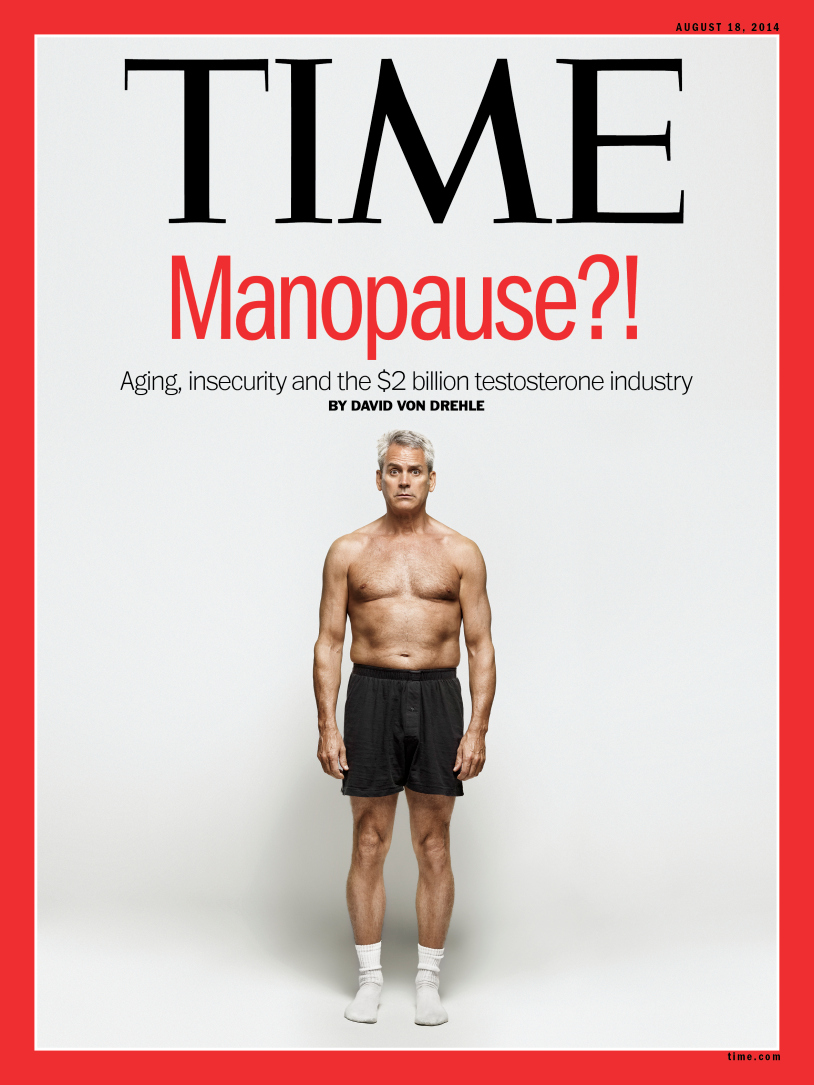
Recently there has been a rise in use of the term “male menopause,” probably a reflection of demographic shifts and concern for the well being of the aging American male. An early advocate of this syndrome was Jed Diamond whose 1998 book, Male Menopause, claims that the purpose of the hypothesized phenomenon (also called viropause or andropause) “is to signal the end of First Adulthood and prepare men for Second Adulthood.”
Another web site identifies eight “symptoms of male menopause,” but reading the list reveals that what is now being called male menopause used to be called simply “getting old,” as it includes items such as declining sex drive, forgetfulness, weight gain, and irritability.
The Fox news network has also gotten behind the idea with testimony from the “Foxsexpert,” Yvonne Fulbright, who sports a sexy pose to support her title under a headline that reads, “NOT SUCH A MYTH: MALE MENOPAUSE” The Sexpert goes on to state, “He’s feeling hot flashes — and they have nothing to do with desire. Like a woman, his body is letting him know it’s going through “male menopause.” Far from being a myth, this hotly debated experience really does exist. Yet few people know about the condition more formally known as andropause.”
Actually, once the article turns its attention to the medical circumstances surrounding andropause, it raises some very important issues that men would be well advised to know about.
It’s Always Funny to Joke About Tampons
December 3rd, 2009 by Chris Bobel- Button by Insanitywear

My friend, the poet and writer Andrea Scarpino, posted this brief essay on a blog she regularly contributes to–Steven Kuuisto‘s “Planet of the Blind.”
It is not a coincidence that a blog centering on disability (specifically the consequences of living with blindness) hosts a narrative like this, one that makes strikingly clear the importance of challenging the denigration of SOME bodies.
We at re:Cycling are heartened whenever we hear that we are not alone speaking up in the aisles of grocery stores (and everywhere else women’s (and their bodies) serve as the punchline).
December 01, 2009
Trader Joe’s and the Menstrual Taboo
By Andrea Scarpino
Los Angeles
I love shopping at Trader Joe’s late in the evening right before it closes. The crowds thin out, restocking of shelves begins, and the employees start pumping some raucous dance music. They also start gossiping, about their shifts and managers, about which area is the most boring assignment, about budding employee romances and new products.
Last night, though, I eavesdropped on another customer. Standing in the aisle with toothpaste and other personal products, I heard a masculine sounding voice in back of me say, Do you need any tampons? And then laugh. I turned around. Both the speaker and the friend to whom he was speaking looked like adult men. One was bald, for god’s sake. The friend made eye contact with me. It’s always funny to joke about tampons, I said to him with my saucy-teenager-perfected sarcasm. The speaker kept laughing, but started to blush. His friend looked uncomfortable. You know, he said, I was just looking at hand soap.
I smiled. You can tell that you’ve reached maturity when you’re still joking about tampons, I said. That’s my tried and true method for sassing people—smile big while you’re doing it. Both men looked at the ground. As I walked away, I thought about the fact that menstruation can be funny—just like Steve has said before about blindness. Remembering first period stories with friends now that we’re adults can be pretty amusing. I use reusable cloth menstrual pads, and on more than one occasion, have found a missing pad folded neatly on top of my apartment’s shared washing machine, left behind from a load I had washed the night before. Imagining one of my macho, muscled, BMW driving neighbor-men folding my missing pad on the washer for me to reclaim totally cracks me up.
But the statement I overheard last night wasn’t an attempt at “honest” humor, so to speak. It was a man mocking his friend by engaging in our cultural menstrual taboo. You know, the thing that makes women use words like “time of the month” to describe their period. My good friend Chris Bobel researches menstruation and has many more insightful things to say about the menstrual taboo than I could ever muster (she contributes to the blog re: Cycling which I highly recommend) but suffice it to say that making women uncomfortable in their bodies is a continually acceptable cultural phenomenon. Sure, we have much more “plus-size” model visibility than we’ve had in the past (and by “plus-size,” I mean still-thinner-than-the-average-American-woman) but on the whole, there is much money and power to be gained from teaching women to hate their bodies.
And the menstrual taboo is part of that. Menstruation is a biological process that almost half the human population experiences at some point or another and yet, it’s so infrequently discussed that a joke about buying tampons is still considered kosher by grown men. Seriously?