Blog of the Society for Menstrual Cycle Research

Blood on Screen: The Runaways

March 23rd, 2010 by Giovanna Chesler

Last July we posted photos from an unnamed film set where Dakota Fanning stood, ready for camera, with blood running down her thighs and a blood stain on the back of her skirt. Were these menstrual markings or the next era of horror film misogyny? The answer can be seen in the newly released film The Runaways, a drama about a 1970′s all girl rock band fronted by Cherie Currie (played by Dakota Fanning) and guitarist, Joan Jett (Kristen Stewart.)

Here, menstruation is a framing element, as the film begins with a screen sized image of a red blood drop falling to the pavement. Cut to Fanning wiping blood from her thigh in disbelief. Her sister, Marie rushes her to the bathroom to attend to their first period, for Marie whines “Everything happens to you first!” Cherie packs her undies with paper towels, ties a sweatshirt around the stain, and in stunned disbelief of what has just transpired, tags behind her sister and her sister’s creepy dude date. He leers at her, “You’re a woman now.”

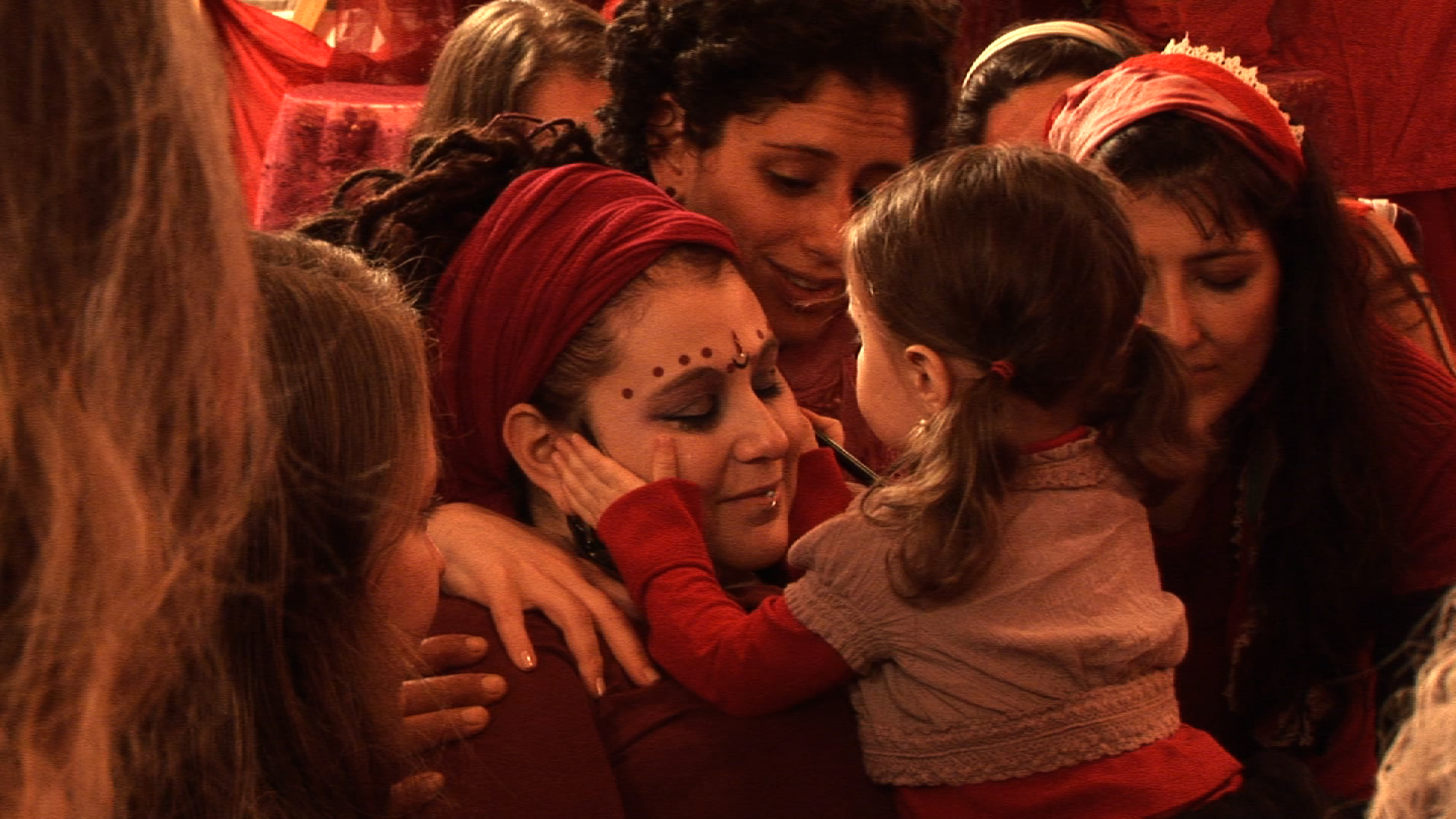
Later that evening, Cherie crops her hair, paints a David Bowie red streak across her face, and begins to come into herself. Becoming a woman in this film, does not include being soft and desirable for boys. Rather, menarche signifies entrance into glam rock iconography.

As Cherie meets up with Joan, and the two launch The Runaways, Cherie’s early entrance into womanhood seems to have come too soon. Still a child, Cherie is pushed into the front of a stage and asked to groan into a mic about her bursting sexuality in the song Cherry Bomb. The demanding manager, Kim Fowley (Michael Shannon), yells at her to give more to the song “This isn’t woman’s lib. It’s woman’s lib-ido.”

In the coming weeks on tour, Cherie will partake in her first kiss, first sip, first line, first pill – revealing how womanhood has not “dropped” upon her. It arrives in waves through her choices, or her inability to make them. And there is still more growing to do.

Post to Twitter Post to Plurk Post to Yahoo Buzz Post to Delicious Post to Digg Post to Facebook Post to MySpace Post to Reddit Post to StumbleUpon

Bravery and Intellect Over Easy: Scrambled

March 12th, 2010 by Giovanna Chesler

(This post also published at the blog g6pix.)

I’ll try not to sound too fan-girlish here as I write about the documentary Scrambled: A Journey through PCOS by Randi Cecchine, but admittedly, it is a difficult task. For in this film, which chronicles Cecchine’s struggle with Polycystic Ovarian Syndrome, we meet a filmmaker brave enough to show us, wart-hairs and all, the challenges inherent in this disease embodied. She does so with humor, with information, and with space for personal reflection.

As Cecchine and the health practitioners she speaks with share, PCOS is a condition that affects 8% of women but that goes under-diagnosed. Though largely undetected in the women who have PCOS, the first sign of something wrong is the absence or change in the menstrual period. According to Cecchine’s participant Dr. Geoffrey Redmond, an endocrinologist who has studied female hormone problems for over twenty years, PCOS generally shows up during puberty or shortly during the menarche period. In his interview, he argues that a delay of fifteen years in diagnosis typically occurs because “people who care for teenagers are typically not clued into this condition.”

In popular rhetoric on menstruation and menstrual suppression, there are many voices who have argued that having a menstrual period is unnecessary and should be done away with through hormonal birth control regimens (for example, Lybrel, Depo-Provera and Seasonale.) These drugs are often presented as choices to girls and young women close to menarche. Scrambled serves to intercept this discourse by demonstrating how the cycle becomes a sign of imbalance and illness. This film reminds us of the value of attending to the menstrual cycle. In Cecchine’s case, as in the case of the many women she interviews in her film, the lack of a period is a personal introduction to the disease.

Cecchine works with a light yet serious tone. A visit to Harry Finley’s Museum of Menstruation underscores the connections between menstruation, body awareness and PCOS. Yet we are able to marvel and smirk at Finley’s collection of menstrual advertising and decades old menstrual protection products which now live in his basement. As her lived investigation continues, Cecchine meets up with the Polycystic Ovarian Association (PCOSA) at their conference. There her film does remarkable work, as it invites the viewer to join in the conversation. In the scenes around the conference, we see how this film works to invite fellow PCOS women into the information Cecchine has gleaned. Though knowledge will not cure one from the illness, certain techniques shared in the film (like limiting carbohydrate intake) will result in reduced symptoms.

In the recent release of the film, which is self distributed, Scrambled is a two disc set. The first disc includes the documentary, but the second disc is chock-full of informative interviews on a variety of topics. Cecchine profiles Redmond along with many other health workers practicing western, eastern and alternative medicine who speak of the options for treatment. These include diet alterations, drug regimens, psychotherapy, acupuncture and others. In this disc, Cecchine provides the tools for a viewer with PCOS to address her syndrome through many methods. By providing information in this manner, Scrambled becomes a guide and a tool for holistic health on a personal level.

But these treatments comes at an expense. Here Cecchine’s humor bubbles up again when she shares the different techniques, like hair removal, pills, acupuncture treatments and their resulting costs. Yet, the feeling that comes afterward: “Priceless!” Bitingly Cecchine reminds us that being a patient also involves being a consumer. Therein she complicates these treatments as choices and necessities simultaneously.

Men in Menstruation: Vinnie’s Tampon Case

February 3rd, 2010 by Elizabeth Kissling


We’ve had a couple of productive discussions recently here at re:Cycling about men and menstrual humor, so it seems a good time to introduce Vinnie D’Angelo, creator of Vinnie’s Tampon Case. Therese Shecter has graciously shared this clip from her thought-provoking film, I Was A Teenage Feminist.


I’ve written about Vinnie and the role of men in menstrual activism before, in the “Menstrual Counterculture” chapter of my book, Capitalizing on the Curse: The Business of Menstruation. Here is a brief excerpt from that chapter:

According to interviews, D’Angelo’s motivation in developing his tampon cases was to help out his female friends. He would see them fishing in purses or backpacks for a tampon and retrieve “a mangled applicator and a lump of cotton with old gum stuck to the string” (quoted in Raappana). He also liked the idea of changing attitudes toward menstruation. . . . Interviews with D’Angelo reveal a feminist sensibility that extends beyond providing menstrual support.

[ . . . .]

I confess to some ambivalence here: I am uncertain what men’s role should be in celebrating menstruation. I appreciate [Harry] Finley’s genuine curiosity, and I admire D’Angelo’s feminist approach and his lack of squeamishness. I’m glad to see men talking about menstruation and not insisting that it remain hidden. I like D’Angelo’s playful, accepting attitude toward menstruation, but at the same time I find the fact that he has built a cottage industry of it vaguely exploitive. No one is harmed by his products, of course, but it is more than a little ironic that someone who doesn’t menstruate launched this successful line of whimsical, self-conscious menstrual products. On the other hand, perhaps D’Angelo’s masculinity adds a social legitimacy (as well as a humorous novelty element, as he has noted in interviews) that a woman’s name would not carry in the current cultural climate. And he’s great with the clever slogans: He owns the domain name knowyourflow.com, and recent ads for his tampon case say, “Don’t let your period cramp your style.”


What do you think, re:Cycling readers? How do you feel about the fact that two of the most visible examples of menstrual activism in the U.S., Vinnie’s Tampon Case and Harry Finley’s Museum of Menstruation, are created and promoted by nonmenstruators? Does it matter if these ventures are commercially successful? (Just for the record, Finley has received no financial benefit – only internet notoriety – from the Museum of Menstruation. Since introducing his eponymous tampon case in the late 1990s, D’Angelo has also developed Vinnie’s Giant Roller Coaster Period Chart and Sticker Book, and Vinnie’s Cramp Relieving Bubble Bath, which is also available packaged with Vinnie’s Soothing Bubble Beats CD of “music to menstruate by”. I do not know how profitable these products are for him.)

Post to Twitter Post to Plurk Post to Yahoo Buzz Post to Delicious Post to Digg Post to Facebook Post to MySpace Post to Reddit Post to StumbleUpon

Blood on Screen: MENstruation

November 4th, 2009 by Giovanna Chesler

I often hear women state that men would be uncomfortable if they overheard our discussion of menstruation. Many women work to keep men out of the menstruation conversation. But… surprise! Men are ready to participate. And very often, I hear men say that they want to learn more about menstruation. In studies by Jane Ussher and Jane Perz they found that women in lesbian relationships that are more egalitarian, empathetic and satisfying have different PMS experiences than women whose male partners misunderstand their PMS symptoms. That is partially because their lesbian partners understand the experiences of menstruation, even if they do not share the same symptoms. Imagine, straight ladies, if a male partner were also aware of your PMS symptoms through the information you impart? And that through this conversation and hopefully, through different behavior on his part, you could potentially change your PMS experience?

Or…what if he understands those symptoms through his own experience?! Last year, Angelique Smith, then a student at Marymount Manhattan College in a course called Social Construction and Images of Menstruation (co-taught by David Linton and myself) made MENstruation. This video was inspired by Gloria Steinem’s 1978 Ms. Magazine article “What if Men Could Menstruate?”. As Smith asks her participants Steinem’s question, “What if men could menstruate,” their answers  reveal much about cross-gender consciousness.  It screened as part of the Blood on Screen series at the Spokane SMCR conference.

Post to Twitter Post to Plurk Post to Yahoo Buzz Post to Delicious Post to Digg Post to Facebook Post to MySpace Post to Reddit Post to StumbleUpon

Blood on Screen: The most popular title for menstrual artwork is…

October 14th, 2009 by Giovanna Chesler

A Period Piece

The third film in the Blood on Screen series is Camille Holder Brown’s award winning A Period Piece (2005). I know of at least two other films and one sculptural artwork that use this title. Yet despite the ubiquitous pun, each work has an equally clever take on the cycle (other Period Piece films include a music video by Zeinabu Irene Davis (1991), a documentary by Jennifer Frame and Jay Rosenblatt (1995,) and this installation by LaThoriel Badenhausen which was presented at the SMCR Conference in 2009.)

Camille Holder-Brown’s piece of the cycle is a fictional film portraying the awkward experiences of Sionne, a girl about to begin menstruating. From her earthy sex-ed teacher who gushes about the beauty of the cycle, to her friends and classmates at different stages of menstrual acceptance, to her mother who warmly and carefully introduces her to menstruation, A Period Piece is filled with menses-positive imagery. But Sionne’s overriding fear and her association of menstruation with shame clouds most of the film.

While this negative menstrual imagery may be viewed as harmful to educating girls about the cycle, I see this film as realistic. Though we’d like to believe that all girls are open to seeing their periods and their bodies as positive and beautiful, this is far from the case (see years of Carol Gilligan’s work if you need a refresher on this fact.) A Period Piece greets many girls where they are at and it can work to begin a conversation with a young girl who is unable to open up to a well-meaning elder. Please contact production company Cinemomma directly for your copy and watch the trailer here: http://www.cinemomma.com/

Post to Twitter Post to Plurk Post to Yahoo Buzz Post to Delicious Post to Digg Post to Facebook Post to MySpace Post to Reddit Post to StumbleUpon

This is What Menstrual Activism Looks Like

October 12th, 2009 by Chris Bobel

Wow. Chella Quint, UK-based real live activist, posted this 40 seconds of brilliance [by filmmaker Lindsey Keith] on her blog recently. I caught the bug and hope to spread it around. No menstrual taboo? Uh…. Then why is this short film positively hysterical?

Post to Twitter Post to Plurk Post to Yahoo Buzz Post to Delicious Post to Digg Post to Facebook Post to MySpace Post to Reddit Post to StumbleUpon

Blood on Screen: Truth or Dare

September 23rd, 2009 by Giovanna Chesler
Truth or Dare (Francois Ozon, 1994)

Truth or Dare (Francois Ozon, 1994)

Surprisingly this isn’t a post on Madonna, but another media artist interested in gender: Francois Ozon. His short film Truth or Dare (1994) welcomes us into the inner circle of four teenagers engaged in the game. As the two boys and two girls challenge each other with “Action” or “Verite” they address and trangress every taboo (sex between children, boys kissing boys, AIDS, girls fondling girls.) Yet one taboo will trump them all!

View a scene from the film here: http://www.francois-ozon.com/en/clip-truth-or-dare

As with most of his work, Ozon manages to engage in taboo with sympathy and emotion. He crafts films that are intimate, inviting the viewer to imagine their own sexual transgression. Screenings of Truth or Dare make a room of viewers squirm and titter with delight as they partake in the pleasure of watching this naughty game. Menstrual activists may not know whether to cheer or boo at the end. That is, of course, Ozon’s wish.

Post to Twitter Post to Plurk Post to Yahoo Buzz Post to Delicious Post to Digg Post to Facebook Post to MySpace Post to Reddit Post to StumbleUpon

Blood on Screen: Menstrual Movies

September 17th, 2009 by Giovanna Chesler

Despite the shame of menstruation, feminist media makers have often turned to the cycle for inspiration. At the 2009 Spokane Society for Menstrual Cycle Research Conference, I curated a screening of short films on the menstrual cycle. Over the next few weeks I will blog about these films. From there, I’ll regularly review film works made on and about the cycle.

These works fascinate me as they diversely render menstruation. In the words of fellow SMCR blogger, Elizabeth Kissling from her book Capitalizing on the Curse, “There is no shortage of blood in US Mass Media: News broadcasts nightly reveal the blood of violent conflict; movies display gallons of simulated blood in simulated explosions and attacks… But menstrual blood is never seen and seldom mentioned; acknowledgment of the fact that women menstruate remains rare. Menstruation is our ‘dirty little secret.” These films put blood back on screen and re-imagine blood as non-violent. Despite visualizing blood, however, these films see menstruation diversely. There is no single essential menstrual experience when these films are viewed together.

The film program included works by celebrated experimental feminist filmmakers Zeinabu irene Davis (Cycles, 1989) and Barbara Hammer (Menses, 1974) as well as new pieces by upstart filmmakers Marina Shoupe (Bounce, 2007) and Angelique Smith (MENstruation, 2008). To see these films, you will need to contact the makers and I will include links to their sites when they have them. However, to begin this blog theme, I’ll tell you about one work that has a maker I have yet to identify, but which is readily available for viewing. And I will call the piece “Menstruation Animation” (though after the screening, everyone called it “Blob.”

If you type “menstruation” into You Tube, this video is first to appear. This is an animated play on the classic sex-ed films which relentlessly detail the release of the egg and its journey to the uterus. However, this egg squeals with fear as it travels. It clutches the uterine wall, begging not to go as a chorus of “blob”s begins. What strikes me are the male voices singing “Blob. Blob. Blob.” And their goatee-d visages! This short animates the body as a trans-gendered space, and the cycle as a trans-event. With humor. Not derision.

If you wish to have your film reviewed on the blog, please mail it to me on DVD or VHS to: Giovanna Chesler, Marymount Manhattan College, 221 E 71st Street, New York, NY 10021.

Post to Twitter Post to Plurk Post to Yahoo Buzz Post to Delicious Post to Digg Post to Facebook Post to MySpace Post to Reddit Post to StumbleUpon

Readers should note that statements published in re: Cycling are those of individual authors and do not necessarily reflect the positions of the Society as a whole.