Blog of the Society for Menstrual Cycle Research

Retro Tampon Commercial — Playtex Deodorant Tampons

January 16th, 2012 by Elizabeth Kissling

Tampons were so empowering in the ’80s.


Note also the brief, fine print warning about Toxic Shock Syndrome. It’s apparently important that you read the other warning.

Post to Twitter Post to Plurk Post to Yahoo Buzz Post to Delicious Post to Digg Post to Facebook Post to MySpace Post to Reddit Post to StumbleUpon

Tampons and Transphobia

January 4th, 2012 by Elizabeth Kissling

Guest post by Lauren Ingram

Libra is the Australian and New Zealand arm of an international brand of women’s ‘feminine hygiene’ products. So basically, they sell tampons, pads, and other femcare products. I’ve never tended to pay much attention to their advertisements, to be honest. To me, tampon ads to seem to (usually) all look the same. Some of them I find mildly offensive due to the stereotyping of women in the advertisements, but most of the time they don’t even make my radar.

Libra’s latest ad definitely made my radar. The ad (courtesy of YouTube) is below if you want to take a look. The ad is currently featured on Libra’s website and is playing on free-to-air television.


The advertisement is incredibly offensive to trans women (and any woman, I would think). It features a pretty young ciswoman in a bathroom next to what appears to be a trans woman or possibly what is meant to be not a trans woman but a ‘drag queen’ (I am unsure what Libra were intending). They both begin applying makeup competitively, mascara then lip gloss ect. The ciswoman then pulls out a box of tampons and offers one to the trans woman. The transwoman walks off in a huff.


The ad ends with a box of tampons and the slogan ‘Libra gets girls’.

This ad has so many problems it appalls me.

Firstly, the stereotyping and mocking of trans women. Portraying trans women with over the top makeup, huge fake nails and fake boobs is extremely stereotypical. Trans women are very rarely portrayed in the mainstream media, and when people only see images like these of transwomen, it is extremely harmful. It reinforces specific perceptions on what a trans woman is.

Secondly, the implication that trans women are not ‘real’ women. The entire ad is based on the premise that ‘real’ women get periods, and that if you don’t, you are excluded from ‘womanhood’. This idea not only excludes transwomen from the club of ‘womanhood’ but also so many other women who do not get periods. For example, women who have had hysterectomies, women who do not get periods due to certain illnesses.

The slogan really frustrates me too. Clearly if Libra ‘got girls’ they would not have made such a damaging advertisement. They would understand that definition of gender is not restricted to if a person has one bodily function.

Implying that women are only women if they menstruate is reinforcing a culture that says that women are only made valid by their ability and desire to have children.

In short, it is a disgraceful ad that should be pulled. Libra should be apologising for even thinking that this was a good idea. It uses trans women as a punchline, something to be laughed at and degraded.

If the ad has made you angry too, here’s how you can help:

If you’re interested, take a look at this website: http://tranifesto.com/transgender-faqs-and-info/ by Matt Kailey, who has a great (but not definitive) FAQ on how to not be offensive to trans people, and general education about trans people.


Update: As of late afternoon, January 3, 2012, Transadvocate reports that Libra has apologized and suspended the campaign.

Lauren Ingram is a Journalism and Political Communication student at the University of Canberra. This post was originally published at her blog, That Politics Girl, on January 1, 2012.

Post to Twitter Post to Plurk Post to Yahoo Buzz Post to Delicious Post to Digg Post to Facebook Post to MySpace Post to Reddit Post to StumbleUpon

Menstrual Sex: The Last Taboo in Advertising?

December 6th, 2011 by David Linton

Click to view full-size image in another window.

For nearly a century, ads and other promotional materials for menstrual products have been based on claims that the pad, tampon or, more recently, cup or pill, would make it possible for women to participate in activities that their periods would otherwise have interfered with.  Furthermore, one would be able to do so without anyone knowing that a period was underway.  References to freedom and secrecy, expressed in a myriad of overt or euphemistic terms and images, have been ubiquitous.  Yet, there has been one constraint marketers have hesitated to defy.  Until now.

Surely the taboos against intercourse during menstruation are among the oldest and most wide-spread of all cultural prohibitions.  And while previously ads have suggested that one’s romantic engagements – dancing, dating, going to parties, etc. – could be continued or even enhanced by using the right pad or tampon, no company ever stated that women could have an active, joyful sex life regardless of, or even despite, a regular menstrual flow.  The new series of ads for Instead Softcup boldly challenges that taboo.

But not only does it reject the taboo, in doing so it depicts women in a sexually assertive way that makes menstrual sex look like fun.  The ad on this page is one in a series that playfully mocks one of the claims usually made for feminine hygiene products: “12-hour leak protection so you can sleep.  Or not.”

The photograph is striking for many reasons.  There’s a voyeuristic quality as we gaze from a high angle at an intimate sexual encounter narrowly framed by dark walls and an open door.  Though we only see the couple’s naked legs, the image is made particularly titillating by the fact that the woman has kept on her somewhat spiky heeled shoes, suggesting urgency and spontaneity as well as a hint of kinkiness.  What’s more, the woman is on top, an image of assertiveness and power reflected in the text, “So now your period can’t stop you from indulging in all your favorite activities, whatever they may be.”  Furthermore the “woman superior” position (as it used to be called in sex manuals) also implies that the cup is so effective that there’s no danger of having your blood stream out onto your partner, even when you’re straddling him.

Another ad in the series uses a similar framing technique showing a young couple who are kissing.  They are glimpsed against a window through dark, heavy drapes in a dimly lit living room decorated in an old-fashioned style with flowered wall paper and a formal mantle upon which rests a delicate tea pot.  Here the image suggests the rejection of old (parental) ways that held that women could not enjoy sex while menstruating.

And then there’s the clever name of the product: Instead Softcup.  The first word is a little dig at the competition; the second aims to reassure the customer that the product is comfortable and easy to use.  The company’s web site also takes a little shot at the chief competitor with the slogan, “No Strings,” but otherwise it’s a fairly straight-forward, even sober, site with video interviews with reassuring doctors and the usual endorsements and images of happy, young women of widely varied ethnic origins.

The marketing campaign is multi-faceted including teams of women staffing tables outside colleges giving away free samples.

Time will tell if Softcup succeeds in dislodging pads and tampons from their market dominance.  Readers are invited to comment on the likely outcomes of the campaign.

Post to Twitter Post to Plurk Post to Yahoo Buzz Post to Delicious Post to Digg Post to Facebook Post to MySpace Post to Reddit Post to StumbleUpon

“When it comes to their balls, guys just don’t seem to have any”

November 18th, 2011 by Elizabeth Kissling

I’ve spent so many years as a professor of Women’s Studies telling students that feminism is about equality, and that being pro-woman doesn’t mean being anti-men. I thought perhaps we’d moved past that 1990s meme of seeing everything that is for women as male-bashing, but here we go again.

The latest marketing strategy of Essure, a permanent birth control method for women that destroys the Fallopian tubes, is to appeal to men’s fear of vasectomy: “because you can only wait so long for him to man up”.

Le sigh.

Post to Twitter Post to Plurk Post to Yahoo Buzz Post to Delicious Post to Digg Post to Facebook Post to MySpace Post to Reddit Post to StumbleUpon

Culture-Jamming Kotex

October 5th, 2011 by Elizabeth Kissling

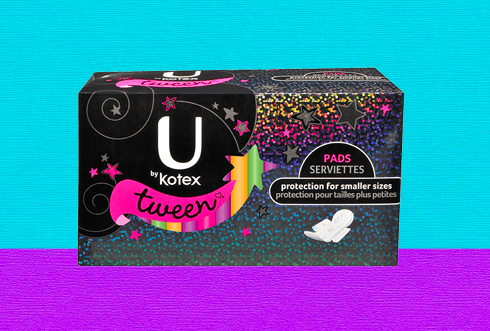
If you’ve been with us for a while, you might remember that we (and our fabulous readers) had a lot to say in the spring of 2010 when Kotex launched U by Kotex (or YOU.BUY.KOTEX, as we came to call it) and its “Break the Cycle” campaign.

In digging up a copy of the “Reality Check” video that launched the campaign for one of my classes this week, I came across this critique of “Reality Check” by an activist/artist identified online only as Annamalprint. She’s a menstrual activist after our own bleedin’ hearts!

The campaign has won many advertising industry awards, and has been credited with increasing Kotex sales by 10%, by the way. We can expect those neon tampons to be around for a while.

Post to Twitter Post to Plurk Post to Yahoo Buzz Post to Delicious Post to Digg Post to Facebook Post to MySpace Post to Reddit Post to StumbleUpon

Love Your Body, Love Your Beach, Love Your Cup

September 5th, 2011 by Chris Bobel

Mooncup, the British reusable menstrual cup makers, just launched their Love Your Beach? Love Your Vagina campaign—a compelling attempt to connect the care for your body/care for your planet messages at the root of the push for alternative menstrual care.

My first reaction: that deliciously sensual vulva has HAIR! ‘Atta girls!’ This body-positive, earth-loving feminist is on board.

Then I read British journalist/commentator (and self described “broad-minded broad”) Julie Burchill’s piece in The Independent about the Mooncup ad and was brought back to reality, that is, the reality that is colored by menstrual taboos and woman-body-hating. Oh geez, really, Julie? Et tu?

In short, Burchill rails against not only the soft cup, but also the sponge and reusable pads, and by extension “breastfeeding, small shopping, slow eating”—other movements, she concludes that “conspire to straight up KEEP WOMEN AT HOME FOR AS MUCH AS POSSIBLE” (yes, her words, her emphasis). Words like gory, inappropriate, and vile pepper her indictment against options she rejects before she tried them. Her basis? Her “best ex-hippie friend, happily brought back to the land of the living.”

If you strip away her regrettable squeamishness at trying something new (single use pads and tampons FTW!), we find a rather clumsy critique of eco-feminism. Though I can’t be sure since I keep tripping over Burchill’s ignorance and the REAL public enemy.

I, too, shudder, when a product is sold to women (or anyone) because THEY MUST or THEY SHOULD. When this US national breastfeeding awareness campaign heavy-handedly warned women that NOT breastfeeding effectively meant selfish mothering, lots of feminists protested.

Give me info, support, and compassion, not a big finger wagging in my face.

So I hear Burchill’s frustration with ‘Go green, you bitch’ messages, but here, it doesn’t stick. She is mad at a cup maker for promoting a product she thinks sets women back. But for me, the scoundrel is not MORE options, but rather our old nemesis the menstrual taboo which grows out of a long standing discomfort with women’s bodies ON THEIR OWN TERMS. We are cursed with an egregious inconsistency bred out of sexism: Women’s bodies on display? Cool. Women’s bodies as commodities? Score! Women’s bodies lactating, menstruating, doing what bodies do. Eeewww!

Exposed breasts and reusable cups and a expanding field of options—these aren’t the problems limiting women’s potential.  No, deep-seated discomfort with women’s bodies in their natural state–that’s one that really keeps us back.

Post to Twitter Post to Plurk Post to Yahoo Buzz Post to Delicious Post to Digg Post to Facebook Post to MySpace Post to Reddit Post to StumbleUpon

The Two Voices of Kotex

August 16th, 2011 by Elizabeth Kissling

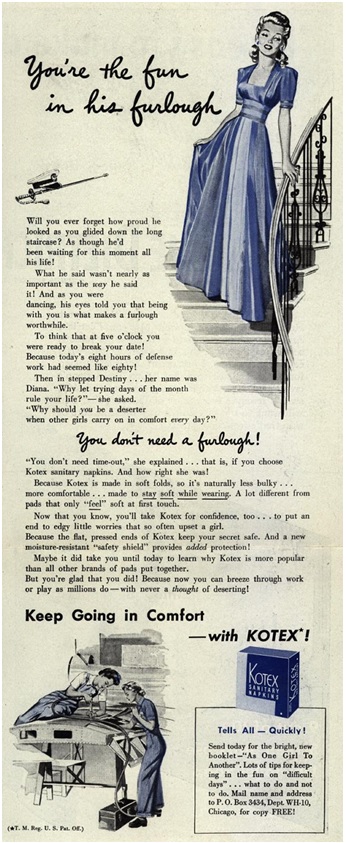
This Kotex advertisement appeared in the September, 2011, issue of Ebony magazine.

Slip on stilettos and zip up those skinny jeans. Because there’s nothing so comfortable to a menstruating woman as skin-tight pants, right? At least they’re not white pants.

It is interesting that for one line of products, Kotex is mocking the usual tropes of femcare ads, while deploying those very same clichés for their other line.


Post to Twitter Post to Plurk Post to Yahoo Buzz Post to Delicious Post to Digg Post to Facebook Post to MySpace Post to Reddit Post to StumbleUpon

Tampon Wars

August 12th, 2011 by Elizabeth Kissling

Remember back in February when I made fun of Tampax for explicitly comparing their Tampax Pearl to U by Kotex in their newest print ads? Such direct comparison to the competitor’s product is not a trendy marketing strategy; it hearkens back to the days when Darrin Stephens was a copywriter. (You young-uns can look up that reference.)

I wasn’t the only one who noticed: a recent article in Ad Age says the “30% better protection” strategy has not been used in femcare marketing since Rely tampons were withdrawn from the market in 1980. Not coincidentally, that was the last time Tampax picked up significant market share — a lot of those former Rely users switched to Tampax (Tampax was not owned by P&G at the time, but Rely was).

With the U by Kotex brand apparently winning new customers as well as winning others away from Tampax, how successful will “30% better protection” be as a persuasive strategy? Jack Neff (author of the Ad Age piece) points out that it’s pretty challenging “in a category where absorbency has been tightly regulated by the Food and Drug Administration in the wake of the Rely withdrawal.”

Post to Twitter Post to Plurk Post to Yahoo Buzz Post to Delicious Post to Digg Post to Facebook Post to MySpace Post to Reddit Post to StumbleUpon

Not Having A Happy Period

August 10th, 2011 by Elizabeth Kissling

Editor’s note, August 10, 2011: Procter & Gamble has responded that this video was NOT produced or commissioned by them, and is in fact a spoof. While it is still offensive and worthy of criticism as such and your comments are welcome here, please do not direct your ire toward Procter & Gamble.


Edited again, August 10, 2011: I’m beginning to doubt the veracity of the unsigned P&G claim that the company is unaffiliated with this video. The same anonymous quote, attributed only to “Procter & Gamble”, is starting to show up in nearly every online discussion of this ad — at least in discussion of how offensive and un-funny it is. I’ve traced the video back to the Ads of the World site, which provides the following credits:

Advertising Agency: Leo Burnett, London, UK
Creative: Jim Thornton
Director: Ben Jones
Production Company: Helimax Films
DoP: George Steel
Producer: Sherry Collins

I note that P&G has not posted their denial at Ads of the World, or at Jezebel – two blogs with *considerably* larger audiences than re:Cycling. Color me suspicious. I’d like to hear what others think.


Final edit, August 11, 2011: Many thanks to blogger Jane Fae, who phoned both P&G office and Leo Burnett UK, and received the following statement from a senior representative at Leo Burnett:

“All creative agencies will look at different creative ideas to push boundaries and engage consumers. We will occasionally make test films to try and bring an idea to life without a request from the client. These films are for internal use only, for us to understand the power of an idea and are not for publication. This creative was never commissioned nor approved by P&G. We regret this has been made public without our approval or authorization and apologise for any offence caused.”


Procter & Gamble have finally responded to consumer complaints about their patronizing “Have a Happy Period” slogan, with a disturbing video showcasing what they term “some of East London’s finest transvestites”. This is so many kinds of wrong, starting with the conflation of transsexuality and drag performance. But instead of re-inventing the wheel and taking it apart myself, I’m going to re-direct re:Cycling readers to the excellent analysis Shakesville’s EastSideKate did yesterday.

I pulled this P&G contact information and sample letter from commenter “Teaspoon” over there:

Toll-free phone number in the U.S. (Always brand specific): (800) 888-3115
Web form for U.S. contact: http://pg.custhelp.com/app/ask

A sample letter that anyone may feel free to adopt or adapt as they like:

Dear P&G representative:

I was recently directed to a web video ad for your Always brand products intended for airing in England and possibly wider audiences, featuring London “drag queens” in tears over an ostensible inability to menstruate.  Quite aside from the errors inherent with conflating cross-dressing performance with transsexuality, this sort of advertising is cruel to transwomen who do feel incomplete, and it helps create a hostile situation for transsexual individuals.  These individuals already face a greater risk of violence simply for being who they are, and your advertising promotes further dehumanization of those who are different.

As a long-time loyal purchaser of Always brand products, I am dismayed by such mocking and harmful advertising.  Until the ad is pulled and a public apology that acknowledges the harmful nature of the ad is issued, I will no longer purchase Always brand products, and I will be reviewing my other purchases to avoid other Proctor and Gamble products as well.

Sincerely,
A former customer

Post to Twitter Post to Plurk Post to Yahoo Buzz Post to Delicious Post to Digg Post to Facebook Post to MySpace Post to Reddit Post to StumbleUpon

Summer’s Eve Campaign Targets Wrong Body Part

August 2nd, 2011 by Laura Wershler

The print ad for the Summer's Eve campaign refers to the "V" but not the vagina.

If a product manufacturer or its advertising company, or both, cannot figure out which part of the female body their new line of feminine hygiene products can be used for, then both are in big trouble.

There has been much hoopla over the recently launched Summer’s Eve campaign. Links to stories about and response to the campaign can be found in my fellow blogger Elizabeth Kissling’s July 27th post. The most serious backlash to the campaign resulted in three videos perceived as “racially insensitive” being pulled from the campaign website late last week.

What rankles me about the campaign – beyond its patronizing, unsophisticated and euphemistically silly approach to the female genital area - is that it appears to target the vagina when it is clear that none of these products are actually intended for use in the vagina.

Regardless of what one might think about the value of or necessity for these femcare products, an advertising campaign for such products must convey accurate information. Like where to use them.

The product line includes: cleansing wash, cleansing cloths, deodorant spray, body powder, and bath and shower gel. Click on the OUR PRODUCTS box on the website home page and you’ll see this: Meet the products that love your vagina. Oh, really?

These products are not intended, I repeat, not intended for use in the vagina. One would think that the product manufacturer knows this. Why then did they choose a talking vagina, and across-the-board references to the vagina, to convey their product message on the website?

Interestingly, the print and TV ads hold no direct reference to the vagina. The website coyly advises viewers that they can call it “V” for short. It is this moniker and the tagline ” Hail to the V” that crosses over to print and television.

Maybe this was intended as a subtle reference to the other “V” word – vulva . It’s pretty clear this is the body part for which the Summer’s Eve products are intended.

I wanted to know why the creative team at The Richards Group, the ad company responsible for the campaign, chose to use the word vagina instead of vulva. My request for an interview to ask this question was turned down, so instead I asked two colleagues what they thought the reason might be.

Valerie Barr, veteran sexual health educator and training centre manager at Calgary Sexual Health Centre, suspects it’s because vagina is assumed to mean what is actually the vulva. She says, “I believe this assumption, or taken-for-granted use of the term, serves to avoid discussion of the clitoris and therefore, female sexual response.”  Barr says she thinks it demonstrates that in our culture we continue to be unconsciously uncomfortable with women being sexual beings.

Rebecca Chalker, female anatomy expert and author of The Clitoral Truth, also believes that fear of the word clitoris has much to do with it. ”Clitoris is the most toxic word in the English language, and to this day is considered obscene and too offensive to be used in the media. Just try it on people,” she says.

“Eve Ensler (author of The Vagina Monologues) made the vagina safe for the general public – even she did not use the C–word. Vagina has now become the default reference for everything ‘down there.’ Those ad guys are no different. Perhaps they’re just using the default because that’s what they think people can relate to most readily,” Chalker says.

Although vulva is the accurate word to describe the female body part intended to benefit from the Summer’s Eve product line, Chalker says, “It would be a tragedy if vulva becomes the new default. In anatomical parlance vulva just means covering.”

We’re back!

July 27th, 2011 by Elizabeth Kissling

Tap, tap.

Is this thing working? Is this thing on?

After some rest, reconnaissance, and re-organization, re:Cycling is back — bigger, bolder, and with more menstruation and women’s health news than ever. Most of our old team is back, along with a few new recruits and some exciting guest bloggers. There’ll be some new features here as well. More about all of that is coming soon. Our posting will be spotty and irregular throughout August, but expect to see a more consistent, regular flow after September 1. (Yeah, see what I did there? )

We’ve missed a lot of action in four months away. We can’t possibly summarize all of it, but here are some of my personal highlights:


July 19 – The Institute of Medicine (U.S.)  just released a report on preventive health services for women, and the consensus is that health plans under the Patient Protection and Affordable Care Act (ACA) of 2010 should cover contraception without demanding co-payments. You can read and/or download the full report here.


July 18 – Remember Summer’s Eve marketing disaster last summer? They still don’t get it. This year’s “Hail to the V” campaign may be saluting vaginas, but it’s still telling everyone vaginas are dirty.

As Maya put it over at Feministing.com,

That chatty hand claims to be my vagina but is clearly an impostor, because my vagina would never refer to herself as a “vertical smile,” knows better than to even mention vajazzaling to me, and is too busy complaining about how long it’s been since she’s gotten laid to give a damn about if my cleansing wash is PH-balanced. My vagina is not a whiny little pussy.

If you’re not offended enough, check out the stereotypes in the Black and Latina vaginas. For a satisfying satirical response, check out Stephen Colbert’s July 25 program.


July 13 – Bloggers at Ms. magazine have done yeoman work drawing attention to the sexism in the latest PSA from the milk industry, criticizing the sexism toward both women and men in the Milk Board’s stereotype-rich “Everything I Do Is Wrong” campaign about PMS. Ms. has also promoted Change.org’s petition protesting the campaign. Update: By July 24, the campaign had been pulled in response to protests.

2011 Ad for Always brand maxi padJuly 5 – As copyranter astutely notes, the use of a RED spot in the center of a maxi-pad to represent menstrual blood is an historic moment in advertising history. Are we finally done with the mysterious blue fluid? (By the way, copyranter is THE source for smart, snarky analysis of advertising;  he oughta know — his day job is writing the stuff.)


June 20 – Corporate and subsidized donations of disposable menstrual pads may be good for girls, but not so good for the environment.


June 2 – British artist Tracey Emin  art student at University of Wisconsin, follows in Judy Chicago’s inspirational footsteps and turns her tampons into art.


What else have we missed? Add your links in the comments, and don’t be shy about sending us suggestions!


Post to Twitter Post to Plurk Post to Yahoo Buzz Post to Delicious Post to Digg Post to Facebook Post to MySpace Post to Reddit Post to StumbleUpon

Shed the Shame

March 10th, 2011 by Elizabeth Kissling

Kotex still wants us to “break the cycle“. But every time I see these ads, I think of Chella Quint‘s message to Kotex: We’re only gonna stop feeling the shame when we take ownership of our periods. And we’re taking it back from you, dude. So you can’t reclaim our periods for us. You’re some of the people we’re reclaiming them from. Got it?

youBUYkotex


Post to Twitter Post to Plurk Post to Yahoo Buzz Post to Delicious Post to Digg Post to Facebook Post to MySpace Post to Reddit Post to StumbleUpon

Readers should note that statements published in re: Cycling are those of individual authors and do not necessarily reflect the positions of the Society as a whole.