Blog of the Society for Menstrual Cycle Research

#Making Menstruation Matter—For All the Wrong Reasons

April 15th, 2013 by Chris Bobel

Oops!

Somebody fell in it.

And by it I mean the tired old WomenCan’tDoStuffBecauseTheyAreWomen pit–a veritable snake hole crawling with misogynists, essentialists, and old school protectionists.

Image adapted from public domain photo // Design by Anne Bobel Zelek
[Actual menstrual status of shooter unknown. That's the point, people. You can't tell]

Terri Proud, a newly hired Administrative Assistant in the Arizona Department of Veterans’ Services, landed in the pit recently when she (allegedly) made comments about women’s menstrual cycles in combat. She was fired, and her boss, Colonel Joey Strickland, was asked by the Arizona governor to resign (apparently, Strickland hired Proud against the Governor’s wishes).

According to the Arizona-Sonora News Service, when asked about women serving on the front lines, Proud said “Women have certain things during the month I’m not sure they should be out there dealing with….”

Proud says she was misquoted. Was she or wasn’t she? Even if the quote is verbatim, I struggle to imagine a government official’s capacity  to register the absurdity of this comment, but maybe I am just cynical. Suffice it to say, there is surely more to this obviously political  here, but I’d like to focus on the menstrual dimension.

The assumptions about what women can and cannot do while menstruating make for a long and logic-defying list. The rationale for menstrual prohibitions is sometimes religious  (e.g., bans on menstruating women from religious rites, sex, and food preparation). There’s another category of no-nos beyond the menstrual taboo, though.  Women can’t do [fill in the blank] because their periods render them incapacitated or otherwise put them at risk. Many people still believe a woman should not camp or hike in bear infested woods because their menstrual odor will render them bear bait.  Not true. Often, women themselves are constructed as the predators during their PRE-menstrual period. You know….PMSing women are dangerous, even potentially homicidal. And women can’t be trusted to make decisions (or serve on the Supreme Court) because they are Out Of Control.

But we know differently. Women—during all phases of the menstrual cycle—can do all manner of things,  all the time, thank you very much, including jobs that are not, shall we say, menstrual management-friendly. They fight forest fires. They collect data in remote field sites. They orbit space. They are perform brain surgery.

Yet, PREJUDICE against women is often JUSTIFIED because they menstruate. The Disability Rights/Inclusion Movement has taught us that often, the most pernicious barriers to inclusion are perceptions, not the actual limits imposed by our disabilities. That’s certainly the case here. Let me go out on limb here: if women were respected, if women were valued, if women were seen as competent peers, then the fact of their menstruation would be less of a “disability” and more of a fact of a life.

But you know what? I want to give Terri Proud the benefit of the doubt for a minute. When pressed about her comment by The Arizona Daily Star, Proud said “I don’t have a problem with women being on the front line if that’s their choice….I’m not going to sit there and say, ‘No, you don’t have that right.” In the same story, Proud is described as harboring  a “curiosity”  about “how menstrual cycles are handled” and noted “that whether or not that hurdle is being addressed is a real issue, even if it isn’t talked about. Women are designed differently from men and need to have their needs met on the front lines.” And I say to that: well done Terri Proud, Menstrual Activist.

Because she is right. Menstruation is a reality, and menstruators need support and resources. Managing our menses can be tough when we don’t have access to facilities, or privacy, or both. Anybody that’s been camping while on their period can tell you that (bears notwithstanding) this IS a REAL issue. So she is right to ask (even if she is merely doing so to recover from blurting out something really dumb) What is the US military doing for women in combat? Now with the ban on women in (officially recognized) combat positions is no more, a change in policy that is expected to open 230,000 front-line positions to women, this question demands answers.

One answer: Suppress menstruation through the use of extended oral contraceptive pills. That is an option, yes, but it might not be the right one for every woman. Even beyond many menstrual cycle researchers discomfort with the one-size-fits-all approach to dosing cycle-stopping contraception (readers of re:Cycling are no stranger to concerns about this trend), there is a deeper concern about the implications of just making the menses go away.

Cycle stopping contraception, Liz Kissling has argued, enables a particularly new manifestation of the docile neoliberal subject. The feminine non-mensturating body, is not, as popularly believed, liberated, but rather, one held even tighter to the hegemonic male standard. Place this compliant amenorrheaic body in the context of the military and a curious paradox is revealed. The submissive soldier? The docile woman packing an assault rifle? Really? Seems both oxymoronic, and hardly like a gain in the fight for women’s equality.

Instead, can we imagine an expanded universe of menstrual management options?

  • Reusable cups and sponges provided for free (with eww-effect reduction training included) ?
  • Cycle stopping contraception offered as an option (not a mandate)—including an honest discussion of risks and benefits?
  • Quality reproductive health care in which menstrual health is a part of a comprehensive whole?
  • Work cultures, even remote ones, that acknowledge cyclical and variable human needs of all sorts?

Otherwise, if women must alter their very bodies to “fit in” and be taken seriously in their jobs, show me the ground we have gained. Cuz when I look down, all I see is the bottom of the same ole stinky pit.

Little Girls! Just Say Yes to Your Dreams!

March 18th, 2013 by Chris Bobel

Seen this one yet? (or the (eerily) related “Birth Control on the Bottom“?)

We posted “Sassy Girlz Candy Birth Control Pills” (written by Carissa Leone in 2011) in our regular installment Weekend Links on Feb 2. I had a mixed reaction. And when a couple re:Cycling readers described the video as “nasty,” I knew we needed to dig in a bit.

Let’s discuss.

There’s something very absurdly funny about eating birth control, even if the women are still tweens and the birth control is merely mulit- colored jelly beans intended to get young girls in the pill-popping groove before they are saddled with a baby and an half-finished high school education.

First of all, women CAN eat their birth control, donchaknow… Warner Chilcott brought to market their chewable, spearmint flavor oral contraceptive, Femcon Fe, for women who have difficulty swallowing pills and apparently, find stopping for 30 seconds to swallow water.

But I digress (I guess I just want to be clear that we are ALREADY munching our pills).

It is hard not to love how this sketch takes down the pandering to the girl tween market. Oh lordy. There’s so much potential there! (one estimate figures that kids aged 8-12 years are spending $30 billion OF THEIR OWN MONEY and nagging their parents to spend another $150 billion annually!) Little girls quickly move from Disney to diets, from fingerpaint to fake eyelashes, from tutus to belly shirts…..I have seen it with my own girls and it feels, frankly, like an inexorable force.

Viral sketch writer Carissa Leone graciously replied to my questions regarding the piece. When I asked her what inspired her, she channeled her Women’s Studies training (go team!) and supplied her two main reasons:

(1) “I saw a little girl on the subway,holding a baby doll in one of those pretend baby slings…and I thought, “If only she really knew what motherhood was like. I wonder if anyone has explained the authentic experience. I wish she were carrying a briefcase and reading a teeny issue of Ms. magazine instead… “

AND

(2) “The idea that women can/should have it all, in terms of relationships and families and career still seems to be put forth as a tangible (and”correct”) goal in Western culture. It’s a pressure I and many other peers feel, and one that I don’t think is truly possible, or necessarily awesome.”

And Big Pharma takes a hit, too, per the spot’s director, Brian Goetz, who offered this when I asked him about what led to the sketch:

“I wanted to do the video because the script spoke so well to the branding of pharmaceutical commercials, where no matter what the product, as long as you say there’s a problem and that you have the solution, throw some happy people and fun b-roll in it, you’ve got a successful campaign. On top of that, it’s always fun to legitimize terrible ideas in sketch comedy. And if that means having multi-colored jelly bean birth control pills, all the better.”

But I think there’s more to it that that.

Why do I find myself laughing and crying at the same time? Well, I just finished my advance copy of Holly Grigg-Spall’s forthcoming Sweetening the Pill  or How We Became Hooked on Hormonal Birth Control (out this Spring with Zero Books). In it (and here as well, on this blog), Grigg-Spall makes the case the hormonal contraceptives have become so normative that we, as consumers, permit an imperfect (at best) product to flourish even while other options may be more appropriate. The one-pill-fits-all mindset is so pervasive and bores in so deep, so young, Grigg-Spall argues, that when someone says, ‘hey! I don’t want to be on the pill,’ these—what she calls “pill refugees” — are hastily branded as irresponsible, antifeminist, or just plain dumb. That is, the pill gets constructed as our savior, our liberator, our saving grace, even when its not.

And that’s where this spoof enters….since the pill IS all these things, let’s get those girlies on board NOW! Why wait? Good habits start young, after all. And product loyalty is not just for toothpaste and laundry detergent….

And so, “Sassy Girlz Candy Birth Control Pills” is super smart feminist critique. It calls out the enduring wrongheadnessness of romanticizing motherhood and co-opting what I would call a tragically hollowed-out pseudo feminism harnessed to push product:

  • Little girls playing Mommy is cute, and kinda bullshit!
  • Its never too early to teach little girls about options!
  • She’ll know that birth control means winning a college scholarship

Yup. There’s lots of problems with that. Thanks to the feminist satirists to help us see.

But I have to say one more thing.

Leone and I discussed (what I consider) the unfortunate below-the-belt invocation of gender dysphoria to as she put it, “most absurd, heightening beat” in the sketch (here’s another, more recent example of same, on SNL). I don’t think trans or gender queer or otherwise gender variant people should ever serve as punchlines, as I told Leone so in our email exchange. When I inquired about this moment in an otherwise spot-on sketch, she said that is was never intended it as a negative perception of transgendered kids. But still  it is, and I think it points with a big fat finger at how much work we still need to do to move trans issues from margin to center.

Let’s push forward without leaving anyone behind. Let’s laugh at feminist satire that avoids (even unintended) transphobia. Let’s keep our targets clear and our allies clearer. Let’s say YES to that dream, for real.

Shameless. Or, How To Make An Ethical Femcare Ad.

February 1st, 2013 by Elizabeth Kissling

Guest Post by Chella Quint, Adventures in Menstruating

I saw a femcare ad that I actually liked.

I know, right? I don’t even know who I am anymore.

I’m kidding. I’m exactly the same person. It’s the ad that’s different.

Now. I don’t promote individual femcare companies. I do ad analysis. As long as femcare adverts remain the loudest voice in the menstrual discourse, I’ll keep encouraging people to use social media to create a two-way conversation and to increase their advertising literacy. Since I started this project, though, I’ve longed to see an ad that was period positive: that didn’t use shame to sell or use humour at the expense of menstruators. This is the first one I’ve ever seen.

It’s a viral video that’s been put out this week by Mooncup UK, a small (but growing), ethical company producing reusable, medical grade silicone menstrual cups. The ad directly challenges the current market leaders and promotes their own product without once dipping into the fear/embarrassment/secrecy triumvirate used throughout the history of femcare.

Here’s the ad:

And here’s the analysis:

Like a number of femcare ads that have made news over the past couple of years, it’s funny, viral, and sends itself up.

Where previous ads by bigger brands have gotten it wrong, though, it’s usually been because there were still echoes of the history of shame, fear and manufactured problems that could all be solved by the product. Ads for disposables somehow never seeming to mention the inconvenient truth (thanks, Al) about landfills and waste.

But the Mooncup ad works because:

They have a massively on-message USP. The unique selling point is that it’s reusable for years. Those who prefer tampons to pads could be persuaded to make the switch. I know many people who have sung their praises for ages, and while I’ve been doing the Adventures in Menstruating project, their company’s reach has grown far beyond its Brighton offices, and awareness around menstrual cups generally (a number of companies produce silicone and latex menstrual cups around the world), has spread, mostly by word of mouth, small distributors, and a few clever ad campaigns.

Brand loyalty for products that you don’t need to replace often is built through trust, reliability, and integrity. It’s a classic advertising model, but it’s usually applied to big ticket items like cars. Gives a whole new meaning to Think Small.

I’m aware that there are very different business models working with a one off purchase vs. repeat purchase disposables. If tampon companies respond, it’d be refreshing if they used what I like to call the Ocean Breeze Soap model. (Tampons are convenient in a pinch. Just like other disposable products are handy for the same reason. It would be way better for the environment if we used fewer convenience products, but if you do choose to use a disposable product of any kind, we hope you’ll choose ours.) Disposable femcare companies can’t deny their carbon footprint, but they frequently take the lazy option and distract consumers with shame and fear.

Shame is out of the equation. Its persuasive powers aren’t tainted by the classic canon of leakage fear, invisibility, euphemisms like ‘comfort’ or ‘freshness’, or that mysterious blue liquid. (Okay seriously – what IS that stuff? Do they use water with food colouring? Wildberry fruit punch? What?) They don’t need to use shame – no femcare company does.

The Little Boy and the BFG

November 26th, 2012 by Chris Bobel

Photo by Andrea Mason. Used with permission

His mother told me she was in the shower and when she came out, there he was. “He kept pushing them through the applicator and saying, ‘A flower!’ and then trying to sniff them,” she explained  (and the t-shirt, by the way, is just a wonderful coincidence).

So why is this such a charming yet cringe-worthy moment captured in time?

A sweet little boy innocently explores some curious objects, ‘flowers’ to him. They are not charged with a snicker and an ‘ohmigod.’ They are not products just for women’s deep dark ‘down there’. They are neither yucky nor gross. In fact, they are FASCINATING and FUN! And that’s because our menstrual shaming culture has not worked its insidious magic on him yet.  Today, these tampons are just flowers. [And a fun fact here: in the Middle Ages, the word “flower” was commonly used to signal menstruation, according to scholars Etienne Van De Walle and Elisha P. Renne]

As I studied this photo, dissecting the typical reactions it surely elicits, my mind wandered to my favorite passage from the Roald Dahl classic, The Big Friendly Giant. In it, Sophie, the little girl who befriends the massive and gentle protagonist with his own unique vocabulary, attempts to explain the impropriety of open, let’s just say it, fart talk.

Everyone is whizzpopping, if that’s what you call it, Sophie said. Kings and Queens are whizzpopping. Presidents are whizpopping, then why not talk about it? Glamorous film stars are whizzpopping. Little babies are whizzpopping. But where I come from it is not polite to talk about it.

Redunculous! Said the BFG. If everyone is making whizzpoppers, then why not talk about it?

Exactly. Everyone farts, so why the hush hush? About one-half the world’s human population menstruates (most for multiple decades) but we are expected to pretend we do not.

Redunculous, but oh-so-common. So when a little boy brings evidence of menstruation into the light of day, we think, if only he knew what THOSE THINGS WERE REALLY FOR! The horror!
But what if he knew AND he didn’t care? What if he knew and he STILL thought they were still fun to play with, still reminded him of flowers?

What then?
 What would menstruation feel like, for menstruators and everyone else, without the yuck factor? How would resistance to shame reshape our menstrual culture? Our menstrual practices?  Our attitudes toward our very own bodies, whatever they do or do not leak? These are not new questions—we ask them again and again on this blog and that’s just here. And yet, while we are clear that menstrual shame is counterproductive, even damaging to quality of life, most of us are still pretty stuck there. What do we actually DO differently to normalize menstruation? Isn’t this how we remake the world, one simple act at a time?

Can we begin with this sweet little guy? Let’s try. What do we say to him when we find him on the bed, about to peel open another super tampon?

Uh..no, honey…those are just for Mommy. Those are not for little boys. Let me have those (as we hurriedly scoop them up and hide them, better this time).

OR

Do we say something else, something that refuses to inject these wads of cotton and rayon with a mysterious negative charge, and just, matter of factly, states their purpose—the same way we would respond as if he had broken into a box of Band-aids or Q-tips. If he has a follow up question (sometimes they do at this age; sometimes not), we answer.

What would YOU say to our little tampon enthusiast?

HALLMARK – When you care enough to send the very . . . ??

August 6th, 2012 by David Linton

Hallmark greeting cards and related trinkets have long exemplified wholesome, up-tempo, Norman Rockwell-styled sentimentality, often packaged in clichéd verses and trite images of puppies, kittens, flowers, babies, sunsets and other references guaranteed to elicit a smile, a tear, or a warm glow. However, as rude humor has spread its influence, expressed most vividly and viciously in celebrity roasts and the Comedy Central show, Tosh .0, Hallmark was not to be left behind. A visit to the racks of cards, books, and novelties at your local card shop reveals a wide variety of snarky items offering cheap shots at a wide variety of groups, hobbies, and practices.

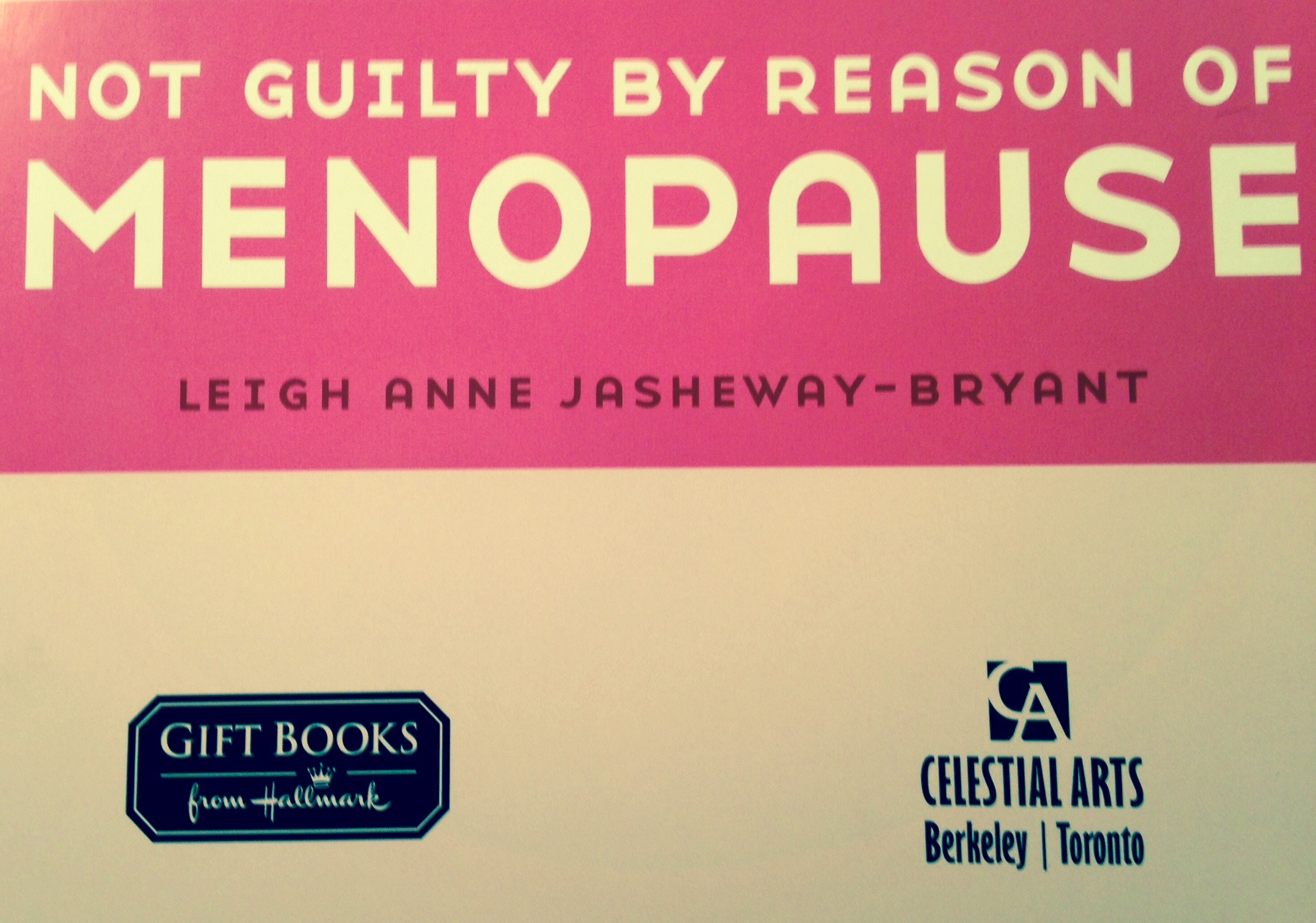
Not Guilty by Reason of Menopause

Among them are several items that attempt to poke fun at what are thought to be characteristics of women in some stage of the menstrual cycle, notably PMS or menopause. Setting aside the fact that the items perpetuate the common misuse of the term  menopause when what is meant is perimenopause, consider a small book presently on sale titled, Not Guilty by Reason of Menopause.

It is comprised of more than 50 pages, organized in double-page spreads, each of which offers a completion to the phrase, “You might be menopausal if. . .”

A few examples will suffice:

“. . . you think about the ‘til death do us part line in your wedding vows a little too often.”

“. . . you tell all your children they’re not your favorite.”

“. . . when your husband proposes a romantic vacation, you suggest ice fishing.”

Collectively, it amounts to an anthology of mean-spirited nastiness with little redeeming humor. Women are depicted as crazy, stupid, vicious, obese, and every other negative stereotype imaginable.

And with each insult women are expected to smile sweetly at being the butt of a bad joke. Of course, to express outrage or even mild annoyance with these sorts of put-downs is to risk of being accused of lacking a sense of humor or, worse yet, of being “politically correct,” the favored dismissive term of those who demand that their repugnant values are somehow benign or lacking in impact or intent.

We’ve come a long way from the days of 1910 when Hallmark was founded and especially from 1944 when the company adopted the slogan that is still theirs today, “When you care enough to send the very best.” In this case one might ask, “The very best of what?”

FemFresh Fails — and we think it’s Funny!

June 27th, 2012 by Elizabeth Kissling

Here’s Chella Quint, of Adventures in Menstruating, with more ad busting and shame busting. For even more, see her post at Ms. blog.

Chella Quint is just back from delivering a TEDx Talk, ‘Adventures in Menstruating: Don’t Use Shame to Sell’, link coming soon!

Flipping the Image: Try New Semen-Off!

June 11th, 2012 by Chris Bobel

Cartoon created by Lisa Leger, with photo by Λ |_ ν- Γ Ø // CC BY-NC-SA 2.0

At the 2007 conference of the Society for Menstrual Cycle Research, a presenter cited the famous satirical essay by Gloria Steinem, If Men Could Menstruate, as inspiration for ”flipping the image”  to raise awareness about an issue.


Remembering this and frustrated by the marketing of cycle-stopping contraception, Lisa Leger created this spoof ad for a drug that suppresses an integral part of the male reproductive cycle.

She says,

I work in a pharmacy setting and monitor the medical journals to observe how the pharmaceutical industry markets drugs to both doctors and patients. An ad framing male ejaculation as a bothersome and icky inconvenience mirrors the way cycle-stopping contraceptives are marketed to women as a modern way to escape the hassles and mess of menstruation. By flipping the image and taking the same marketing tactics that are used toward women and using them toward men, the absurdity of suppressing a vital body function for the sake of convenience is revealed.


Lisa Leger is an SMCR member and fertility awareness educator who works in a community pharmacy setting on Vancouver Island. Her cartoons featuring the adventures of Wanda the Wandering Uterus have appeared in Femme Fertile, the newsletter of Justisse Healthworks for Women.


Shit I Say

April 10th, 2012 by David Linton

Guest Post by Alexandra Epstein

A series of videos on YouTube have taken stereotypes to a whole new level.  Not only is ‘Shit Girls Say’ sexist, but it has created an empire of homemade ‘Shit (insert proper noun here) Say’ videos stereotyping hundreds of categories. To name just a few, “hung over girls,” “Asian moms,” “boyfriends,” “hot girls,” “fat girls,” “single girls,” and of course we cant forget about “girls who are on their periods.”

In this two-minute video, this girl seems to suffer from every social construction created pertaining to menstruation. From her constant longing for chocolate, to her feeling as if she is dying, to her mood swings, this girl over exaggerates all of the symptoms she claims to have.

The point of this video is to get a laugh, I know. So why be so harsh? It’s funny, right? The typical menstruating female is supposed to watch this and say “oh my God, I do that too! Haha!” However, not all women experience menstruation in the same ways. This generalization of how women act while they are on their periods is only reinforcing the stereotypes that men gain their information from and that so many women are trying to fight every day.

I have a proposition for someone. I want to see a new “Shit Girls Say on Their Periods” video. Only I want this video to portray a woman who embraces menstruation. I want to see a woman feeling extra creative, or extra in touch with herself, or even extra sexual. Why does this video have over a million hits? As a society we need to start changing the way people think about menstruation.

Advertise Your Period Dot Com

February 15th, 2012 by Elizabeth Kissling

Today, in vintage femcare advertising, we bring you Tampax’s idea of menstrual shaming, 1990s style:


But Tampax doesn’t understand menstruation as well as they think they do. Sure, it might be a little tiresome to have a Mariachi band follow you around everywhere for most of a week, but as I’ve indicated before, I love the idea of a musical celebration of my monthly miracle.

Tina Fey’s Menstrual Musings

January 31st, 2012 by David Linton

Tina Fey, true to her reputation for being feisty and transgressive, tells two amusing menstrual tales in her recent bestselling book, Bossypants.


The first is, appropriately for a “tell all” memoire, about her menarche.  The story, familiar to thousands of other women, relates how her mother gave her a “first period” kit from the Modess company that contained two pamphlets, “Growing Up and Liking it” and “How Shall I Tell My Daughter,” and pretty much left her on her own.  Fey’s humor derives largely from exaggeration and in this case she compares the Modess box stashed in her closet to a Freddy Krueger nightmare figure lurking in the dark: “Modessssss is coming for you.”


She goes on to describe the moment of the period’s arrival when she was ten years old and performing in a choral concert.  She claims that her surprise was not so much that she got her period but that the fluid wasn’t blue as she’d been lead to expect from TV ads.


The second, and more interesting, story is about how as a writer for the long-running TV series, Saturday Night Live, she managed to get the Kotex Classic sketch on the air.  Fey refers to it as “my proudest moment as one of the head writers of SNL.”  (The anecdote was also published in the March 14, 2011 New Yorker.)  The ad parody has become an SNL classic in itself and an indispensible inclusion in any discussion of the history of menstrual references on television.


The Kotex sketch is a send-up of the trend at the time for nostalgia sales pitches such as the Coke Classis campaign.  Written by Paula Pell, it features women proudly flaunting their Kotex belts and bulging sanitary napkins, even in a swimming pool and while wearing low cut, tight evening wear.  A man in the ad comments approvingly, “Them  girls are Old School!”


Fey describes how the men at the studio who had to approve the scripts balked at selecting it.  Their resistance was eventually overcome once the women explained the exact nature of the unfamiliar menstrual technology and how it was worn.  As Fey puts it, “They didn’t know what a maxi pad belt was.  It was the moment I realized that there was no ‘institutional sexism’ at that place.  Sometimes they just literally didn’t know what we were talking about.”


Beyond the fascinating behind-the –scenes access that Tina Fey’s book provides to the working of an influential TV show – and lots of other settings as well – she has also offered a glimpse of the menstrual social gap, the chasm of ignorance that separates women and men when it comes to understanding even the most rudimentary details of menstrual management.  In this case she was able to educate the men and succeed in producing a memorable – and perhaps even liberating! – piece of TV comedy.

Getting Cozy with Tampon Cozies

November 21st, 2011 by David Linton

Guest post by Michael Yazujian — Marymount Manhattan College

Photo by Caitlin Weigel (used with permission)

Caitlin Weigel knits and sells tampon cozies on her Etsy site, a website where people can sell crafts that they make. These cozies are perfect for women who are trying to avoid humiliation who are also fans of squids (and probably other tampon users as well). They may reinforce the shame and embarrassment that some women associate with tampons by concealing them, but they do so in a playful way that suggests the taboo be taken less seriously. The squids seem to be mocking society’s belief in tampon awkwardness with their googly eyes and promote a sort of tampon pride that you could show off to your friends. The reduction of shame through humor is not a new concept, but I believe that Caitlin Weigel has knit a useful weapon against the uncomfortable and serious manner in which tampons are viewed.


Editor’s note: See also Vinnie’s Tampon Case

Culture-Jamming Kotex

October 5th, 2011 by Elizabeth Kissling

If you’ve been with us for a while, you might remember that we (and our fabulous readers) had a lot to say in the spring of 2010 when Kotex launched U by Kotex (or YOU.BUY.KOTEX, as we came to call it) and its “Break the Cycle” campaign.

In digging up a copy of the “Reality Check” video that launched the campaign for one of my classes this week, I came across this critique of “Reality Check” by an activist/artist identified online only as Annamalprint. She’s a menstrual activist after our own bleedin’ hearts!

The campaign has won many advertising industry awards, and has been credited with increasing Kotex sales by 10%, by the way. We can expect those neon tampons to be around for a while.

Readers should note that statements published in re: Cycling are those of individual authors and do not necessarily reflect the positions of the Society as a whole.