Blog of the Society for Menstrual Cycle Research

The Many Faces of Cervical Fluid

May 7th, 2013 by Elizabeth Kissling

Guest Post by Kati Bicknell, Kindara

It has been brought to my attention several times that not all women’s cervical fluid matches the usual descriptions of sticky, creamy, egg white, or watery. This means some women are having a hard time charting their fertility, because they don’t know how to categorize their cervical fluid for their chart.

So today I’ll give you very detailed descriptions of the different types of cervical fluid, and how to classify them.

I’m going to be incorporating vaginal sensation into the mix here. Vaginal sensation is the way your vagina *feels* when different types of cervical fluid are present. You know how you can tell if the inside of your nose is wet, like when you have a runny nose? And you know how you can tell if the inside of your nose feels dry, like when you are in a dusty desert? You can tell the same things about your vagina as well, if you pay attention. The way your vagina feels can give you a lot of insight on the state of your fertility and what kind of cervical fluid you’re likely to find.

One thing to keep in mind when it comes to cervical fluid is that there is a baseline level of moisture that will always be present in the vagina. After all, it’s a mucus membrane, like your mouth. If you touched the inside of your cheek, it would be damp — same thing with the vagina. Don’t let that normal vaginal moisture confuse you. Unless there is a physical substance on your fingers or toilet paper, it doesn’t count as cervical fluid. (The exception here is watery cervical fluid: sometimes the water content is so high that there is nothing that will hold together, and it’s just plain wet. But in those cases there is usually so much of it that there is no question about whether or not it’s cervical fluid.)

Cervical fluid is measured above that baseline level of moisture. It tends to start out on the drier end of the spectrum, and it increases in water content as a woman approaches ovulation. Generally, the higher the water content, the more fertile the cervical fluid. After ovulation the water content will decrease.

Note: all cervical fluid is potentially fertile. If you are charting to avoid pregnancy, any cervical fluid you notice before ovulation means that your fertile window has begun. But for women who are trying to achieve pregnancy, there are definitely types of cervical fluid that are more optimal for getting pregnant. So, shall we launch our boat onto the sea of cervical fluid exploration? Lets!

These are the different categories of cervical fluid.

None:

  • What it feels like (vaginal sensation): dry, or like “nothing’s going on.”
  • What it looks like: nothing! Maybe a slight dampness on your fingers that will quickly evaporate.
  • What it feels like on your fingers: a slight dampness.
  • What it looks like on your underpants: nothing. Squeaky clean. You could wear those underpants again tomorrow if you wanted to (ain’t no one gots to know about it!).

Sticky:

  • What it feels like (vaginal sensation): dry, sticky, or like “nothing’s going on.”
  • What it looks like: whitish or yellowish, tiny bits of clear gummy bears, tiny pieces of drying rubber cement, grade school paste, wet Elmer’s glue, wet wood glue, crumbly off-white Play-doh, thick white or yellow cream, clumpy, pasty, tacky, gummy.
  • What it feels like on your fingers: springy, sticky, crumbly, dry, pasty.
  • What it looks like on your underpants: white or yellowish lines or areas that tend to sit on the top of the fabric, as opposed to soaking in. When it dries it forms a crust that can hard to wash out on laundry day.

Creamy (similar to sticky, but with a higher water content.):

  • What it feels like (vaginal sensation): cool, slightly damp, or may not feel like anything.
  • What it looks like: milky, cloudy, like hand lotion, yogurt, whole milk, or heavy cream.
  • What it feels like on your fingers: smooth, creamy.
  • What it looks like on your underpants: white or yellowish lines or areas that tend to sit on the top of the fabric, as opposed to soaking in. When it dries it forms a crust that can be hard to wash out on laundry day.

Eggwhite:

  • What it feels like (vaginal sensation): slippery, lubricative.
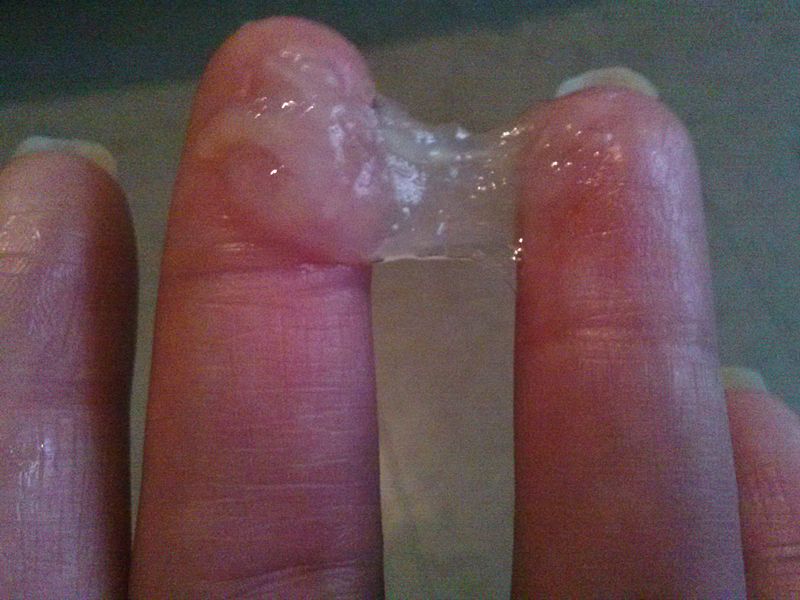
  • What it looks like: raw egg whites, wet rubber cement, clear, stretchy.
  • What it feels like on your fingers: slippery or lubricative or stretches an inch or more between thumb and forefinger.
  • What it looks like on your underpants: slippery, wet, may sit on top of the fabric, or soak in slightly.

Watery:

  • What it feels like (vaginal sensation): water rushing, dripping or gushing out of your vagina; cold, wet sensation.
  • What it looks like: clear or milky/clear, about the consistency of water or skim milk.
  • What it feels like on your fingers: wet, slippery.
  • What it looks like on your underpants:  leaves round wet patches that soak into your underpants.

I’m sure I left out some possible descriptions of cervical fluid here. If I didn’t name one that you’ve personally experienced, let me know in the comments. I’ll add in more descriptors as needed, so we can make the most thorough cervical fluid compendium known to humankind!

Cross-posted at Kindara, February 20, 2013.

Five Things You Should Know About the Three Vs

April 9th, 2013 by Elizabeth Kissling

Guest post by Kati Bicknell, Kindara

Now I know in the title of this post I say “Five things you probably don’t know about your vagina,” but really it’s about more than your vagina. The V Book, by Elizabeth Gunther Stewart and Paula Spencer, is basically the owner’s manual for all people who have any of the following V’s — vagina, vulva, and vestibule. Don’t know what a vestibule is? Read on, my good friend!

I am a bonafide vagina nerd myself, and when I read this book I learned a BUNCH of things that I did not know. Here are my top five:

  1. So we all know (now) about cervical fluid, but did you know that it’s not the only substance produced by your lady bits to keep things running smoothly? Your vulva actually produces a thin waxy substance, called sebum that lubricates the folds of your labia! It’s a blend of oils, fats, waxes, and cholesterol. If it didn’t, your labia and everything else would be all friction-y and chafe when you walked, had sex, moved, did anything really. That blew my mind. Thanks, body!
  2. Have you ever wondered how the vagina is simultaneously quite small, (i.e., sometimes even putting in a tampon might be uncomfortable and “stretchy”) and also somehow stretches to accommodate a baby passing through it? I definitely have. Well, it’s all thanks to your rugae! Rugae are small pleats that allow the vagina to be both very small and compact, and then to expand to many times its original size when necessary. Rugae is kind of like ruching! You know, the process of using tons of fabric and then scrunching it so it becomes a smaller form. I’m wearing a ruched jacket at this very moment, actually. It makes you think, if you wore this dress to the prom, are you subliminally broadcasting “HEY! THIS IS WHAT THE INSIDE OF MY VAGINA LOOKS LIKE”?
  3. Vestibule! (I told you we’d get here.) Okay! So the vestibule is important enough to be included in the three V’s of the V book, and yet I was like, “where the heck is my vestibule?” Well, it’s the place in between your inner labia. Here it is on Wikipedia, with an image that is ***not safe for work,*** unless you work in the field of sexual health, in which case, click away!
  4. Labia (as in the labia majora and labia minora). This word is actually plural. If you are referring to only one lip it’s called a labium.
  5. Only in rare instances is a human female born with the hymen completely covering the vaginal opening. Most hymens are a little circle of very thin skin that partially covers the vaginal opening, but still leaves space for menstrual blood and cervical fluid to come out. Here is a hilarious and educational video explaining more about this. [Editor's note: Many sex educators today call it the vaginal corona, not the hymen.]

And there is a LOT more info in that book. Tons. Go pick it up today and learn more than you ever thought possible about vaginas, vulvas, and vestibules!

Cross-posted at Kindara.com March 29, 2013.

A Week of Vaginas

April 3rd, 2013 by Mindy Erchull

The Cast of the 2013 UMW Production of The Vagina Monologues || photo used with permission from JB Bridgeman and the cast

A surprising amount of my time last week was spent thinking about vaginas.  In part, this was because I had plans to attend  the Friday night show of The Vagina Monologues on my campus.  It’s always a great show, and this year, one of my students was directing it.  During the course of the week, however, a former student of mine also posted a news story about the use of the word vagina on my Facebook wall.  All of this led to me reflecting a lot of people’s comfort and discomfort with this word.

The Vagina Monologues does address people’s comfort, or lack there of, with vaginas (or vulvas – although the way the two terms are conflated is a topic for another post) and women’s sexuality.  My focus was a bit different.  I was thinking about the word vagina itself….

In the late 1990s, when I was a senior in college, I had the wonderful opportunity to see Eve Ensler perform The Vagina Monologues as a one woman show on my campus as part of the dedication celebration for the newly funded Women’s Studies chair which would allow for the formal creation of a Women’s Studies major.  Since I was one of the students most involved with the program, I was given one of the few tickets for students.

Since so few students attended the show, Sunday brunch conversation the next day largely consisted of a discussion of The Vagina Monologues over dining hall french toast sticks. One of my friends was very uncomfortable with the conversation because I was consistently using the word vagina “in mixed company”.  I try to be respectful of others’ limits, but I couldn’t wrap my head around how to talk about this show without using the word vagina. Plus, it’s not a slang or pejorative term – it’s a formal anatomical name for a body part.

Given that The Vagina Monologues were part of my plans for the week, this experience immediately came to mind when my former students shared a Jezebel.com post about a tenth grade science teacher facing investigation and possible disciplinary action for using the word vagina in an anatomy lesson. Seriously? Once again, this is a formal biological term for a body part.  Yes, it’s a body part associated with sex and reproduction, but we need to be able to use these words.

photo taken by Mindy Erchull

When I teach Psychology of Women and get to development, reproduction, and women’s health, I typically have to spend a few minutes just saying vagina repeatedly until the giggles stop, the discomfort dies down, and we can actually move on with the content of the class. Yes, words have power – but we don’t get like this about the words knee or forehead. People run around in “Save the Ta-Tas”  t-shirts. Why can’t we say vagina?

One of the fundraisers the students staging The Vagina Monologues did this year was to sell buttons that say “I ♥ My Vagina”. Yes, we should love our vaginas and the vaginas of our consensual sexual partners. I also think we should love the word vagina. Let’s stop being scared of this one.  Don’t shush people if they say it in public. Don’t try to come up with covert ways of referring to vaginas without using this word. Just say vagina.

Vagina. Vagina, vagina, vagina. Va-gin-a.

Give me a V, give me an A, give me a G, give me an I, give me an N, give me an A.  What’s that spell?  VAGINA!

Come on – say it with me: Vagina!

Be loud. Be proud. Love and respect vaginas, but also embrace the word.  Some words need to be normalized. It astounds and saddens me that this has not yet happened with vagina. Let’s change that starting today.

How to Check Your Cervical Fluid When You Feel Like You Just Don’t Have Any

February 12th, 2013 by Kati Bicknell

In an older post I wrote, I talked about how to check your cervical fluid with a folded piece of toilet paper or your clean fingers.

BUT! What if you’re doing that and not finding anything? What if you, like many women I talk to, think that they don’t have any cervical fluid?

Well, you’re in luck, because I’m about to explain how to measure your cervical fluid, even if it seems like you don’t have any! Are you ready for this? You’re so ready.

Adapted from a photo by Lamerie // Creative Commons 2.0

Things you’ll need:

  • Hand mirror
  • Clean towel
  • Soap and water

So … it goes a little something like this — CRAM YOUR FINGERS IN YOUR VAGINA! Just kidding. Not really. Kind of. Kidding about the “cramming” thing, but not about the “in your vagina” thing.

First things first, wash your hands. You don’t want to introduce any foreign bacteria into the vagina — it’s got a whole host of its own friendly bacteria that keeps things running smoothly, and you don’t want to upset the balance.

Now that your hands are clean … wait a minute! Okay, a lot of you reading this are probably very familiar with your vagina, where it is, how it looks, and every little nook and cranny inside and out. But some of you may not be. For those of you in the second camp, there is an extra step.

Grab a hand mirror!

Okay, was that hand mirror very dirty? Did you take it out of the woodshed or something? Is it your husband’s shaving mirror? If any of the above are true, wash your hands again.

Now get naked from the waist down — think gynecologist’s office, but significantly less unpleasant. You can leave your socks on. No cold stirrups (hopefully). Now sit or squat on a clean towel on the floor, and hold the hand mirror between your legs so you can actually get a good look at your vulva (external genitalia). As women, our genitals are positioned in such a way that they are very hard to get a clear look at without the aid of a hand mirror, so unless you’ve done this before, you may be surprised at what you see. Look at how beautiful you are! So many little folds of soft delicate skin, so many different shades of color. Vulvas come in all shapes and sizes and colors, and each are perfect and beautiful and packed with nerve endings, so don’t you even dare consider labiaplasty, even if the vulva you see in the mirror doesn’t look like the ones you may have seen in certain adult movies (or Canadian strip clubs). Yours is perfect. I promise.

Have a look and a feel around! Gently spread your inner labia apart and take a peek at what’s in there. You’ll see your clitoris, vaginal opening, and, if you have keen eyesight, the urethral opening. Neat, huh? You may even see some cervical fluid at the vaginal opening.

Now see where your vaginal opening is? Gently slide one clean finger inside, see how that feels? Okay, now you know WHERE to stick your finger when checking your cervical fluid internally.

Crouch in a squatting position, and place one or two (if they fit) fingers in your vagina, until you feel something like the tip of a nose (if you are fertile it might be much softer). This is your cervix! The place from whence all cervical fluid hails! The motherland!

Now draw your finger(s) gently out of your vagina and have a look at them. They will be slightly damp, because the vagina is a mucus membrane, like the inside of your mouth, so wetness is a given. Other than that, is there any “substance” on them? Anything that looks like grade school paste, or hand lotion, or raw egg whites? If so … there is your cervical fluid!!!! You found it! Hooray!

If not, you may be a) on the pill, b) in the pre-ovulatory infertile phase of your cycle, before you’ve started to make cervical fluid, or c) in the post-ovulatory infertile phase of your cycle, after ovulation, and your body may have stopped making cervical fluid for the remainder of your cycle.

If you don’t notice any, check again later in the day, and several times tomorrow, and every day after that! Soon you’ll have something to record on your chart!  :-)

Now you can stand up, wash your hands (again), pull up your pants (this step is critical), and go about your day!

Wheeee!!! Any questions on that? Ask me in the comments.

Cross-posted at Kindara, February 5, 2013

Politics and Sex Education Make Strange Bedfellows

June 6th, 2012 by Elizabeth Kissling

Guest Post by Lisa Leger

Yesterday (June 4) on MSNBC-TV, my girl Rachel Maddow interviewed New York Times columnist Gail Collins, author of the new book, As Texas Goes. The book criticizes the state’s politics and morality laws and their impact on the rest of the country. Now, I’m all for slagging the state of Texas for its abstinence-only sex ed policy, and I look forward to reading Collins’ book (which Maddow called “the funniest political book of the year”). However, my problem started when Maddow read a quote that seems to mock a piece of sexual health information that is actually correct.

The statement in question is “if the woman is dry, the sperm will die” , followed by the interpretation that it is some sort of colonial-era notion relating to the woman’s enjoyment or collusion in the sex act. Of course, the quote refers to fertile mucus and not lubrication or ejaculate, as the rather garbled interpretation seemed to imply. It’s a shame that a piece of perfectly useful information about fertility is confused with some arcane puritanism to make the [valid] point that abstinence-only sex ed is backward. I’m also disheartened [and vindicated] to see my assertion that mucus is either left out of sex education or inadequately taught being demonstrated once again.

In this story, though, my concern is not for the un-informed teens I champion in the blog linked here — but for the many adults who worked with Collins on her book and with Maddow on her show who let that reference get by them. Are we to assume that none of them ever learned to chart their cycles? Could there be no one on either staff trying to get pregnant? How can not a single one of the likely dozens of professional writers, fact checkers, and other staff members not have noticed that the reference they chose to hold up to ridicule is actually valid information about sperm survival in mucus?

A “Strange Bedfellows moment” for me as a Fertility Awareness Method (FAM) teacher is when what we teach is lumped in with what abstinence-only courses teach.  Another example would be finding oneself in favor or opposed to something like hormone pills for entirely different reasons.  As a Justisse Method teacher for 20 years, I’ve watched how charting is portrayed as some sort of Vatican roulette and how mucus is hidden away even more than menstrual blood is. I wince when I see perfectly good educational opportunities go by the wayside like that. How do the biological facts of fertility (sperm need mucus to survive) become invalidated simply by being taught from an authoritarian religious perspective?  I usually see the humor in a strange bedfellows moment, but hearing an evangelical Texan being mocked for teaching kids some mystical version of what I teach — this one stings a bit.

Lisa Leger is a member of the Society for Menstrual Cycle Research and a Justisse Fertility Awareness teacher on Vancouver Island.


Is Your Period A Sentence?

June 1st, 2012 by Elizabeth Kissling

My friend and colleague Patty Chantrill loves clever menstrual puns as much as I do, and recently snapped this picture of an area billboard from her car. I’ve edited the photo to try to highlight the sign, but there’s only so much one can do with a Blackberry in motion [clicking the image will show you a larger, slightly clearer version]. The sign features a photo of presumably female feet in high-heeled shoes, wearing a ball and chain, next to the words, “Does Your Period Feel More Like a Sentence? There’s Help.” This is followed by the name of a local women’s health clinic that shall remain unnamed.

Photo by Patty Chantrill

The clinic offers numerous treatments for heavy periods, including NovaSure endometrial ablation, a process of permanently removing the uterine lining with radio frequency, and HerOption cryoablation, which removes the uterine lining by freezing the tissue. I haven’t yet researched these procedures enough to form strong opinions for or against them, but I do have strong opinions about some of the other procedures offered by this clinic. They are providers of what their website terms ‘aesthetic gynecological surgery’, which includes such mutilations as labiaplasty, G-spot augmentation, vaginal rejuvenation, and ‘radiofrequency tightening’. Check out the price list for these crimes against womanity:

  • Labiaplasty: $4200 (surgery cost)*
  • Vaginoplasty: $6000 (surgery costs)*
  • Combined Labiaplasty and Vaginoplasty: $9400 (surgery cost)*
  • *IV sedation is done by a separately contracted CRNA and is $150 per hour.
  • Radiofrequency Tightening $999 (never covered by insurance)
  • Initial G-spot augmentation (hyaluronic acid, lasts up to 4 months): $100 for initial 30 minute consultation, $850 for initial G-spot augmentation itself (never covered by insurance)
  • Follow-Up G-Spot Augmentations (hyaluronic acid, lasts up to 4 months): $600 each (never covered by insurance)

May I recommend, again, Lisa Rogers’ documentary film, In Search of the Perfect Vagina? You can watch the film for no cost at all at either link, no insurance needed, and discover that you already have the perfect vagina.

Tell me again, why can’t we talk about body stuff?

March 15th, 2012 by Alexandra Jacoby

Tell me again, why can’t we talk about body stuff?

Your body is your home.

It’s your medium of self-expression — your voice spoken and written, your hands gesturing, making things, touching someone, legs walking toward, running away from, hips dancing, butt sitting, with arms folded — are you bored, annoyed, worried, satisfied?

Your body is your receiver and interpreter of the world around you and the people in it with you.

It’s integral to your life.

How can it be weird, embarrassing, inappropriate, [tactless?] to talk about your bodylife?

What happens inside your body is literally defining your experience of the outside world, and of yourself, and your possibilities.

You can’t feel your blood moving, hair growing, cells changing…

…Some things you can feel as they happen inside you, and with those experiences, you interact directly.

Our bodies aren’t sealed containers. They are living— we are living beings.

Nutrition, hydration, elimination of waste, sweating, breathing, menstruating — these things happen in our bodies and outside them.

We make choices about our behavior, buy supplies, clothing, fixtures — we are involved in the care and maintenance associated with these aspects of our body lives.

Why wouldn’t you talk about it?

Why wouldn’t you be interested in ways to improve your experience, or someone else’s?

Why would it be unusual or unacceptable to share your experience, to ask questions, to get advice? (out loud, anywhere) — like you would when it came to any other aspect of your life.

Why wouldn’t it be normal to be interested in the quality of your body-life?

What exactly is more important than that?


Endometriosis and the Mysteries of Pelvic Pain

December 16th, 2011 by Elizabeth Kissling
Endometrial tissue embedded in abdominal wall

Endometriosis in abdominal wall. Photo by Ed Uthman, MD. Public domain.

I’ve recently developed a whole new understanding of why it takes so long for women to receive a diagnosis of and treatment for endometriosis. It’s not just the constraints of menstrual etiquette or the belief that painful periods are normal, especially for young women.


It’s about poop. No one wants to talk about that, least of all me.


I have endometriosis, and I’ve known it known for years. My doctors know it, too. It was seen through the laparoscope during a procedure for something else when I was about 35. But I’m still having trouble getting a diagnosis and treatment.


A flare-up of pain began two months ago, and I went to the clinic for relief and told the responding physician, “I think it might be my endometriosis”, pointing to the low area on my pelvis where it hurts. He asked a lot of questions about my bowels — I’ll spare you the grisly details — and ordered blood tests and an abdominal x-ray. After studying the results, he prescribed treatment for constipation, and urged me to call or return if my pain was not soon resolved.


Since that October afternoon, I’ve seen three additional physicians and continue to experience daily pelvic pain. I’ve had more blood tests, another x-ray, and a contrast CT scan, which showed normal bowel function. Perhaps because I had a hysterectomy a few years ago for adenomyosis, my doctors* continued to focus their attention on my ‘bowel problem’, rather than reproductive health issues, even though I retain healthy, functioning ovaries.


Until this week, when I finally saw the gastroenterologist. He listened to my description of the pain and its location, and more detail about my bowel habits than I’ve ever had to report since my mother toilet-trained me. And after a brief examination, he referred me back to the gynecologist who performed my hysterectomy. That’s right — he found nothing wrong with my bowels. My appointment with the gynecologist is early next week, and I’m optimistic that I will finally have an answer about the source of my pain, and even better, a means to resolve it.


For me, a well-educated, 48-year-old ciswoman with good health insurance who already knows she has endometriosis, this has been only two months of dealing with pain and the annoyance of waiting and medical bureaucracy. I can only imagine what kind of torment this might be for women with more severe symptoms without these resources, and without the knowledge that endometriosis frequently presents as, or with, gastrointestinal symptoms. Doctors who don’t specialize in women’s reproductive health may not even know this. Frequently, the symptoms of endometriosis are bowel symptoms:

  • Painful bowel movements
  • Constipation
  • Diarrhea
  • Alternating constipation and diarrhea
  • Intestinal cramping
  • Nausea and/or vomiting
  • Abdominal pain
  • Rectal pain
  • Rectal bleeding

I’m reminded again of my friend and colleague Laura Wershler’s frequent calls for body literacy; we need to know our own bodies, and know how to talk about them. I can talk about menstrual cycles until the cows come home, but it has been a real challenge to observe and talk about the details of bowel habits, even with my trusted physician.


Good health requires good communication.


P.S. I’m still in pain, and it’s really hard to say this in public, but thank you, Dr. S., for recommending the daily dose of MiraLax.


*I’m compelled to note that, Dr. S., my primary care physician, or ‘PCP’, as my health insurance plan refers to him, is a wonderful doctor. I really don’t have complaints about his care, and I have pretty good health insurance, and I’m lucky to have both.

“When it comes to their balls, guys just don’t seem to have any”

November 18th, 2011 by Elizabeth Kissling

I’ve spent so many years as a professor of Women’s Studies telling students that feminism is about equality, and that being pro-woman doesn’t mean being anti-men. I thought perhaps we’d moved past that 1990s meme of seeing everything that is for women as male-bashing, but here we go again.

The latest marketing strategy of Essure, a permanent birth control method for women that destroys the Fallopian tubes, is to appeal to men’s fear of vasectomy: “because you can only wait so long for him to man up”.

Le sigh.

Hymen Seek; or, Good Blood, Bad Blood

August 18th, 2011 by David Linton

The cultural taboo against male contact with menstrual blood can be traced all the way back to the Biblical book of Leviticus, and there have been various attempts to explain its origins, including the Freudian notion that male avoidance of menstrual blood stems from the fear that blood on the penis evokes fears of castration.

However, the contrary social value that prizes the presence of the hymen and, therefore, the evidence of its having been broken being blood on the penis, suggests a more complicated dynamic.*  James Joyce identified the conflict in the long stream of conscious ramble by Molly Bloom in Ulysses when she reflects on the connections she sees between the blood of her period and that produced by the broken hymen.

I bet the cat itself is better off than us have we too much blood up in us or what O patience above its pouring out of me like the sea anyhow he didn’t make me pregnant as big as he is I don’t want to ruin the clean sheets the clean linen I word brought it on too damn it damn it and they always want to see a stain on the bed to know youre a virgin for them all that’s troubling them theyre such fools too you could be a widow or divorced 40 times over a daub of red ink would do or blackberry juice no that’s too purply. . .

Today, rather than resorting to red ink or berry juice, as Molly Bloom suggests, women who can afford a surgical solution can purchase a hymen reconstruction operation.  But for those with fewer resources there are available fake hymen kits marketed under the name Joan of Arc Red.  Aside from the unfortunate image of poor Joan of Arc whose blood was shed at the burning stake rather than in a sexual encounter, these devices promise cheap and effective means of “passing” as a virgin.

When they first appeared, even the New York Times reported on the product, but not because of interest in quaint notions of virginity.  Rather, the focus was on the political ramifications.  The Times headline read, “Egyptian Lawmakers Want to Ban Fake Hymen.”  (10/5/2009) A member of the Muslim Brotherhood, Sheik Sayed Askar, was quoted as saying, “It will be a mark of shame on the ruling party if it allowed this product to enter the market.”  Other individuals interviewed for the article called for the exile of those who import the kits or some other forms of punishment.  The medical procedure that reconstructs a broken hymen by stitching is already illegal in Egypt.  It remains to be seen if the recent upheaval in Egyptian society will lead to changes in hymen values.

For more information on the story, a more detailed report is available at the Huffington Post.

*Editor’s note: For more on the just the anatomical eomplexity of this dynamic, see our December 8, 2009, post about the re-naming of the hymen as the vaginal corona.

Summer’s Eve Campaign Targets Wrong Body Part

August 2nd, 2011 by Laura Wershler

The print ad for the Summer's Eve campaign refers to the "V" but not the vagina.

If a product manufacturer or its advertising company, or both, cannot figure out which part of the female body their new line of feminine hygiene products can be used for, then both are in big trouble.

There has been much hoopla over the recently launched Summer’s Eve campaign. Links to stories about and response to the campaign can be found in my fellow blogger Elizabeth Kissling’s July 27th post. The most serious backlash to the campaign resulted in three videos perceived as “racially insensitive” being pulled from the campaign website late last week.

What rankles me about the campaign – beyond its patronizing, unsophisticated and euphemistically silly approach to the female genital area - is that it appears to target the vagina when it is clear that none of these products are actually intended for use in the vagina.

Regardless of what one might think about the value of or necessity for these femcare products, an advertising campaign for such products must convey accurate information. Like where to use them.

The product line includes: cleansing wash, cleansing cloths, deodorant spray, body powder, and bath and shower gel. Click on the OUR PRODUCTS box on the website home page and you’ll see this: Meet the products that love your vagina. Oh, really?

These products are not intended, I repeat, not intended for use in the vagina. One would think that the product manufacturer knows this. Why then did they choose a talking vagina, and across-the-board references to the vagina, to convey their product message on the website?

Interestingly, the print and TV ads hold no direct reference to the vagina. The website coyly advises viewers that they can call it “V” for short. It is this moniker and the tagline ” Hail to the V” that crosses over to print and television.

Maybe this was intended as a subtle reference to the other “V” word – vulva . It’s pretty clear this is the body part for which the Summer’s Eve products are intended.

I wanted to know why the creative team at The Richards Group, the ad company responsible for the campaign, chose to use the word vagina instead of vulva. My request for an interview to ask this question was turned down, so instead I asked two colleagues what they thought the reason might be.

Valerie Barr, veteran sexual health educator and training centre manager at Calgary Sexual Health Centre, suspects it’s because vagina is assumed to mean what is actually the vulva. She says, “I believe this assumption, or taken-for-granted use of the term, serves to avoid discussion of the clitoris and therefore, female sexual response.”  Barr says she thinks it demonstrates that in our culture we continue to be unconsciously uncomfortable with women being sexual beings.

Rebecca Chalker, female anatomy expert and author of The Clitoral Truth, also believes that fear of the word clitoris has much to do with it. ”Clitoris is the most toxic word in the English language, and to this day is considered obscene and too offensive to be used in the media. Just try it on people,” she says.

“Eve Ensler (author of The Vagina Monologues) made the vagina safe for the general public – even she did not use the C–word. Vagina has now become the default reference for everything ‘down there.’ Those ad guys are no different. Perhaps they’re just using the default because that’s what they think people can relate to most readily,” Chalker says.

Although vulva is the accurate word to describe the female body part intended to benefit from the Summer’s Eve product line, Chalker says, “It would be a tragedy if vulva becomes the new default. In anatomical parlance vulva just means covering.”

In Search of The Perfect Vagina

February 28th, 2011 by Elizabeth Kissling

“If you’d told me three months ago that I’d let a plastic surgeon examine my froufrou, that I’d show it to another woman (who wasn’t a doctor) and then allow an artist to take a cast of my Mary, I’d have laughed you out of the house. But it’s extraordinary how documentary-making changes your mind about even the most concrete of things . . . “

–Lisa Rogers, presenter of Channel 4 documentary “The Perfect Vagina”


Rogers’ film is a poignant exploration of why young women in the UK seek labiaplasty and hymenoplasty.

Readers should note that statements published in re: Cycling are those of individual authors and do not necessarily reflect the positions of the Society as a whole.