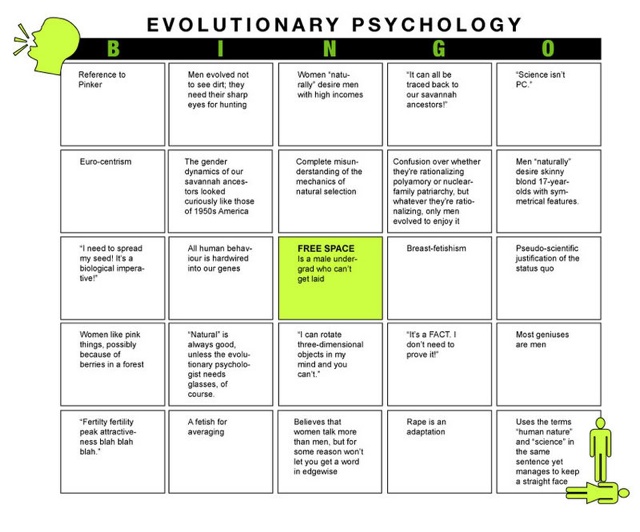
Ready to play Evo-Psych bingo, that is. I don’t know quite what else to do with a study like this: Women’s preferences for masculinity in male faces are highest during reproductive age range and lower around puberty and post-menopause.
Are you ready?
May 29th, 2010 by Elizabeth KisslingSaturday Surfing One Day Early
May 28th, 2010 by Elizabeth KisslingWeekly reading for the last Saturday of May:
- Vanessa at Feministing discusses the FDA deliberations over Flibanserin, the purported “Viagra for women”, and dreads the marketing we’ll be subjected to if the product is approved.
- Reporting for The Nation, Lynn Harris discusses new research on “reproductive coercion”: the alarming frequency with which young men try to get their partners pregnant, often by sabotaging birth control methods.
- The always-awesome Doc Gurley discusses the question of condom size relative to penis size, and associated condom failure rates. It’s a fascinating article, despite her report that “the body of literature (so to speak) on penis size and condom size is surprisingly (ahem) small”.
- Amanda Hess at The Sexist does the smackdown on Jesse Bering’s inane conclusion that my whole career has been a monumental waste of time. As Mr. Bering might say, those are great ideas, Elizabeth, but let’s wait until we hear a man say them.
- Madeleine Shaw at Lunapads observes that Kotex is still selling U by Kotex outside the U.S. with ad campaigns in the vein of those mocked in the popular “Why Are Tampon Ads So Ridiculous?” television commercials for U.S. audiences.
Researcher Elizabeth Miller and others surveyed nearly 1,300 16- to 29-year-old women who’d sought a variety of services at five different Northern California reproductive health clinics. Among those who had experienced intercourse, i.e. who could be at risk of unintended pregnancy, not only did 53 percent of respondents say they’d experienced physical or sexual violence from a partner, but one in five said they had experienced pregnancy coercion; 15 percent said they experienced birth control sabotage, including hiding or flushing birth control pills down the toilet, intentional breaking of condoms and removing contraceptive rings or patches. These figures were consistent from clinic to clinic.
Pill Protests – It’s About the Environment
May 25th, 2010 by Elizabeth KisslingA whole bunch of anti-choice political organizations are co-sponsoring a national protest against birth control pills, but they say it’s not about killing babies or controlling women; it’s all about the environment!
The following is released by the American Life League and the following groups:
WHO: American Life League , Human Life International, Pro-Life Wisconsin, Pharmacists for Life International, Archdiocese of Mobile Respect Life, Operation Rescue, Jill Stanek, Generation Life/Brandi Swindell, Life Education Ministry, Pro-Life Unity, Movement for a Better America, AMEN (Abortion Must End Now), Pro-Life Action of Oregon, Children of God for Life, Expectant Mother Care/Chris Slattery, Mother and Unborn Baby Care, Defenders of the Unborn, California Right to Life Education Fund, Delaware Pro-Life Coalition, Life Guard, Homeschoolers for Life, Focus Pregnancy Center, Central Texas Voices for Life and Dubuque County Right to Life
WHAT: Protest the Pill Day 2010: The Pill Kills the Environment
This year, birth control advocates are celebrating 50 years of decriminalized hormonal contraceptives. American Life League and our co-sponsors don’t think half a century of contaminating our waterways is something to celebrate. Study after study has shown that hormonal estrogen in the water has severely damaged the ecosystem and our health.
Join American Life League and co-sponsors as they launch the largest nationwide protest against the birth control pill.
You know what, American Life League? ALL prescription drugs, not just birth control pills, contaminate our waterways, both through human excretion and production waste. And some of that “hormonal estrogen” is from the hormone supplements taken by middle-aged women. Are you protesting hormone “replacement” therapy, too?
[via Miriam at Feministing]
How the Pill Gave Birth to the Women’s Health Movement
May 25th, 2010 by Elizabeth KisslingOnly a latter-day Rip Van Winkle could avoid knowing that this month marks the 50th anniversary of the FDA’s approval of Enovid, the world’s first birth control pill. Hundreds of newspaper and magazine articles have marked this anniversary.
Many incorrectly credit the pill with giving birth to feminism. As Elaine Tyler May notes in the current issue of Ms., the pill didn’t start the feminist movement but was in the right place at the right time:
The timing could not have been better. The feminist movement gained momentum just as the Pill became available. With the ability to control their fertility, women could take full advantage of new opportunities for education, careers and participation in public life.
But in the midst of all this celebrating, we’ve neglected another anniversary: 2010 marks the 40th anniversary of U.S. Senator Gaylord Nelson’s congressional hearings about the pill’s safety profile, which arguably did launch the women’s health movement.
That launch received a giant shove from Barbara Seaman, a magazine writer who published a book called The Doctor’s Case Against the Pill in 1969, and Alice Wolfson, a then-student and feminist activist. Seaman’s book documented medical risks of the pill–such as blood clots, decreased sex drive, mood disorders and certain cancers, and she alleged that the pharmaceutical industry had suppressed such information. Sen. Nelson was investigating other allegations against the pharmaceutical industry and read Seaman’s book, which motivated him to take on the pill as well.
At the time of the hearings, Wolfson was part of an activist collective known as D.C. Women’s Liberation. In discussing whether or not to attend the hearings, Wolfson and several other members discovered they all had experienced negative side effects of the pill, which their physicians had not warned them about. That revelation led to something bigger. As Wolfson later wrote in her memoir, “We went to the Hill to get information. We left having started a social movement.”
At the Nelson pill hearings, as they soon became known, medical experts delivered testimony about the known risks of synthetic estrogen, one of the main ingredients in birth control pills. No pill users were on the agenda. The only woman who testified was Dr. Elizabeth Connell, who expressed the fear that if dangers of the pill were publicized, women would give up birth control entirely. Connell said she worried that would lead to an explosion of unwanted pregnancies, or “Nelson babies.”
Alice Wolfson says she doesn’t remember the exact tipping point in the hearings that prompted her to speak up, but I like to think it was the moment when a medical researcher testified, “Estrogen is to cancer what fertilizer is to wheat.” Wolfson and other women raised their hands politely to comment, but when Sen. Gaylord refused to recognize them, they began shouting their questions.
Why weren’t we told about side effects?
Why aren’t any women testifying?
What happened to the women in the Puerto Rico study?
Why are you using women as guinea pigs?
Why are you letting the drug companies murder us for their profit and convenience?
The feminists immediately had the attention of reporters, and a movement was born. Seaman and Wolfson met during one of the breaks in testimony, and eventually worked together to create the National Women’s Health Network – still a vibrant and vital advocacy organization for women’s health.
Today in International Advertising
May 24th, 2010 by Elizabeth Kissling
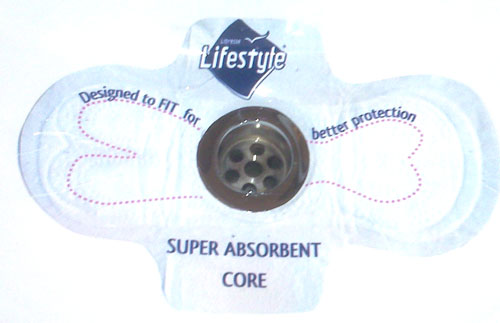
This ad for Lifestyle stretch fit menstrual pads is actually a sticker placed over the drain in sinks of public restrooms. There are no flowers, no gauzy white dresses or white spandex pants, and it demonstrates the key features of the product, such as adaptable fit of the pad and absorbency, and there’s no blue fluid anywhere in sight.
What do you think, readers? Does it make you want to buy Lifestyle brand pads?
[via Copyranter, who tells us that this ad was produced by Johannesburg ad agency TLC Marketing]
Saturday Surfing: Linkworthy recommendations
May 21st, 2010 by Elizabeth Kissling- Heather Corinna on sexuality and disability.
- Strange ads for menstrual products. [via Glad Rags]
- If you’re on Twitter, you absolutely MUST follow FeministHulk.
- One in five American men between the ages of 18 and 29 believe having sex standing up prevents conception – WTF?!?
Book Review: In Our Control
May 21st, 2010 by Elizabeth KisslingLaura Eldridge’s new book In Our Control: The Complete Guide to Contraceptive Choices for Women (Seven Stories Press, 2010) isn’t kidding with that subtitle. The last time I remember reading so much detail about contraceptive options was poring over Our Bodies, Ourselves when I was in my 20s.
Eldridge reviews every method of birth control known to modern woman–and, importantly, some that aren’t widely known. She even briefly reviews the history of contraception in 19th and 20th centuries, reminding us that birth control is not a new invention. People, especially female-bodied people, have struggled to control their fertility from pretty much the first moment humans figured out how it worked.
In Our Control differs from Our Bodies, Ourselves in offering more than just the mechanics of both hormonal and barrier methods: Eldridge provides a history of each method and analysis of the political and cultural contexts of their use in the 21st century U.S.
For example, the chapter about the morning-after pill (also known by either the brand name Plan B or as emergency contraception, EC) discusses the political battle to achieve Federal Drug Administration approval, including Susan Wood’s resignation from the FDA’s Office of Women’s Health over what she believed to be “willful disregard of scientific evidence showing Plan B to be safe.”
Eldridge extensively addresses the relationship between birth control and menstruation, focusing one chapter specifically on the use of hormonal contraception to reduce or eliminate menstrual cycles. She draws upon a wide range of resources to illustrate the cultural attitudes and contexts of menstruation, from stories of the role of birth-control pill co-developer John Rock’s Catholicism in the three-weeks-on/one-week-off dosing of the first pill to a Saturday Night Live parody of advertising schemes for menstrual suppression drugs (with Annuale, you’ll menstruate only once a year, but hold on to your fucking hat!).
The book also covers environmental impacts of contraception, the politics of HPV vaccinations, ongoing research into a birth control pill for men and natural methods of birth control such as fertility awareness–which Eldridge carefully distinguishes from the much-maligned “rhythm method.” She notes that the method approved by the Catholic church is properly called a calendar-based method and involves estimating when ovulation occurs and avoiding sex during that time. Fertility awareness, however, involves a more complex, systematic attention to physiological markers of female fertility. It requires careful monitoring of waking temperature, vaginal sensation, position of cervix and cervical fluid, as well as dates of menstrual flow and sexual activity. Eldridge cautions that fertility awareness is too complicated to be taught in a short chapter, and that observing and charting one’s cycle must be done “for a significant amount of time before you begin to rely on it for contraception.”
Laura Eldridge learned women’s health writing at the side of the late women’s health advocate and activist Barbara Seaman, and it shows. She contextualizes her work with her own experience and preferences, but provides thorough documentation so that women can more easily make their own decisions. This is women’s health activism at its best. Feminism isn’t just about choices, but about having access to information and resources to make informed, authentic choices–and that is only possible when reliable and comprehensive information is widely available.
Cross-posted at Ms. magazine blog.
SMCR Bloggers Respond to ACOG’s Homage to the Pill
May 20th, 2010 by Laura WershlerMenstruationResearch.org – Today, during an email exchange among the Society for Menstrual Cycle Research blogging team, research-advocacy experts on the menstrual cycle spoke out in response to the unbridled passion for the pill expressed by members of the American College of Obstetricians and Gynecologists at their 58th Annual Clinical Meeting. Amidst the hoopla surrounding the 50th anniversary of the pill, it must be noted that not all experts believe the pill to be an unequivocally positive contribution to women’s health and well-being that those quoted in the ACOG media release purport it to be.
Mark S. DeFrancesco, MD, MBA, Cheshire, CT |
Laura Wershler, Sexual Health and Reproductive Rights Advocate, |
Scott D. Hayword, MD |
Elizabeth Kissling, Ph.D. |
Jeanne A. Conry, MD, PhD |
Jerilynn C. Prior, MD, FRCPC |
J. Craig Strafford, MD, MPH, |
Chris Bobel, Ph.D. |
Douglas H. Kirkpatrick, MD, Denver, CO |
Holly Grigg-Spall, Journalist |
James N. Martin, MD, Jackson, MS Secretary, The American College of Obstetricians and Gynecologists |
Laura Wershler, Sexual Health and Reproductive Rights Advocate, |
James A. Macer, MD, Pasadena, CA Assistant Secretary Elect, The American College of Obstetricians and Gynecologists |
Christine L Hitchcock, PhD, Research Associate, Centre for Menstrual Cycle and Ovulation Research, and Clinical Assistant Professor, School of Population and Public Health, University of British Columbia |
This ACOG statement furthers a broader message to young women that they should trust pharmaceutical menstrual rhythms over that of their own bodies and that they should trust clinical authority over their own authority. In and of itself, ceding their bodily authority, ownership and stewardship to medicine causes harm to women.
###
The Society for Menstrual Cycle Research is a nonprofit, interdisciplinary research organization. Our membership includes researchers in the social and health sciences, humanities scholars, health care providers, policy makers, health activists, and students with interests in the role of the menstrual cycle in women’s health and well-being.
Really? Even “Period” is Bleep-worthy?
May 19th, 2010 by Chris Bobel
Monday morning: A friend tips me off that Joan Rivers’s on-TV use of the word PERIOD was bleeped! Yes, dear reader, somewhere, a censor deems even the innocuous euphemism for MENSTRUATION unsuitable for television.
Uh…speechless.
[You can view the clip at Jezebel.com, my friend's source for this sad information.]
Ultrasound Man:Birth Control Superhero
May 17th, 2010 by Laura Wershler
You know how most superheros become superheros because of exposure to some weird, intensified chemical or element? Take Peter Parker’s spider bite for example.
According to a story reported in various media, including International Planned Parenthood Federation’s website, if science can perfect the contraceptive effect of ultasound on men’s testicles, then we may be in for a new breed of superhero. Ultrasound Man: able to bear the burden of pregnancy prevention for women everywhere.
I joke, but for decades women have yearned for gender equality when it comes to bearing the burden of birth control. Could the promise of six months of ultrasound induced, reversible infertility in men be the answer? Well, to date, we only know it works in rats. There is a long way to go before we send the men for a bi-annual ultrasound “zap test”.
This isn’t the first male method touted over the last decade. In 2003, news out of the UK about a birth control pill for men had women nodding their heads with approval. I was immediately dubious and dashed off a commentary for the Calgary Herald that began thus:
Memo to Big Pharma: Save your money. If you think the male birth control pill is going to be a big seller, think again. Memo to women everywhere: Curb your enthusiasm. If you think it’s time men took more responsibility, you’re right — but the Pill for Bill is not going to be it.
Because of the complex hormonal action of the pill for men, I knew it wouldn’t fly. As I noted in my piece:
According to a story from the London Telegraph, because the treatment is invasive, it is likely to be used only by men in long-term relationships. Read it and weep, gals, because this is the wicked truth. It’s OK for women of any age or relationship status to ingest birth control pills or receive the Depo-Provera injection that completely shuts down their reproductive systems, but men would never do the same. It is already postulated that only men in committed relationships are likely to submit to invasive hormonal contraception. That would be supportive husbands and partners of the best kind.
Although a recent survey by the Family Planning Association found that one third of men would definitely use a birth control pill for men if it became available, I doubt very much, once the mechanism of action were explained (full disclosure), that there would be many takers. I suspect the side effects, and concerns about synthetic testosterone, would result in a pathetic compliance rate.
Certainly the ultrasound method sounds much less invasive. Research leader James Tsuruta of the University of North Carolina said: “We think this could provide men with reliable, low-cost, non-hormonal contraception from a single round of treatment.
Happily, “the team plans to investigate the mechanism that causes temporary infertility.” I think the guys would want to know how and why it works before signing up. But they can rest assured because Dr. Tsuruta also said: “Establishing safety, efficacy and reversability: these are our top concerns.”
As media stories proliferate documenting the growing trend among young women to eschew the Pill (et. al) in favour of non-hormonal methods, news that there may be a safe, simple method for men on the horizon is both welcome and long overdue.
What I find hard to take, however, is this suggestion expressed by Allan Pacey from the University of Sheffield:
There is certainly a place for an effective non-hormonal contraceptive in men, but whether men would find it acceptable to have their testicles scanned regularly remains to be seen.
Saturday Surfing: Have a linktastic weekend
May 15th, 2010 by Elizabeth Kissling- Blogger RMJ (Deeply Problematic) wrote a series on disability and birth control: Part One. Part Two. Part Three.
- Feministing reports on clinical trials of a new hormone-free birth control method – for men.
- Via Ms. magazine’s blog, we learn that vulvodynia, the inflammation and irritation of the vulva, is finally starting to receive some attention and research funding.
- The Health Crazies identify 17 adverse effects of hormonal contraception.
- Medical advice columnist in the Calgary Herald offers recommendations for dealing with painful periods.