Blog of the Society for Menstrual Cycle Research

“Prince Charles made me do it.”

March 15th, 2010 by Elizabeth Kissling

Frequent re:Cycling contributor David Linton was profiled last week in The Online Rocket, the student newspaper of Slippery Rock University. Professor Linton gave a talk on campus about the role of men in advertising for menstrual products.

Post to Twitter Post to Plurk Post to Yahoo Buzz Post to Delicious Post to Digg Post to Facebook Post to MySpace Post to Reddit Post to StumbleUpon

Highlights of Our First Six Months

March 14th, 2010 by Elizabeth Kissling

Calendar page

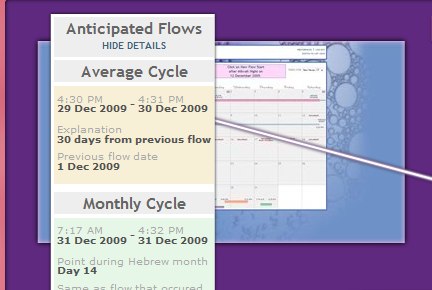
We posted with a few warm-up entries last summer, but re:Cycling officially launched on September 15, 2009. So we’ve been period-blogging for six months! Here are some of our milestones:

And this weekend we added a Facebook page.

Post to Twitter Post to Plurk Post to Yahoo Buzz Post to Delicious Post to Digg Post to Facebook Post to MySpace Post to Reddit Post to StumbleUpon

Saturday Surfing: It’s linx-cellent!

March 13th, 2010 by Elizabeth Kissling

A few highlights from our reading this week:

Post to Twitter Post to Plurk Post to Yahoo Buzz Post to Delicious Post to Digg Post to Facebook Post to MySpace Post to Reddit Post to StumbleUpon

Bravery and Intellect Over Easy: Scrambled

March 12th, 2010 by Giovanna Chesler

(This post also published at the blog g6pix.)

I’ll try not to sound too fan-girlish here as I write about the documentary Scrambled: A Journey through PCOS by Randi Cecchine, but admittedly, it is a difficult task. For in this film, which chronicles Cecchine’s struggle with Polycystic Ovarian Syndrome, we meet a filmmaker brave enough to show us, wart-hairs and all, the challenges inherent in this disease embodied. She does so with humor, with information, and with space for personal reflection.

As Cecchine and the health practitioners she speaks with share, PCOS is a condition that affects 8% of women but that goes under-diagnosed. Though largely undetected in the women who have PCOS, the first sign of something wrong is the absence or change in the menstrual period. According to Cecchine’s participant Dr. Geoffrey Redmond, an endocrinologist who has studied female hormone problems for over twenty years, PCOS generally shows up during puberty or shortly during the menarche period. In his interview, he argues that a delay of fifteen years in diagnosis typically occurs because “people who care for teenagers are typically not clued into this condition.”

In popular rhetoric on menstruation and menstrual suppression, there are many voices who have argued that having a menstrual period is unnecessary and should be done away with through hormonal birth control regimens (for example, Lybrel, Depo-Provera and Seasonale.) These drugs are often presented as choices to girls and young women close to menarche. Scrambled serves to intercept this discourse by demonstrating how the cycle becomes a sign of imbalance and illness. This film reminds us of the value of attending to the menstrual cycle. In Cecchine’s case, as in the case of the many women she interviews in her film, the lack of a period is a personal introduction to the disease.

Cecchine works with a light yet serious tone. A visit to Harry Finley’s Museum of Menstruation underscores the connections between menstruation, body awareness and PCOS. Yet we are able to marvel and smirk at Finley’s collection of menstrual advertising and decades old menstrual protection products which now live in his basement. As her lived investigation continues, Cecchine meets up with the Polycystic Ovarian Association (PCOSA) at their conference. There her film does remarkable work, as it invites the viewer to join in the conversation. In the scenes around the conference, we see how this film works to invite fellow PCOS women into the information Cecchine has gleaned. Though knowledge will not cure one from the illness, certain techniques shared in the film (like limiting carbohydrate intake) will result in reduced symptoms.

In the recent release of the film, which is self distributed, Scrambled is a two disc set. The first disc includes the documentary, but the second disc is chock-full of informative interviews on a variety of topics. Cecchine profiles Redmond along with many other health workers practicing western, eastern and alternative medicine who speak of the options for treatment. These include diet alterations, drug regimens, psychotherapy, acupuncture and others. In this disc, Cecchine provides the tools for a viewer with PCOS to address her syndrome through many methods. By providing information in this manner, Scrambled becomes a guide and a tool for holistic health on a personal level.

But these treatments comes at an expense. Here Cecchine’s humor bubbles up again when she shares the different techniques, like hair removal, pills, acupuncture treatments and their resulting costs. Yet, the feeling that comes afterward: “Priceless!” Bitingly Cecchine reminds us that being a patient also involves being a consumer. Therein she complicates these treatments as choices and necessities simultaneously.

New Research Indicates Link between Early Menarche and Endometriosis

March 11th, 2010 by Elizabeth Kissling

Drawing of uterine cross-section indicating endometriosis.In a controlled study of 268 Australian women with surgically confirmed moderate-to-severe endometriosis (cases) and 244 women without endometriosis (controls), researchers found that characteristics of a woman’s early menstrual cycles were associated with later development of endometriosis. Data showed those who did not start their menstrual cycle until after they turned 14 had a significantly reduced risk of later developing endometriosis.

Duration of the cycle, intensity of flow, and preferred choice of menstrual product showed no association with endometriosis.

The results are published in the American Journal of Obstetrics and Gynecology, December 2009. You can read the abstract here.

Post to Twitter Post to Plurk Post to Yahoo Buzz Post to Delicious Post to Digg Post to Facebook Post to MySpace Post to Reddit Post to StumbleUpon

Jesus: A Menstrual Hero?

March 10th, 2010 by Elizabeth Kissling

Guest Post by David Linton, Marymount Manhattan College

Debates about Christianity’s attitudes toward women sometimes focus on Jesus’ relationship with Mary Magdalene and isolated engagements with other unnamed women encountered during his travels.  Little is made of a healing scene in the book of Luke(8:43-48) where Jesus had momentary contact with a woman who, in all likelihood, had a severe case of menorrhagia.  Here’s how the translation is described in the Revised Standard Version”

“As he went, the people pressed round him.  And a woman who had a flow of blood for twelve years and could not be healed by any one came up behind him, and touched the fringe of his garment; and immediately her flow of blood ceased.  And Jesus said, “Who was it that touched me?”  When all denied it, Peter said, “Master, the multitudes surround you and press upon you!”  But Jesus said, “Some one touched me; for I perceive that power has gone forth from me.”  And when the woman saw that she was not hidden, she came trembling, and falling down before him declared in the presence of all the people why she had touched him and how she had been immediately healed.  And he said to her, “Daughter, your faith has made you well; go in peace.”

The story is rendered with remarkable efficiency.  The stealth of the woman was motivated by her clear understanding that she was a pariah in her community,that she was forbidden by the rigid rules of Leviticus from having contact with others lest she contaminate them.  Peter’s response is particularly interesting.  Rather than acknowledging the severe violation of the rules and dealing with its consequences (Jesus would have had to go away from everyone to be cleansed), Peter denied that any contact had even occurred. (Does this foreshadow his later denial of even knowing Jesus?)

But Jesus seems utterly indifferent to the rules as he places the well being of a suffering woman above the demands of his cultural prohibitions.

The fact that Jesus’ heroic menstrual encounter has been expunged from the narrative of his life reveals, yet again, just how pernicious the taboos and prejudices are. Wouldn’t it be wonderful if Sunday School classes set the menstrual record straight?

To make matters worse, the wonderful gospel song that extols the woman’s faith, first recorded by Sam Cooke and the Soul Stirrers, “The Hem of His Garment” has been similarly sanitized so that she is simply “sick.”  The  YouTube link that contains the song takes on extra layers of meaning when you listen to it with the thought in mind that it is an unacknowledged story of reactons to the menstrual taboo.  The YouTube link also contains an additional Soul Stirrers recording, “Jesus Wash Away My Troubles” – a bonus!

Post to Twitter Post to Plurk Post to Yahoo Buzz Post to Delicious Post to Digg Post to Facebook Post to MySpace Post to Reddit Post to StumbleUpon

Is PMDD Genetic?

March 9th, 2010 by Elizabeth Kissling

White lab mouse sitting in a gloved palm.

Guest Post by Amber Steele, University of Cambridge

There have been a couple of stories in the press recently touting a study by Joanna Spencer and colleagues suggesting that PMDD may be genetic. I had a cursory look through the paper and read the article. Changes in dendritic branching of neurons in the limbic system across the menstrual cycle, owing to changes in estrogen, has been well documented in the female mice and rat. Additionally, changes in neuronal activity and accompanying receptor activity is also well document during periods of hormone change, again in the female mice and rat models. Individual differences in how this change occurs and the fact that it can be linked to differences in genes make sense. It seems that Spencer et al., have identified one of probably many genes that mediates these differences. This is not the first time that a gene of this kind has been identified or implicated. For example, Susan Girdler at Chapel Hill has done some interesting work on PMDD and suggests a genetic i.e., differing protein response to a hormone, difference in response to progesterone that might, in part, explain symptoms associated with PMDD.

The fact that Spencer et al., found a relationship to anxious behavior does not say anything conclusively about PMS or PMDD. It only states that if you have this variant then your levels of anxiety may change as estrogen fluctuates.

The news article is exploiting the findings from the Spencer study to construct a simplistic view of varying responses to hormone change within and across women. I suppose the author of the news article thought it might be interesting to examine the debate on whether or not there is a “clinically disordered” state during the luteal phase of the menstrual cycle in some women and whether it should be recognized officially. While it may do this, it also perpetuates misunderstandings and stereotypes about women’s hormones and their emotional states.

Amber Steele is a graduate student at the University of Cambridge with a biomedical background. She is writing a thesis is on wellbeing over the menstrual cycle and how it relates to hormonal “biomarkers” cortisol and progesterone.

Post to Twitter Post to Plurk Post to Yahoo Buzz Post to Delicious Post to Digg Post to Facebook Post to MySpace Post to Reddit Post to StumbleUpon

Equal Rights, Equal Opportunities: Progress for All

March 8th, 2010 by Elizabeth Kissling

Today is International Women’s Day, and the subject line above is the IWD theme for 2010. Search here for events in your area.

Post to Twitter Post to Plurk Post to Yahoo Buzz Post to Delicious Post to Digg Post to Facebook Post to MySpace Post to Reddit Post to StumbleUpon

Of Hot Flushes, Lie Detectors, and Stress

March 7th, 2010 by Elizabeth Kissling

Guest Post by Jerilynn C. Prior, Centre for Menstrual Cycle and Ovulation Research

A hot flush causes failure on a lie detector test! The same galvanic skin response (in simple terms—clammy skin) is positive in both. Why? Because—with every flush—there is massive dogs’ breakfast of neurotransmitters and brain stress hormones released. These are the same brain chemicals that are produced as we struggle to create a plausible falsehood. Both arise from a fundamental, brain pathway that mediates both our physical and emotional responses to “threats” (be they nutritional, emotional, physical or some combination of stressors).

Some years ago a psychologist from London Ontario showed that menopausal women’s hot flushes were increased by stressful environment (1). Menopausal women who regularly experienced eight hot flushes a day attended two randomly-ordered 4-hour sessions a week apart. During the sessions they had flushes objectively documented by galvanic skin response. When they were forced to experience a chaotic environment, loud noises, unpleasant videos and bright lights, each of these women experienced more hot flushes; they did not in the alternative calm and pleasant session (1). Likewise, the large Study of Women Across the Nation showed that perimenopausal women who reported “trouble paying for basics” (like food and shelter) had more hot flushes than did those with economic and social security (2).

Given these fundamental relationships between hot flushes and stress, it is no wonder that “paced respiration,” “yoga breathing,” mindfulness meditation, the relaxation response, acupuncture, exercise training and many other techniques that reduce our central reaction to stress will decrease night sweats and hot flushes.

I totally agree with Janet Carpenter that women are eager to find non-pharmaceutical ways to decrease the number and intensity of night sweats and hot flushes (collectively called vasomotor symptoms, or VMS for short).  However, to put into perspective the new research being done by the investigators at the School of Nursing at Indiana University, we need to realize that the first randomized controlled trial of “yoga breathing” for VMS was published in 1984 (3) and followed in 1991 by a similar study using objective VMS measures (4). Subsequently, studies of acupuncture (5-8), relaxation (9) and relaxation plus other therapies (10) all show that they are better than placebo at decreasing VMS. [Editor’s note: As she stated in the Indianapolis Star interview published March 4, 2010, Dr. Carpenter is building upon previous research. She did not claim to invent the concept of managing hot flashes with breathing techniques.]

The research on hot flushes and our central stress response is just beginning. But the average 25-50% improvement in VMS in those taking placebos in trials of soy beverage (11) or hormone therapy (12) are evidence that believing a treatment is therapeutic is pretty effective all by itself.

Saturday Surfing: Sharing the Linky-Love

March 6th, 2010 by Elizabeth Kissling

This week’s recommendations:

By the way, if any re:Cycling readers will be attending the Gender Studies Symposium at Lewis & Clark (hello, Portland!) next week, please introduce yourself and say hello!

Post to Twitter Post to Plurk Post to Yahoo Buzz Post to Delicious Post to Digg Post to Facebook Post to MySpace Post to Reddit Post to StumbleUpon

Brief News Update: Screening for Cervical Cancer

March 5th, 2010 by Elizabeth Kissling

England’s Advisory Committee on Cervical Screening (ACCS) has developed new guidelines [pdf] for screening cervical cancer in young women who experience symptoms such as bleeding after sex or between periods, pain during sex or an unusual discharge. Screening for cervical cancer normally begins at age 25 in England, as it is rare in young women. The new guidelines were developed after the ACCS discovered that young women seeking medical consultations for abnormal bleeding often experience delays in diagnosis because they do not receive a full pelvic examination.

Post to Twitter Post to Plurk Post to Yahoo Buzz Post to Delicious Post to Digg Post to Facebook Post to MySpace Post to Reddit Post to StumbleUpon

What do men know about birth control and periods?

March 4th, 2010 by Elizabeth Kissling

Here’s a hint: the title of the new study by the National Campaign to Prevent Teen and Unplanned Pregnancy is How Misperceptions, Magical Thinking, and Ambivalence Put Young Adults at Risk for Unplanned Pregnancy.

The study [PDF] surveyed American singles ages 18–29 about their perceptions about and use of contraception. Twenty-eight percent of young men think that wearing two condoms at a time is more effective than just one. Twenty-five percent think that women can prevent pregnancy by douching after sex. Eighteen percent believe that they can reduce the chance of pregnancy by doing it standing up.

A staggering 42% of men and 40% of women believe that the chance of getting pregnant within a year while using the birth control pill is 50% or greater (despite research suggesting that the pill is typically 92% effective).

And many unmarried young adults believe they are infertile. Although available data suggest that about 8.4% of women 15–29 have impaired fecundity (measured as an inability to conceive or carry a baby to term): 59% of women and 47% of men say it is at least slightly likely they are infertile (19% of women and 14% of men describe it as quite or extremely likely.

In a very good short essay about the study at The Sexist, Amanda Hess links men’s lack of knowledge about contraception to their lack of knowledge about menstruation and physiology more generally, and illustrates with some telling anecdotes. There are a few more examples in the video at right, in which Amanda corners several men and asks them to explain how hormonal birth control works.

It all seems quite shocking, until one remembers that abstinence-only sex education that includes lessons about the ineffectiveness of condoms and other contraceptives has been standard in the U.S. since 1996. (See here for U.S. Government definitional criteria for abstinence-only sex education. At present, 22 states have opted out of receiving federal funding, so that they may provide accurate and comprehensive sex education.)

Post to Twitter Post to Plurk Post to Yahoo Buzz Post to Delicious Post to Digg Post to Facebook Post to MySpace Post to Reddit Post to StumbleUpon

Readers should note that statements published in re: Cycling are those of individual authors and do not necessarily reflect the positions of the Society as a whole.