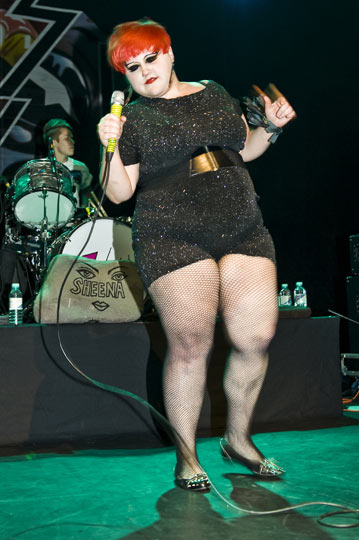
As if you needed one. Gossip played a sold-out show Saturday night at London’s HMV Forum. Her period started moments before the performance, and instead of fretting about how to conceal it, Beth Ditto asked her fans to go on ‘bleed watch’. She said: “I started my period about four minutes ago and I was like ‘Oh no!’” She then asked them to go on “bleed watch” before adding, “If you see period stains you let me know!”
Another reason to love Beth Ditto
November 30th, 2009 by Elizabeth KisslingPlease Advise: Matt’s girlfriend doesn’t know she has PMS
November 27th, 2009 by Elizabeth Kissling
Dear Amy: My girlfriend wants to “talk” again. She is currently experiencing her monthly cycle.
Can I ask her to wait until this is over? She usually gets a bit worked up and later apologizes.
I do not want to come across as inconsiderate. Based on past discussions, I’m sure she wants to talk about our future together. This is important but shouldn’t it be done when she is a little more balanced?
If you agree, can you offer a caring way to frame this statement of concern to talk at a later time?
— Matt
Poor considerate Matt. He doesn’t want to hurt his girlfriend’s feelings by telling her that he doesn’t take her feelings seriously. What would you tell him, re:Cycling readers? Ask Amy advises him to patronize and belittle her.
Dear Matt: You might think: “Let’s have this conversation at a time when I don’t think your head will spin around and fall off.”
What you should say is, “I want to talk to you, too, honey — because this is important. But for now, why don’t you enjoy these flowers? Oh, and by the way, have you lost weight?”
Amy further suggests that Matt do her the kind favor of letting her know that she’s moody: “You should also talk about her hormonal issues. Many women, myself included, don’t quite realize the patterns in our monthly moods until someone else lovingly points them out to us.”
I can’t help but recall Joan Chrisler’s comments about over-diagnosis of PMS and PMDD (which are both associated with high levels of relationship and family stress): “We’re conditioned to want a pill. Instead of something you might need more, like a nap or a divorce, or the ERA.”
Use of Birth Control Pill Declining in Canada
November 25th, 2009 by Elizabeth Kisslingre:Cycling readers may be interested in this story in the current issue of Macleans about the declining interest in oral contraceptives among Canadian women, particularly among women in their 20s who’ve been using The Pill for a decade.
[O]ral contraceptive prescriptions in Canada levelled off in 2008, reports pharmaceutical industry analyst IMS Health Canada. Health care workers are seeing a growing demand for non-hormonal methods. Spurred by concerns about their health, the environment, or even frustration with family doctors, who sometimes seem to push the pill as a modern-day cure-all, Canadian women are looking for other options.
The report echoes a couple of recent discussions here at re:Cycling, such as our guest post from Holly Grigg-Spall and Laura Wershler’s response, guest post from Moira Howe about the quiescent uterus, and discussion of risks of YAZ.
And Dr. Jerilynn Prior, scientific director of the Centre for Menstrual Cycle and Ovulation Research (and past president of the Society for Menstrual Cycle Research) is quoted in the article: “There’s an emotional identity attached to achieving your own menstrual cycle, and being able to read your body,” she says. “When you’re on the pill, it’s the doctor who’s controlling your cycle. You don’t own it.”
It’s good to see this issue getting some attention in mainstream media.
Pads STILL as big as your head!
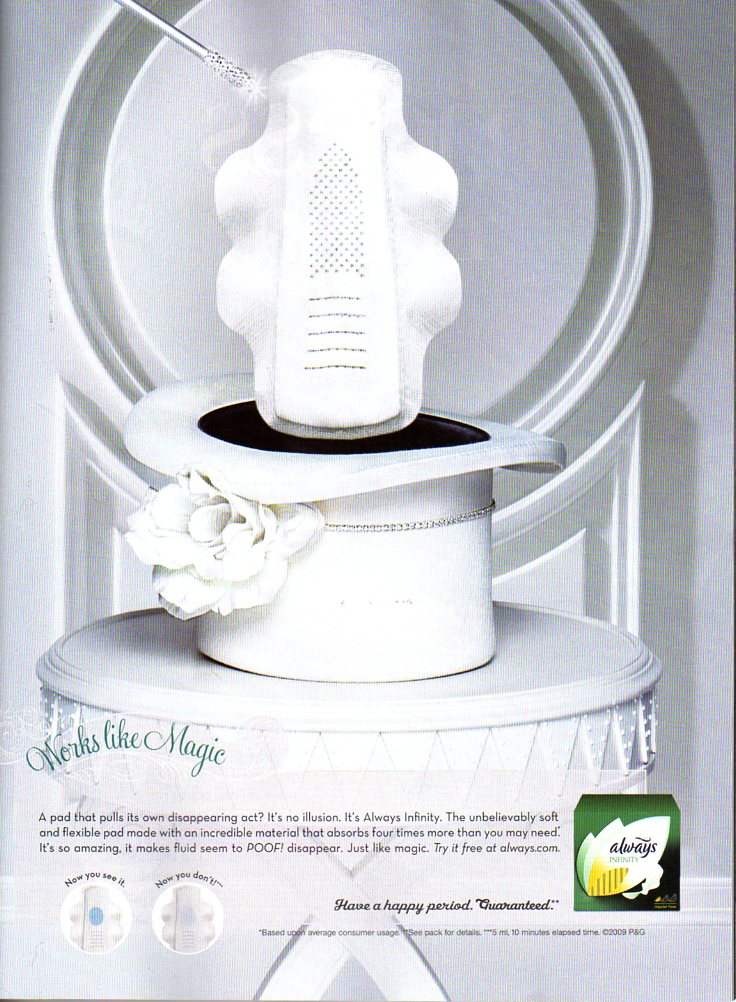
November 24th, 2009 by Elizabeth KisslingLooks like our friends at Always Infinity have ditched the skinny model,* but everything else in the ad is the same, right down to the copy about a disappearing act and the close-up shot of magic blue fluid.
That pad still looks disproportionately large to me: its width measures less than 1/2 inch (1.2 cm) the inside circumference of the hat!
*Or is she missing because this version of the ad appeared in Ebony magazine, and P&G found it cheaper to use half the image than to create a new ad with an African-American model?
PremPro’s Losing Streak Continues
November 23rd, 2009 by Elizabeth KisslingThere are more than 10,000 lawsuits against Wyeth/Pfizer regarding the link between PremPro and breast cancer. There have been 12 verdicts so far, and juries have awarded money to the plaintiffs in ten of those cases. The latest was announced today, in Donna Kendall v. Wyeth (Phila. CCP, June Term, 2004, No. 0965). The jury awarded Ms. Kendall $6.3 million in compensatory damages, and $28 million in punitive damages.
So far, thirteen women have settled their claims with Wyeth/Pfizer, but if awards like these continue, can we expect Pfizer soon to be offering to settle the rest?
The film clip at left is a video press release prepared by Littlepage Booth, the Houston law firm that represented both Connie Barton and Donna Kendall in their claims against Wyeth/Pfizer.
Telling Secrets
November 22nd, 2009 by Elizabeth Kissling
I’m guessing many re:Cycling readers are familiar with Frank Warren’s Post Secret project. Every Sunday, Frank publishes online a collection of confessional postcards he’s received. He’s also curated several larger collections into best-selling books. The postcards are fascinating, both sociologically and artistically.
If you follow Frank on Twitter, you are privy to additional secrets posted mid-week via his Twitter stream. That’s how I came across the secret posted at right: “I sign men who I don’t like up for every single pad and tampon sample I can find.”
Apparently menstruation is so disgusting, so shameful, so dirty, that the writer of this secret believes that receipt of new, clean menstrual products is a good way to humiliate a man.
Note, however, that this revenge strategy works only on men; perhaps women are in a state of perpetual humiliation from dealing with femcare products on a regular basis. This message reinforces the core feature of hegemonic masculinity: the worst insult to a man’s masculinity is to suggest that he is female.
With Vampax, He’ll Never Guess It’s Your Bleeding Vagina
November 20th, 2009 by Elizabeth KisslingConcealing menstruation is always a chore, but especially when your boyfriend is a vampire.
Twilight Cycles from Brandon Routh
[via Glad Rags]
Is Menstruation a Disability?
November 19th, 2009 by Elizabeth KisslingI think few people would consider menstruation per se a disability, with exceptions for menorrhagia and unusually painful periods. But I’ve been reading a bit in the field of disability studies lately, for both professional and personal interest, and starting to think about disability differently. I’m currently reading Susan Wendell’s The Rejected Body and finding it especially powerful and provocative.*
She writes of disability as social construction; that is, disability cannot be defined solely in biomedical terms but must be considered in terms of a person’s social, physical, and cultural environment. A person is disabled when they live in a society that is “physically constructed and socially organized with the unacknowledged assumption that everyone is healthy, non-disabled, young but adult, shaped according to cultural ideals, and, often, male” (p. 39).
A feminist philosopher by training, Wendell points out that feminists have long sustained criticisms that the world has been designed for the convenience of men and male bodies.
Hysteria: It’s HIS, too
November 15th, 2009 by Elizabeth KisslingThere’s a brief article in the current issue of The Lancet (free registration required) about the history of hysteria. Although I was aware of the history of the word referring to women’s health and behavior being determined by the uterus (hystera is Greek for womb), I did not know of the ancient belief that “retained sperm could contribute to male hysteria, igniting a debate which was to run for centuries over whether men could indeed suffer hysteria.” I’ve only heard of – and seen – the concept used against women. The article also references Elaine Showalter’s analysis of hysterical epidemics as a cultural phenomenon, but offers little analysis of its own.
New Drug for Heavy Periods
November 14th, 2009 by Elizabeth KisslingThe FDA announced yesterday that they have approved tranexamic acid tablets for the treatment of heavy menstrual bleeding, under the brand name Lysteda. According to the press release, approximately 3 million US women experience heavy bleeding, usually with no underlying health condition. The report states that there was a statistically significant reduction in menstrual blood loss in women who received Lysteda, compared with those taking placebo.
As is the case with many newly approved drugs, tranexamic acid is not a new drug but an approval for a new usage: tranexamic acid has been used in injection form more than 20 years to reduce bleeding during tooth extraction in people with hemophilia (a blood disorder in which blood lacks a clotting factor).
Although it’s unlikely that anyone using hormonal contraceptives would also have heavy menstrual bleeding (remember, hormonal contraceptives suppress menstruation), the new drug comes with a big warning: taking Lysteda along with hormonal contraceptives increases one’s risk of blood clots, stroke, or heart attack.
I’m not a biochemist or a physician, but it sounds like Lysteda is a viable alternative for women who are currently taking (or recommended to take) hormonal contraceptives for the management of menstrual bleeding.


RSS