Blog of the Society for Menstrual Cycle Research

Introducing…

October 30th, 2009 by Chris Bobel

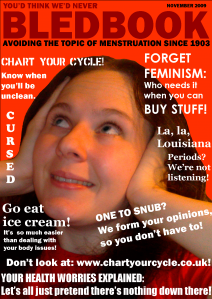
bledbook copyThem was fightin’ words.

re:Cycling readers (thanks!) already know about Redbook’s dimwitted “snub” of the soon-to-be released FLOW: The Cultural History of Menstruation:

You welcome it, bemoan it, or just live with it. However you feel about your period, we’re pretty sure most of you would rather spend your cash on a three- to five-day supply of Ben & Jerry’s than this 250-plus-page tome that teaches you about menstruation in the animal kingdom and the origin of tampons.

Menstrual activists Chella Quint and Sarah Thomasin sprung into comedic action and put together this oh-so-clever response ’cause they know a knee-jerk reaction to the big M when they see it.

Luckily, Redbook readers can and do think for themselves!  Quint remembers her ahead-of-her-time Grandma who knew a thing or two about our favorite topic  IN SPITE of her subscription to a particular ladymag.

Way to give it back, gals!

Post to Twitter Post to Plurk Post to Yahoo Buzz Post to Delicious Post to Digg Post to Facebook Post to MySpace Post to Reddit Post to StumbleUpon

How (and When) to Make a Baby

October 29th, 2009 by Chris Hitchcock

According to this article, a surprising number of women seeking infertility care don’t know when to effectively focus their efforts. Australian researcher (and SMCR member) Kerry Hampton asked women seeking infertility advice about the normal ovulatory menstrual cycle, and found that most women lack basic knowledge about the menstrual cycle, ovulation, and when the optimal time is to conceive.

A study of 204 women who attended assisted-reproduction clinics in Melbourne during 2007 and 2008 showed only 13 per cent had a good knowledge of the ”fertility window” in their monthly menstrual cycle when pregnancy can occur.

Fertility nurse specialist and Monash University researcher, Kerry Hampton, told the Fertility Society of Australia’s annual scientific meeting yesterday that 11 per cent of the women had no knowledge of the fertility window and 52 per cent had poor levels of awareness.

Ms Hampton said most of the women had been trying to conceive for one year or more when they were surveyed, and that if they had of known more about natural conception, they would have had a better chance of success.

”A lot of these women were not able to optimise their chance of natural conception because they didn’t understand the window,” she said.

Dia de los Muertos Cloth Menstrual Pads

October 29th, 2009 by Elizabeth Kissling

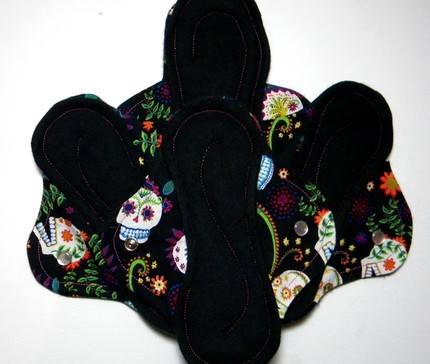
diamuertas_padsFor your seasonal pleasure, I bring you cloth menstrual pads decorated with Dia de los Muertos motifs (with thanks to Lisa, one of my Women’s & Gender Studies alumnae). These handmade pads are available at Etsy (of course!), either individually or as a set with several different sizes for your menstruating convenience.

Soft flannel or terrycloth pads are far more comfortable than paper, as well as more economical and better for the environment. If you’re going to use cloth pads, you may as well have some fun with them! CherryRiot, the Etsy seller who makes these beauties, also offers mentrual pads with tattoo themes, cherry blossoms, and other designs, as well as plain red.

Post to Twitter Post to Plurk Post to Yahoo Buzz Post to Delicious Post to Digg Post to Facebook Post to MySpace Post to Reddit Post to StumbleUpon

Laughing AT Us

October 28th, 2009 by Chris Bobel
SKIDS: Masculine Hygiene, 2007, Chella Quint

SKIDS: Masculine Hygiene, 2007, Chella Quint

I don’t know how it happened, but somehow, I missed the viral web-based marketing campaign  “Men with Cramps” launched in 2006 by Dandelion for P&G’s ThermaCare. (Dandelion, by the way, calls themselves a “brand-sponsored storytelling company”. I. Am. Not. Making.This.Up)  The campaign generated 1.3 million views and over 15K mentions in blogs and chats and critical acclaim with a 2008 Bronze Effie Award. Nothing like a good story, I guess.

Full disclosure:

I find the campaign hilarious. This is very witty satire. The parodies of “doing science,” of Ken Burns-style documentaries and especially of MASCULINITY are beautifully executed.  As I watched the series of short videos, I laughed so hard my partner had to take his work to another room (and I had the audio on headphones). But it was the kind of laughter that felt naughty, betraying, even forbidden (and alert readers already know we at re:Cycling are consistently suspicious of “the forbidden”).

Why the guilty pleasure, then? Why not JUST pleasure?

Who in their right mind wants to read about menstruation?!?

October 27th, 2009 by Elizabeth Kissling
From November 2009 Redbook magazine

From November 2009 Redbook magazine

Well, we do, of course. But the editors of Redbook magazine assume that the topic is not of even the slightest interest to their readers.

The clipping at the left is from the November, 2009, issue, which I found at my neighborhood laundromat. It’s from a larger sidebar that lists three books for the month with capsule reviews: Lit by Mary Karr is headed “With the Club”; Lauren Grodstein’s A friend of the family is headed “In the Tub”; and Elissa Stein and Susan Kim’s Flow: The cultural history of menstruation receives the heading “One to Snub”. In case the text is too small or the image isn’t visible in your browser, the review reads as follows:

You welcome it, bemoan it, or just live with it. However you feel about your period, we’re pretty sure most of you would rather spend your cash on a three- to five-day supply of Ben & Jerry’s than this 250-plus-page tome that teaches you about menstruation in the animal kingdom and the origin of tampons.

Apparently Redbook editors know their readers; one only has to travel about 15 pages further into this issue to find the featured cover story about questions you’re too embarrassed to ask your doctor. You know, questions about periods and other things down there.

Post to Twitter Post to Plurk Post to Yahoo Buzz Post to Delicious Post to Digg Post to Facebook Post to MySpace Post to Reddit Post to StumbleUpon

Pyrrhic Victory for Prempro Users

October 27th, 2009 by Elizabeth Kissling

Connie Barton, an Illinois woman who developed breast cancer after taking Prempro for menopausal symptoms, was awarded punitive damages by a jury in Philadelphia yesterday. The jury has already awarded her $3.7 million in compensatory damages, back in September, but we will not learn the amount of punitive damages until another Philadelphia jury reaches their verdict in similar case against the Pfizer, the drug’s manufacturer. (Technically, the case was filed against Wyeth, but the two companies just completed a merger deal last week, and Wyeth is now a subsidiary of Pfizer.)

Wyeth’s attorneys successfully argued that public revelation of the amount of damages might influence the jurors in Kendall v. Wyeth. However, the jury’s finding that Wyeth ignored evidence that the drug could cause cancer is now public information. Would I sound bitter if I said I hope that news influences potential jurors?

According to the news story about Barton’s case at philly.com, Pfizer has now lost five of eight trials over its hormone-replacement drugs since cases began reaching juries in 2006. 1500 more trials against Wyeth are pending at the Philadelphia Court of Common Pleas. But a longer story in Philadelphia Magazine reports 23 out of 31 cases set for trial have been resolved favorably for Wyeth; the company has settled five, and several are on appeal.

World Menopause Day

October 25th, 2009 by Elizabeth Kissling

We’re a week late in commemorating World Menopause Day here at re:Cycling. Sounds like a holiday right up there with Menstrual Monday, but it doesn’t sound very celebratory, from what I can discern.

I discovered World Menopause Day, observed annually on October 18, when a press release for GEM Keep it cool™, “the first ever, ready to drink wellness supplement for menopause relief made with natural and nature-identical ingredients free of the risks associated with hormones” showed up in my inbox yesterday. Cynic that I am, I wondered if this holiday was simply about selling products to middle-aged women, so I began poking around on the internetz.

I found that World Menopause Day has a venerable history: it was started in 1984 by the International Menopause Society (IMS) and the World Health Organization (WHO). Both are reputable, credible organizations with admirable goals, so I was easily persuaded that World Menopause Day isn’t all about marketing. IMS marks World Menopause Day by doing its best to spread the word about potential health consequences of menopause:

Because Health Care Reform Is A Women’s Issue

October 22nd, 2009 by Elizabeth Kissling

A Woman Is Not A Pre-Existing ConditionOur readers outside the U.S. may want to just skip over this post.

I’ve been watching what passes for debate over health care reform in the U.S. for months now, and it’s making me increasingly cranky. I suppose I’ve known for years that political decision making is heavily influenced by lobbyists and other financial interests, but it has never been so crystal clear to me as it has been this summer as I’ve watched so-called progressive and democratic congress members fight against doing what’s right. Americans need health care reform, and especially American women need it. Not only do women have distinct health care needs, women are more likely than men to require health care their whole lives, including care related to reproductive and menstrual concerns. That is not “extra”.  As Sen. Debbie Stabenow (D-Michigan) forcefully reminded Sen. John Kyl (R-Arizona), the sad fact that 60% of insurance plans don’t cover basic maternity is relevant to everyone.

Furthermore, women are frequently decision-makers regarding health care for their whole family, especially in woman-headed single-parent families (which are approximately 23% of all families in the U.S.). According to the Department of Labor, women make approximately 80% of all family health care decisions. Women are also more prone to certain chronic conditions, and on average, use more prescription drugs than men.

Yet in most of this country, insurers are allowed to set premium rates that take sex into account: these “gender ratings” mean that women (and businesses with predominantly female workforces), are often charged more than men for the exact same coverage. Sometimes the gender penalty is as much as 140% more. In a few states, a woman can be legally denied health insurance if she has been a victim of intimate partner violence; it’s a pre-existing condition. Now reports are emerging that women who have been sexually assaulted are denied insurance coverage for rape exams and medication and therapy for trauma.

And you don’t want to get me started on affordability issues; I’ve witnessed the struggle to keep health insurance first-hand in my own family, helping my parents pay for their coverage as their rates were jacked up each year. Rather than just rant about the insurance industry and the state of health care in the U.S., I’m going to leave you with these links to recommended reading:

Sharon Lerner, The Nation, Why Women Need Healthcare Reform

Nancy Folbre, economics professor at M.I.T.: Health Care Reform is a woman’s issue

Michelle Chen, Air America, Being A Woman Is A Pre-Existing Condition: Domestic Violence and Health Care

Ezra Klein, Washington Post, You Have No Idea What Health Costs

Matt Tiabbi, Rolling Stone, Sick and Wrong (Tiabbi’s trenchant analysis is one of the best pieces I’ve read about the need for health care reform in the U.S.):

Fully $350 billion a year could be saved on paperwork alone if the U.S. went to a single-payer system — more than enough to pay for the whole goddamned thing, if anyone had the balls to stand up and say so.

The National Women’s Legal Center has several excellent articles about health care, health care reform, and women’s needs (NWLC reports are the sources for much of the data I cite above), including this brief intro (.pdf) and this longer statement (.pdf). Visit their Reform Matters site for more.

You can also visit their educational campaign site, complete with easy links for emailing your representatives in Congress. Because being a woman is not a pre-existing condition.

Post to Twitter Post to Plurk Post to Yahoo Buzz Post to Delicious Post to Digg Post to Facebook Post to MySpace Post to Reddit Post to StumbleUpon

First, do no harm

October 20th, 2009 by Elizabeth Kissling

When a link to this study, which found that the higher a patient’s BMI, the lower their physician’s respect for them, showed up in my Twitter feed yesterday (thanks, Michelle), I started connecting some dots.

Women delay seeking treatment for menstrual pain due in part to taboos about menstruation and concealment, often waiting and suffering for years. As I learned recently (and reported here), research estimates an average delay between onset of pain and diagnosis of endometriosis of 8 years in the UK and 11 years in the US.

Women (and men) who are considered “overweight” are frequently treated badly by health care practitioners, who tend to focus on the weight as the Cause Of All Illness and Ailments. Regardless of the reason for seeking treatment, fat patients are advised to lose weight. Given this reality, many fat people avoid seeing health care providers altogether, and those who do are less likely to be screened for breast, cervical, and colorectal cancers. Even fat people with college educations and health insurance avoid doctors.

So what happens when fat women have menstrual problems? (Please note that I am following the practice of other advocates of fat acceptance and Health At Every Size (HAES) in using the term fat as a descriptive adjective, not a pejorative.)

In Search of the “Normal” Vagina….

October 19th, 2009 by Chris Bobel

Guest Post by Alexandra Jacoby, independent artist

VulvagraphicsSince September 2000, I’ve been capturing a glimpse of women’s most private selves. So private that most women have not seen their own, much less others. I’ve been making vagina portraits. They are close-up, documentary-style photographs of our vulvas—the elusive faces of our vaginas in plain view—so we can see ourselves for ourselves.

The project began when a friend of mine asked me if I liked the way my vagina looked. Apropos nothing: did I like the way my vagina looked? As I answered, I realized that I had never really taken a good look at it, and that other than a bit of porn, I hadn’t actually seen any other women’s vaginas.

I was pretty sure that they were all different, but had nothing to point to when talking with my friend, who clearly thought there was something wrong with how hers looked.

It struck me that there should be a book, a visual reference for women—of actual women. And, so began vagina vérité®—an unabashed exploration of the plain, ordinary, mysterious matter of our vaginas.

I’ve photographed 90 v-portraits so far—each beautiful and strikingly unique!

“Happy It’s Here”

October 16th, 2009 by Elizabeth Kissling

P&G_WhisperProctor and Gamble has just launched a new internet campaign in Singapore for their menstrual pads. The flash-heavy website tells why girls are Happy It’s Here :

Happy, confident, and loving life. You know what you want and where you want to go next. You feel wonderful about being a girl!

This is not a new product, but a new campaign for the pads known as “Always” in the U.S. Guess what they’re called in Asian markets.

Wait for it.

Whisper“.

That’s right. P&G’s ad promotion “to instill a positive attitude in young Singaporean women about their menstrual periods, seeking to dispel some of the squeamishness toward the subject that persists in much of Asia” is for a product called Whisper, with all the connotations of menstrual silence that carries.

In fairness to P&G, the name change from the U.S. product pre-dates the new internet campaign by ten years. And I wanted to give them a break after reading this quote in the Wall Street Journal article about the new campaign:

Women, Men, and PMDD

October 15th, 2009 by Elizabeth Kissling

A new study published in a recent issue of Women & Therapy finds problems with the diagnostic criteria for PMDD. No surprise – feminist psychologists, researchers within the Society for Menstrual Cycle Research, and many others have repeatedly criticized the concept of PMDD as a mental illness related to menstruation for these and other reasons.

Supposedly, PMDD occurs in 3% to 8% of menstruating women. There is a host of problems with how this is determined, including varying means of defining and applying the DSM-IV criteria for PMDD across studies, but I’ll spare you that litany here. If PMDD is truly an illness related to the menstrual cycle, the criteria should be sex-specific; that is, only those capable of menstruating should meet the diagnosic criteria (the research implicitly assumes everyone is cissexual and that all non-pregnant women of reproductive age menstruate and no men do – let’s set that aside for now).

To test the sex-specificity of the criteria for PMDD, the researchers created two versions of the assessment tools they used to determine its presence: one version included sex-specific terms like menstruation, menstrual cycle, and premenstrual symptoms, while the other version substituted sex-neutral terms such as experiences and symptoms.

Readers should note that statements published in re: Cycling are those of individual authors and do not necessarily reflect the positions of the Society as a whole.